
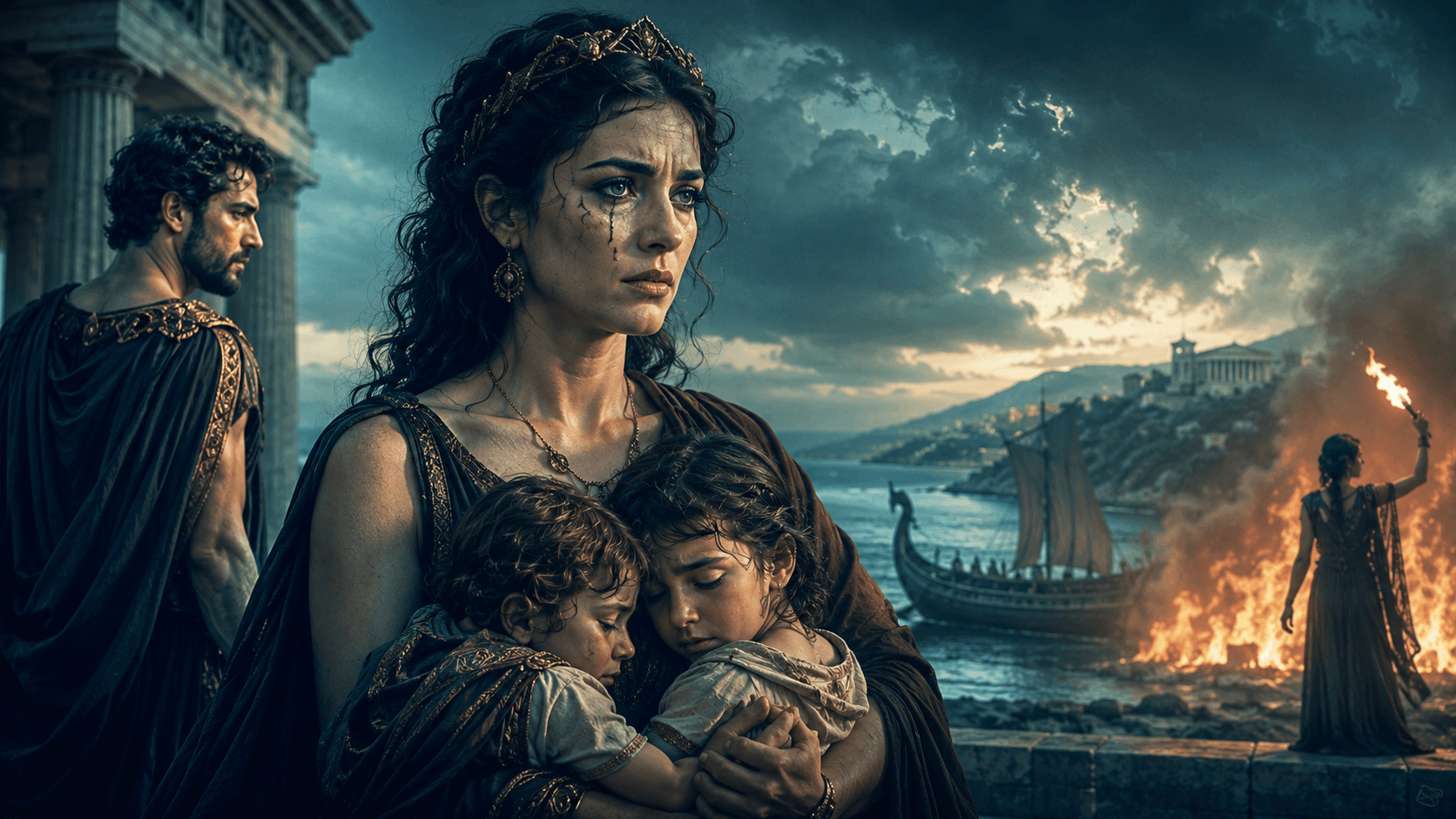
MEDEA: LOVE, BETRAYAL AND THE MOST BRUTAL REVENGE IN MYTHOLOGY
 Andres Aguilar
But to understand what Medea did, you must first understand who she was and what they did to her. Because this story doesn't start with a woman who goes crazy for no apparent reason.
There is a moment in Euripides' tragedy when Medea has already made her decision but has not yet executed it. He is watching his children sleep. He sees them breathing, he sees their innocent faces, and in that scene there is a monologue that Greek theater specialists consider one of the most devastating in the entire history of literature. Medea says she knows what she is about to do. Who knows it's a crime. That the impulse that leads her to do it is stronger than her reason. And he is clear that he is going to act the same. In that phrase that is more than two thousand four hundred years old, something about human psychology is contained that even today psychiatrists and philosophers have not yet fully resolved: what happens when someone acts against what they know to be correct, knowing perfectly well that it is. The Greeks had a word for that: akrasia. The weakness of the will. The moment when we know what we should do and do something else anyway. Medea is the myth of akrasia taken to its most brutal extreme. And that is why two thousand four hundred years later we are still talking about it.
But to understand what Medea did, you must first understand who she was and what they did to her. Because this story doesn't start with a woman who goes crazy for no apparent reason. It starts with a woman who bet absolutely everything and lost everything. And he lost it at the hands of the man he had bet it on.
Medea was the daughter of King Aeetes, the ruler of Colchis, a kingdom located on the eastern coast of the Black Sea in what is now roughly the region of Georgia. Aeetes was the son of the sun god Helios, which made Medea the granddaughter of Helios and the niece of Circe, the sorceress of the island of Aeaea who had appeared in the story of Odysseus a few episodes earlier. It was no coincidence that Circe and Medea shared certain powers: they were both heirs of a divine line that brought with it the knowledge of plants, poisons, incantations and magical rituals. Medea was priestess of Hecate, the goddess of magic and crossroads, one of the oldest and most feared deities in the Greek pantheon. She was not a conventional princess waiting to be rescued. She was a woman with powers that very few mortals could match and that the gods themselves respected.
The context of his meeting with Jason must be found in this article eighteen of this text, where we recount in depth the expedition of the Argonauts. But it is worth recovering the essential elements because without them Medea's story does not have the dimension it deserves. Jason arrived in Colchis after a journey that had tested him on multiple occasions, with a ship called the Argo manned by the best heroes of Greece, including Heracles, Orpheus, the Dioscuri Castor and Pollux, and several others who were practically legends in life. The objective was to obtain the Golden Fleece: a golden ram's skin that hung from a tree in the sacred forest of the god Ares, in the territory of King Aeetes, and which according to tradition guaranteed the prosperity and legitimacy of the king who possessed it. Jason needed the fleece to reclaim the throne of Iolcus that had been usurped from him. The fleece was the symbol of the power and legitimacy of the kingdom of Colchis, and Aeetes had no intention of giving it to anyone. On the contrary: he designed a series of impossible tests that functioned as a trap disguised as a challenge. Jason would have to yoke two bronze bulls with metal hooves and breath of fire, plow with them a sacred field, plant in that field dragon teeth that would become fully armed warriors that would spring from the earth, and defeat those warriors alone. Any failure at any point in the sequence meant death. It was a death sentence presented as an opportunity.
Jason was the kind of hero the Greeks admired: brave, determined, well-spoken and good-looking, able to lead other men in difficult circumstances. What he didn't have in abundance was the superhuman ability to take on fire-breathing bulls and armies springing from the earth. And I knew it. It was in that moment of vulnerability that Aphrodite, at the request of Hera who was protecting Jason, intervened by sending Eros to do his job. Eros shot an arrow at Medea. And Medea fell in love with Jason with an intensity that in Greek texts is described almost as an illness: the fire that burns inside, the impossibility of thinking about anything else, the awareness that what she is feeling is going to lead her to betray her father and her country and that she cannot do anything to avoid it. The Greeks did not romanticize passionate love. They saw it with an honesty that is almost uncomfortable to us today: eros was not something that one chose but something that happened to one. A force that took control from outside, that not even the bravest men nor the most powerful priestesses could resist when a god decided to use it.
Medea prepared for Jason an ointment made from the Caucasus saffron flower, a plant that according to myth had sprouted from the blood of Prometheus when the eagle tore it from the rock each day, capable of making anyone who applied it invulnerable for a full day. He explained to him how to sow the dragon's teeth in the field and how to defeat the warriors that sprang up by throwing a stone between them so that they would attack each other instead of him, because those warriors born from the earth were so primitive and violent that they attacked everything that was nearby. Jason completed the tests with Medea's help and went to look for the fleece, which was guarded by a huge snake that never slept and wrapped around the tree where the fleece hung. Medea lulled it with her incantations, singing to it until the animal's eyes closed for the first time. Jason took the fleece. And the two fled together in the ship Argo that same night, before Aeetes understood the magnitude of what had happened.
The escape was brutal and says a lot about how far Medea was willing to go for the man she loved. Aeetes sent a fleet to pursue them, commanded by Absyrtus, Medea's brother. When the Colchis fleet was about to catch up with the Argonauts, Medea killed her own brother, cut the body into pieces and threw them into the sea. Aeetes had to stop to collect the remains of his son to give him a dignified burial, and that gave the Argo time to move away permanently. Medea had killed her brother. He had betrayed his father. He had abandoned his kingdom, his position, his entire life. She had left everything for Jason, a man she had met days before.
In Greece the situation was not what Medea expected. They arrived at Iolcus, the city of Jason, where King Pelias had sent Jason to look for the fleece precisely because he hoped that he would die in the attempt and never return to claim the throne that belonged to him. Jason returned. And Pelias had no intention of honoring the agreement. Medea solved the problem in her own way. He convinced the daughters of Pelias that he could rejuvenate their elderly father using his knowledge of magical herbs: to demonstrate it, he took an old ram, cut it into pieces, put them in a pot with special herbs, and out of the pot came a young, bouncing lamb. The daughters, convinced and genuinely wanting to help their father, followed the instructions step by step. They cut Pelias up and put him in a pot. The rejuvenation didn't work, because Medea knew exactly which ingredients to include and which to omit. Pelias was boiled to death by his own innocent daughters. Jason and Medea had to leave Iolcus immediately and settled in Corinth, where they lived for years, had two children, and built something that looked a lot like a life together.
And then Jason abandoned her.
In Corinth they had built something reasonably solid. Medea was well-known, she had a certain respect for her knowledge, her children were growing up in a Greek city with all that that implied in terms of access to education and public life. It wasn't the kingdom she had left behind, but it was a life. And Jason came one day and explained to him that that life was going to end.
It was not a gradual estrangement or a sad separation between two people who no longer understand each other. Jason decided to marry Glauce, the daughter of King Creon of Corinth, for reasons that the texts do not show as passionate but as strictly political. It was the way to establish oneself in local power, to ensure a respectable future in the hierarchy of Greek cities. He wanted to send Medea into exile. Jason's argument, as constructed by Euripides in his tragedy, is one of the most cynical in all of ancient literature: that Medea should be grateful to him, because by bringing her to Greece he had removed her from a barbaric place and given her the opportunity to live among civilized people. That his children would have a good social position thanks to the father's new marriage. That he was actually doing her a favor by reorganizing his life like this. It's not a stance that has aged well, to put it mildly.
Medea heard that. He listened to it with the calm of someone who is processing something he still can't fully believe, and then spent several days apparently accepting the situation, speaking calmly, showing resignation. It was the most dangerous performance of his life. And he decided to destroy absolutely everything he had.
The plan he executed had the precision of someone who understands exactly what the enemy cares about and how to take it away from them. He pretended to accept the situation. He asked his children to bring gifts to the new bride: a dress and a gold crown. Beautiful, seemingly generous gifts, as a gesture of good will. Both were impregnated with a poison that Medea had prepared with the care she put into everything. When Glauce put on the dress and crown, the poison activated upon contact with body heat. The clothes stuck to the skin and began to burn it from the inside with a fire that no water could extinguish. When King Creon tried to tear off his daughter's clothes to save her, the poison passed to him too. They both died in a way that the sources describe with a level of detail that the reader would prefer the authors had left out. Jason, who had believed he was making an intelligent political move, lost his fiancée and the father-in-law who guaranteed him access to power at the same moment.
What came next is what made Medea the most disturbing character in all of Greek mythology. The versions before Euripides said that it was the Corinthians who killed Medea's children in retaliation for the death of Glauce and Creon. Euripides changed that radically and completely deliberately: in his tragedy, it is Medea herself who kills them. And the logic is of a specific and calculated cruelty: Medea knows that what matters most to Jason in the world, the only thing he has left after losing Glauce and Creon, are his children. And she's going to take them off. Not because I hate them. But precisely because he loves them, and knows what that love is worth to Jason. Children become the instrument of the most painful revenge possible. It is the moment of the monologue that we mentioned at the beginning, where Medea watches her children sleep, knows what she is about to do and does it anyway.
Euripides premiered this version in 431 BC and won only third place in the tragedy competition of that year. This gives an idea that the Athenians of the time did not know exactly what to do with what they had seen. First place that same year went to Sophocles. Euripides' work is uncomfortable in a way that is not resolved by time or distance. Medea is not a textbook villain. She is a woman who was systematically betrayed, who lost everything she had for love of a man who used her and discarded her when it was no longer convenient for him, and who responded with the only weapon she had left: her own powers and her willingness to pay any personal price. That doesn't justify what he did. But he explains it in a way that makes it impossible not to understand it, although it is equally impossible not to be horrified. This simultaneous tension, that of understanding and being horrified at the same time without being able to separate the two reactions, is exactly what Greek theater sought to produce in its audience. The Greeks didn't want theater to make them feel good. They wanted me to make them think about things they'd rather not have to think about.
After killing her children, Medea escaped in a chariot drawn by winged dragons sent to her by her grandfather Helios. It flew over Corinth, passed over the head of Jason who was below looking up helplessly, and disappeared. The image of Medea rising above the city in her divine chariot while Jason looks down at her empty-handed is one of the most powerful in all of Greek mythology: the man who believed he could discard her as expendable was literally reduced to watching her go from below. Jason survived with the type of life that corresponded to someone who had acted as he did: he lost the favor of the gods, he lost all the prosperity he had had, and according to the best-known version, he died crushed under the rotting bow of the Argo when he sat down to rest in its shadow, alone and with nothing. It is the kind of ending that the Greeks reserved for those who betrayed xenia and loyalty: not an epic death on the battlefield but a small, anonymous and inglorious death.
Medea went to Athens, where King Aegeus received her. She had another son, Medo, with Aegeus. Tradition says that he tried to poison Theseus when he returned to Athens to claim his place as the king's son, but that is another story. What matters is that Medea continued to exist, continued to act, continued to be herself in whatever context she was put in, because that was her character, and character in Greek myths is destiny. The myths that followed show a Medea who continued to navigate that borderline territory between survival and destruction, because Greek myths rarely end on a clean slate: there are always ramifications, consequences, children who inherit the weight of their parents.
It is worth stopping for a moment on the curious fact surrounding the premiere of this work. The year 431 BC was also the year in which the Peloponnesian War began, the devastating conflict between Athens and Sparta that would last almost thirty years and would end up ruining the period of greatest splendor of Athenian culture. Euripides premiered Medea in that context: a city that was about to enter into a long and costly war, facing a play that talked about the price of betrayal, about what destroys people from within before any external enemy. If there is a political reading in that, I leave it for each one to do on their own.
Medea's legacy in Western culture has a particularity that is worth noting. The character who should be the villain of the story is the character that most readers and viewers find themselves unexpectedly close to. Not in the sense that they will do the same thing, but in the sense that the dynamic that the myth describes, the person who gives everything for another and then is discarded when it is no longer convenient, is not a scenario that requires too much imagination to understand. The asymmetry between what Medea gave and what she received in return is something that Euripides' original text underlines precisely: Medea explains to the Corinthian women who listen to her that the condition of women in Greece is that of permanent foreigners even in their own homes, with no real possibility of choosing a husband, no possibility of escape once marriage turns out to be a trap. And she, who was also literally a foreigner, was twice exposed to that condition.
Seneca, the first century Roman philosopher and playwright, wrote his own version of Medea that is even darker than Euripides'. The character appeared in baroque literature, in opera, in painting of all periods. Delacroix painted Medea with her children in a painting that is now in the Louvre and that has the peculiarity that you have to look at it for a while to understand if the central figure is protecting or threatening them. This ambiguity is exactly what the myth has incorporated from the beginning. In 1969, Pier Paolo Pasolini made a film about Medea starring Maria Callas, who since they were putting the most famous soprano of the twentieth century in the role of the most operatic character in all of Greek mythology. It wasn't a particularly subtle casting decision, but it worked.
What makes Medea endure is not the magic or the poison or the infanticide themselves, although that is all part of the story. The myth asks a question that has no comfortable answer: when someone who was betrayed in a systematic and destructive way responds with violence, at what point does he stop being a victim and start being a victimizer? Does that moment clearly exist? Is it important to trace it, or is it more important to understand what conditions made it possible to get there? And there is another question underneath that: what do we say about a society that puts a person in the position of losing everything and leaves them no other way out? The Greeks did not answer those questions. They put them on stage in all their rawness and left them there, so that each generation that saw them would try to answer them on their own. Two thousand four hundred years later, we are still trying. And Euripides' play is still playing in theaters around the world right now, most certainly.
Related episodes

First, he got Polyphemus drunk on concentrated wine he had brought with him, filling the cup generously and refilling it several times. When the giant, in his drunkenness, asked his name so he could reward him with a gift, Odysseus answered...
An arrow to the heel, shot by the man who started it all and guided by a god carrying a grudge. That was how Achilles died. Then came the horse, the night, and the fall of Troy. Then Homer: the poet who turned fifty days of that war into the most widel...
The first word of the Iliad is not glory or war — it is wrath. Achilles' rage was not just wounded pride; it was the force that left the Greeks exposed, burned their ships, and killed the person who mattered most to him. All over a dispute about spoils...