
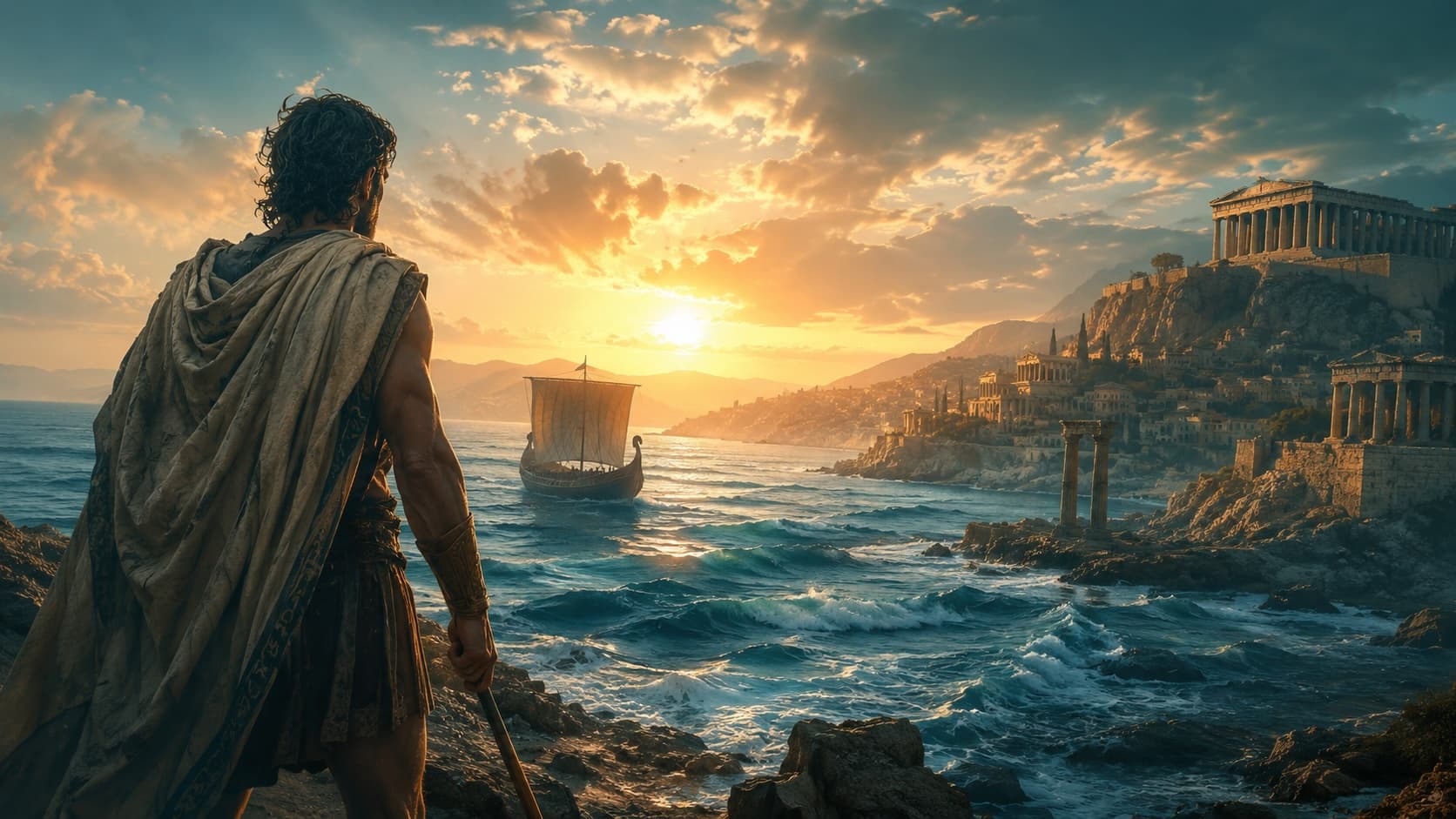
Odysseus: The Journey Home
 Andres Aguilar
First, he got Polyphemus drunk on concentrated wine he had brought with him, filling the cup generously and refilling it several times. When the giant, in his drunkenness, asked his name so he could reward him with a gift, Odysseus answered...
Ten years of war to reach Troy. Ten more years to get back home. A man who had left his wife with a baby in her arms returned to find that child already a grown adult capable of fighting, while the wife was surrounded by more than a hundred suitors who wanted to take the place of the missing king. Odysseus, king of Ithaca, the shrewdest of all the Greek heroes, the man who came up with the idea of the wooden horse, the one who never lost his head at the most critical moment — he took twenty years to make the round trip. And the journey back was, in some ways, harder than the war itself. This is the Odyssey. And before we dive into the adventures, it's worth introducing the protagonist properly, because Odysseus is not the kind of hero we usually picture when we think of the Greek world.
He wasn't the tallest, the most muscular, or the most handsome of the warriors. He didn't have Ajax's imposing physique, Achilles' superhuman speed, or Agamemnon's distinguished lineage. He was the most intelligent. And intelligence in the Homeric world was not the supreme value of heroes — that place was held by valor in combat, strength, the capacity to kill and to face death without flinching. But Odysseus demonstrated in every situation that there are moments — and they are more frequent than warriors tend to admit — where cunning is worth more than any amount of muscle. It was he who found Achilles disguised as a woman on Scyros. He who organized the theft of the Palladium, a sacred statue of Troy without which the city could not fall. He who designed the horse plan. The other heroes admired him and sometimes resented him — which is exactly what happens with very intelligent people in almost any group in almost any era.
When they left Troy, the Greek fleet was scattered by the storms the gods sent as punishment for the desecrations committed during the sack of the city. Odysseus was left with his own ships and his men, and what began was the series of adventures Homer narrated in the Odyssey — a poem of twenty-four books and more than twelve thousand lines, as foundational to the Western tradition as the Iliad but with a completely different spirit. If the Iliad is a poem about war, glory, and irreversible loss, the Odyssey is a poem about the journey, personal transformation, and the return to who one truly is. They are the two faces of the same epic coin.
The Cyclops
The first major stop in the voyage was the island of the Cyclopes. The Cyclopes were one-eyed giants, sons of the sea god Poseidon, who lived without laws, without farming, without any form of social organization whatsoever — in a state that the Greeks, who valued the city and its institutions as the pinnacle of civilization, would have described as absolutely primitive. Odysseus and a group of his men entered the cave of the Cyclops Polyphemus looking for supplies. When Polyphemus arrived and found intruders, instead of practicing xenia — the sacred hospitality the Greeks considered a religious duty — he began eating them two at a time with the calm of someone who recognizes no rule beyond his own appetite. Odysseus designed an escape plan that is still taught today as an example of creative thinking under extreme pressure.
First, he got Polyphemus drunk on concentrated wine he had brought with him, filling the cup generously and refilling it several times. When the giant, in his drunkenness, asked his name so he could reward him with a gift, Odysseus answered that his name was Nobody. When Polyphemus lost consciousness from the wine, Odysseus took a wooden stake he had found in the cave, sharpened it to a point, heated it in the embers, and drove it with all available force into the Cyclops's single eye.
Polyphemus screamed in pain. The other Cyclopes who lived in neighboring caves came running to ask what was happening. Polyphemus shouted from inside the cave: Nobody is hurting me, Nobody is destroying me. The other Cyclopes, after a moment of understandable confusion, concluded that if nobody was hurting him then it must be some affliction sent by the gods, went back to their caves, and left him alone. Odysseus and his men escaped by hanging under the bellies of Polyphemus's sheep, passing beneath the blind giant's hands as he patted each animal on the way out to make sure no people slipped through. The combination of planning, improvisation, and use of available resources that Odysseus demonstrated in that situation is an example of what the Greeks meant by metis — practical intelligence, cunning applied to concrete situations.
> But Odysseus made a mistake that cost him dearly. When they were already on the ships and at a distance he thought was safe, he couldn't resist mocking Polyphemus.
But Odysseus made a mistake that cost him dearly. When they were already on the ships and at a distance he thought was safe, he couldn't resist mocking Polyphemus. He shouted his real name from the boat: Odysseus, king of Ithaca, the one who did this to you. It was the pride of the winner wanting to be recognized by the loser. And Polyphemus, son of Poseidon, prayed to his divine father to avenge his blinding. Poseidon listened. And from that moment on, the god of the sea became the worst obstacle in Odysseus's journey home. The worst possible obstacle for someone who traveled primarily by water in a world where the sea was the only road between islands.
Circe
The voyage continued. They arrived at the island of Aeaea, where Circe lived — a sorceress, daughter of the sun god Helios, gifted with considerable powers and an intelligence that made most mortals underestimate her until it was too late. Circe received Odysseus's men with food and drink that was really a magic potion, and transformed them into pigs. She kept the pigs in her pen with the indifference of someone who handles this kind of thing routinely. One man who had escaped running came to warn Odysseus what had happened. Odysseus went to confront Circe, protected by a magic herb given to him by the god Hermes to neutralize the spell's effect. When Circe's potion didn't work on him, the sorceress understood she was dealing with someone who was no ordinary sailor. She received him as an equal. Odysseus spent a year on Circe's island — which was pleasant in several respects — until his men urged him not to waste any more time and to stay on the path home.
The Underworld
Before leaving the island, Circe warned Odysseus that to find the right way home he had to do something no living mortal had done before: descend to Hades, the kingdom of the dead beneath the earth, and consult the spirit of the seer Tiresias. The same blind Tiresias who had appeared in the story of Oedipus several episodes back. Tiresias had died, but his soul remained prophetic even in the underworld — a privilege the gods had granted him as part of his special condition.
The descent into Hades is one of the most extraordinary episodes in the Odyssey. Odysseus performed the rituals Circe had instructed, dug a pit at the edge of the world, poured blood from sacrificed animals, and the spirits of the dead began to come, drawn by the smell of fresh blood. The dead in the Greek Hades are shadows without real substance, without clear memory of who they were in life — until they drink blood. Only after drinking do they temporarily recover consciousness and the recollection of who they were. It's a poetic image that speaks to memory and identity: the dead are only who they were when they drink of what the living take for granted.
Odysseus spoke with Tiresias, who gave him the instructions he needed to return to Ithaca. But he also encountered other spirits he recognized. He found the spirit of his own mother, who had died of longing during his long absence, without seeing him return. He tried to embrace her three times and his arms found nothing — because the dead have no body to hold. Only shadow. He found the spirit of Achilles, who asked about his son Neoptolemus, still alive, and wanted to know if he had distinguished himself in the war. And Achilles — the hero who in life had chosen brief glory over a long life — said something to Odysseus that nobody who knew the character could have predicted: that he would rather be the humblest slave in the world of the living than king of all the dead. The hero who had chosen immortal glory in life was expressing, from the other side of death, something profoundly different about the value of being alive.
The Sirens, Scylla, and Charybdis
Back on the surface, the voyage continued with more obstacles designed to test different aspects of Odysseus. The Sirens were creatures whose song was so irresistibly beautiful that any sailor who heard it threw himself into the sea to reach them and died — drowned or dashed against the rocks. Circe had warned him. Odysseus took beeswax and plugged the ears of all his men so they couldn't hear a thing. But he wanted to hear the Sirens' song without dying, because he was the kind of person who has to know, who cannot pass by something extraordinary without experiencing it. He ordered himself lashed to the ship's mast with tight ropes and gave strict instructions not to release him no matter how much he begged or threatened. The men rowed. Odysseus heard the most beautiful song any human ear had ever heard, and survived to tell it — tied to the mast, screaming to be released, unable to act on what he felt.
Then came Scylla and Charybdis, two opposite dangers positioned at the two ends of a narrow channel that was impossible to avoid. Charybdis was a monstrous whirlpool that three times a day swallowed all the water of the strait and spat it back out. Any ship passing over it when it was active would be destroyed beyond any chance of survival. Scylla was a six-headed monster perched on a cliff, capable of snatching six sailors at once with her snake-like necks. The channel was so narrow that there was no way to get far enough from one without coming dangerously close to the other. Circe had explained the only option available: if he tried to avoid Charybdis, he would pass too close to Scylla and lose six men — but the ship and the rest of the crew would be saved. If he tried to avoid Scylla, he risked losing everything to Charybdis. The cruelest navigational choice imaginable: accept a limited and certain loss to avoid a total loss. Odysseus passed on Scylla's side. He lost six men. The ship continued.
The Cattle of the Sun
The island of the Sun was the ultimate test that Odysseus's men could not pass. Helios, the sun god, kept his sacred cattle on that island — animals no mortal was to touch. Every warning they had received had been clear on this point. But the men were stranded by contrary winds for weeks, with no food, no way to depart. Resistance has a limit. When Odysseus finally fell asleep after days of keeping watch, the men killed some of Helios's cattle and roasted them. When the sun god saw what had happened, he went to Zeus to complain. Zeus responded with a storm that destroyed the ship as soon as they put out to sea. Every single one of Odysseus's men died. Only he survived, clinging to the wreckage of the mast and the keel, floating alone in the sea that so badly wanted to deny him his return.
The sea carried him back to the strait of Charybdis at the moment the whirlpool was swallowing water. Odysseus grabbed hold of a fig tree growing on the cliff over the maelstrom and hung there, suspended in the air above the void, until Charybdis spewed the wreckage back out. He dropped onto the debris and kept floating.
Calypso
He arrived at the island of Ogygia. There lived Calypso, a nymph — a minor sea divinity — who fell in love with Odysseus and held him on her island for seven years. This was no captivity of chains and darkness. Calypso loved him genuinely, or at least what a minor divinity understands by love. She offered him immortality if he stayed with her forever: never to age, never to die, to live on that beautiful island with her without end. Odysseus refused. He spent his days gazing at the sea with longing and his nights with Calypso. But he still wanted to return to Ithaca, to Penelope, to his son Telemachus whom he barely remembered as a baby. The immortality offered by a goddess was not worth what a mortal and real life in his own place was worth.
Finally, the gods of Olympus — particularly Athena, who had always been Odysseus's protector on account of his intelligence and strategic genius — intervened. Hermes was sent to ask Calypso to let him go. Calypso obeyed with genuine sadness. Odysseus built a raft with his own hands and set sail. One last storm sent by Poseidon destroyed the raft, but Odysseus swam to shore in the land of the Phaeacians, a hospitable people who received him, listened to his stories through an entire night, and finally carried him sleeping to Ithaca on one of their ships, setting him gently on the beach of his island.
The Return
Odysseus arrived in Ithaca disguised as a beggar, with Athena's help changing his appearance so he wouldn't be recognized. The precaution was necessary. In his absence, Ithaca was filled with suitors who wanted to marry Penelope and claim the kingdom: more than a hundred men installed in the royal palace, eating and drinking Odysseus's resources, pressuring Penelope to choose one of them as her husband, mistreating the servants, and treating the absent king's house as if it were their own.
Penelope had resisted them for years with a strategy of her own: she told them she would choose a husband when she finished weaving a burial shroud for her father-in-law Laertes. Each night she unraveled what she had woven during the day. Weaving and unraveling, buying time, waiting for something she no longer knew whether would ever come. Penelope is one of the most intelligent characters in the entire saga, and her resistance was not passive resignation but active strategy — a form of intelligence the poem values as highly as Odysseus's own, and which the poem doesn't let pass without explicit recognition.
> Penelope is one of the most intelligent characters in the entire saga, and her resistance was not passive resignation but active strategy.
Odysseus's reunion with his son Telemachus — whom he went to find before approaching the palace — was one of the most deeply human moments in the poem. A father and son who barely knew each other, strangers bound by blood and by the need to face together what was coming. Odysseus revealed his identity only to Telemachus and two trusted servants who had remained loyal for decades. And together they planned what would come next.
Penelope organized a contest among the suitors that turned out to be a perfectly designed trap. Whoever could string Odysseus's bow and fire an arrow through twelve axe-heads in a row would win her hand. It was Odysseus's bow, which only he knew how to string properly after years of practice. The suitors tried one by one — sweating, straining, unable to bend the bow enough to string it. The beggar nobody took seriously, sitting in a corner of the hall, asked to be allowed to try. They handed it to him as a joke. And Odysseus, on his feet, strung the bow with the ease of someone who has done it thousands of times. He fired the arrow and sent it through all twelve axe-heads without touching any.
What followed was the slaughter of the suitors. Telemachus had blocked the exits without anyone noticing. Odysseus, with Athena at his side, killed every man who had dishonored his house during his absence. The violence of that final scene is considerable even by the standards of epic poetry. There is no possible clemency for those who had behaved as they had for years.
The final obstacle — the most unexpected — was Penelope herself. When they told her that the beggar who had killed all the suitors was in fact Odysseus, she did not immediately believe it. Twenty years is a long time. A man can know many things about Odysseus without being Odysseus. Penelope tested the man who claimed to be her husband with an indirect question about their bed. Odysseus described how he had built the marriage bed himself, around the trunk of a living olive tree rooted in the ground of the bedroom — a bed that literally had roots in the earth and couldn't be moved from its place without destroying it. It was a secret that absolutely nobody else could know. Penelope listened. And then she believed him. And she wept.
The Hero's Journey
The voyage of Odysseus is the archetype of what the comparative mythology scholar Joseph Campbell called the hero's journey — a narrative structure he identified in myths from cultures around the world and across different historical eras. Campbell described the path that runs from departure, through the trials and transformations along the way, to the return transformed to the place of origin. Odysseus departs as the clever commander of the Trojan War. He returns as something harder to define: a man who has seen death from the inside, who has spoken with the dead, who has refused the immortality he was offered because a mortal life in his own place was worth more, and who chose to return to what is human, imperfect, and limited — because it was his place in the world and nothing else could replace it.
There's something truly remarkable about that central choice of the character. Calypso offered him eternity: never to age, never to die, to live on a beautiful island with a goddess who loved him. Odysseus chose Ithaca, with everything Ithaca meant in concrete terms: the inevitable aging, the death that would come someday, the everyday life with its ordinary limitations and its joys that are not divine.
> Odysseus chose Ithaca, with everything Ithaca meant in concrete terms: the inevitable aging, the death that would come someday, the everyday life with its ordinary limitations and its joys that are not divine. The Greeks, who had built a culture that glorified the immortality of fame as the supreme good, put in the mouth of their most intelligent character a different and subtler choice. Odysseus chose the mortal, the limited, the real. And that too is a myth that speaks directly to something human beings are still debating and deciding every single day.
That was the Trojan cycle and its protagonists. From the wedding of Peleus and Thetis to the return of Odysseus to Ithaca, Greek mythology built one of the richest narrative universes humanity has ever produced — one where the gods are not perfect, the heroes aren't either, and the questions that truly matter have no simple or definitive answers.
If you made it this far, I hope this journey gave you the same thing it gives me: the feeling that two thousand five hundred years isn't really that long, and that the people who lived in that time thought, loved, feared, and made mistakes in ways we recognize without effort — because they're the same ways we're still living today.
Related episodes
But to understand what Medea did, you must first understand who she was and what they did to her. Because this story doesn't start with a woman who goes crazy for no apparent reason.
An arrow to the heel, shot by the man who started it all and guided by a god carrying a grudge. That was how Achilles died. Then came the horse, the night, and the fall of Troy. Then Homer: the poet who turned fifty days of that war into the most widel...
The first word of the Iliad is not glory or war — it is wrath. Achilles' rage was not just wounded pride; it was the force that left the Greeks exposed, burned their ships, and killed the person who mattered most to him. All over a dispute about spoils...