
Troy: The Iliad (Part 3)
 Andres Aguilar
An arrow to the heel, shot by the man who started it all and guided by a god carrying a grudge. That was how Achilles died. Then came the horse, the night, and the fall of Troy. Then Homer: the poet who turned fifty days of that war into the most widel...
The Death of Achilles
The previous episode ended with the burial of Hector and twelve days of truce. Achilles had returned the body to old Priam, the two enemies had wept together, and for a moment the war seemed almost human. After those twelve days, the truce ended. The war resumed its course. And with it resumed the weight of something Achilles had known before he ever set sail from Scyros: if Hector died, he would die next. That was already done. Now it was his turn.
But before that happened, Achilles kept fighting. And in that final stretch, between Hector's death and his own, Achilles may have been more destructive than ever — as if he knew time was running out and wanted to leave a bill that couldn't be ignored. He killed Memnon, the Ethiopian king who had arrived at Troy with an army to reinforce the city's defense. Memnon was the son of Eos, the Dawn goddess, and his confrontation with Achilles is one of those duels between demigods that the Greek tradition remembered for centuries. Neither of them was entirely mortal. Both had divine mothers watching from Olympus while their sons killed each other below. Zeus held the scales of fate, as he had done with Hector. Memnon's side sank. Achilles killed him. And pressed on.
He kept advancing toward the gates of Troy. That was what defined him in those final weeks: he pushed further than any prudent calculation advised, as if the only measure of progress that mattered was the shrinking distance between him and the walls of the city he had to take. He came so close to the Scaean Gates — the great wooden gates that opened onto the battlefield — that the Trojans watching from the battlements could make out his face.
And it was there, at the gates of Troy, that Paris killed him.
Paris was on or near the wall. He was an archer, not a hand-to-hand fighter. That distinction mattered enormously in the Homeric world. The man who looks you in the eye and faces you with spear and shield has a status that the man who kills you from a safe distance will never have. In the Iliad, Paris appears multiple times trying to avoid direct combat — hiding behind others, letting the real warriors fight while he fires from a distance. His own brother Hector calls him out for it in the poem with a directness that leaves no room for interpretation. Paris could fight with the bow. He was skilled, precise. But in a culture that measured valor by the willingness to put yourself in the place of immediate danger, the bow carried something of a cheat about it, a coward's distance. And it was exactly that distance that ended the life of the greatest warrior in the world.
But Paris was only the arm. The one who guided the arrow was Apollo.
Apollo had been Troy's protector long before the war began. It was Apollo who sent the plague on the Greek camp in year ten when Agamemnon insulted his priest. It was Apollo who intervened to protect Hector at several critical moments. And it was Apollo who, when Patroclus came too close to the walls of Troy, struck him from behind and left him vulnerable for Hector to kill. The god had an outstanding debt with Achilles, and it wasn't just the matter of Troy. In the tradition surrounding these events, there are versions that mention Achilles having killed young Troilus, an adolescent Trojan prince, inside Apollo's own sacred sanctuary. If that happened, it was a desecration the god could not leave unanswered. The Greek gods didn't forgive that kind of outrage. They filed it away with a patience that could be mistaken for forgetting — until it wasn't.
Apollo appeared to Paris. In some versions he spoke directly, pointed out Achilles, and guided his hand. In others he simply steered the arrow's flight after it was loosed, as if the god himself were the wind correcting its trajectory. The arrow found the heel.
The heel — that specific, particular point — was no accident. To understand why that was the only place where Achilles could be mortally wounded, you have to go back to the beginning of his story. Thetis had known it before he was born. She knew her son would choose glory over a long life, knew the battlefield of Troy would call him with a force no maternal argument could overcome. But she was also his mother, and motherhood in the Greek world didn't resign itself from trying to protect, even when protection was futile. She took the infant Achilles and submerged him in the waters of the Styx. The Styx was the river of the underworld, the one the dead crossed to reach the realm of Hades. Its waters had a power no other water in the world possessed: they made invulnerable everything they touched. Thetis submerged her son completely, holding him by the heel. The water of the Styx touched every inch of his body. Every inch, except the heel by which his mother held him. The hand that was trying to save him was also the place that death had kept for itself.
There is something in that image the Greeks thought about very carefully. It wasn't carelessness that left the heel exposed. It was love itself. The only point on Achilles' body that the water of the underworld never touched is exactly the point held in his mother's hand. Protection and vulnerability are born of the same gesture. It's the kind of paradox that appears often in Greek mythology, and in this case it carries a dimension that goes far beyond the mechanics of how to kill an invulnerable warrior.
Apollo knew where that heel was. And now Paris knew too.
The arrow struck and Achilles fell. Not instantly — not in every version. There are traditions that show him trying to pull out the arrow, rising to his feet once more, still fighting even while wounded before the strength finally left him. He was Achilles. His body took time to accept that the moment had come. But it came. The greatest warrior Greece had sent to Troy died at the gates of the city he had spent ten years trying to take, with an arrow in his heel fired by the man who had started it all, guided by the god who protected the city.
The irony of that death is so perfect that no poet could have constructed it better without it seeming contrived. Paris started the war. Paris finished Achilles. The love that set everything in motion became the instrument of the end of the war's most important man. And it happened not through the kind of glorious duel that heroic Greek culture considered the fitting end for a warrior of that magnitude, but through an arrow fired from a distance — the distance the bow allows, the distance that traditional epic considered the resource of a man who prefers not to put himself in the place of real danger.
What followed the death of Achilles was a fierce battle over the body. The Greeks could not allow the Trojans to carry off the remains of their greatest warrior. Ajax — the big man from Salamis — hoisted the body on his shoulders and carried it off the battlefield while Odysseus covered the retreat, holding back the Trojan advance. The body reached the Greek camp. Achilles' funeral was on a scale befitting his life: days of mourning, the funeral games tradition demanded, the procession of the Myrmidons — his personal warriors from Phthia, who had followed him from the beginning. Thetis rose from the sea to mourn her son. The Nereids, her sisters, accompanied her. It was what she had always known was coming, from before he was born. That didn't make it any less real when it arrived.
Achilles' death did not end the war. The Greeks still couldn't break through Troy's walls, and the Trojans still couldn't expel them from the territory. The grinding equation that had defined nine of the ten years of conflict was still in play — only now without the man who in recent weeks had seemed capable of tipping it decisively. The war that had started over a woman and a violation of sacred hospitality needed something different to end. It needed an idea.
The Wooden Horse
The idea was Odysseus's.
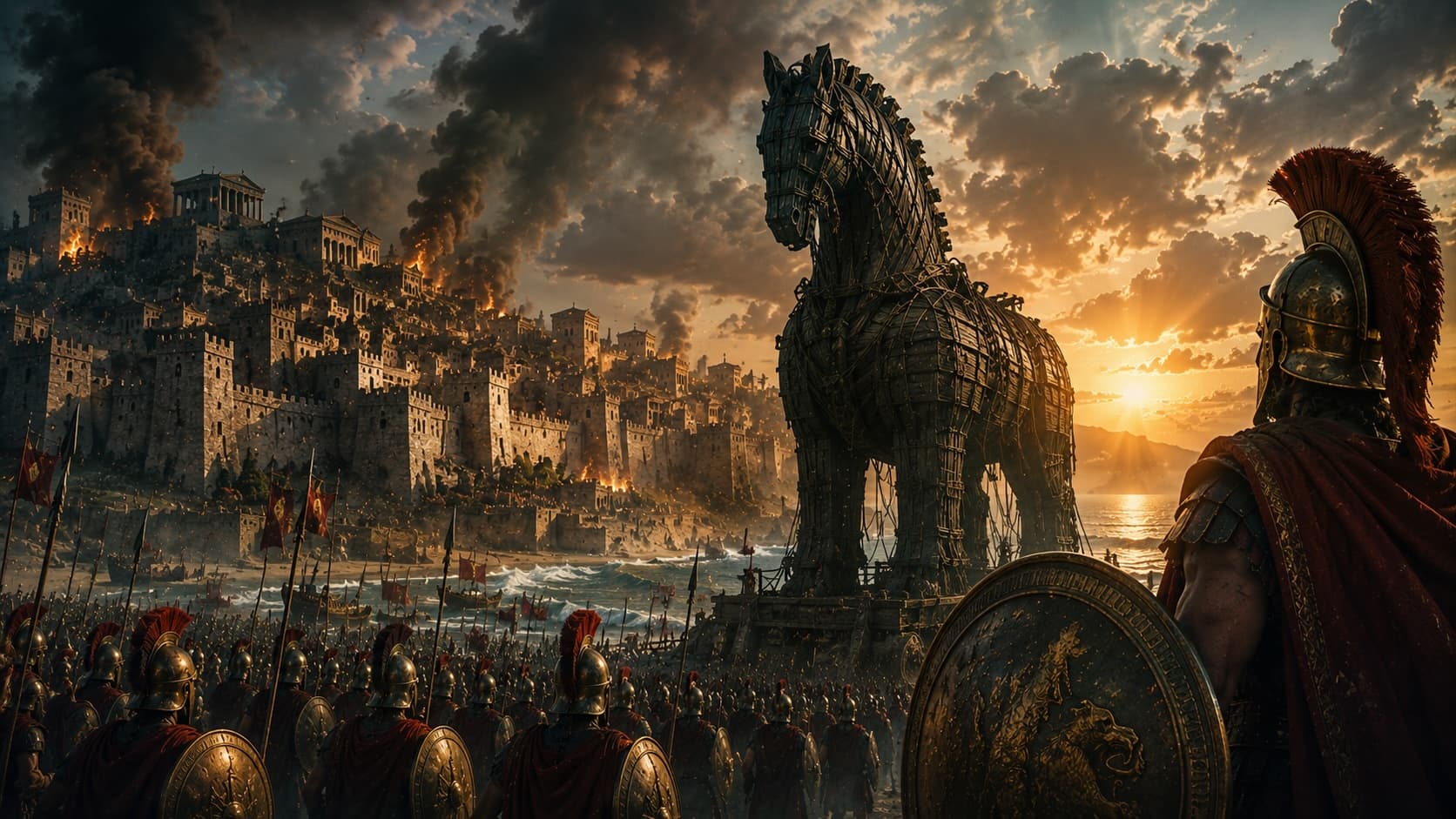
A wooden horse of enormous proportions, built by the finest carpenter in the Greek army, Epeius, with technical help from Athena. Hollow inside. With a concealed hatch in the belly that could be opened from within without leaving any visible trace from outside. The interior space calculated to hide a select group of warriors: the ancient sources vary between twenty and forty men, but they agree these were the best available. Odysseus among them. Menelaus among them. Men with the cold nerve to remain completely still and silent for hours, in a dark, enclosed space, waiting for a signal that might never come if something went wrong.
The second part of the plan was the hardest. Not the carpentry — the lie. For that work, Odysseus chose a man named Sinon, selected specifically because he was capable of maintaining a false story under hostile interrogation without cracking. You had to find someone like that. Not just anyone could lie to an entire city while surrounded by people pressing him with the accumulated suspicion of ten years of war. Sinon could.
The plan: the Greeks would load the ships, break camp, and disappear over the horizon. They would leave the horse on the beach as a votive offering to Athena, deliberately built too large for the Trojans to bring inside their walls — because if they did, the goddess's protection would shift to the Trojan side forever. Sinon would remain on the beach alone, bound, as if his own companions had abandoned him. When the Trojans found him, he would tell them he had escaped an attempted human sacrifice before the fleet departed. A story with the texture of truth: the Greeks had sacrificed Iphigenia so the winds would blow ten years before. It wasn't hard to believe they might attempt something similar on the way out.
The perverse logic of the plan lay in that specific measurement of the horse. If the Trojans believed the Greeks had built it too large to fit through the gates, the natural reaction was to want to demolish a section of the wall to make it fit. That was exactly what Odysseus needed.
The Trojans came out of the city for the first time in years. They walked across the empty beach, saw the abandoned camp, the marks in the sand where the ships had been. They found the horse. They found Sinon. And Sinon's story sounded exactly like the truth because it had all the details a carefully constructed lie needs: internal consistency, a credible victim, logic that holds up under questioning.
Two voices warned them not to trust it.
The first was Cassandra. Priam's daughter and one of the most tragic figures in all of Greek mythology. Cassandra had the gift of prophecy — she saw the future with a clarity no other mortal could match. But Apollo, the same god who had guided Paris's arrow, had cursed her with a specific sentence: no one would ever believe her. He had loved her when she was young, she rejected him, and the god who couldn't take back a gift he had already given took away instead the only thing that made that gift useful. Cassandra screamed that the horse was a trap. That there were armed warriors inside. That if they brought it into the city, Troy would burn that very night. Nobody believed her. They never believed her.
The second voice was Laocoön, a priest, who warned the Trojans with a phrase the Roman poet Virgil immortalized centuries later: beware of Greeks bearing gifts. Laocoön went so far as to hurl a spear into the horse's flank to demonstrate it sounded hollow. And while the Trojans were still debating, two enormous sea serpents rose from the sea and devoured Laocoön and his two sons in front of everyone. The Trojans took it as an unambiguous sign from the gods. The priest had offended a sacred offering. The horse was legitimate. It had to come inside.
To bring it through the gates they had to demolish a section of the wall. The wall that had withstood ten years of war was voluntarily opened by the Trojans themselves to make way for the thing that was going to destroy them. It's the most precise possible image of how deception works when it's well constructed: it doesn't need to break down the defenses from outside. It needs to convince those inside to open them on their own.
> The wall that had withstood ten years of war was voluntarily opened by the Trojans themselves to make way for the thing that was going to destroy them.
That night Troy celebrated. After ten years, the war was over. The Greeks were gone. The sacred horse stood inside the walls. There were reasons to drink, to sing, to let the guard down for the first time in a decade. And while Troy slept, Sinon opened the hatch from outside. The warriors came out one by one in the silence of the early hours. They opened the city gates. The ships that had sailed away had returned in the darkness. And Troy fell that night, from within, in a matter of hours. The city that had withstood the finest warriors in the world for ten years was taken in a single night through deception.
The fall was savage. Slaughter, fire, enslavement. King Priam was killed. Many Trojan princes died that night. Astyanax, the small son of Hector and Andromache, was thrown from the walls. The Greeks didn't want to leave alive any possible future avengers. Andromache was taken to Greece as a slave. Helen was recovered by Menelaus, who came to her with his sword in hand and the intention of killing her. According to several versions, when he saw her, the sword simply dropped from his hand. He took her with him. They returned together to Sparta and lived there for years, as if the war had been a parenthesis that time could close.
The Fall of Troy and the Cursed Return
The Greek victory was not what the victors had expected. The gods were furious at the way the Greeks had desecrated Troy's temples during the sack. Crimes had been committed in Athena's own temple that the goddess could not ignore. Poseidon sent storms. The Greek fleet, which had crossed the Aegean ten years earlier with the wind at its back and the optimism of those who don't yet know what something will cost, returned scattered and shattered. Many heroes spent years trying to reach their homes. Some never made it.
Agamemnon reached Mycenae and was murdered by his own wife. Clytemnestra had never forgiven him for the sacrifice of Iphigenia — the cruel deception with which he'd brought her to Aulis under the pretense of marrying her to Achilles. During the ten years of war she had taken a lover, Aegisthus, who also coveted the throne. The man who had commanded the greatest military coalition the Greek world had ever seen was killed in his own palace on the very day of his victorious return. Aeschylus's Oresteia — the most important theatrical trilogy in all of Antiquity — tells what followed: Agamemnon's son Orestes avenges his father by killing his mother, and finds himself trapped in the pursuit of the Erinyes, the goddesses of vengeance. The story ends when Athena establishes a human court to judge Orestes' case, a moment the Greeks presented as the mythical origin of the Western judicial system — the replacement of personal vengeance by institutional justice. The Trojan War, even for those who won it, was only the beginning of another story that cost more blood.
Homer and the Oral Tradition
And so we arrive at the question this episode perhaps should have started with: where does everything we just heard come from?
The Iliad is the most famous epic poem in the entire history of Western literature. And there's a fact about that poem that almost always surprises people hearing it for the first time. The Iliad does not tell the beginning of the Trojan War. It doesn't tell the end either. It says nothing about the Judgment of Paris. Nothing about the wooden horse or the fall of the city. Nothing about the death of Achilles. The Iliad narrates fifty-one days of the tenth year of the war. Nothing more. A small slice of an enormous story. And it is probably the most influential text Western civilization ever produced.
Who wrote it? The honest answer is that we don't know for certain. Ancient tradition speaks of a blind poet, Homer, who lived sometime between the ninth and eighth centuries BCE. Perhaps from the island of Chios, perhaps from the city of Smyrna on the coast of Asia Minor, perhaps from somewhere else in the Greek world. Several cities claimed him as their own for centuries — which doesn't prove much, except that everyone wanted the glory of having produced him. The historical reality is more complicated than that simple image of the blind poet who sat down and composed the two foundational poems. For two centuries scholars have debated what's known as the Homeric Question: was Homer a real person who composed these texts, or is the name a label for a collective oral tradition spanning generations? There's no definitive answer. There probably never will be.
What we do know is that the Iliad and the Odyssey belong to an ancient oral tradition. Before writing existed in Greece, aoidoi passed these stories down from generation to generation for centuries. The aoidoi were professional singers or bards who recited from memory at the courts of kings and at festivals. They had fixed formulas, phrases that repeated in similar contexts, structures that aided in memorizing enormous texts. Expressions like "swift-footed Achilles" or "the rosy-fingered Dawn" appear dozens of times throughout the poem. They are the building blocks of a tradition that functioned before writing was possible. When writing finally developed in Greece, someone — or several someones — put these poems down on paper. The result survived more than two thousand five hundred years and remains an object of study, translation, and fascination across the entire world.
In ancient Greek, the Iliad is written in dactylic hexameter, a very particular poetic meter that in its original language sounds almost like the gallop of a horse when read aloud. That sonic effect was fundamental. This was a tradition born to be heard, not read in silence. The average Greek of the fifth century BCE didn't have a copy of the Iliad in his home library. Books were hand-written papyrus scrolls — expensive and scarce. The way nearly everyone knew these poems was by listening to them. At the great Panhellenic religious festivals, like the Panathenaea in Athens held every four years, part of the program was the recitation of the Homeric poems in order, passing from rhapsode to rhapsode — as the professional reciters who had memorized them were called. People came from different parts of the Greek world and listened for hours to the story of Achilles, of Hector, of the war. It was a collective experience that culturally unified communities who spoke the same language but had very different laws and customs. Homer was far more than a poem. He was the shared cultural element that made it possible to speak of a Greek identity beyond the borders of each city-state. He had a political and social function that went far beyond narrating a war.
> There is one element that distinguishes the Iliad from almost everything Western literature produced afterward, at least when it comes to war. Homer takes no sides.
There is one element that distinguishes the Iliad from almost everything Western literature produced afterward, at least when it comes to war. Homer takes no sides. There are no good guys and bad guys in the way we understand those terms today. The Greeks have their virtues and their failings, and the Trojans have exactly the same ones. Hector, Troy's greatest warrior, is presented with as much sympathy as any of the Greek heroes — arguably more. That capacity to understand the enemy as a complete human being, with his family, his fears, his love for the city he defends, is something that war rarely produces in those who live through it, and that a poem about war achieves in an extraordinary way. Andromache has in the Iliad one of the most heartbreaking farewell monologues in all of literature. Priam, the defeated king who goes alone at night into the enemy camp to kiss the hands that killed his son, is a figure of a dignity that has almost no equivalent in any text written since. And Troy, the city that falls, is not the abstract enemy whose destruction we should celebrate. It's a city the reader loves while watching it crumble.
> That is what makes the Iliad something more than war epic. It is a poem about grief. About irreversible loss. About what it means for something beautiful to be destroyed beyond any possibility of recovery.
That is what makes the Iliad something more than war epic. It is a poem about grief. About irreversible loss. About what it means for something beautiful to be destroyed beyond any possibility of recovery. Troy doesn't come back. Hector doesn't come back. Achilles doesn't come back. And yet the poem makes them live forever — which was exactly what glory promised in the Greek world.
The legacy of the Iliad in the cultural history of the West is impossible to exaggerate. Alexander the Great, the Macedonian conqueror who in the fourth century BCE built the largest empire the world had ever seen, carried with him a copy of the Iliad annotated by his own teacher, Aristotle. He kept it under his pillow alongside his dagger. At the beginning of his conquests, when he crossed into Asia Minor and passed near the region of Troy, he went to visit the legendary tomb of Achilles. He wept there, in front of the tomb. And he said he envied Achilles for having had Homer to immortalize him. A man who had conquered the known world considered the greatest glory possible to be the protagonist of a poem. That says something about the power of a story told well, and also about what kind of immortality the Greeks were after.
Schliemann and the Real Troy
One last thing before we close. Heinrich Schliemann was a nineteenth-century German archaeologist who from childhood was convinced that Troy was real and not simply a poetic myth. He devoted his life to finding it against the opinion of almost the entire academic community of his time, who considered him an eccentric. In 1871 he began excavating at a site on the coast of what is today Turkey, called Hisarlik. And he found ruins. Not one city but several, stacked on top of one another, each civilization built on the ashes of the one before it, like layers of a story that never ends. The layer that most archaeologists today identify as the Troy of the Homeric period, known technically as Troy VIIa, shows clear evidence of violent destruction by fire around the twelfth century BCE. It's not proof that the war happened exactly as Homer tells it. But it does say that in that place there was a major city that was destroyed, and that the memory of that destruction survived centuries passed by word of mouth before anyone wrote it down.
The story that began with Eris's apple at an Olympian wedding ended with a city in flames, thousands dead, and a poem that two thousand five hundred years later we are still reading and debating. Not bad for a wedding that went very, very wrong.
In the next episode we follow the shrewdest character in the entire saga. Odysseus. The man who spent ten years trying to get home from a war that had already lasted ten years. Who encountered monsters, magic, the dead, nearly irresistible temptations, and a sea that seemed determined never to let him arrive.
Related episodes
But to understand what Medea did, you must first understand who she was and what they did to her. Because this story doesn't start with a woman who goes crazy for no apparent reason.
First, he got Polyphemus drunk on concentrated wine he had brought with him, filling the cup generously and refilling it several times. When the giant, in his drunkenness, asked his name so he could reward him with a gift, Odysseus answered...
The first word of the Iliad is not glory or war — it is wrath. Achilles' rage was not just wounded pride; it was the force that left the Greeks exposed, burned their ships, and killed the person who mattered most to him. All over a dispute about spoils...