
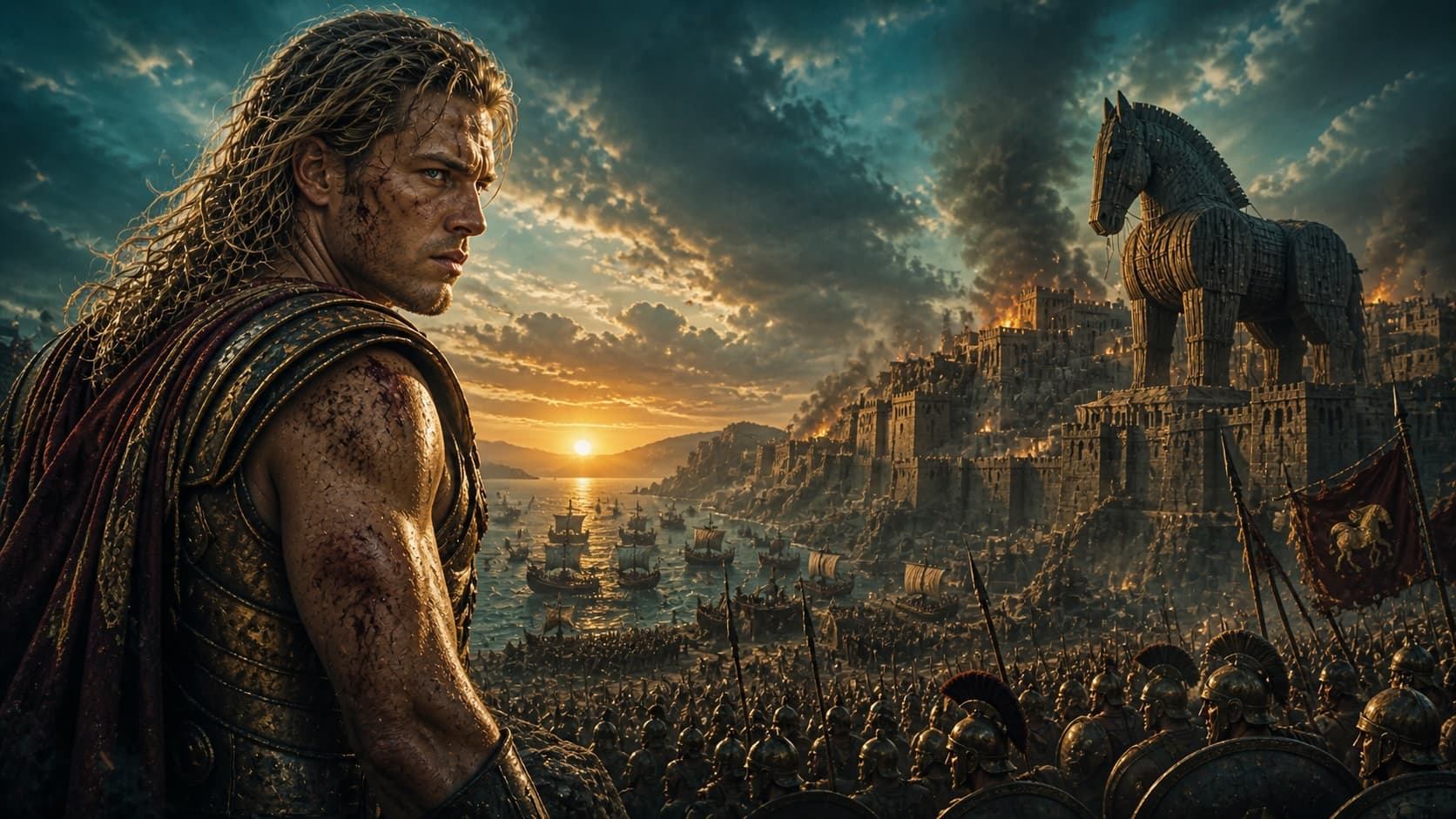
Troy: The Wrath of Achilles (Part 2)
 Andres Aguilar
The first word of the Iliad is not glory or war — it is wrath. Achilles' rage was not just wounded pride; it was the force that left the Greeks exposed, burned their ships, and killed the person who mattered most to him. All over a dispute about spoils...
Menis: The First Word of the Iliad
The first word of the Iliad — the oldest poem in Western literature and one of the most widely read texts in all of human history — is wrath. In ancient Greek: menis. And this is no ordinary kind of wrath.
Menis was a word the Greeks reserved specifically for the rage of the gods, or for a human fury of divine proportions — a fury that transcends the personal and becomes a force that transforms the world around whoever feels it.
The poem opens by announcing that it will sing of the wrath of Achilles, and that wrath is not the anger of someone having a bad argument. It's the rage of someone who withdraws his protection from the world and lets everything burn.
Achilles was the greatest warrior in Greek history — the fastest, the most terrifying in close combat, practically invulnerable. And when he got angry, he crossed his arms. And when he crossed his arms, Greeks began dying in numbers they had never seen before. This is the story of the wrath of Achilles, and it begins in the tenth year of a war that nobody expected to last this long.
Nine Years of War and the Honor of the Spoils
The Trojan War had already been going on for nine years when the Iliad opens. Nine years of combat, sieges, beach encampments, battles that never quite decide anything definitive. To understand what that length of time means in a human life, think about it in concrete terms: warriors who had set sail as twenty-year-olds were now nearly thirty. Those who had been thirty were pushing forty. They had slept in tents for a decade, eaten whatever war and plunder allowed, watched friends die whose faces they could barely remember anymore. Letters sent to their families took months to arrive. Children born the year they left were already in school without ever having known their fathers. A war of attrition doesn't only destroy those who die — it also destroys, in a slower and less dramatic way, those who keep living.
The Greeks couldn't take Troy through its walls, which were too solid and too well defended by warriors who knew every corner of the city they were protecting. The Trojans couldn't expel the Greeks from the territory, who were too numerous and too well organized to be dispersed. The war had entered a grinding phase that consumed lives on both sides without the balance tipping definitively in either direction. Over those nine years there were minor battles, plundering expeditions against cities allied with Troy to obtain supplies, diplomatic negotiations that went nowhere. And in one of those plundering expeditions, the Greeks captured two women who would become the trigger for a conflict that would change absolutely everything.
Chryseis, Briseis, and the Plague of Apollo
One was called Chryseis, daughter of Chryses, a priest of Apollo who lived in the region. The other was Briseis, a woman of equally noble origin. In the division of spoils that follows every successful plundering expedition, Chryseis went to Agamemnon, the commander-in-chief. Briseis went to Achilles. Chryseis's father, the priest Chryses, came to the Greek camp to ask for his daughter. He didn't come empty-handed: he brought a generous ransom and the religious authority of a man who serves Apollo. Agamemnon treated him with total contempt, sent him away empty-handed, and threatened him if he returned. Chryses, humiliated and desperate, prayed to Apollo, his god, to punish the Greeks for that outrage. Apollo listened. The god sent a plague down on the Greek camp. Men began to die.
Achilles called a general assembly of the army. The Greeks were a coalition of different kingdoms that had come together with their own troops and their own commanders, and assemblies were the mechanism for resolving internal conflicts. The seer Calchas, when asked the cause of the plague, revealed the truth with visible fear: Agamemnon had to return Chryseis to her father. Agamemnon listened, understood he had no alternative, and agreed. But with one condition he was not prepared to negotiate: if he gave up his prisoner, he demanded to receive someone else's in compensation — to avoid being seen as lesser than any other chief in terms of honor and spoils. And Agamemnon's gaze fell on Achilles. He wanted Briseis.
> Taking a warrior's spoils after they had already been distributed was an insult of enormous proportions in the Greek cultural context.
Taking a warrior's spoils after they had already been distributed was an insult of enormous proportions in the Greek cultural context. Spoils were the visible materialization of honor earned in combat. They were public recognition of each warrior's bravery and skill. Not merely an object of value — they were proof that could be shown, that others could see, that someone had acted with excellence and deserved to be treated accordingly. Without that visible proof, honor was reduced to one's own words, which in a culture where reputation was everything carried far less weight than deeds. To take them away was to publicly declare that your honor was worthless — that it could be ignored and diminished at will by someone with more power. And Agamemnon said exactly that to Achilles, the greatest of all, the one with the most reason to feel his honor was untouchable.
The Withdrawal of Achilles
Achilles responded the only way he knew how: with an absolute intensity that left no room for moderation. He nearly drew his sword and killed Agamemnon right there in the assembly, in front of the entire army. It was the goddess Athena — invisible to everyone but him — who appeared, grabbed him by the hair from behind, and quietly suggested that he put the sword away. That he respond with words, that there were better ways to take revenge than killing the commander-in-chief in public and making himself the cause of the defeat. Achilles sheathed the sword. But he promised something that was about to change the course of the war: he was withdrawing. He and his Myrmidons, his personal warriors from Phthia, would not fight again as long as Agamemnon was in command. And he went to find his mother Thetis and asked her for something that went beyond wounded pride: to intercede with Zeus so that the Trojans would gain ground, so that the Greeks would suffer, so that Agamemnon would understand through the blood of his men what it meant to have insulted the greatest warrior in his army.
Thetis went to Olympus and spoke with Zeus, reminding him of past favors. And Zeus, who had his own reasons for granting this request, nodded. From that moment on, the Trojans began to win. Battles that had previously been inconclusive began tilting toward the Trojan side. The Greeks were losing ground. The beachhead camp, which had felt like a secure base for nine years, began to feel threatened for the first time.
The Gods on the Battlefield
The gods in the Iliad are a central element for understanding the entire narrative. The Greek gods are not impartial arbiters watching from afar. They are active participants with their own preferences, their own grudges, their own favorites, and their own personal agendas. In the Trojan War, the gods were divided into factions. On the Greek side: Hera and Athena, who despised Paris for not awarding them the golden apple. Poseidon, with his own historical reasons for disliking the Trojans. On the Trojan side: Apollo, the city's special protector. Aphrodite, who had made the promise that started everything. Ares, the god of war, who in the Iliad appears almost like a divine bully who simply enjoys the bloodshed without caring much who wins. Zeus tried to maintain a certain balance while fulfilling his promise to Thetis. The battlefield was also the board where the gods moved their pieces with an indifference that men could sometimes sense but never fully understand.
During Achilles' absence, the weight of the Greek war effort fell on other men. Diomedes, king of Argos, had a moment of glory that in any other war would have been enough to remember him by forever: with Athena's direct support, he managed to wound two gods on the same day — Ares and Aphrodite, who were on the battlefield helping their favorites. The gods don't die when they're wounded, but they do feel pain, and the image of Aphrodite crying and fleeing to Olympus to complain that a mortal had hurt her has a certain comedy that Homer handles with remarkable subtlety. Ajax, the big man from Salamis, a warrior of enormous physical valor, held much of the defensive line through sheer imposing presence. And Odysseus, as always, thinking, maneuvering, looking for the most intelligent solution available to the most immediate problem.
But without Achilles, the Greeks couldn't manage. There came a point when the Trojans, led by Hector — Priam's eldest son and the greatest warrior of Troy — reached the Greek ships on the beach and began setting them on fire. That was the worst possible scenario for the Greeks. If the ships burned, they were trapped in foreign territory with no way home. The entire strategy of the war depended on those ships remaining intact.
Patroclus and the Borrowed Armor
Patroclus was Achilles' closest friend. The exact nature of that relationship is one of the longest debates in classical scholarship: some interpret it as a fraternal friendship of enormous depth, others suggest something more, and Homer's text is ambiguous enough to support both readings. What is beyond doubt is that Patroclus was the most important person in Achilles' life — the only one who could truly reach him, the only one whose opinion mattered when everything else had stopped mattering. And Patroclus, watching the Greeks lose, watching the ships burn, went to speak with Achilles. He begged him to return to battle. Achilles refused. Then Patroclus asked for something different and more limited: to borrow his armor. If the Trojans saw who they believed was Achilles entering the battle, they might fall back on the strength of the name alone.
Achilles agreed. With one very clear condition: Patroclus could fight to push the Trojans back to their positions, but he must not advance too far, must not stray from the camp, must not try to take Troy. It was a reasonable limit for someone who was not Achilles. Patroclus took the armor, dressed in it, and entered the battle. The Trojans, seeing the armor everyone recognized, were frightened and fell back. The plan worked for a time.
But Patroclus grew bold. More victories were within reach. He went beyond what had been agreed. He pushed toward the walls of Troy, toward the city itself. And that's when Apollo intervened — Troy's protector. The god struck Patroclus from behind, stunned him, disarmed him in a moment of confusion. And in that moment of vulnerability, Hector moved in and finished him off. Patroclus died at the gates of Troy, wearing Achilles' armor, having gone further than any boundary had told him he should go.
The news reached the camp. Achilles received it with a devastation that goes beyond what any description can fully capture. It was not just grief at the loss. It was the collapse of something fundamental inside him — the destruction of the anchor that had kept him connected to the world. The man who until then had been absent from the war over wounded pride was on his knees in the sand, his face covered with dirt, screaming a name that could no longer answer. Patroclus was irreplaceable. And Hector had killed him.
> Patroclus was irreplaceable. And Hector had killed him.
Thetis came to comfort him. And Achilles told her he wanted to return to battle, that he wanted to kill Hector. Thetis reminded him of what they both had always known: if Achilles killed Hector, his own death would follow shortly after. That was the order of fate, the chain already written. Achilles knew it. And he accepted it without hesitation. Brief glory over a long life. The decision he had made when Odysseus found him disguised on Scyros was now becoming concrete and definitive in a way that before had been only theory.
The Return of Achilles and the Shield of Hephaestus
Thetis commissioned the craftsman god Hephaestus to make a new suit of armor for her son, because Achilles' armor had been captured by the Trojans when Patroclus died. Hephaestus was the only god who worked with his hands — the smith of Olympus, the one who fashioned the most extraordinary objects in the divine world. The new armor was ready overnight. And Homer devotes an enormously detailed section of the poem to describing the shield Hephaestus made for Achilles, decorated with scenes from the entire world: cities in war and in peace, the sea, the stars, weddings and funerals, farmers harvesting, young people dancing in a town square. The Shield of Achilles is an image of the entire world engraved in divine metal. A world that Achilles is about to defend again, knowing that in doing so he signs his own death warrant.
Achilles returned to the battlefield with the new armor blazing in the sun, and the Trojans fell into genuine panic. The presence of Achilles transformed everything on the battlefield absolutely. It was not just his technical skill. It was something harder to describe — a combination of reputation, physical presence, the certainty he projected that nothing could stop him. He killed dozens of Trojan warriors in that single day. The river Scamander, which flowed across the plain of Troy, actually rose against him because so many bodies were clogging it and the river itself felt profaned. Achilles literally fought against a river advancing on him with its full mass of water. Hephaestus had to intervene from Olympus with fire to dry up the advancing water and protect the warrior. It's one of the most hyperbolic and expressive scenes in the entire poem.
The Duel with Hector
Finally, Hector and Achilles came face to face at the gates of Troy. The two greatest warriors of their respective armies, standing opposite each other. Hector was a character Homer had built with tremendous care throughout the poem. He wasn't simply the Trojans' main enemy of the Greeks. He was a complete human being: husband of Andromache, father of a small son named Astyanax, defender of a city he loved and knew was doomed. There was an earlier scene — told with extraordinary delicacy — in which Hector said goodbye to his family before going out to fight for what would be the last time. The baby cried, frightened by the plume on his father's helmet, and Hector took it off to comfort him, laughing through tears, knowing he probably wouldn't return. It's one of the most human images in the entire poem. The warrior who removes his helmet before going to his death so he won't frighten his son.
When the moment came to face Achilles, Hector ran. He circled the walls three full times, with Achilles behind him. The gods watched from Olympus. Zeus held the scales of fate to weigh the life of each man. The scale tilted toward Hector. Apollo, who had been protecting him, abandoned him in that moment. Athena appeared to Hector disguised as his brother Deiphobus, convincing him he wasn't alone in facing Achilles. Hector stopped. He turned around. And he faced Achilles.
The duel was brief. Achilles drove his spear through Hector's throat, in the only point left unprotected by the armor. Hector fell. And with him something fell in Troy that would never recover. The city that for ten years had resisted largely because of its eldest son was suddenly left without its main defender.
What Achilles did after Hector's death was equally significant for the narrative. He didn't bury him. He tied the body to his chariot and dragged it around the walls of Troy, in front of Hector's family watching from the battlements. He did this for days, repeating the gesture over and over. It was a serious desecration even by ancient warfare's standards, and the Olympian gods themselves began to grow uncomfortable with the excess. Achilles had crossed a line separating legitimate grief from vengeance that no longer had any limit.
Priam and the Close of the Iliad
The close of this cycle came when King Priam — Hector's father, old, devastated, with nothing left to lose — went alone at night to the Greek camp. He came before Achilles. He kissed the hands that had killed his son. And he asked him to return the body so it could be given a proper burial. Achilles, faced with that scene, broke. He saw in Priam his own father, aged and vulnerable, and he wept alongside the old king, who also wept. Two enemies crying together, recognizing each other as human beings before adversaries. Achilles returned the body and granted a twelve-day truce for Hector's funeral. The Iliad ends there — with the burial of Hector, on a note of shared humanity that stands as one of the most powerful closing words any war poem has ever spoken.
> The Iliad ends there — with the burial of Hector, on a note of shared humanity that stands as one of the most powerful closing words any war poem has ever spoken.
The truce lasted twelve days. When it ended, the Greek camp resumed its march and the war resumed its course. And with it resumed the weight of the choice Achilles had made with full awareness before setting sail from Scyros: brief glory over a long life. While he had been furious over Briseis, while he had been mourning Patroclus, while he had been chasing Hector around the walls, that choice had been the constant backdrop to everything he did. He knew it. Thetis knew it. And the chain of events that was about to make it irreversible was already in motion.
In the next episode we close out the saga of Troy. We dive into the Iliad as a literary work: who was Homer, how was this poem passed down through generations before anyone wrote it down, and why is it remarkable that the most influential text in Western literature doesn't cover either the beginning or the end of the war named in its title. We also complete what's still unfinished in the story: the final fate of Achilles, the wooden horse and what was inside it, the fall of Troy in a single night, and what happened to the victors when they tried to go home. Because the Trojan War didn't end well for almost anyone — including the side that won.
Related episodes
But to understand what Medea did, you must first understand who she was and what they did to her. Because this story doesn't start with a woman who goes crazy for no apparent reason.
First, he got Polyphemus drunk on concentrated wine he had brought with him, filling the cup generously and refilling it several times. When the giant, in his drunkenness, asked his name so he could reward him with a gift, Odysseus answered...
An arrow to the heel, shot by the man who started it all and guided by a god carrying a grudge. That was how Achilles died. Then came the horse, the night, and the fall of Troy. Then Homer: the poet who turned fifty days of that war into the most widel...