
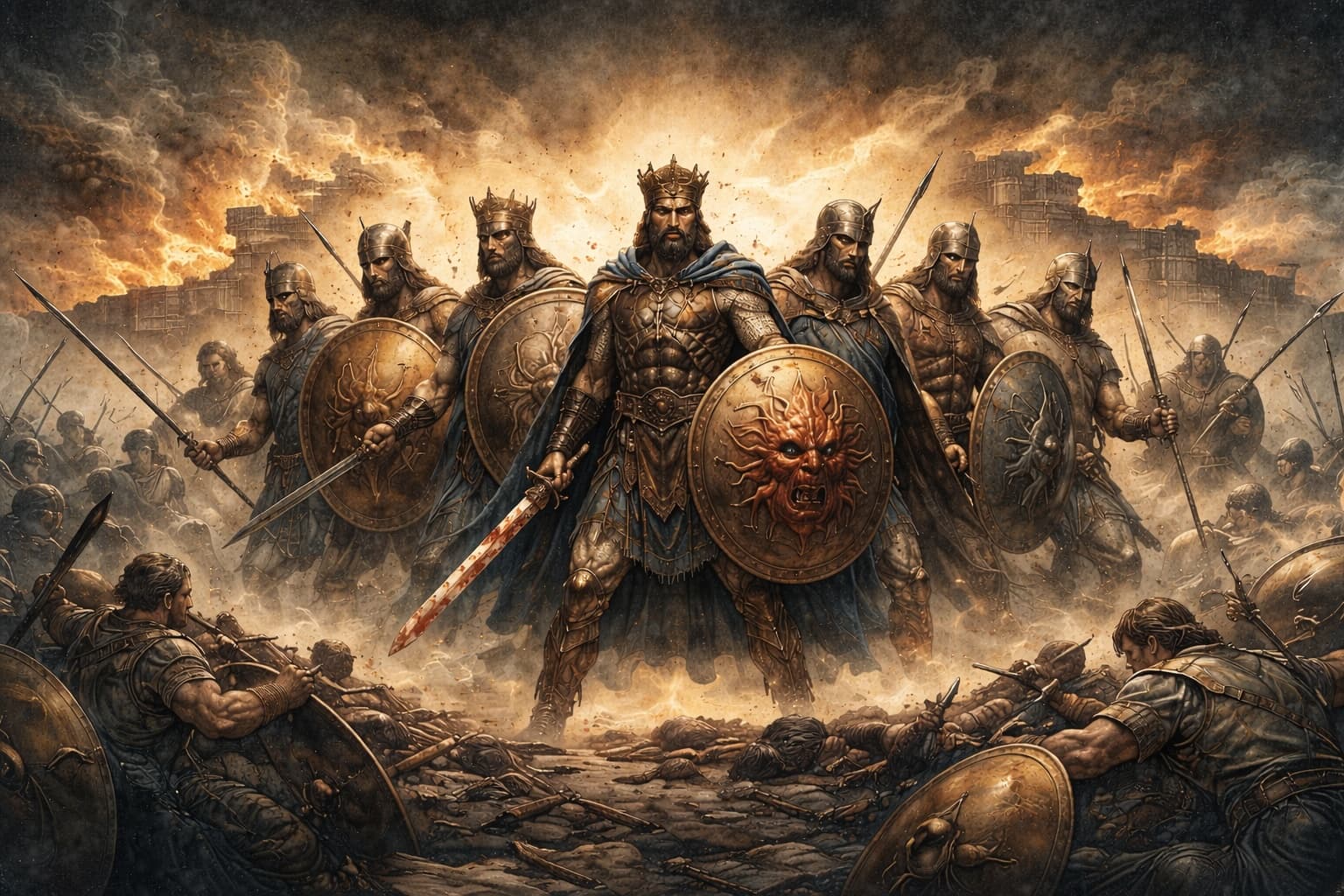
The War of Thebes: The Seven Against Thebes
 Andres Aguilar
Why? Because his wife Eriphyle had been bribed by Polynices with the Necklace of Harmonia, a legendary piece of jewelry with a particularly dark history.
The most destructive wars aren't always fought against strangers. Sometimes the ones that leave the deepest wounds are the ones fought within a family — between people who share blood, and who because of that very bond have a unique capacity to hurt each other in ways no outsider ever could. Today's story is exactly that: two brothers who inherited the most cursed throne in Greece, made a perfectly reasonable pact, and ended up killing each other at the gates of their own city while seven armies laid waste to everything in sight. This is the Seven Against Thebes, and to understand it properly, we need a quick recap of where we left off.
If you listened to the previous episode, you know that Oedipus was the king of Thebes who discovered — far too late — that he had killed his own father and married his own mother. When the truth came to light, Oedipus gouged out his eyes and was exiled. But before he left, according to several versions of the myth, he launched a curse upon his two sons: Eteocles and Polynices would never be able to enjoy the throne of Thebes in peace, and they would end up destroying each other. As paternal curses go, it wasn't exactly warm and fuzzy. But fathers in Oedipus's family were never known for their tenderness.
The Broken Pact and the Exile of Polynices
Eteocles and Polynices faced a concrete problem: the throne couldn't belong to both of them at the same time, and neither was willing to give up his share. They reached an agreement that seemed perfectly fair: they would alternate rule year by year. One year one would reign, the next year the other. A clean pact, backed by a public commitment and the logic of men who understood that sharing was better than losing everything in a fratricidal war. Eteocles took the throne first.
The year passed. The time for the change arrived. And Eteocles didn't hand over the throne. The exact reasons vary depending on which source you consult. Some say he simply refused, with no justification beyond the appetite for power that grows when you hold it in your hands. Others say he argued some failing of Polynices that morally disqualified him from ruling. But the result was the same: Polynices was left out in the cold — exiled, crownless, and cityless — having kept his end of the bargain and received his brother's betrayal in return.
A man stripped of what he believes is rightfully his, especially one from a family that already has an intimate relationship with tragedy, doesn't stay quiet. Polynices went into exile, and exile took him to Argos, an important city in the Peloponnese ruled by a king named Adrastus. Adrastus was known throughout the Greek world both for his genuine nobility and for his tendency to wade into other people's troubles with the best intentions in the world. He wasn't a bad man. He was someone who made enormous decisions with incomplete information and a heart too generous for his own good. The description, honestly, isn't too far from quite a few political leaders of any era.
Polynices' arrival in Argos came with a remarkable coincidence. That same night, another exile had come seeking refuge at the palace of Adrastus: Tydeus, a warrior from Calydon who was fleeing troubles of his own. The two strangers started fighting each other at the palace gate, as tends to happen when two strong-willed men meet in a tight space with their nerves already frayed. Adrastus had a prophecy telling him he must marry his two daughters to a lion and a boar, and when he saw the shields of the two fighters decorated with exactly those animals, he took it as a divine sign. He married them to his daughters that very night. That's how marriages worked in the ancient world: fast, symbolic, and generally with some divine omen thrown in to justify the speed of the decision.
After the wedding, Polynices explained his situation to Adrastus. Adrastus listened with the attention of a man who is about to make a decision he will come to regret, and decided to help. He organized a military expedition to restore Polynices to the throne he was owed under the broken pact. He recruited the best warriors he could find from across the Greek world and formed the group that history knows as the Seven Against Thebes: Adrastus himself as commander of the expedition; Tydeus, the fierce Calydonian warrior who had just become Polynices' brother-in-law; Amphiaraus, a completely extraordinary figure who was simultaneously a warrior and a seer — a combination that gave him a unique weight within the group; Capaneus, famous above all for an arrogance that recognized no limits whatsoever; Hippomedon, a warrior of enormous physical reputation; Parthenopaeus, son of the celebrated huntress Atalanta, young but with abilities of his own; and finally Polynices himself, whose cause had brought all the others together.
Amphiaraus: The Man Who Knew His Fate
Amphiaraus deserves special attention, because what happens to him in this story is truly extraordinary and says something very clear about the human condition. This man knew, with the absolute certainty that the gift of prophecy gives, that the expedition was going to end in disaster. He knew the Seven would die. He knew that he himself would die on that battlefield. There was no doubt about it. He had all the information. And yet he marched anyway.
> This man knew, with the absolute certainty that the gift of prophecy gives, that the expedition was going to end in disaster. He had all the information. And yet he marched anyway.
Why? Because his wife Eriphyle had been bribed by Polynices with the Necklace of Harmonia, a legendary piece of jewelry with a particularly dark history. Harmonia was the wife of the hero Cadmus, the mythical founder of Thebes, and the necklace had been forged by the craftsman god Hephaestus as a wedding gift. Objects that come out of Hephaestus's forge are always beautiful and always have a trap built in, as if technical perfection came with a moral cost the recipient never negotiated. The Necklace of Harmonia was beautiful and it was cursed, and those who possessed it paid considerable prices across generations. Eriphyle couldn't resist it. The beauty of the necklace was more powerful than the wisdom of listening to her husband. She convinced Amphiaraus to go to war.
Amphiaraus went. But before he left, he asked his son Alcmaeon to, when the expedition failed — which he knew with certainty it would — avenge him by killing the mother who had betrayed him through her greed. A task that any modern psychologist would identify as extremely problematic to lay on a son. And indeed, Alcmaeon spent years working up to completing that task, which ultimately destroyed him too — but that's a story for another day. Families in the ancient Greek world rarely had simple problems.
The Assault on Thebes and the Hubris of Capaneus
The army of the Seven marched on Thebes. Thebes had solid walls built through generations of labor, a disciplined army, and King Eteocles at the head of its defense. The city also had something more: the support of certain gods, particularly Apollo, who did not look kindly on the boundless arrogance of some of the attackers. Thebes had seven gates, and Eteocles assigned one of his best warriors to defend each one, to directly face one of the Seven attackers. It was an elegant solution to the problem of defending a city with multiple entry points.
What followed was brutal. At almost every gate, the defenders of Thebes held. Tydeus fought at his gate with a ferocity that impressed even the gods watching from Olympus. Athena so admired his valor that she was preparing to grant him immortality when Tydeus fell grievously wounded — and in his agony did something so horrible, devouring the skull of his fallen enemy, that the goddess, repulsed by that excess, withdrew the gift she had already prepared and let him die as what he was: a man. War has that effect on people. It takes them to places from which there is no return, and from those places, the decisions they make define forever who they are.
The most dramatic moment of the entire battle — and the one most loaded with meaning in terms of Greek values — was that of Capaneus. This warrior, whose defining characteristic was an arrogance that recognized no limit, human or divine, reached the walls of Thebes with a wooden ladder and began climbing with the confidence of someone who can't imagine anyone stopping him. Near the top of the walls, he screamed at the top of his lungs that not even Zeus himself could stop him from taking this city. Zeus, who hears everything from Olympus and has a very precise sense of what it means to be challenged by a mortal at the peak of his arrogance, responded immediately. A thunderbolt struck Capaneus and threw him dead to the ground, off the ladder, in front of the eyes of both armies.
In the Greek world there is a concept that appears constantly in myth, called hubris. Hubris means the excessive arrogance that dares to challenge the gods or overstep the limits they have set for mortals. It's not simply the pride of someone who feels capable: it's pride that reaches the point of forgetting that you are human, that there are greater powers, that arrogance has consequences. And in every Greek story where someone commits hubris, the consequence arrives. Always. Without exception. Capaneus is the most literal and most cinematic example of that rule: a man at the peak of his personal pride, literally at the top of a ladder shouting at Zeus, struck by exactly the thunderbolt he had coming.
Amphiaraus, the seer who had known from the very beginning that he was going to die in this campaign, fought bravely to the end. He didn't flee. He didn't try to escape the fate he had clearly foreseen. When his enemies were pursuing him after the defeat, the earth opened beneath his feet and swallowed him alive. He didn't die face-to-face in combat. He disappeared into the ground, and according to some versions of the myth he was immortalized in that state, becoming a kind of subterranean oracle that could be consulted from the depths of the earth. A death that is not entirely death, in the case of the only man who from the very start knew exactly how everything was going to end for him.
> The most concentrated moment of the entire tragedy — the one that captures in an instant everything this story is trying to say — was the final duel between the two brothers.
The most concentrated moment of the entire tragedy — the one that captures in an instant everything this story is trying to say — was the final duel between the two brothers. At some point during the battle, when it became clear that neither army could achieve a decisive victory, someone proposed resolving the conflict in the most direct way possible: Eteocles and Polynices would fight in single combat. The army of the surviving brother would take Thebes without further bloodshed. Both sides accepted. The two brothers faced each other in an open space between the walls and the battle lines. And both died. They ran each other through with their spears in the same instant, in a synchrony that has something of the perfectly terrible about it — a destiny fulfilling itself with a precision that goes beyond what chance can produce. The curse of Oedipus was fulfilled with devastating exactness. The sons of the blind king fell dead facing each other, at the gates of the city they both wanted to rule, with neither able to call himself the victor.
The army of the Seven, without its main leaders, fell apart. Those who survived fled or surrendered. The only one of the seven champions to escape with his life was Adrastus, mounted on his horse Arion, a divinely-bred animal attributed to Poseidon that ran with a speed no pursuer could match. Adrastus returned to Argos utterly alone, defeated, having lost his sons-in-law, his best warriors, his allies, and the most important and costly gamble of his reign. The political victory he had sought became a total personal disaster.
Creon, Antigone, and the Unwritten Law
In Thebes, power fell to Creon, Oedipus's brother-in-law and Jocasta's brother. Creon made two decisions whose consequences would extend far beyond what he could imagine. The first was to decree that Eteocles would receive full and solemn funeral honors, as befitted a defender of the city who had died in the performance of his duty. The second was to strictly forbid that the body of Polynices be buried. Polynices had brought a foreign army against his own city, and for Creon that disqualified him from every right, even the rights the world considered sacred.
We have to stop here, because Creon's decision was immensely serious in the Greek context, and without understanding why, the rest of the story loses half its emotional and moral impact. For the Greeks, burial was not an aesthetic or sentimental matter. It was a religious obligation of the highest order, directly protected by the gods. The soul of someone who had not been properly buried — who had not received the minimum necessary rituals — could not cross the river Styx, the river that separated the world of the living from the world of the dead. It could not enter Hades, could not rest. It was left to wander on the shore of that river in a kind of eternal limbo, unable to go forward or back. Denying someone burial was the most definitive way to harm them even after death. And for their family, allowing it without resistance was a disgrace that stained them as well.
That was exactly what Creon was imposing on Oedipus's daughters, Antigone and Ismene. Their brother Polynices lay dead at the gates of Thebes, and the king was forbidding them to bury him. Antigone refused to accept it. She went by night to the battlefield, covered her brother's body with earth, and performed the minimum funerary rituals the soul needed to cross to the other side. She was discovered, brought before Creon, and the king sentenced her to be buried alive in a cave carved into the rock.
The story that follows — which Sophocles told in his play Antigone, earlier in the order of composition than Oedipus Rex even though it covers later events — raises one of the most enduringly relevant conflicts in all of intellectual history: what happens when the law of the State collides with moral law, with what individual conscience says is right? To whom do we owe obedience: to the government, or to our own sense of justice and duty? Antigone chose divine law, the unwritten law that says the dead deserve rest regardless of what they did in life. Creon chose reason of state, political stability, the message that traitors have no rights either in life or in death. Neither yielded. And the result was the catastrophe that in Greek tragedy always arrives when the rigidity of two positions equally convinced of their own rightness leaves no room for compassion or dialogue: Antigone died in the cave. Haemon, Creon's son who loved her, killed himself upon finding her dead. Eurydice, Creon's wife, upon learning of her son's death, also took her own life. Creon was left alone, his power intact and no one left to love.
The story of Thebes didn't end there. Ten years later, the sons of the Seven organized a second expedition against the city, known as that of the Epigoni — which in Greek simply means those who come after, the next generation. This time the expedition was better planned, better executed, and more effective. The Epigoni took Thebes and virtually destroyed it, avenging their fathers. The curse on the lineage of Laius operated even in the generation that followed Oedipus's, as if the damage had enough momentum to be passed down by inheritance.
What strikes me as worth taking from this story is something the Greeks knew how to see clearly. They didn't glorify war blindly. They glorified warriors — that's evident throughout Greek epic, in the Iliad and in the poems that narrate these conflicts. But they also knew how to look with brutal honesty at the consequences of violence. The Seven Against Thebes is the story of a war that destroyed nearly everyone who participated in it, that resolved nothing at its core, that left two brothers dead facing each other in the very place where both had wanted to live. There are no real winners in any meaningful sense. Only different degrees of defeat and different timelines for when the destruction becomes visible.
> Amphiaraus is the archetype of the person who knows but does it anyway. And that has no expiration date.
The figure of Amphiaraus is particularly relevant today. A man who knew exactly what was going to happen, who had all the necessary information about the future, and who marched anyway because the pressure of those around him, the loyalty to his wife, the manipulation and the bribery were stronger than his own knowledge. How many times do we see today people who know perfectly well that a path chosen by the group leads off a cliff, and they go along anyway — because the cost of resisting the current is too high, because nobody wants to be the one who says no when everyone else is saying yes. Amphiaraus is the archetype of the person who knows but does it anyway. And that has no expiration date.
In the next episode we make a big leap. We leave Thebes behind and travel north, toward a city on the coast of Asia Minor that was about to become the setting for the most famous conflict in all of Greek mythology. We're talking about the beginning of the Trojan War. The abduction of Helen. The Judgment of Paris. The moment when the gods chose sides and men paid the price for ten years.
Related episodes
But to understand what Medea did, you must first understand who she was and what they did to her. Because this story doesn't start with a woman who goes crazy for no apparent reason.
First, he got Polyphemus drunk on concentrated wine he had brought with him, filling the cup generously and refilling it several times. When the giant, in his drunkenness, asked his name so he could reward him with a gift, Odysseus answered...
An arrow to the heel, shot by the man who started it all and guided by a god carrying a grudge. That was how Achilles died. Then came the horse, the night, and the fall of Troy. Then Homer: the poet who turned fifty days of that war into the most widel...