
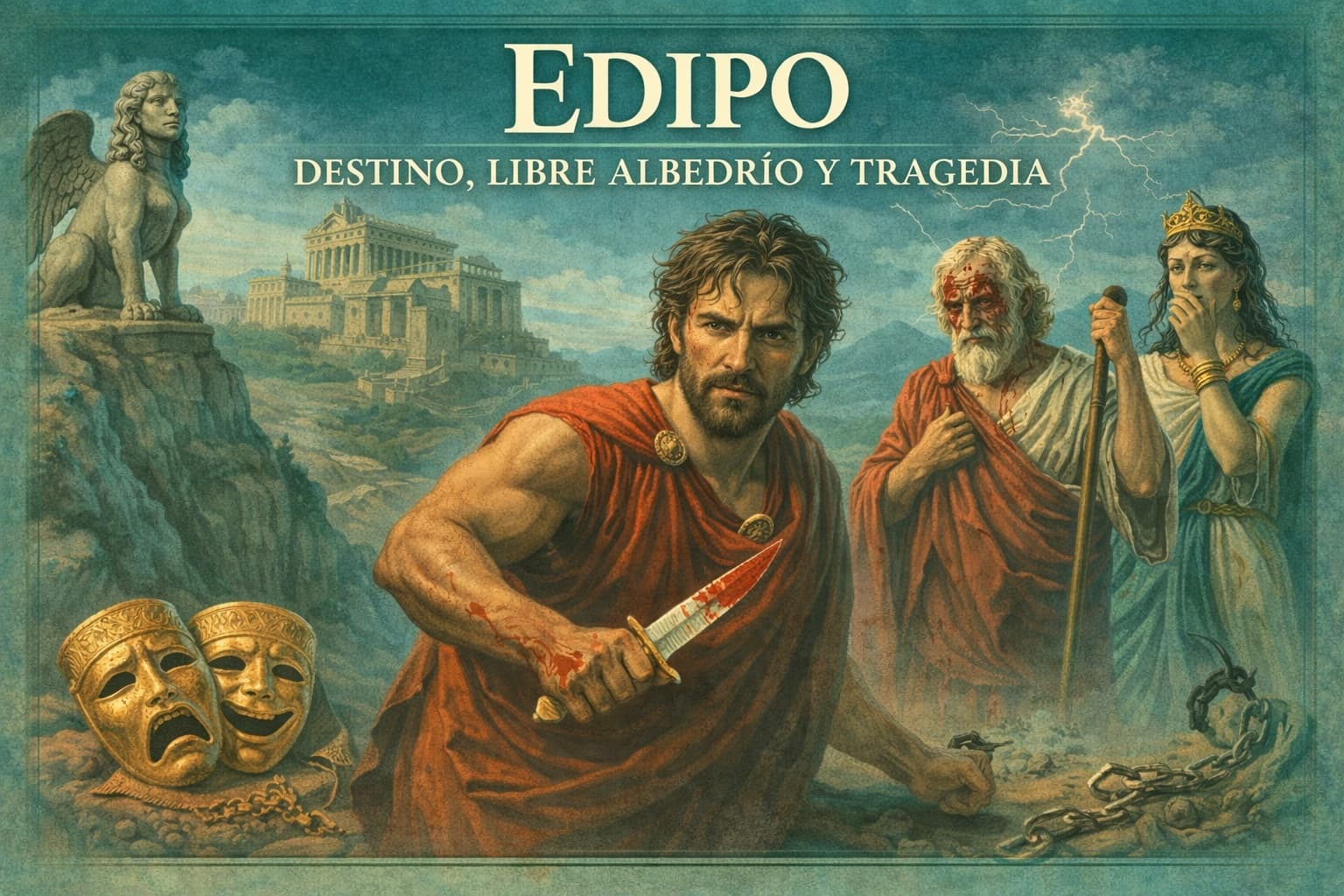
Oedipus: Fate, Free Will, and Tragedy
 Andres Aguilar
What the oracle told Laius was this: your own son will kill you. And after killing you, he will marry your wife — his own mother.
There is a question human beings have been asking themselves since the beginning of rational thought. It doesn't matter whether you're religious or atheist, whether you believe in fate or in pure free will, whether you're an optimist or a die-hard pessimist. The question shows up anyway, usually at three in the morning, staring at the ceiling: are the things that happen to us written in advance, or do we build them ourselves with every decision we make? The ancient Greeks asked it too. And instead of writing a philosophical treatise that nobody would read with much enthusiasm, they created a story. The story of a man who learned early what his fate was, who did everything humanly possible to escape it, and who with every step taken in that flight drew a little closer to the abyss. That story is Oedipus. And it is probably the most perfect story ever told.
Before we dive in, there's something worth clarifying from the start. When most people hear the name Oedipus, the first thing that comes to mind is Sigmund Freud and psychoanalysis. Freud borrowed the name from this myth and turned it into a label for a theory about desire, childhood, and family dynamics. Modern psychology debates that theory quite a bit, but what's certain is that if you stick only with that version, you miss almost everything that makes this story extraordinary. Freud borrowed the name. We're going back to the source. We're going to Thebes.
Thebes and the Oracle
Thebes was one of the most important cities in ancient Greece. Not the most famous or the most powerful militarily, but a city with real political and cultural weight, located in the heart of Greek territory, in the region of Boeotia. Thebes had a long and complicated history even before Oedipus: according to myth, it had been founded by the Phoenician hero Cadmus, and from its very origins the city was tied to a series of catastrophes that seemed to be part of its collective destiny. Its ruler was Laius, a king with everything the title implies — power, prestige, a city to govern. But Laius carried something that tormented him from inside, something he had received from the oracle at Delphi.
It's worth explaining what the oracle at Delphi was, because without understanding that, the weight of this story fades considerably. Delphi was a city on Mount Parnassus, northwest of Athens, where a sanctuary dedicated to the god Apollo stood — Apollo being the god of the sun, reason, music, and prophecy. In that sanctuary lived the Pythia, a priestess who acted as intermediary between mortals and the god. According to tradition, the Pythia entered an altered state, perhaps induced by vapors rising from cracks in the volcanic rock beneath the site, and from that state she pronounced messages that the temple priests transcribed and delivered to those who came seeking answers. The messages were famous for being ambiguous, for having double meanings, for telling you the truth in a way you couldn't fully understand until it was too late to do anything about it. Kings, generals, and entire cities made their most important decisions based on those words. The oracle at Delphi was the most influential spiritual and political center in the Greek world for centuries, and carved above the entrance of the sanctuary was a phrase that became famous forever: know thyself.
What the oracle told Laius was this: your own son will kill you. And after killing you, he will marry your wife — his own mother. Stop for a second. That is exactly what Laius heard. Not a vague warning. A specific, detailed, devastating prediction.
> What the oracle told Laius was this: your own son will kill you. And after killing you, he will marry your wife — his own mother.
Laius decided the most reasonable solution was to have no children. No son, no prophecy to fulfill. Solid reasoning in theory, but hard to sustain in practice for an entire lifetime. At some point — maybe after too much wine at a celebration, maybe simply because human willpower has its limits — Laius slept with his wife Jocasta. And Jocasta became pregnant. The plan had its first crack.
The Abandoned Child
When the baby was born, panic seized the king. Killing it outright would have been too dark — a stain on the soul the gods would not easily forgive. So Laius took what he considered a middle road: he ordered that the newborn's ankles be pierced with a spike and bound with leather straps to immobilize him, then left the baby on Mount Cithaeron, a wild and rugged stretch of terrain where exposure and animals would do the work for him. A way to wash his hands of it, to pass the responsibility to fate itself. The name Oedipus, in ancient Greek, comes from oidipous, meaning "swollen feet," a direct reference to that birth wound. From his very name, this character carries written on him the mark of what was done to him on the first day of his life. It's a detail the Greeks did not include by accident.
But the plan failed, as nearly all plans designed to sidestep fate fail in Greek mythology. A shepherd ranging those hillsides found the baby still alive, crying among the rocks, his ankles wounded and bound. He couldn't leave it to die. He took the child with him and handed it off to a messenger coming from Corinth — an important city located on the isthmus connecting the Peloponnese to the rest of Greece, a place of heavy commerce and considerable wealth. That messenger brought the baby to the palace of King Polybus and his wife Merope, a royal couple who couldn't have children and who received the newborn as a blessing from heaven. They adopted him, raised him, loved him as their own. Oedipus grew up in the palace of Corinth convinced he was the crown prince, the legitimate son of Polybus and Merope, with all the security and privilege that implied.
For years everything was fine. Oedipus had a childhood and an adolescence appropriate to his station. He was educated, respected, loved. He grew up with the confidence that comes from always having been treated with genuine affection. But buried secrets rarely stay put. At a party, someone who had drunk more than their share shouted at him that he was a bastard, that he was not the king's blood son. Those words never left him. He went to speak with Polybus and Merope, who denied it firmly. But the doubt was already lodged, and doubt has a way of growing on its own in silence.
Oedipus did what any sensible Greek would do in a situation of such profound existential uncertainty: he went to the oracle at Delphi to ask who he really was. He traveled to the most sacred sanctuary in the Greek world to ask the most fundamental question a human being can ask. And the Pythia did not tell him what he expected to hear. She did not tell him who his parents were. She told him his fate: you will kill your father and marry your mother. No room for doubt. Clear, direct, and terrifying.
The Road to Thebes
Oedipus left the sanctuary in horror. And he made the decision that seemed most logical: if that was the damage he was destined to cause Polybus and Merope — the people he believed were his parents — the only way to prevent it was to never return to Corinth. To go as far as possible in the opposite direction and never look back. He fled his fate. And it was on that very road of flight that fate came to find him.
At a crossroads on the outskirts of Boeotia, Oedipus encountered a caravan. An older man was traveling in a chariot with guards and servants. The road was narrow and neither party wanted to yield. One of the chariot's servants struck Oedipus to make him step aside. Oedipus was not the kind of man who takes a blow in silence. He responded with violence. The fight escalated quickly. In the end, the older man and nearly all his companions lay dead. A single servant managed to escape in the confusion.
That older man was Laius, king of Thebes. Oedipus's biological father. But Oedipus didn't know that. To him it was an unfortunate incident on the road, a fight he hadn't started. He continued traveling without thinking much more about it, because for Oedipus that encounter had no context. He kept on the road that led away from Corinth. That road brought him to Thebes.
Thebes at that moment was in desperate straits. A monster called the Sphinx had taken control of the city's entrances. The Sphinx was a hybrid creature the Greeks depicted with the body of a lion, the wings of an eagle, and the head of a woman — a combination that mixed animal ferocity with human intelligence. Every traveler who tried to enter or leave Thebes was stopped and put to a test. Answer the Sphinx's riddle correctly and you could pass. Fail, and the Sphinx devoured you. The city had been paralyzed by this terror for some time, unable to receive supplies or trade. It was a real emergency.
The Riddle of the Sphinx
The question was this: what creature walks on four legs in the morning, two legs at midday, and three legs in the evening? Oedipus heard it, thought for a moment, and answered without hesitation: man. As a baby he crawls on four legs. As an adult he walks on two. In old age he leans on a cane — the third leg. The answer was correct. And the Sphinx, who according to the myth was forbidden from surviving if anyone solved her riddle, threw herself from the rock where she was perched and died. The city was free.
There is a detail worth noting about the symbolism of the riddle. The answer is mankind in general, but it also describes Oedipus's own life with precision. A creature who crawled wounded on Mount Cithaeron on the first day of his life, who walks on two legs in the fullness of his adulthood, and who in old age will walk leaning on his daughter Antigone as if she were his cane. The riddle that Oedipus solves describes, without his knowing it, his own entire story from beginning to end. The Greeks loved that kind of structural irony, and Sophocles deploys it here with a mastery that hits you hard when you catch it.
The Thebans received Oedipus as a savior. The city council deliberated quickly: King Laius had died recently under unknown circumstances, the throne was vacant, and the newcomer had just freed the city from its greatest threat. Tradition dictated that the new king should marry the widowed queen to guarantee the continuity of the royal line. That widowed queen was Jocasta. Oedipus's biological mother. Oedipus married her knowing nothing, suspecting nothing, with the honest intention of taking on the role the city was offering him with gratitude.
For years everything seemed to work. Oedipus governed wisely, Thebes prospered, and from the union of Oedipus and Jocasta four children were born: two sons, Eteocles and Polynices, and two daughters, Antigone and Ismene. The royal family lived in the palace of Thebes like any royal family of the era, with its rituals, its responsibilities, its everyday conflicts. The tragedy slept beneath the surface the way water sleeps beneath a volcano.
The Truth Comes Out
But buried truths eventually surface. A new plague fell on Thebes. Disease, drought, the deaths of animals and people. The desperate population pressed the king. Oedipus sent to consult the oracle at Delphi once more, and the answer was unsettling: the city is morally contaminated. The killer of King Laius still walks among the Thebans unpunished, and that stain is poisoning the entire community. For Thebes to heal, that guilty party must be identified and expelled. Oedipus swore it publicly: he himself would find the one responsible. It was the kind of commitment that comes from honesty combined with ignorance of who one really is.
He summoned Tiresias, the most respected seer in all of Greece. Tiresias was blind from birth but famous for seeing what no one else could. He had an extraordinary personal history he considered his own: according to tradition, he had lived as a woman for seven years after striking a pair of sacred serpents, then returned to being a man. Zeus and Hera chose him to settle a dispute over who experiences more pleasure in love, men or women. Tiresias said women, by a wide margin. Hera, offended by the answer, blinded him. Zeus, unable to undo the damage done by another deity, compensated him with the gift of prophecy and a lifespan seven times longer than that of a normal human. He was a man who had seen more life, in every sense, than almost anyone in the Greek world.
Tiresias was brought before Oedipus. And Tiresias knew everything. But he refused to speak. He stayed silent in the face of the king's questions. Oedipus insisted — first with pleas, then with mounting pressure, then with direct accusations. He shouted that Tiresias was a traitor, that he was protecting the murderer, that he was behind a political conspiracy orchestrated by Creon, the king's brother-in-law. And Tiresias, pushed to his limit by the injustice of those accusations, finally spoke: the killer you are looking for is yourself. Oedipus didn't believe him. The human mind has a remarkable ability to reject truths that threaten its own picture of the world. He kept investigating on his own.
The Pieces Fall Into Place
The threads came together on their own. A messenger arrived from Corinth with news that King Polybus had died of old age and natural causes. Oedipus felt relief: if Polybus died without him killing him, maybe the prophecy wasn't as inevitable as it had seemed. But the messenger, trying to reassure him further, made the mistake of revealing a secret he had kept for decades: Polybus was not Oedipus's biological father. He himself had received the baby from a shepherd on Mount Cithaeron years earlier and had brought it to Corinth.
That shepherd was summoned to the court. He was the same man who had saved the newborn on the mountain, the one who couldn't leave it to die among the rocks. Under the pressure of royal interrogation, surrounded by guards, with no way out, he confessed everything. The baby was the son of Laius and Jocasta. They had given him up to die of exposure. He had saved him.
In that instant Oedipus understood everything. Every piece fell into place with brutal, perfect precision. The man he had killed at the crossroads was his father. The woman he had been married to for years, with whom he had had four children, was his mother. The prophecy had not been avoided. It had been fulfilled exactly, step by step, thanks to every one of his attempts to escape it. Fate had used his own decisions to bring him exactly where it wanted him.
Jocasta understood before he did. As the interrogation advanced she saw the trap closing on both of them. She did not wait for the end. She went to her chambers and hanged herself. Oedipus found her dead. And he took the metal brooches from Jocasta's dress and with them gouged out his own eyes.
> Jocasta understood before he did. As the interrogation advanced she saw the trap closing on both of them. She did not wait for the end.
The voluntary blinding is one of the most powerful symbolic gestures in ancient literature. Tiresias, the blind man who saw the truth, stands in contrast to Oedipus, who had eyes and saw nothing. Now Oedipus chooses darkness because he can no longer bear what the light shows him. But there is something even more important in that gesture: it is an active thing, a free choice. At the moment of total collapse, Oedipus does something. He does not freeze, he does not wait for others to decide for him. He remains the agent of his own story, even if that story has destroyed him completely. That combination of action and catastrophe is what makes him a tragic character rather than a simple victim of chance.
Exile and Legacy
Banished from Thebes, he wandered blind for years along the roads of Greece. Only his daughter Antigone accompanied him, guiding him step by step, being his eyes when he no longer had them — a loyalty none of his sons had the integrity to offer. He died finally at Colonus, near Athens, in a scene Sophocles told in a second play, Oedipus at Colonus. A death that arrives as release, on sacred ground, with the promise that his tomb would be a blessing to whoever received him. A life that began with abandonment among the rocks and ends in peace — even if the peace comes too late to change anything that happened.
There is a fact that speaks volumes about the greatness of this story. Sophocles premiered Oedipus Rex around the year 429 BCE, during the period of Athens's greatest cultural flourishing. About eighty years later, Aristotle wrote the Poetics — the first treatise on literary theory in the history of Western thought. When he needed an example to illustrate what perfect tragedy was, the model every playwright should follow, he chose Oedipus Rex. Not as one of several possible examples, but as the example. The perfect work. Aristotle had read practically everything that could be read in his era, and from all that material he chose this text. That is not a small thing.
> What Sophocles built is a story in which the detective discovers that the criminal is himself.
What Sophocles built is a story in which the detective discovers that the criminal is himself. The twist the Greeks called anagnorisis — a term meaning recognition, the moment when the character truly understands who he is and what he has done — is so perfect that it hits you even when you already know what's coming. Greek audiences who went to the theater in Athens knew the story of Oedipus. They didn't go to find out the ending. They went to experience how it was told, to feel that moment of recognition alongside the character. And even so, the impact was devastating. That speaks to something universal that transcends knowledge of the facts and reaches directly into the emotional.
The Question That Has No Comfortable Answer
The question Oedipus leaves us with has no comfortable answer. Can we escape what we are? Are the circumstances we're born into, the family we get, the starting point we didn't choose — are those a sentence, or simply a beginning? The Greek concept of hamartia — the fundamental flaw that leads the tragic hero to his fall — has been debated in the case of Oedipus for two thousand years. Is his flaw the arrogance of believing he can outsmart fate? The anger that led him to kill at the crossroads? Or simply ignorance — not knowing who he really was? That debate doesn't close. And it is precisely that openness, that resistance of the story to offer an easy answer, that keeps it alive today as strongly as on the first day it was told.
The next episode is a direct continuation. Oedipus's sons will inherit the throne of Thebes and will meet a fate that is, if anything, even more violent. It is the story of the Seven Against Thebes — the war that destroyed an entire generation at the gates of the cursed city.
Related episodes
But to understand what Medea did, you must first understand who she was and what they did to her. Because this story doesn't start with a woman who goes crazy for no apparent reason.
First, he got Polyphemus drunk on concentrated wine he had brought with him, filling the cup generously and refilling it several times. When the giant, in his drunkenness, asked his name so he could reward him with a gift, Odysseus answered...
An arrow to the heel, shot by the man who started it all and guided by a god carrying a grudge. That was how Achilles died. Then came the horse, the night, and the fall of Troy. Then Homer: the poet who turned fifty days of that war into the most widel...