
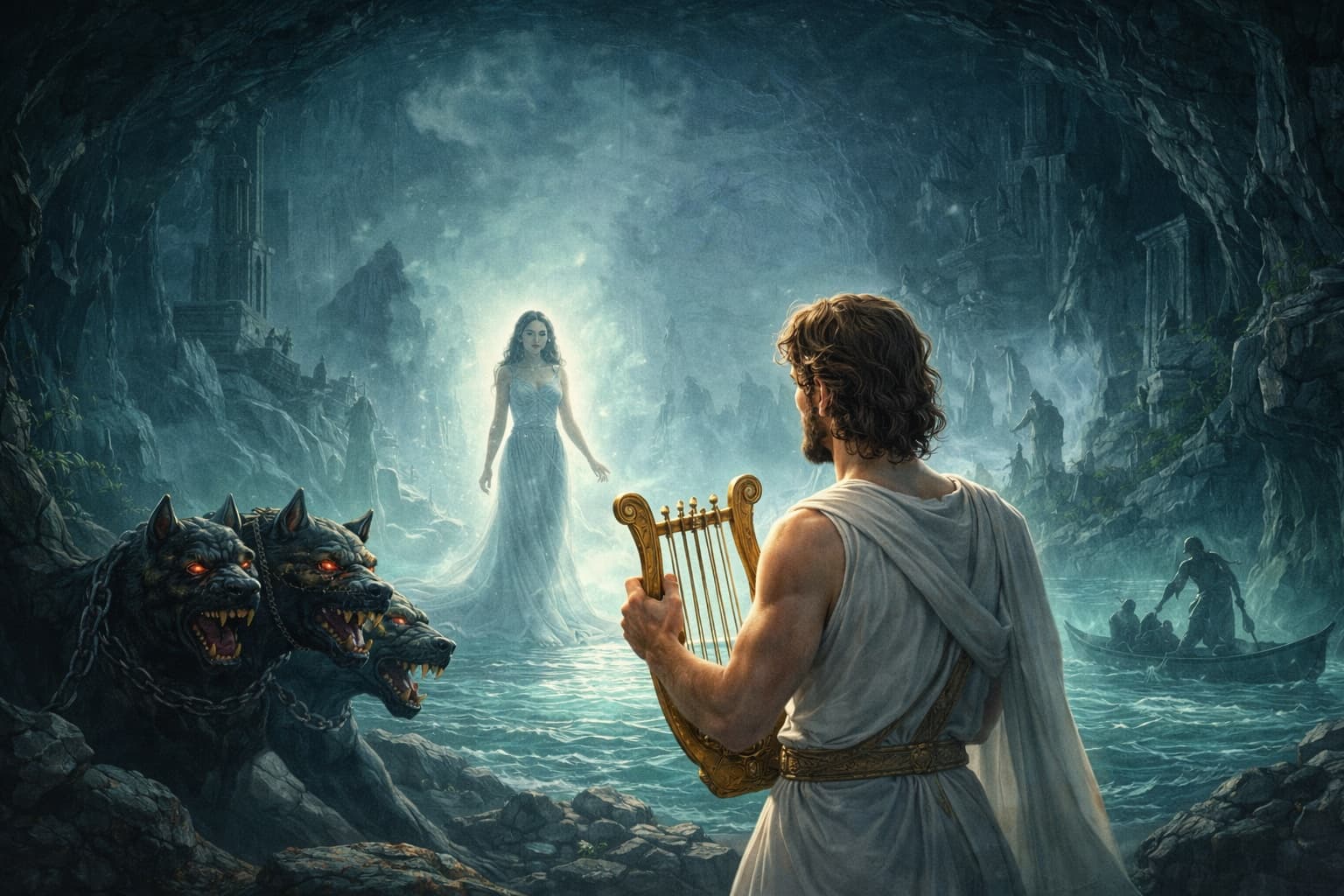
Orpheus in the Underworld
 Andres Aguilar
Orpheus was the greatest musician the ancient world could imagine — when he played, trees uprooted themselves and walked closer to hear him. But all that ability would be put to the most human test imaginable when he lost the person he loved and decide...
The night that cost the god of death the most was not any of the nights when wars were declared or cities fell. It was the night a musician stood before him, started to play, and Hades realized he had no way to ask him to leave. The guards who normally wouldn't let even the most powerful gods through had lowered their weapons. The Furies — goddesses of vengeance who are usually pretty busy chasing down the guilty and don't have much time for entertainment — had wet cheeks. And Sisyphus, the man condemned to roll a boulder up a hill for eternity, had sat down on the ground and was listening. For the first time in all of eternity, the rock did not roll.
That was Orpheus. Before rock and roll existed, before jazz existed, before anyone invented opera or a composer wrote his first symphony, the Greeks already had a story about a musician whose art stopped time, suspended pain, and bent the will of the gods of death. It is probably the most moving story in all of Greek mythology. And it ends in a way that no one can be prepared for.
The Birth of a Legend
Let's start with Orpheus himself, because he is a fascinating character even before the tragedy begins. He was the son of Apollo — god of music, poetry, and light — and of the muse Calliope, muse of epic poetry. A muse, for anyone unfamiliar with the term, was in Greek mythology one of the nine goddesses who presided over the various arts and sciences. Calliope presided over epic poetry, the grandest literary form that existed. With that lineage, Orpheus was born for music the same way the sun is born to shine. There was no possible escape.
He learned to play the lyre from a very young age. The lyre was the instrument most associated with Apollo and with high Greek culture — a stringed instrument plucked with the fingers or a plectrum, capable of a delicacy no other instrument of the time could match. According to some versions of the myth, Apollo himself gave his son a golden lyre. With that instrument, Orpheus reached a level no human being had ever achieved before. When he played, trees tore themselves from their roots and walked closer to hear him. Stones moved. Rivers stopped their course. Wild animals approached without fear and sat around him like tame pets that didn't want to miss a single note.
That is not poetic exaggeration. In Greek mythology, it was literal. The Greeks used these images to say something they considered true: Orpheus's music was so perfect it suspended the laws of nature. Today we would say he was the musician every musician wishes they could be — the one who reaches that place where art transcends technical skill and touches something universal that every living being can feel, even if they don't understand a single note.
Orpheus took part in the expedition of the Argonauts, Jason's voyage in search of the Golden Fleece. The Argonauts were basically the All-Star team of Greek mythology: Heracles, Castor and Pollux, Peleus who would become the father of Achilles, and many others. On that voyage, Orpheus filled a very specific role. When the ship Argo passed the islands of the Sirens — the same creatures we discussed in the Odysseus episode, the ones who lured sailors to their doom with their singing — Orpheus picked up his lyre and began to play. And the Sirens' song, which in no other context could be outdone by any human sound, was drowned out. The Argonauts sailed past without a problem. It was the only possible way to win that duel: not with defense, but with something better.
But all that glory, all that near-divine ability to fill the world with beauty, was about to be put to the test in the most human way possible. Orpheus fell in love.
Eurydice
Eurydice was a nymph — a minor divinity of nature associated with the natural world, forests, and rivers. The love between Orpheus and Eurydice is one of the most intense in Greek mythology, and also one of the briefest. They married, and on their wedding day itself, Eurydice died.
The versions vary on the details. The most common says that while Eurydice was walking through the fields, a shepherd named Aristaeus tried to assault her. She ran, and in the flight she stepped on a snake hidden in the tall grass. The bite was fatal. Before the wedding day was over, Eurydice was dead and her soul had descended into the underworld.
What Orpheus lived through in the days that followed is not described in detail in the ancient sources, but it doesn't need to be. Anyone who has lost someone deeply loved in a sudden and unjust way knows what that is. The grief that flattens the world, that turns light into something aggressive, that makes time stop making sense. Orpheus had instruments to express it: he played, and what came out of his music was so heartbreaking that even the gods of Olympus were unsettled hearing it. But playing wasn't enough. Eurydice didn't come back.
So Orpheus made a decision no living mortal had made before. He would go down to Hades to find her. Not in spirit, not in a dream, but in person — alive, crossing the border that separates the world of those with bodies from the world of those who no longer have them. To do it he had to find one of the entrances to the underworld, which the Greeks believed existed at specific locations in the real world, mainly in deep caves near rivers or lakes of dark water. The region of Cape Tainaron in the southern Peloponnese was one of the most commonly mentioned. Orpheus went down.
The Underworld
The Greek underworld is not what most people picture when they think of the Greek afterlife. It is not a place of universal torture, nor some generic paradise. It is a kingdom organized by its own rules, governed by Hades — god of the underworld — and his queen Persephone. To get there, souls must cross the river Styx, and to cross they need a coin to pay the ferryman Charon. That is why the Greeks placed coins on the eyes or in the mouths of their dead: it was payment for the journey. Souls without a coin could not cross and were left wandering on the bank for a hundred years before Charon would take them anyway. The underworld itself was divided into zones. The Elysian Fields for heroes and the especially virtuous. Tartarus for the punished. And in between, the Asphodel Fields for the vast majority — the place where ordinary souls existed in a kind of half-light, without much joy but without torture either.
Orpheus arrived at the bank of the Styx. Charon normally did not ferry the living. There were very clear rules about that. Orpheus began to play. And Charon ferried him across. The guardians of the underworld, among them Cerberus — the three-headed dog that prevented the dead from leaving and the living from entering — stood still and listened. Orpheus kept walking.
He finally arrived before Hades and Persephone. Hades was one of the most sober and most unyielding gods in the Greek pantheon. He was not the equivalent of the Christian devil — he wasn't evil, he was simply the administrator of a part of the world nobody wanted to administer. He never forgave debts. Souls that arrived in the underworld stayed. There were no known exceptions.
Orpheus stood before the two of them and began to speak. And what he said was, according to some versions of the myth, a poem. A sung argument. He told them that everything that existed in the world above — everything with life and light — would inevitably end up here, in the underworld. That Eurydice was also destined to remain here forever, that this was inevitable. But that she had arrived before her time. That the love he felt for her was so real and so powerful that he could not simply accept her absence as something ordinary. That he was not asking them to free her forever. Only that they lend her to him. That when the two of them reached the natural end of their lives, they would both return together and stay.
And while he said all of this, he played.
The Moment That Changed Everything
What happened in that moment is one of the most extraordinary instants in all of Greek mythology. The Furies — goddesses of vengeance charged with pursuing those who commit serious crimes — were famous for never crying. Their faces were stone. They wept. Tantalus, the king condemned to stand for eternity surrounded by water and fruit that pulled away whenever he reached for them, forgot for a moment his hunger and thirst and listened. Sisyphus, the king condemned to push his boulder up the hill for eternity only to watch it roll back before reaching the top, sat down. The rock stayed still.
And Hades relented. Not completely — there were conditions. Eurydice could return with Orpheus to the world of the living. But throughout the entire ascent, Orpheus would have to walk in front of her. And he could not turn around to look at her at any point until both of them had come out completely into the world above. If he looked before that, Eurydice would return to the underworld forever.
Orpheus accepted. They began to walk. The climb through the dark tunnels that led back to the surface was long. There was no indication of how much farther it was. There was no way to know how close the light was. Orpheus walked in the darkness, listening to Eurydice's footsteps behind him. He kept walking. The darkness was total. The footsteps kept sounding behind him. He kept going.
And then, when the light was already visible — when the end of the tunnel was right there ahead of him — Orpheus turned around.
The ancient versions don't fully agree on why. Ovid, the Roman poet who told this story in the Metamorphoses, says it was love, it was the fear that something had happened to Eurydice, that the need to see her was stronger than any instruction. Some readers see in that turn a form of doubt: what if the condition was real? What if Eurydice wasn't following him? What if the underworld had tricked him and he was walking alone toward the light while Eurydice stayed behind? The Roman poet Virgil, who also told this story in his Georgics, gives no explanation. He simply describes the turn as something inevitable, as if from the beginning fate had known it was going to happen.
Eurydice disappeared. There was no scream, no visible drama. Just the image of someone beginning to dissolve, who perhaps raises a hand in a gesture of farewell — or of something that is not anger but something harder to name — and vanishes back into the darkness. And Orpheus was left alone at the entrance of the tunnel, with the light of the real world before him, his lyre in his hand, with nothing.
After the Loss
He tried to go back down. Charon would not ferry him. The gates of the underworld were closed to him. He spent days on the bank, playing, waiting for something to give. Nothing gave. He had to go back.
What followed were years of grief that Orpheus turned into music. According to Ovid, during that time he rejected the love of every woman who approached him, which eventually provoked the hostility of the maenads — women devoted to the cult of Dionysus, god of wine and ecstasy. The maenads were followers who in states of religious trance carried out intense and sometimes violent rituals. According to the best-known version, a group of maenads killed him, and his head and lyre, thrown into the river Hebrus, continued singing as they floated toward the sea, until they reached the island of Lesbos, which became a center of Greek lyric poetry. The lyre was eventually placed in the sky by the gods and became the constellation Lyra, which still exists and remains visible in the northern hemisphere during summer. His head was buried on the island of Lesbos, where according to tradition it became an oracle.
Before the central question this story raises, it's worth closing the narrative with something that tends to get lost in the best-known versions. Orpheus's death at the hands of the maenads was not an accident or a meaningless crime within the myth. The maenads represented the Dionysian — collective ecstasy, the abandonment of the individual self, the power of altered states over rationality. Orpheus represented the Apollonian: disciplined music, formal beauty, art that orders chaos. In a sense, his death at the hands of the maenads was the conflict between two visions of the world. The Apollonian order destroyed by Dionysian chaos. Friedrich Nietzsche, the nineteenth-century German philosopher, built on that very distinction between the Apollonian and the Dionysian one of the most influential theories in Western aesthetics, in his work The Birth of Tragedy. Not a bad legacy for a musician from ancient myth.
Why It Endures
There is something that makes the story of Orpheus different from almost every other Greek myth we've covered. It is not a story of transgression and punishment. Orpheus did nothing wrong. He loved someone, lost her, went to the end of the world to find her, convinced the most unyielding gods in existence, and in the last stretch of the journey made the only mistake possible. And that mistake was not arrogance, not hubris, not any of the flaws that normally lead Greek characters to their destruction. It was love. It was the fear of losing her. It was the very same thing that had taken him to the gates of the underworld in the first place.
That detail is what turns this story into something that transcends the two thousand five hundred years it has been alive. Orpheus did not fail because he was too ambitious or too proud. He failed because he was human. Because he couldn't hold faith in the invisible long enough. Because he needed to confirm with his own eyes what his heart already knew.
The philosophical and religious movement that grew out of the figure of Orpheus — known as Orphism — took that central idea and transformed it into a worldview. Orphism believed in the immortality of the soul, in a cycle of reincarnations, in the possibility of purification. Its sacred texts were the Orphic Hymns. The influence of Orphism on later Greek thought was enormous: some researchers trace direct lines between Orphism and Plato's ideas about the soul, and others point to similarities with certain ideas that would later appear in early Christian thought about life after death and redemption. All of that comes, to some degree, from the story of a musician who went down to the underworld and couldn't help turning around.
The cultural legacy of Orpheus in the history of Western art is also hard to overstate. Opera as an art form was born in Italy around the year 1600, and one of the first works of the genre was precisely Orfeo, composed by Claudio Monteverdi. Then came Gluck's Orfeo ed Euridice in 1762, which is still performed today and is considered one of the most important works in the operatic repertoire. The story has been retold in novels, films, paintings, and sculptures. The 1959 Brazilian film Black Orpheus, directed by Marcel Camus, transplanted the myth to the carnivals of Rio de Janeiro and won the Palme d'Or at Cannes. The musician Nick Cave, after the death of his son, recorded a double album — Skeleton Tree and then Ghosteen — that speaks deeply to the themes of grief and loss that animate the myth of Orpheus. The poet Rainer Maria Rilke wrote the Sonnets to Orpheus, one of the most influential works of twentieth-century poetry in the German language. Two thousand five hundred years after the myth's origin, Orpheus is still the way human beings talk about irreversible loss and about a love that refuses to accept that irreversibility.
A separate mention is worth making for the way the Greeks understood Orpheus musically. In ancient Greece there was no separation between music and poetry: poems were sung, and singers were also poets. The Homeric poems — the Iliad and the Odyssey — were not read in silence but recited aloud with musical accompaniment, in a style that was closer to performance than to reading. Orpheus was the extreme, mythical version of that: the singer who took that union of music and word to a superhuman level. That is why in the underworld he did not speak to Hades and Persephone. He sang. He used the only language that could cross the borders ordinary language could not.
The Question That Has No Answer
There is a question that comes up every time someone sits down to think about this story. Why did he turn around? And the most honest answer is that that question has no satisfying answer — and that is exactly what makes it a story that holds up to being told over and over again. If Orpheus had turned around out of arrogance, the story would be a moral lesson. If he hadn't turned around, there would be no story. But he turned around for the same reason that had taken him down there in the first place, and that is what breaks us. Because we all know what it is to need to see. We all know what it is to have faith crack one second too early. We all know what it costs — that one second of doubt in the last stretch before you get there.
Orpheus didn't lose Eurydice because he was weak. He lost her because he was human. And that is all.
Related episodes
But to understand what Medea did, you must first understand who she was and what they did to her. Because this story doesn't start with a woman who goes crazy for no apparent reason.
First, he got Polyphemus drunk on concentrated wine he had brought with him, filling the cup generously and refilling it several times. When the giant, in his drunkenness, asked his name so he could reward him with a gift, Odysseus answered...
An arrow to the heel, shot by the man who started it all and guided by a god carrying a grudge. That was how Achilles died. Then came the horse, the night, and the fall of Troy. Then Homer: the poet who turned fifty days of that war into the most widel...