
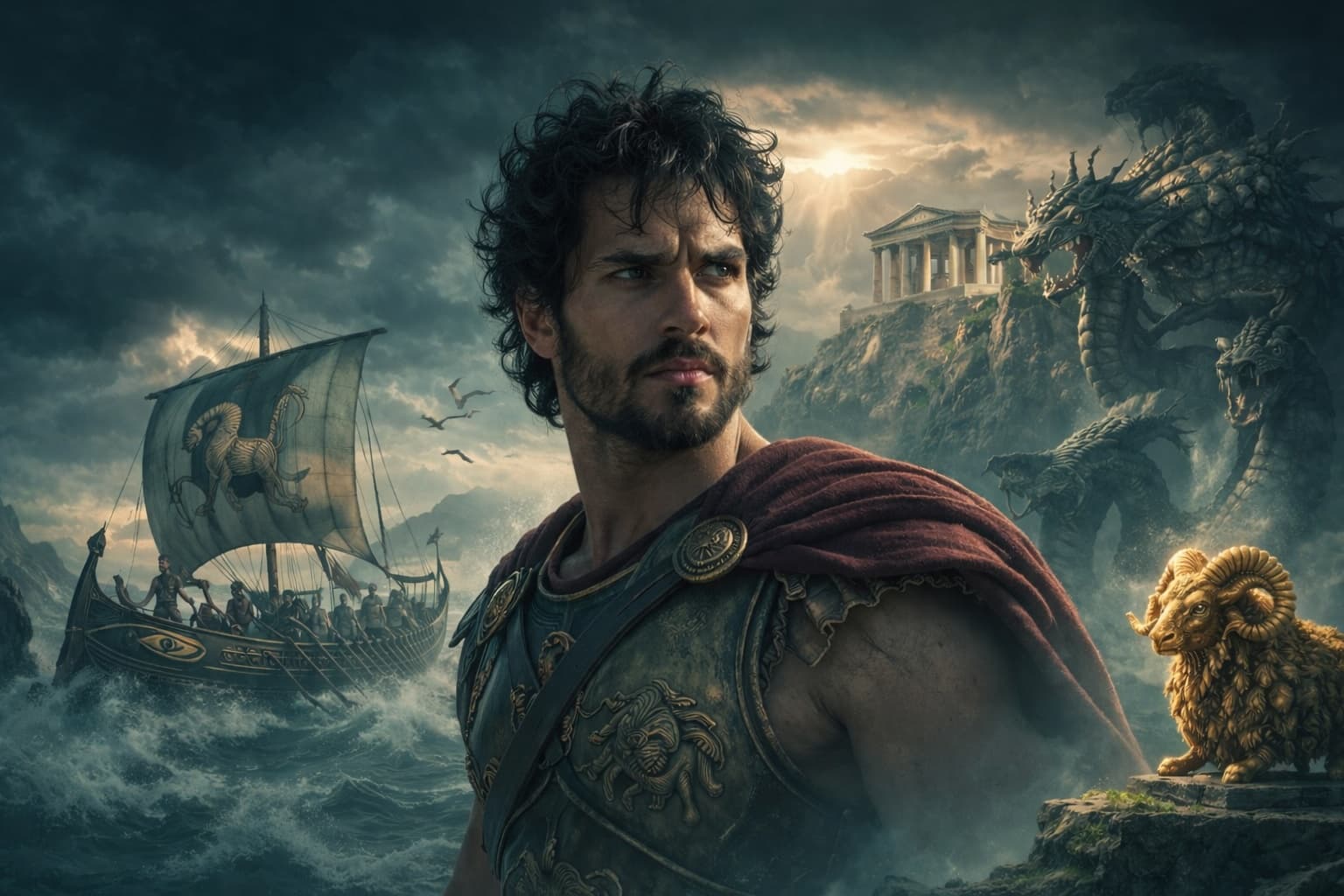
Jason and the Argonauts
 Andres Aguilar
Jason assembled the greatest heroes of his generation, built the most famous ship in mythology, and sailed to the edge of the known world to bring back a golden sheepskin. What he found on the other side of the Black Sea was a dragon that never slept, ...
In 1984, a British sailor and historian named Tim Severin built a replica of a Bronze Age Greek galley and named it Argo. A galley is an ancient warship — the kind with oars. Tim assembled a crew, set sail from Greece, and followed the route Jason had supposedly traveled three thousand years earlier. He crossed the Aegean Sea, passed through the Bosphorus strait, hugged the coast of the Black Sea, and reached the coast of Georgia — the region believed to be Colchis, the kingdom of the Golden Fleece. The voyage took several months. Severin concluded that the route was entirely navigable, that the geographical dangers described in the myth corresponded to real places, and that the story of Jason was probably connected to Mycenaean commercial expeditions from the thirteenth century BCE.
In other words: the story of Jason and the Argonauts may have a core of historical truth. A real expedition — of Greek merchants or adventurers — who sailed to the edge of the known world in search of something valuable, who encountered strange cultures and real dangers, and who came home with a story so extraordinary that it grew into myth.
> The Golden Fleece may have originally been a mining technique that the Greeks transformed into a sacred object and the destination of an epic.
Pelias, the Prophecy, and the Lost Sandal
Pelias was the king of Iolcus in Thessaly. He had usurped the throne that rightfully belonged to his half-brother Aeson. And Aeson was Jason's father — the legitimate heir — who had been sent away for his protection and grew up in secret under the tutelage of the centaur Chiron, the wise teacher of heroes.
When Jason came of age, he came down from the mountains and went to Iolcus to reclaim the throne. On the way, he helped an old woman cross a river, and with that act he earned the lasting affection of Hera, who was traveling in disguise and would accompany him throughout the entire adventure. Crossing the river, he lost one sandal in the mud.
Pelias had received a prophecy warning him: beware the man who arrives wearing only one sandal. When Jason appeared before him, barefoot on one side, Pelias knew exactly who he was. He needed to get rid of him without getting his own hands dirty.
He proposed a deal: if Jason brought him the Golden Fleece from Colchis, he would hand over the throne.
The Fleece: Myth and Mining Technique
It's worth pausing here for a moment, because the Golden Fleece isn't simply a shiny fantasy pelt. The word "fleece" refers to the wool of a freshly shorn ram or, in this mythological context, the whole hide with its wool intact. In this case it was the skin of a ram with golden wool that had belonged to the gods. And there's something even more interesting: the story of the Fleece probably has a very concrete basis. In the Caucasus region, near where Colchis is set, it was common practice to submerge sheepskins in rivers to trap gold particles carried by the current. The wool captured the gold dust, the skin was pulled out heavy with precious metal, and hung in the sun to dry. A skin impregnated with gold would shine exactly the way the myth describes.
It was also a suicide mission. Colchis lay at the far eastern end of the Black Sea, at the edge of the known world. The Fleece was guarded by a dragon that never slept. No one had ever come back from there.
Jason accepted.
The Argo: A Ship with a Voice
And here's what makes this story different from everything else in Greek mythology: Jason didn't go alone. He assembled the greatest heroes of his generation for a joint expedition. The ship was called the Argo, and the man who built it deserves a special mention because his story says a great deal about what that vessel was.
Argus was the most gifted shipwright of his time. He built the Argo from the wood of sacred oaks from the forest of Dodona, where Zeus's oracle spoke through the whisper of wind in the branches. Athena personally supervised the construction and placed in the prow a beam from that oak which, according to tradition, had the power to speak and offer guidance.
> The Argo was not a tool. It was a companion.
The Greek Justice League
That's where the crew got their name: the Argonauts. And the roster is impressive. There was Heracles, the strongest man in the world. There were the twins Castor and Pollux, sons of Zeus, who would later become the constellation Gemini. There was Orpheus, the legendary musician, whose job on the expedition was to set the rowing rhythm with his lyre and keep tensions on board from boiling over. There was Peleus, who would later become the father of Achilles. There was Meleager, Idmon the seer, Lynceus who could see straight through solid earth, and dozens more.
Lemnos: The Island of Women
The first destination was the island of Lemnos, where the expedition was delayed by something that says a great deal about Greek epic. The island was inhabited only by women. The women of Lemnos had killed all their men because those men had abandoned them for Thracian slave women. The queen was Hypsipyle, and when the Argonauts arrived, she welcomed them and invited them to stay.
The heroes stayed so long that Heracles eventually had to go remind them what they had actually come for. It's one of those details that appears throughout Greek epic: men are always on the verge of forgetting their mission the moment comfort becomes available. The heroic journey demands resisting the pull of settling down.
> Hypsipyle had children with Jason, and Jason left her when they set out again. First woman. First abandonment. A pattern that would repeat itself.
The Night Battle with the Doliones
They sailed on and landed in the territory of the Doliones, who received them warmly. That night, a storm drove them back to the same shore, and in the darkness and confusion the Doliones attacked, believing the newcomers were pirates. The Argonauts fought back. When dawn broke and both sides recognized each other, there were dead on both sides, including the king of the Doliones. Jason had unknowingly killed his own host. The guilt weighed on him for days.
The Loss of Heracles and Hylas
Further along, Heracles became separated from the expedition. The reason was one of those small incidents that ends up changing everything. A young man named Hylas, Heracles's closest companion, went to fetch water from a spring. The nymphs of the place, enchanted by his beauty, pulled him down into the water. Heracles searched desperately, calling his name up and down the coastline. The Argonauts couldn't wait and set sail without him.
> It's one of the most melancholy stories in the whole cycle: the strongest man in the world searching forever for someone who is already gone, on a shore the ship left behind.
Without Heracles, the expedition lost its most powerful warrior — but gained in cohesion. And it kept sailing east.
The Clashing Rocks: The Impossible Crossing
The most famous episode of the voyage was the passage through the Symplegades — the Clashing Rocks. These were two enormous crags at the entrance to the Black Sea that opened and closed like jaws, crushing everything that tried to pass between them. No ship had ever made it through.
Idmon the seer gave them clear instructions: release a dove first. If the dove made it through, they could follow. The dove flew, the rocks slammed shut and clipped the tip of its tail. That was enough of a sign. While the rocks were opening again, the Argonauts rowed with everything they had, driven by Orpheus's lyre marking the fastest tempo possible. The Argo cleared the rocks just as they closed again: they only lost the very tip of the stern.
After the crossing, according to legend, the Symplegades froze in place forever. The Argo's passage stopped them. As if the mere fact of someone achieving the impossible had changed the rules of the world.
Colchis and the Three Impossible Tasks
They finally reached Colchis, the kingdom of King Aeetes, son of Helios, the sun god. Aeetes had the Fleece hanging in a sacred tree in the grove of Ares, guarded by the dragon that never slept. Jason went to the king and asked for the Fleece. Aeetes had a reputation for hospitality but also for calculated cruelty. He imposed three tasks: first, yoke two fire-breathing bronze-hoofed bulls. Second, plow a field with them and sow dragon's teeth. Third, defeat the armed warriors that would spring from those teeth.
It was impossible. Aeetes was confident Jason would die in the attempt.
But then Medea appeared. And everything changed.
Medea: Passion Like Fire
Medea was the king's daughter — a powerful sorceress, a priestess of Hecate, goddess of magic and crossroads. When Medea saw Jason, Aphrodite — at Hera's request — made her fall in love with him with absolute, consuming intensity.
> A passion that wasn't romantic poetry but something closer to fire: devouring, brilliant, and capable of destroying everything.
Medea was not Greek. She was from Colchis, which the Greeks placed at the far eastern edge of the known world, at the edge of the Caucasus. She was a barbarian in the Greek sense of the word: someone from a different world, with different customs and a different value system. When she decided to help Jason, she wasn't just betraying her father. She was betting her entire identity on the promise of belonging to Greek civilization.
She met with Jason in secret and told him she would help him if he promised to take her to Greece and marry her. Jason promised. Medea gave him an ointment that would make him invulnerable to fire and iron for one day. She explained how to sow the dragon's teeth and what to do when the warriors rose from the earth.
With Medea's ointment, Jason yoked the fire-breathing bulls without being burned. He plowed the field and sowed the teeth. The warriors burst fully armed from the ground. Following Medea's advice, Jason threw a stone into the middle of them. The warriors, confused, believed the blow had come from one of their own companions and began slaughtering each other. Jason finished off the ones that remained.
The Escape and the Body of Absyrtus
Aeetes had no intention of honoring his promise. That night he planned to massacre the Argonauts. Medea found out and went with her brother Absyrtus to help Jason seize the Fleece. She put the dragon to sleep with her potions, Jason took the golden skin, and they fled to the Argo. When Jason slung the Fleece over his shoulders, witnesses said it shone in the darkness like the sun. It had hung in that sacred oak for years, and when Jason held it he seemed to have a piece of the sky in his hands.
What Medea did next is what transforms this story into something far darker than an adventure.
When Aeetes pursued them with his fleet, Medea killed her own brother Absyrtus, cut his body into pieces, and threw the pieces into the sea one by one. Aeetes was forced to stop and collect his son's remains to give him a proper burial. The Greeks believed that a dead person without burial could not rest in the underworld.
> It was a cold, calculated act that showed just how far she was capable of going when she loved someone. There was no going back. She had burned every bridge to her past.
The Return Voyage: Orpheus and the Sirens
The return voyage was long and full of obstacles. They crossed the Mediterranean, traveled along the North African coast. On the sea of the Sirens — those creatures whose song lured sailors to crash on the rocks — it was Orpheus who saved the crew: he played his lyre with such intensity that he drowned out the Sirens' song and the men couldn't hear them. The Sirens, who according to their curse were doomed to die if anyone passed by without listening, threw themselves into the sea.
They reached the island of Circe, the sorceress who was Aeetes's sister and Medea's aunt. Circe purified them of the murder of Absyrtus but drove them from her island. She wanted nothing to do with what her niece had done. It was the first rejection Medea would receive from the world she had bet everything on.
The Trap of the Cauldron
They arrived in Iolcus. Jason had the Fleece. Pelias was supposed to hand over the throne.
He didn't. While Jason was away, Pelias had killed Jason's father Aeson and his brother. When the Argonauts arrived and saw what had happened, Medea took charge.
She went to Pelias's daughters and told them she knew a secret: she could rejuvenate the elderly by boiling their body parts in a cauldron with magical herbs. To prove it, she took an old ram, cut it into pieces, boiled them, and pulled a live lamb out of the cauldron. Pelias's daughters, desperate to save their father, followed her instructions to the letter. Pelias died boiled by his own daughters, who loved him.
Medea had orchestrated the whole thing. She had used filial love as a weapon. It was a perfect, cold, and absolutely effective revenge. But Iolcus would not accept Jason's return after that episode. They were exiled and settled in Corinth.
The Abandonment That Broke Everything
And there, years later, Jason made the decision that would end up destroying his life.
He decided to marry the Corinthian princess Glauce to improve his social standing. A political wedding. Medea, with whom he had children, was left out. Jason argued that a good marriage would benefit everyone, even Medea, because the children would have a better future.
To understand what that abandonment meant, you have to see the exact situation Medea was left in. She had betrayed her father, abandoned her home, killed her own brother out of love for Jason and the promise of belonging to Greek civilization. When Jason left her for a Greek princess, he didn't just leave her.
> He left her without a homeland, without a family, without an identity, without legal protection. She didn't belong anywhere.
Euripides and the Political Context
Euripides, the playwright who wrote the most famous work about Medea in 431 BCE, understood all of that perfectly. He premiered it in Athens in a very specific political context: Pericles had just established that only the children of two Athenian citizens would be recognized as citizens. Jason and Medea's children, in that context, were legally stateless. The conflict of Medea wasn't just between two people. It was the conflict between two worlds, and the Greek world had decided she had no place in it.
The Athenian audience that attended the premiere was speechless. But Euripides had led them there step by step — to understand that Medea had been created by the very system that destroyed her. That the same city that applauded its citizenship laws had produced the conditions for a woman to reach the point where what she did next seemed like the only way out.
The Final Revenge
Medea's response is one of the most famous scenes in all of Greek tragedy. She sent Glauce a wedding dress soaked in poison. When the princess put it on, the flames consumed her. Her father, King Creon, died trying to embrace her. And Medea, so that Jason would have nothing left to love in the world, killed her own children.
The debate over whether Medea is a monster or a victim has been open for two thousand years. The most honest answer is that she's both at the same time, and that ambiguity is exactly what keeps Euripides's play being performed all over the world to this day.
The End of Jason
Jason died alone, old, sitting beneath the rotting hull of the Argo as it lay abandoned on the shore. A beam from the ship fell and crushed him.
> The hero of the great expedition ended up crushed by the wreckage of his own glory.
The story of Jason has something that makes it unlike any other in Greek mythology. The protagonist is not the bravest, nor the strongest, nor the wisest. Jason is the hero who depends most on others. Heracles would have left him behind. Orpheus saved the crew when he couldn't. Medea made everything possible.
And when he left her — when he betrayed the person who had helped him most — he lost everything she represented. As if without her there simply was no more story.
Why the Myths Are Still Modern
That's what makes Greek myths so modern. They don't talk about gods and monsters. They talk about what happens when we use people as tools. About what happens when love turns into betrayal. And about what it costs someone who has lost everything not to be monstrous in their response.
Medea is not the villain of this story. Neither is Jason, entirely. They are two people who broke each other, with consequences that reached everyone around them.
> The Greeks didn't resolve that dilemma in Euripides's play. They left it open, uncomfortable, without an easy catharsis. And two thousand five hundred years later, we still haven't resolved it.
Related episodes
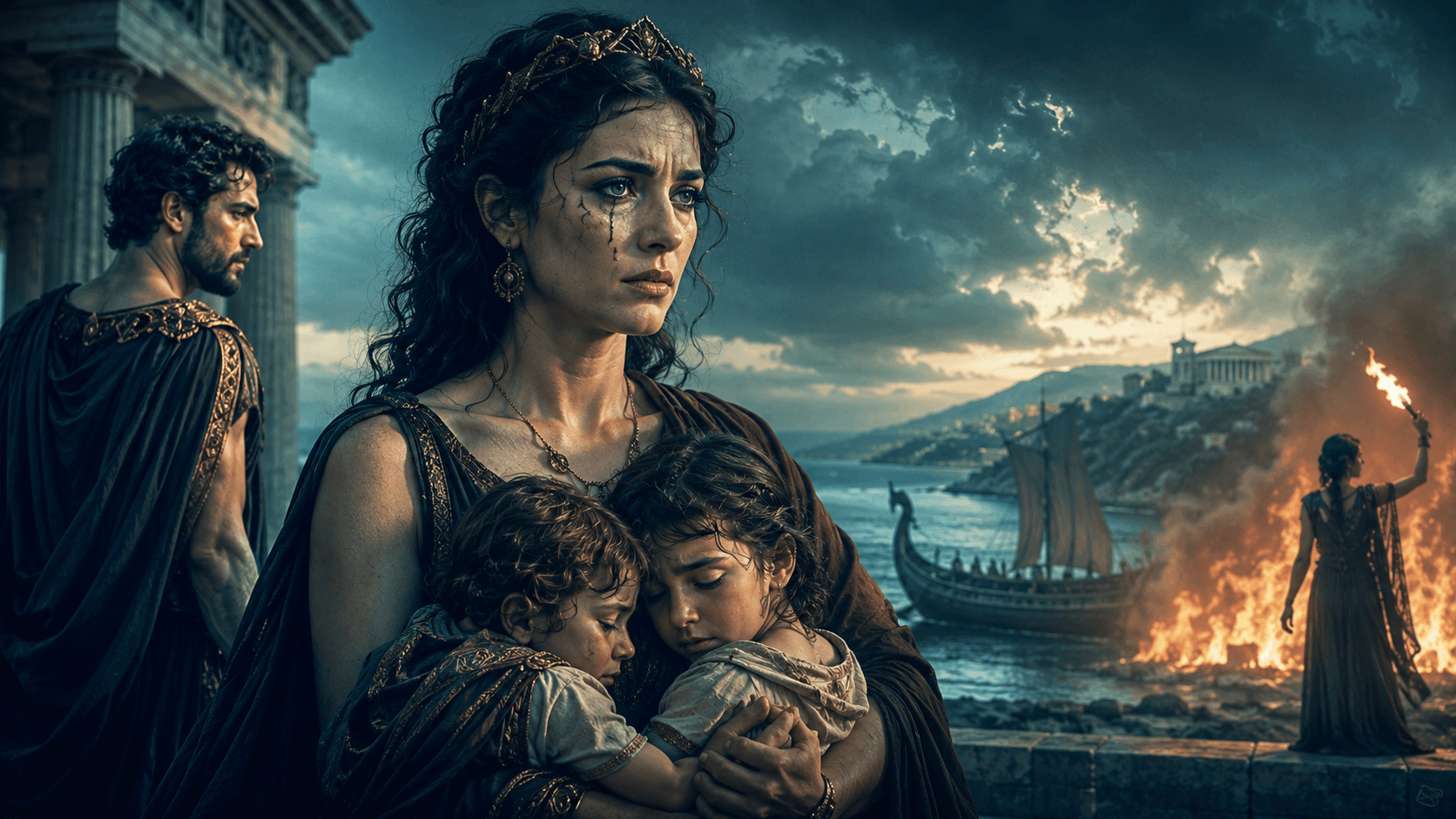
But to understand what Medea did, you must first understand who she was and what they did to her. Because this story doesn't start with a woman who goes crazy for no apparent reason.
First, he got Polyphemus drunk on concentrated wine he had brought with him, filling the cup generously and refilling it several times. When the giant, in his drunkenness, asked his name so he could reward him with a gift, Odysseus answered...
An arrow to the heel, shot by the man who started it all and guided by a god carrying a grudge. That was how Achilles died. Then came the horse, the night, and the fall of Troy. Then Homer: the poet who turned fifty days of that war into the most widel...