
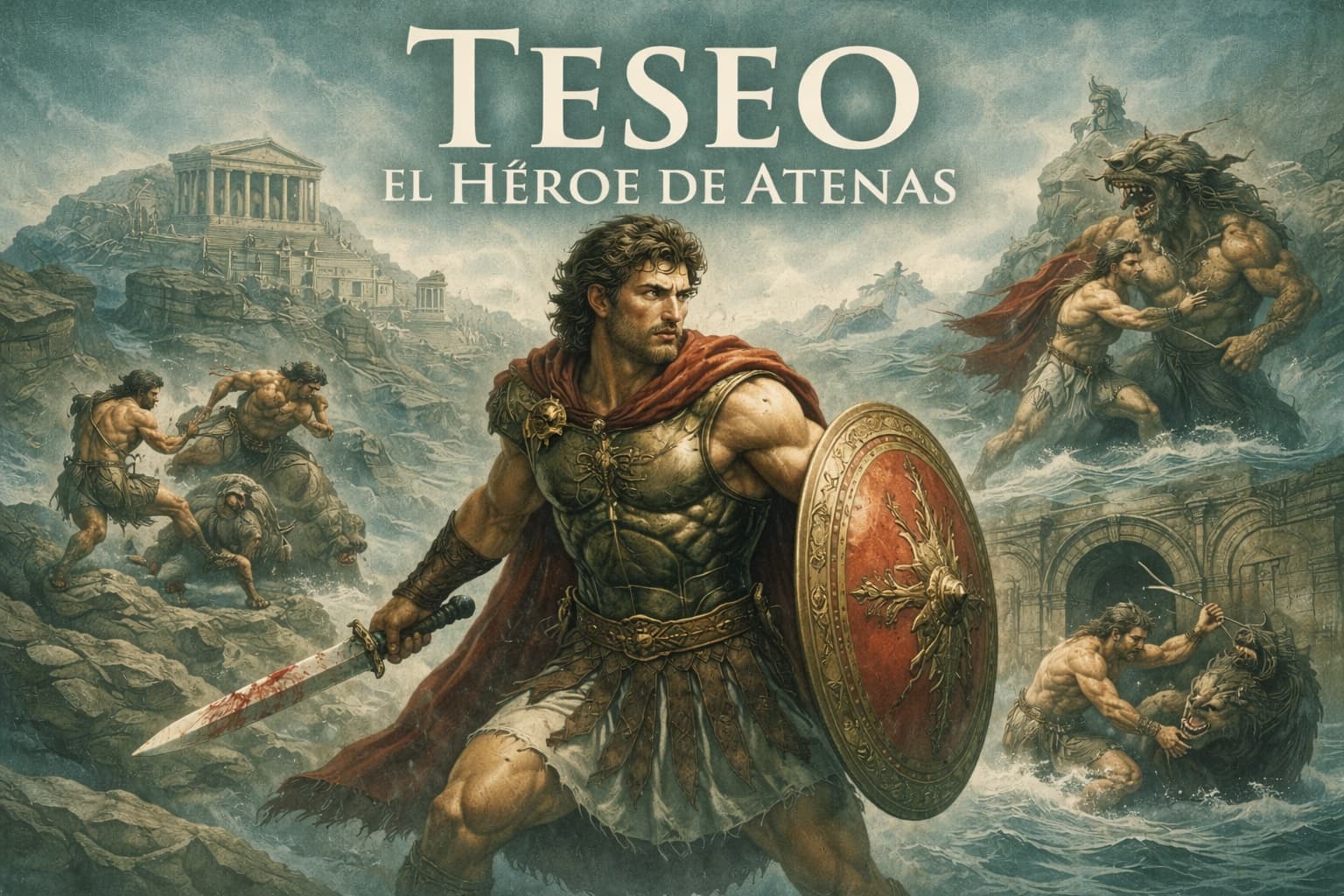
Theseus: The Hero of Athens
 Andres Aguilar
There's a philosophical question that carries the name of a Greek hero. It's called the Ship of Theseus paradox, and it goes roughly like this: if you have a ship and you replace its parts one by one, one plank at a time, until not a single original pi...
There's a philosophical question that carries the name of a Greek hero. It's called the Ship of Theseus paradox, and it goes roughly like this: if you have a ship and you replace its parts one by one, one plank at a time, until not a single original piece remains — is it still the same ship? At what point did it stop being itself?
Philosophers have been arguing about that for centuries. But what I find fascinating is that the paradox carries that name because the Athenians actually preserved Theseus's ship for centuries, replacing worn-out parts to keep it standing as a sacred relic. It was the ship Theseus had used in his most famous adventure. And they couldn't even agree on whether what they had was really the original ship or just a perfect copy of it.
> There's no better metaphor for talking about a hero whose entire identity is built around the question of who he really is, where he comes from, and whether what he inherits or what he does defines him more.
Today we're talking about Theseus, the hero of Athens. And as is almost always the case in Greek mythology, the story is considerably more complicated and more heartbreaking than it looks from the outside.
The King Without an Heir
Aegeus was the king of Athens. A man tormented by a problem: he had no children. Without an heir, his kingdom was at the mercy of his nephews — the Pallantidae, fifty men who were impatiently waiting for their chance to seize power. Fifty nephews. Not one, not five. Fifty. That already tells you something about the pressure the poor man was under.
He went to the Oracle at Delphi for guidance. The response was, as usual, completely cryptic: don't unstopper the wineskin until you reach Athens, because if you do before then, you'll lose your son. He had no idea what it meant, since he didn't have a son yet.
Pittheus's Maneuver
On his way back, Aegeus stopped in Troezen and visited King Pittheus. Pittheus was famous for his wisdom, and when he heard the oracle's prophecy, he understood something Aegeus hadn't been able to figure out: the prophecy announced that if Aegeus lay with a woman before reaching Athens, he would father a powerful son. Pittheus wanted that son for his own city. So he arranged a dinner with plenty of wine, introduced Aegeus to his daughter Aethra, and things took their natural course. That night, according to the most widely accepted version of the myth, the god Poseidon also visited Aethra. This is why Theseus had two possible fathers: a mortal king and the god of the sea.
The Rock and the Test of Identity
Before leaving, Aegeus did something that became the central symbol of the entire story. He took his sword and his sandals, placed them under an enormous rock, and told Aethra: if you have a son, when he's strong enough to lift that rock and retrieve what's underneath, send him to Athens. And tell no one else he's my son, for his safety.
> That rock became the threshold of Theseus's identity. Until he could move it, he wouldn't know who he was.
Theseus grew up in Troezen with his mother and his grandfather Pittheus. He was intelligent, curious, physically exceptional. At sixteen, his mother brought him to the rock. He moved it without much trouble. He took out the sword and the sandals. And he knew he had a father in Athens he needed to find.
The Overland Road and Poetic Justice
To reach Athens there were two routes: the sea route, quick and safe, or the overland route through the Isthmus of Corinth, which was extraordinarily dangerous — infested with bandits and monsters. Theseus chose the overland route. Not because he was reckless, but because he wanted to prove something before he arrived. He wanted to show up having already become someone.
And along that road there's a sequence of encounters that is fascinating, because each villain Theseus faces has a very specific killing method, almost artistic in its brutality.
First came Periphetes, known as the Club-Bearer, who beat travelers to death. Theseus defeated him and kept his club as a trophy. Then came Sinis, the Pine-Bender, who tied his victims between two trees bent toward the ground and let them go. Theseus used his own method against him. Next was the Crommyonian Sow, a monstrous beast that terrorized the countryside. He killed it. Then Sciron, who forced travelers to wash his feet at the edge of a cliff before kicking them into the sea, where a giant tortoise waited for them. Theseus threw him off the same cliff. After that came Cercyon, who challenged everyone to wrestle and crushed the losers, and finally Procrustes, the most unsettling of all — a man with a bed who would tie his guests down: if they were longer than the bed, he cut off their limbs; if shorter, he stretched them to fit. Theseus laid him in his own bed.
This sequence follows a very clear logic that scholars of mythology always point out: Theseus doesn't just kill the monsters along the road — in several cases he uses their own methods against them. It's a poetic, almost talion-style justice.
> The world he encountered was a place where the strongest tortured the weak using their own systems and rules. And Theseus applied each villain's own rules right back at them.
The Poisoned Dinner
He arrived in the city and was received as a stranger. Aegeus didn't know who he was. At that moment the king was under the influence of Medea, the sorceress from Colchis who had fled to Athens after her tragedy with Jason, and who had become the king's lover and advisor. Medea recognized Theseus immediately. She understood that if Aegeus acknowledged him as his son, she would lose her position, and she convinced the king that the young stranger was dangerous — that they should poison him at dinner.
The dinner scene is one of those scenes that, if it were a movie, would make the whole audience hold its breath. Aegeus was about to hand the poisoned cup to Theseus when the young man drew his sword to cut his meat. Aegeus recognized the sword. His sword — the one he had placed under the rock in Troezen sixteen years earlier. He threw the cup away and embraced his son, proclaiming him heir before all of Athens.
Medea fled. And Theseus, who had arrived as an unknown, became prince of Athens in an instant.
The Tribute to Crete
Athens owed a human debt to Crete. Years earlier, King Minos had lost his son Androgeus on Athenian territory, and to avenge that death he demanded a horrific tribute: every nine years, Athens had to send seven young men and seven maidens to Crete, where they were thrown into the labyrinth and devoured by the Minotaur.
The Minotaur was the son of Queen Pasiphae and a sacred white bull of Poseidon. Yet another act of vengeance by the sea god — this time against Minos for promising to sacrifice the bull and then substituting an inferior one because the original was too beautiful. Greek gods had little patience for that kind of creative bookkeeping. The queen of Crete bore a child with the body of a man and the head of a bull, and that child lived in a labyrinth built expressly for him.
Daedalus: The Inventor Without Foresight
The architect who designed that labyrinth was Daedalus, and it's worth pausing on him because he's one of the most modern characters in all of Greek mythology. He was the most gifted craftsman and inventor who had ever lived — a genius who built statues so lifelike they seemed to breathe and mechanisms so ingenious that the gods themselves admired them. He had arrived in Crete fleeing Athens, where he had pushed his nephew off a rooftop out of jealousy over the young man's talent. An inventor who killed out of fear of being surpassed. Minos hired him to work on his island, and Daedalus built the labyrinth with such mastery that he himself, according to legend, struggled to find the exit after finishing it. A trap so perfect it caught even its own designer.
But Daedalus had a flaw the Greeks consistently pointed to: he didn't fully calculate the consequences of what he created. He built brilliant solutions without asking whether they were good solutions.
> Technology without foresight. Intelligence without wisdom. The Greeks saw it three thousand years before we had modern words to name it.
The Black Sails and the Promise
When the time for the third tribute came, Theseus decided to go voluntarily among the fourteen young people. His plan was to enter the labyrinth, kill the Minotaur, and end the tribute once and for all. His father Aegeus let him go in terror, with one condition: if Theseus came back alive, he would change the ship's sails from black to white so Aegeus could see from the shore that his son had survived.
The Thread of Ariadne
In Crete, while they waited to be thrown into the labyrinth, something happened that changed the course of history. Ariadne, King Minos's daughter, saw Theseus and fell in love with him. She sought him out in secret and offered her help. And the form that help took is one of the most powerful images the ancient world ever gave us.
She would give him a ball of thread to unwind as he moved through the labyrinth, so he could find his way back. In exchange, Theseus had to take her to Athens and marry her.
> The thread of Ariadne. The thread that lets you enter chaos without getting lost, because you always have the way back marked out.
Today that image is used in mathematics, philosophy, narrative design, and systems theory. Some versions of the myth say the idea wasn't Ariadne's at all but Daedalus's own — he had whispered it to her in secret because he wanted to see the creature he had imprisoned destroyed. If so, the architect of the labyrinth also designed the key to escape it. Another perfectly Greek paradox.
Theseus entered the labyrinth, followed the thread, found the Minotaur, and killed it with his bare hands. No weapons. Just his fists. Then he followed the thread back out.
Asterion: The Most Human Monster
Before moving on, there's something about the Minotaur I don't want to pass over. The Minotaur didn't choose to be born. He didn't choose his form. He was locked in a labyrinth from birth, without company, without light, without any model of what it was possible to be. He was the product of Minos's disobedience and Poseidon's punishment, and all the consequences of decisions others had made were heaped upon him.
In some versions of the myth, the Minotaur has a name: Asterion. Star. A being locked in the darkest depths of the world and given the name of the sky. That poetic cruelty is specifically Greek. Jorge Luis Borges, in his story "The House of Asterion," rewrote the myth from the Minotaur's own perspective: a solitary being who waits for someone to come and free him, and who, when Theseus finally arrives to kill him, receives him almost with relief. As if death were the only exit from the labyrinth that no one had offered him before.
Borges read the Greeks better than most.
The Abandonment of Ariadne
They escaped from Crete with the other young people and with Ariadne, sailing toward Athens. And here comes the darkest part of Theseus's story — the part that makes clear that being a hero doesn't necessarily mean being a good person.
On the return voyage, Theseus abandoned Ariadne on the island of Naxos while she slept. He simply left without her. The versions of why vary enormously. Some say the god Dionysus had claimed her in marriage and Theseus left to avoid interfering with a god. Others say Theseus simply didn't want to keep his promise. Others say it was an oversight — though it's hard to forget someone to whom you owe your life.
Ariadne woke up alone on a strange island, watching the ship of the man she had betrayed her family for sail away without her. She had abandoned her father, betrayed her kingdom, helped kill her half-brother, all for a foreigner who left her sleeping on a beach. The image is gut-wrenching. Greek poets treated her differently depending on the telling: some had her die of grief, others had her marry Dionysus and become immortal. The most compassionate version transforms her into a goddess of the harvest.
The Forgotten Sails That Killed a Father
But Theseus's damage didn't end there. He forgot to change the sails.
When the ship approached Athens with the black sails that signaled death, Aegeus — who had spent days watching the horizon from a cliff — saw them and believed his son had died. He threw himself into the sea. That sea carries his name to this day: the Aegean.
> Theseus arrived in Athens victorious to find that his father had died because of his own forgetfulness.
He became king of Athens carrying that death.
Icarus and the Melted Wax
Meanwhile, back in Crete, King Minos had discovered that Daedalus was the one who had given Ariadne the idea of the thread, and he locked the inventor and his son Icarus in a tall tower. Imprisoning the most brilliant inventor in the ancient world in a tower turned out to be, predictably, a mistake. Daedalus built wings of feathers and wax — a pair for himself and a pair for Icarus. Before they flew, he warned his son: don't fly too low, because the sea's moisture will soak the feathers, but don't fly too high either, because the sun's heat will melt the wax. Keep to the middle path.
Icarus, in the ecstasy of flight, flew higher and higher. The sun melted the wax. The feathers came loose. And the young man fell into the sea that now bears his name — the Icarian Sea, near the island of Samos. Daedalus reached Sicily and spent the rest of his life in exile, carrying his son's death the same way Theseus carried his father's. Two men who created extraordinary things and lost what they loved most along the way.
The Reign: Greatness and Tragedy
Theseus's reign had moments of genuine greatness. He unified the various peoples of Attica under Athens in a process the Greeks called synoikismos — gathering under one roof communities that had previously lived scattered and in tension. He created institutions that prefigured what would centuries later become democracy, opened the city to foreigners and exiles, and organized the first Panathenaic Games.
But he kept accumulating tragedies. He went on adventures with his friend Pirithous, and together they made decisions that in hindsight seem incredibly ill-conceived, even by Greek standards. On one occasion they attempted to kidnap Persephone directly from the underworld so she could be Pirithous's wife. Hades trapped them and chained them to chairs of forgetfulness — chairs from which it was impossible to stand. When Heracles descended to the underworld for his twelfth labor, he managed to free Theseus by physically tearing him away, but Pirithous remained trapped there forever.
Theseus returned to Athens to find that his son Hippolytus had died because of his own actions, that his second wife Phaedra had falsely accused him and killed herself, and that his own citizens had lost faith in him. He was exiled and died under murky circumstances on the island of Scyros, where according to some accounts the local king simply pushed him off a cliff.
> The hero of Athens died shoved into the void, old and in exile.
Heroes as Mirrors, Not Role Models
What does Greek mythology say with all of this? It says that heroes are not role models. They are mirrors. They reflect human greatness and human wretchedness at the same time, without separating the two. Theseus killed the Minotaur and abandoned the woman who made it possible. He freed Athens from the tribute and forgot to change the sails. He built a democracy and made decisions that destroyed everyone he loved.
He was not a god. He was a man with an uncertain father, an unclear destiny, tremendous talent, and an equally tremendous capacity for error. And that's exactly why Athens loved him so much. Because deep down, he was the way they wanted to see themselves: extraordinary and flawed at the same time.
The Paradox Revisited
The Ship of Theseus paradox isn't just about philosophy. It's about him. At what point — after so many losses, so much accumulated guilt, so much abandonment and so much forgetting — did Theseus stop being the hero who set out to conquer the labyrinth? Was he still the same man who had lifted the rock in Troezen? Is anything left of the original person when everything around them has been replaced by scars?
> The Greeks didn't answer the question. They left it open. And two thousand years later, we're still asking ourselves the same thing.
Related episodes
But to understand what Medea did, you must first understand who she was and what they did to her. Because this story doesn't start with a woman who goes crazy for no apparent reason.
First, he got Polyphemus drunk on concentrated wine he had brought with him, filling the cup generously and refilling it several times. When the giant, in his drunkenness, asked his name so he could reward him with a gift, Odysseus answered...
An arrow to the heel, shot by the man who started it all and guided by a god carrying a grudge. That was how Achilles died. Then came the horse, the night, and the fall of Troy. Then Homer: the poet who turned fifty days of that war into the most widel...