
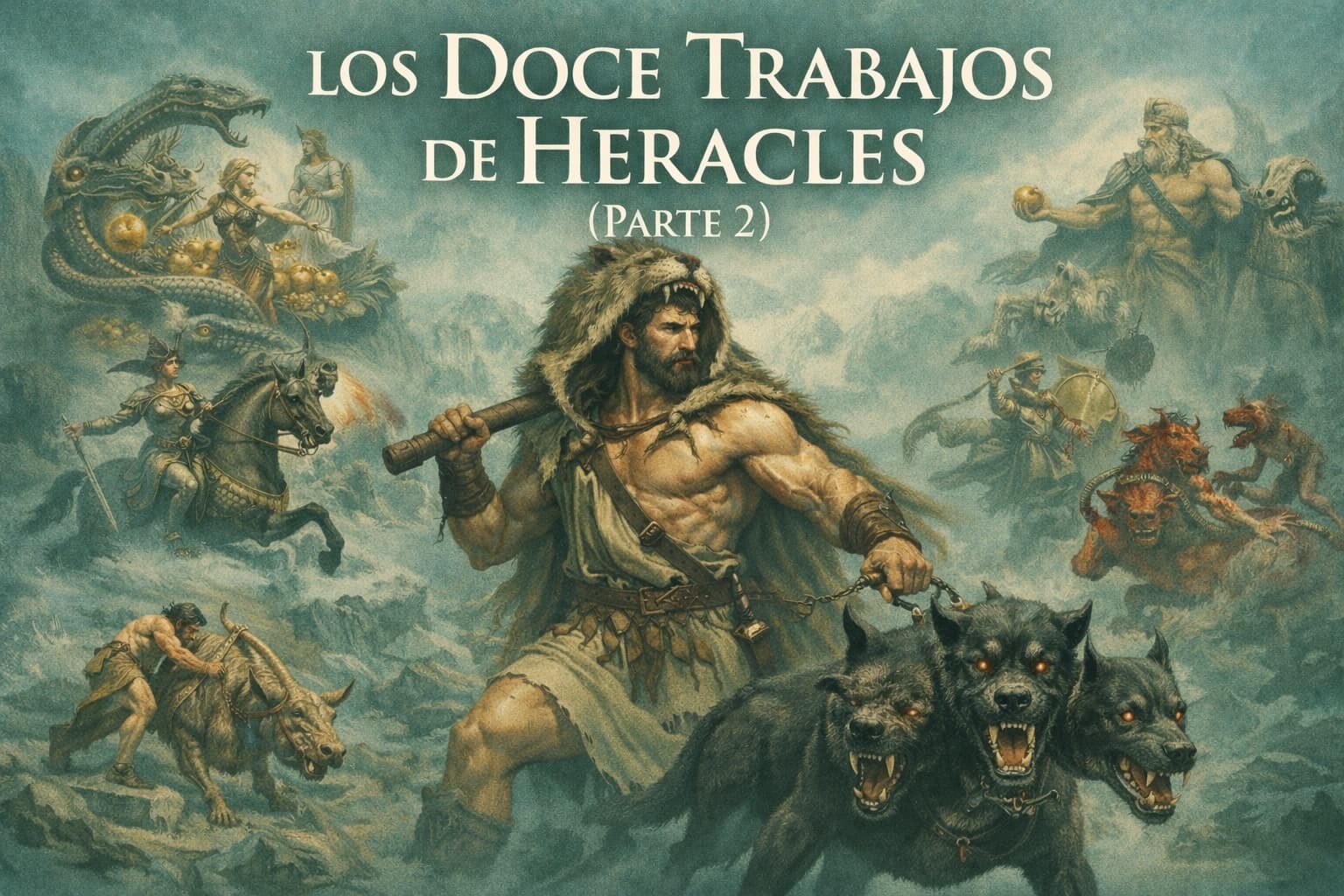
The Twelve Labors of Heracles (Part 2)
 Andres Aguilar
With four labors done and eight still ahead, Heracles faces the second half of his penance: stables no one wanted to clean, bronze birds that ravaged harvests, man-eating mares, and a war belt. And at the end, the darkest test of all: descending into t...
In Part 1, we left Heracles with four labors completed and eight still ahead of him. A man who killed his own family in a fit of madness sent by Hera, who traveled to the Oracle at Delphi seeking guidance, and who now serves the most cowardly man in Greece through a series of tasks that should be impossible — but aren't. The Nemean Lion, the Lernaean Hydra, the Ceryneian Hind, and the Erymanthian Boar. Four monsters, four victories, and Eurystheus growing more desperate with every passing task from the bottom of his bronze jar.
Today we finish the cycle. And the eight remaining labors include some of the strangest, most ingenious, and most epic adventures in all of Greek mythology. The last one, in particular, is the most disturbing of all: Heracles will have to descend into the underworld and face what no living mortal should ever face.
The Fifth Labor: The Stables of Augeas
This labor deserves a special pause, because it's the only one where the challenge isn't a monstrous creature — it's something completely mundane. And the way Heracles solves it is so elegant that we still use the phrase "cleaning the Augean stables" today to describe a massive, filthy task that nobody wants to touch.
Augeas was the king of Elis, in the Peloponnese, and he had the largest cattle stables in the known world. Thousands upon thousands of head of livestock. The problem was that those stables hadn't been cleaned in decades. The accumulated manure was so staggering in scale that it had contaminated nearby rivers, ruined harvests across the entire region, and made the surrounding area genuinely unlivable.
Eurystheus ordered Heracles to clean all of it in a single day. The intention was humiliation. This wasn't a hero's job. It was the job of a slave — someone who deals with other people's filth. The king wanted to watch the son of Zeus drag dung with a shovel.
Engineering in the service of mythology
Heracles went to see Augeas and proposed a deal: he would clean the stables in one day in exchange for one-tenth of the king's cattle. Augeas laughed. It was impossible. He agreed.
Then Heracles did not pick up a shovel. He picked up a pickaxe and a crowbar, broke through the stable walls at two strategic points, and redirected the course of two rivers — the Alpheus and the Peneus — so they ran straight through the stables. The rushing water cleaned everything in a matter of hours.
> Engineering in the service of mythology.
Augeas refused to pay when the job was done. He argued that since Heracles had used the rivers, it wasn't really his own doing. Heracles took him to court. Augeas's own son testified in Heracles's favor, confirming the deal had been made. Heracles won. But Augeas, furious at his son for the betrayal, banished them both from the kingdom. Years later, once Heracles had completed all his labors and was free, he returned to Elis with an army, overthrew Augeas, and killed him. The debt was collected with interest.
This episode reveals something worth underlining about Heracles: he didn't forget betrayals. He was generous with those who helped him and those who asked for mercy. But with anyone who had deliberately cheated him, the account always stayed open.
Eurystheus declared the labor invalid because Heracles had negotiated a reward. The list of labors that "didn't count" kept growing, along with the king's cynicism.
The Sixth Labor: The Stymphalian Birds
In the forests around Lake Stymphalis in Arcadia lived a flock of monstrous birds. These weren't cute little sparrows. They were crane-sized creatures with bronze beaks and claws, capable of launching their own feathers like arrows, and their equally toxic droppings poisoned the surrounding crops. They had multiplied so extensively that they literally blocked out the sun when they flew in formation.
Heracles went to the lake and immediately ran into his first problem: the surrounding terrain was a marsh that couldn't support a man's weight. He couldn't get anywhere near the birds without sinking.
Athena, goddess of wisdom, came to his aid and gave him a pair of bronze castanets, forged by Hephaestus, the blacksmith god. Heracles climbed a nearby hill and clashed them together with all his strength. The noise was so overwhelming that the birds erupted into the sky in a panic. And as they crossed overhead, Heracles shot them down one by one with his arrows.
This labor reveals something interesting worth noting: Heracles didn't always act alone or from sheer brute force. Athena helped him directly in this labor; Apollo assisted him at other moments. The son of Zeus had allies among the gods, even as he had the permanent enmity of Hera. And his whole life moved within that tension — between those who helped him and the one who hounded him.
The Seventh Labor: The Cretan Bull
Poseidon, god of the sea, had sent King Minos of Crete a magnificent white bull to be sacrificed in his honor. Minos looked at it and decided it was too beautiful to kill. He kept it for himself and sacrificed a lesser animal in its place. Poseidon, offended, drove the bull mad. The animal began devastating the island, destroying everything in its path.
Heracles went to Crete, captured the bull with his bare hands, tamed it, and brought it back alive to Mycenae. He did it the way he did everything: head-on, no detours.
In Mycenae, Eurystheus wanted to dedicate the bull to Hera. The goddess refused. She would not accept any trophy that glorified Heracles. The bull was released and wandered across Greece until it reached Marathon, where it became the famous beast that Theseus would later have to face.
> All connected, as things tend to be in Greek mythology, where monsters have genealogies and stories chain together into a web that seems to have no end.
The Eighth Labor: The Mares of Diomedes
Diomedes was a Thracian king, son of Ares, god of war. He kept four magnificent mares with a disturbing habit: he fed them human flesh. The bones and meat of his own guests. The animals had acquired a taste for blood and were extraordinarily dangerous.
Heracles went with a group of volunteers, subdued the mares, and drove them to the coast, leaving his young companion Abderus to guard them while he turned to face Diomedes's pursuing army. Heracles defeated Diomedes in combat and, in a moment of poetic justice, fed the king to his own mares. Once the mares had eaten their master's flesh, they grew calm. They were led to Mycenae without a fight.
Abderus, the young companion, did not survive. The mares had devoured him while Heracles was fighting. Heracles founded a city in his honor and named it Abdera. Once again, the shadow of loss following him everywhere. No matter how many victories he piled up, the price always came due somewhere.
The Ninth Labor: The Belt of Hippolyta
Hippolyta was the queen of the Amazons, the legendary warrior women who lived on the shores of the Black Sea. She possessed a golden belt, a gift from Ares, symbol of her power and authority. Eurystheus wanted the belt as a gift for his daughter.
Heracles sailed with a fleet of ships and several companions. And something unexpected happened: Hippolyta welcomed them. She was a woman who admired courage, and Heracles impressed her. She told him she was willing to hand over the belt voluntarily.
It was too easy. And Hera made sure it wouldn't be.
The goddess disguised herself as an Amazon and ran through the warrior women's camp, spreading the word that the newcomers planned to kidnap their queen. The Amazons grabbed their weapons and attacked. In the chaos of battle, Heracles believed Hippolyta had been setting a trap for him from the start. He killed her and took the belt.
This is one of the saddest stories in the whole cycle, because Hippolyta's death was unnecessary. She had been willing to help him. It was Hera who sowed the distrust.
> The pattern repeats: power without control destroys the very thing it means to protect.
The Tenth Labor: The Cattle of Geryon
Here the labors crossed into a more extreme mythic dimension. Geryon was a monstrous being who lived on the island of Erytheia, beyond the Pillars of Heracles — that is, beyond the Strait of Gibraltar, at the western edge of the known world. He was a giant with three bodies joined at the waist, son of the Titan Chrysaor. He kept a herd of red cattle that Heracles was to bring back.
The cup of the sun
To get there, Heracles had to cross the deserts of North Africa under a sun so merciless that, according to legend, he drew his bow and aimed it at the sun in fury. Helios, the sun god, far from taking offense, lent him his golden cup to cross the ocean. The image is magnificent: Heracles crossing the sea in the sun god's cup, floating on the water like a divine raft.
The Pillars of Heracles
Before departing from Gibraltar, he set up two great columns on either side of the strait to mark the end of the civilized world. These are the famous Pillars of Heracles — which the Romans would call the Pillars of Hercules — and for centuries sailors used them as a signal that beyond this point there was nothing known. Columbus crossed them in 1492.
> That is the geographical legacy of the myth: a legendary hero who marked the edge of the known world, and whose landmark served as a real geographical reference for two thousand years.
On Erytheia, Heracles killed the two-headed dog Orthrus that guarded the cattle, then the herdsman Eurytion, and finally Geryon himself — with a single arrow that pierced all three bodies at once. The journey home was endless and full of setbacks, but he arrived in Mycenae with the cattle.
The Eleventh Labor: The Apples of the Hesperides
The Hesperides were the nymphs of the evening, who tended a garden at the far western edge of the world where golden apples grew. They were sacred to Hera, who had received them as a wedding gift. An immortal dragon named Ladon watched over them, never sleeping.
The problem was that Heracles didn't know where the garden was. He had to track it down by asking various divine beings across the world. And along that journey, something happened that says a great deal about his character.
The liberation of Prometheus
He found Prometheus, the Titan chained to the Caucasus mountains, condemned to have an eagle eat his liver for eternity as punishment for giving fire to humanity. Heracles shot the eagle dead with an arrow and set Prometheus free. It was an act of pure generosity — no reward asked, no order given. Prometheus, grateful, revealed where the garden was.
The trick on Atlas
To actually obtain the apples, Heracles turned to Atlas, the Titan who held the weight of the sky on his shoulders. He proposed a deal: Heracles would hold the sky while Atlas went to fetch the apples. Atlas agreed, delighted to set his burden down for a moment.
The Titan returned with the apples and decided he had no interest in picking the sky back up. He would personally deliver the apples to Eurystheus and leave Heracles holding the sky forever. Heracles pretended to agree but asked Atlas to hold the sky for just a moment while he repositioned himself to carry it more comfortably. Atlas, without thinking, put the apples down and took back the sky. And Heracles grabbed the apples and walked away.
One of the rare times he won through pure cleverness. And proof that Heracles wasn't just muscle: when the situation demanded it, he thought.
The Twelfth Labor: Bringing Cerberus from the Underworld
The final labor was the most impossible of all. Eurystheus played his last card, one that seemed definitive: Heracles had to descend into the realm of the dead — into Hades — and bring back Cerberus, the three-headed guard dog, without using weapons or causing him harm.
Go down to the underworld. Bring back the guard dog alive. No weapons. If anything could truly kill Heracles, this was it.
A promise made to a dead man
But before Heracles ever reached the throne of Hades, something happened that's rarely told in the most familiar versions of the myth. On his way through the depths of the underworld, Heracles encountered the shades of the dead he had left behind in life. He found Meleager, one of the Argonauts who had fallen in battle, and they had a conversation that marked him deeply. Meleager asked him to look after his sister Deianira when he returned to the world of the living — the most vulnerable of his surviving family. Heracles promised he would.
It was a promise made in the kingdom of the dead, to someone who could no longer hold him to it. And yet, when the labors were over, Heracles went to find Deianira, married her, and they had children together. It may have been the most deliberate and conscious choice of his entire life: choosing a wife out of a commitment made to a dead man, as an act of honor toward someone who could no longer ask for anything.
The poisoned shirt
The final irony is brutal. Deianira, with no intention of hurting him, ended up causing his death. The centaur Nessus, dying from Heracles's poisoned arrows after attempting to abduct Deianira, told her with his last breath that his blood was a love potion. That if she ever felt Heracles's love growing cold, she should rub his clothing with that blood and everything would return to the way it had been at the beginning.
Years later, when Heracles arrived home with a captive named Iole whom he clearly loved, Deianira remembered the centaur's advice and soaked a tunic in his blood. Nessus had deceived her: his blood, mixed with the poison of the Lernaean Hydra, was lethal. When Heracles put on the tunic, fire consumed him from the inside. He couldn't die because he was half-divine, but he couldn't bear the pain either. He asked his companions to build a funeral pyre and place him on top of it. The fire destroyed his mortal half, and his soul ascended to Olympus.
> His own poisoned arrows, in a roundabout way, killed him. The weapon of his victories was also the instrument of his end.
Cerberus, defeated without weapons
Back to the twelfth labor. Heracles presented himself before Hades and Persephone, explained his mission, and Hades set the only condition he could: Heracles could take Cerberus if he overpowered him without weapons. Heracles faced the three-headed dog with his bare hands, used his lion skin as a shield, and strangled the beast until it submitted. He bound it and dragged it up to the surface.
When he appeared in Mycenae with Cerberus, Eurystheus hid so deep inside his jar that he sent word asking please to take that dog away and confirming that all the labors had been completed. Heracles returned Cerberus to the underworld.
Twelve labors. Redemption fulfilled, according to the oracle.
But was it enough? That's the question mythology leaves floating in the air.
The Labors Through Jung's Eyes: A Map of the Unconscious
The psychologist Carl Jung, who devoted much of his work to analyzing Greek myths as maps of the unconscious mind, interpreted the twelve labors as the process he called individuation: the path by which a person genuinely becomes themselves through confronting their own inner shadows. The Nemean Lion was the unchecked ego. The Lernaean Hydra was the unconscious that multiplies when you try to suppress its contents directly. The Stymphalian Birds were the obsessive thoughts that block out the light. Each monster, a dimension of the human being that must be integrated in order to reach something resembling wholeness.
I don't know if the Greeks thought of the labors that way. Probably not, at least not in those terms. But the fact that a twentieth-century psychologist found in a three-thousand-year-old story an exact map of human psychological development says something powerful about why these myths have survived so long.
> They are not simply entertainment. They are an inventory of the challenges every human being faces at some point in their life.
Peace at the End of the Longest Road
Heracles went on to live a turbulent life after the labors. More tragedies, more accidental deaths, more consequences of his uncontrolled strength. And in the end he died in the most ironic way possible, as we've already told. But the Greeks didn't end the story there. When his mortal body perished, his divine side was taken to Olympus. Zeus welcomed him among the gods. He even reconciled with Hera and married Hebe, goddess of youth.
The strongest man in the world ended up immortal. The cycle of guilt and redemption closed — though not in the way anyone would have expected.
And that, in the end, is the greatness of the story of Heracles. It's not the story of a superhero who always wins. It's the story of someone who carried the darkest burden that can exist, who kept going anyway, and who found, at the end of the longest and hardest road imaginable, something resembling peace.
> The Greek answer to the deepest pain was always the same: you keep going. With work. With effort. With your bare hands, if it comes to that. With no guarantee that it will be enough to redeem you completely. But you keep going.
Related episodes
But to understand what Medea did, you must first understand who she was and what they did to her. Because this story doesn't start with a woman who goes crazy for no apparent reason.
First, he got Polyphemus drunk on concentrated wine he had brought with him, filling the cup generously and refilling it several times. When the giant, in his drunkenness, asked his name so he could reward him with a gift, Odysseus answered...
An arrow to the heel, shot by the man who started it all and guided by a god carrying a grudge. That was how Achilles died. Then came the horse, the night, and the fall of Troy. Then Homer: the poet who turned fifty days of that war into the most widel...