
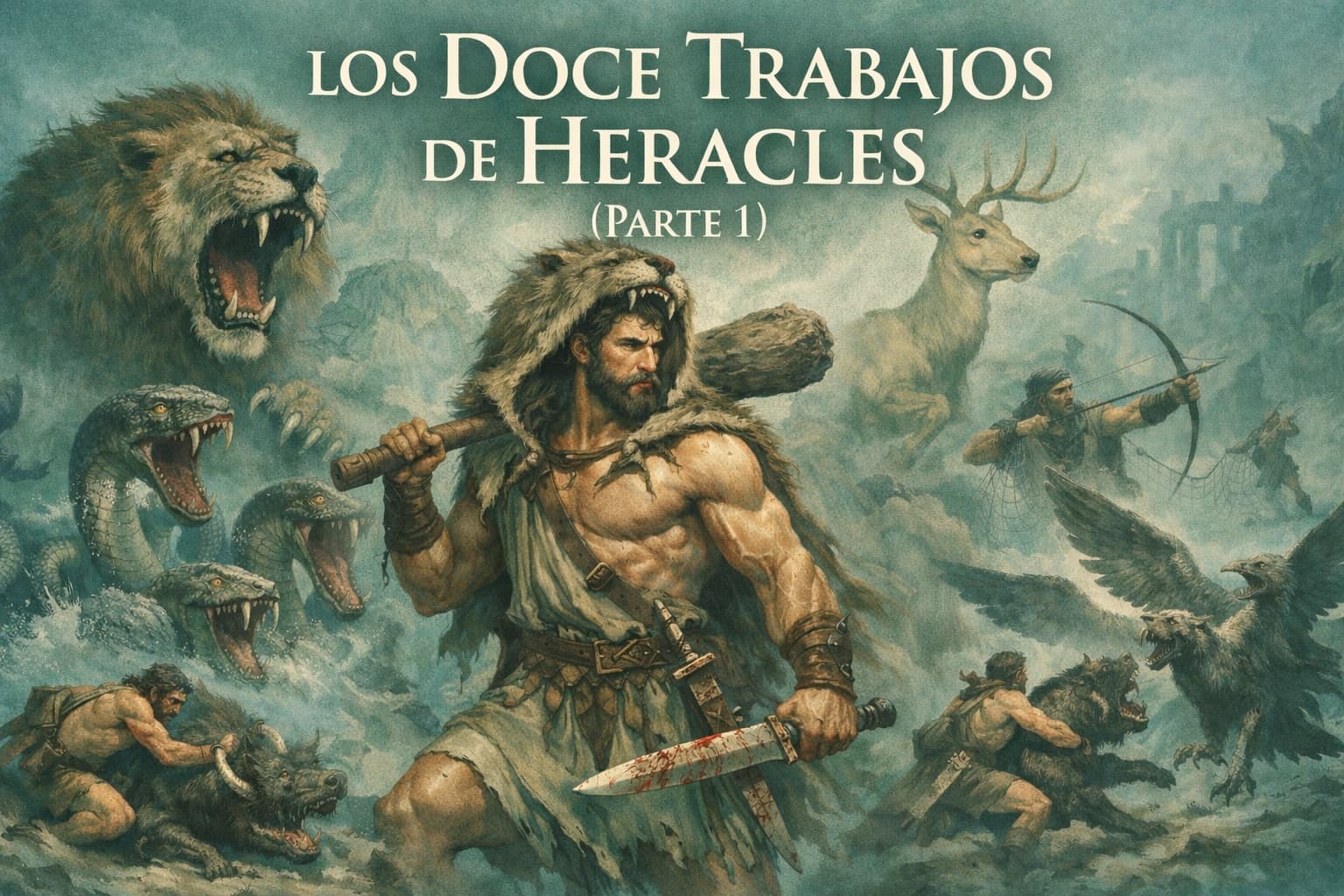
The Twelve Labors of Heracles (Part 1)
 Andres Aguilar
The Twelve Labors of Heracles were not born of ambition or a thirst for glory. They were born from a night of terror in which the strongest man in the world woke up and killed his own family without knowing what he was doing. What came after was penanc...
There's a moment in Greek mythology that almost nobody mentions when they talk about Heracles. A moment that completely changes the way you see him. Before there was the strongest man in the world, before the lions and the hydras and the bulls, there was a night when Heracles woke up and killed his own family. His children. His wife. Believing they were his enemies.
That is what set everything in motion. Not ambition, not glory, not a thirst for adventure. The Twelve Labors were born from the most absolute horror, from the deepest guilt a human being can carry. They were born from a tragedy.
> And that detail is what turns Heracles into something more than a muscular guy with a club.
It's what turns him into one of the most human characters in all of mythology — even with divine blood in his veins.
How Pop Culture Ruined Heracles
Before we get into the monsters and the feats, I want to talk for a moment about how pop culture wrecked our perception of this character. Because the image we have of Heracles today — the one from the 1997 Disney animated movie, the one from the action films of the sixties, the superhero with the exaggerated muscles and the locker-room-poster catchphrases — completely flattens the character. It strips away exactly what makes him interesting.
The Greeks who invented this story didn't live in a world where physical strength was enough to earn admiration. Brute force was common. What made Heracles the most popular hero in all of Greek antiquity was his story of suffering, guilt, and perseverance.
> He was the man who had fallen lower than any human being can fall, and who had chosen to get back up anyway. Not because he was invincible. But because he was incapable of giving up.
An Origin Loaded with Irony
Zeus, the most powerful god on Olympus, had a well-known weakness: mortal women. He couldn't resist them. And at a certain point he set his eyes on Alcmene, a married woman considered the most beautiful and virtuous in all of Greece. Her husband was Amphitryon, a general from Thebes. The problem for Zeus was that Alcmene was completely faithful to her husband. She had no intention whatsoever of getting involved with anyone else.
So Zeus did something that, when you think about it, is pretty disturbing. He took on Amphitryon's exact appearance. His voice, his face, his body, his memories. Everything. He presented himself as if he'd just returned from a military campaign and spent the night with Alcmene. She suspected nothing. She believed she was with her husband.
The next day, the real Amphitryon came home. And Alcmene was pregnant with twins: one was Zeus's son, the other a mortal man's. The twins would be called Heracles and Iphicles.
Hera, the Goddess Who Hated Before Birth
But Hera, Zeus's wife, found out. And that's when a story of hatred began that would run through every chapter of the hero's life.
Hera hated Heracles before he was born. He was living proof of her husband's infidelity, and that was something she could not bear. So while Alcmene was in labor, Hera maneuvered to delay the birth as long as possible while accelerating the birth of another child — Eurystheus — who, according to a prophecy, would rule over the descendants of Perseus. If Heracles was born first, he would be the king. Hera made sure that didn't happen.
From the very beginning, Heracles entered the world with a goddess against him.
"Glory of Hera": The Name as Elegant Cruelty
There's a detail most people don't know, and it's one of the most elegant cruelties in all of Greek mythology. The name "Heracles" — in Greek, Heraklés — literally means "glory of Hera." The hero whose entire life was hounded and ruined by Hera carries, in his very syllables, the name of his persecutor. Some scholars suggest the name was assigned by the Oracle at Delphi when Heracles went seeking guidance after the catastrophe with his family.
> As if his destiny of redemption were written, ironic and cruel, in the very first sound people pronounced when they called his name.
The story goes that when the baby was just a few months old, Hera sent two enormous serpents into his cradle to kill him. Iphicles, the twin brother, cried in terror and called for his mother. Heracles, on the other hand, grabbed the two snakes with his little baby hands and strangled them. Just like that, calmly, as if it were nothing.
That already said everything about what was to come.
The Tragedy That Changed Everything
Heracles grew up and was educated by the best teachers. He learned to fight, to play the lyre, to drive war chariots. He was exceptional at everything physical, though the tradition also paints him as someone with an impulsive temperament — when he got angry, he lost control in catastrophic ways. He married Megara, a princess of Thebes; they had children; and for a time it seemed life was smiling on him. But Hera wasn't finished.
The goddess sent a fit of madness down on Heracles. A mental fever, a distortion of reality so complete that when Heracles came back to his senses, he found his children and Megara dead by his own hand. He had believed he was fighting enemies. In reality he had destroyed everything he loved most.
The weight of that moment is hard to grasp. The Greeks had a word for this kind of god-sent madness: mania. It wasn't a mental illness in the modern sense — it was divine intervention, a form of possession. But that didn't ease Heracles's guilt in the slightest when he came back to reality. He had done it. With his own hands.
The Oracle and the Sentence
He went to the Oracle at Delphi seeking guidance. The priestess of Apollo, known as the Pythia, told him he had to place himself in service to his cousin Eurystheus, king of Mycenae, and carry out whatever he was ordered. If he completed those tasks, he would attain immortality.
That was what awaited him: to serve the man who — through Hera's maneuvering — had denied him the throne that was rightfully his. To serve the man who was so viscerally afraid of Heracles that, according to the accounts, whenever Heracles came to report on the results of his labors, Eurystheus hid inside a bronze jar buried in the ground.
> The irony is brutal. The strongest man in the world in service to the most cowardly.
Heracles, the Stoic Philosopher
It's worth pausing on what this episode means from a philosophical standpoint, because it connects directly to something still very relevant today. There was a first-century CE thinker named Epictetus — born a slave in the Roman province of Phrygia — who became one of the most influential philosophers of antiquity. Epictetus founded a Stoic school and used Heracles constantly as a central example in his teachings. For him, Heracles represented the most important idea in all of Stoic philosophy: the capacity to choose the right response to what you cannot control.
Heracles did not choose to kill his family. That was imposed on him. But he did choose how to respond to that catastrophe. And in that choice lay his greatness.
Stoicism is experiencing a remarkable revival today through books, personal development podcasts, and everyday practical philosophy. When someone today says "control what you can control and accept what you can't," they're — without knowing it — repeating an idea that the Greeks illustrated with the story of the man in the lion skin and the twelve labors. The muscular superhero of action movies conceals, in reality, a three-thousand-year-old philosophical model that remains completely current.
The First Labor: The Nemean Lion
In the valley of Nemea there lived a lion that terrorized the entire region. But it was no ordinary lion. It was a monstrous creature — the offspring of Typhon and Echidna, two of the most fearsome beings in Greek mythology. And it had one characteristic that made it practically invincible: its hide was impenetrable. No weapon could pierce it. Arrows, spears, swords — everything bounced off.
Heracles arrived in Nemea and spent several days tracking the animal without success. He finally found it and tried all his weapons. Nothing worked. So he made the only decision left: he grabbed the lion with his bare arms and strangled it. Face to face, no weapons.
The problem came afterward, when he tried to skin the animal. No knife could cut through the hide. How do you skin an animal whose hide no metal can pierce? Heracles found the solution by using the lion's own claws to cut the pelt. Brilliant and unsettling in equal measure.
From that moment on, Heracles wore that skin as his signature armor. The hood was the animal's head. It was, in a sense, wearing the defeated enemy. A statement.
When he returned to Mycenae with the dead animal, Eurystheus climbed into his bronze jar. The first time he saw his cousin return alive from the impossible, he panicked. And he sent word that going forward, Heracles was to present his trophies outside the city walls. Don't come in.
The Second Labor: The Lernaean Hydra
If the first labor was already difficult, the second was logically absurd from the start.
The Hydra was a multi-headed water serpent that lived in the swamps of Lerna. The sources vary on how many heads it had — some say nine, others fifty, some say they were countless. But all agree on this: if you cut off one head, two grew back in its place. And there was one central head that was immortal.
Heracles went with his nephew Iolaus as his aide. And there he discovered the core problem: fighting the Hydra with a sword was counterproductive. Every time he cut off a head, the creature became more dangerous. The solution they found was practical and brutal: while Heracles cut the heads off, Iolaus immediately cauterized the stumps with lit torches. No open wound, no regeneration. They worked through head after head until they reached the central, immortal one. That one they cut off and buried under a massive rock.
Hera's Crab
But Hera, always watching, couldn't let things go smoothly. During the battle she sent a giant crab to harass Heracles, biting at his heels to distract him. Heracles crushed it with a stomp, barely paying attention. Hera, grateful to the little crustacean for its futile sacrifice, immortalized it in the sky as the constellation Cancer. It's one of those anecdotes that confirms that in Greek mythology even the losers get their reward, as long as someone remembers them fondly.
Heracles dipped his arrows in the Hydra's blood, which was extremely poisonous. Those arrows would stay with him for the rest of his life and generate consequences he never fully anticipated.
Eurystheus, upon hearing that Heracles had had help from Iolaus, declared the labor didn't count. It was the first move in a pattern that would keep repeating: the king changing the rules of the game whenever it suited him.
The Third Labor: The Ceryneian Hind
Now Eurystheus switched tactics. The first two labors had been about destroying something. This one was about capturing something and bringing it back alive — which sounded simpler but turned out to be just as complicated in its own way.
The Ceryneian Hind was an animal sacred to Artemis, goddess of the hunt. It was a female deer with golden antlers and bronze hooves, extraordinarily fast. The challenge was twofold: it had to be caught alive and unharmed, because injuring one of Artemis's animals meant inviting serious trouble with the goddess.
Heracles chased it for an entire year. Twelve full months of running through the forests of northern Greece and into the far north. He finally caught up with it at the river Ladon and captured it in a net, without harming it. On his way back, Artemis and Apollo appeared before him, pretty unhappy. Heracles explained the situation: he was serving a penance ordered by the Oracle at Delphi. The gods understood the context and let him pass, with a warning to return the animal when the labor was done.
He did. He always made a point of honoring the commitments he made to the gods, even in the middle of the labors.
> That's a trait of Heracles that pop culture almost always ignores: it wasn't just strength. It was also, in his imperfect way, being a man of his word.
The Fourth Labor: The Erymanthian Boar
On Mount Erymanthus there lived a colossal boar that destroyed crops, flattened villages, and terrorized everyone who dared come near. The task was to capture it alive and bring it to Mycenae.
The Centaur Party That Went Sideways
On the way to Erymanthus, Heracles passed through the region where the centaurs lived — those creatures with the body of a horse and the torso of a man. He was welcomed by his friend Pholus, a hospitable centaur who invited him to eat. Heracles asked for wine. Pholus had a jar of sacred wine that belonged to all the centaurs in common. Heracles pushed him to open it.
The smell of the wine drifted through the surrounding area and drew a horde of centaurs who arrived furious, demanding their drink. A chaotic battle broke out. Heracles used his arrows poisoned with Hydra blood. Some centaurs died, others fled. Among those who fled was the wise Chiron — teacher of heroes — who was accidentally struck by one of the arrows. Chiron was immortal and couldn't die, so he was condemned to suffer the poison forever without release, until he finally surrendered his immortality.
It was one of the unintended consequences that marked Heracles's life: his power, when poorly directed, caused destruction even where he didn't want it.
Jung's Shadow
The psychologist Carl Jung, who dedicated much of his work to analyzing Greek myths as maps of the human unconscious, used this episode as an example of what he called the shadow: that destructive capacity every person carries within, which, if not consciously integrated, ends up harming those closest to us. The centaur accidentally wounded by the poisoned arrow was, for Jung, the perfect representation of the collateral damage done by power that hasn't yet found its proper channel.
> A man who destroys his teacher with the same instrument that makes him great.
To capture the boar, Heracles used his head before his muscles. He chased it into the mountain snow and exhausted it. The animal, stuck in the snow, became immobilized. Heracles bound it and hoisted it onto his shoulders.
The image of Heracles arriving in Mycenae with a live, furious boar strapped to his back became iconic. Eurystheus, once again, ran to hide in his jar. According to one amusing version of the myth, the boar — seeing the king flee in a panic — also went berserk, and between the two of them chaos broke out and no one was quite sure what happened next.
Four Labors Down
Four labors down. Eight to go. And what's interesting is that as we move forward, the labors become more complex — almost more philosophical. They're not just "go and kill the monster." They start to involve ingenuity, negotiation, unforeseen consequences. Each one reveals something different about the man completing them.
Heracles wasn't a soldier following orders. He was a man carrying an enormous weight of guilt, trying to find something that might feel like enough to redeem himself. And that, more than any physical feat, is what makes him fascinating.
A Massive and Enduring Cult
That's why in classical Greece the cult of Heracles was absolutely enormous. There were temples dedicated to him all across the Mediterranean basin. Athletes prayed to him before competing. Soldiers invoked him before battle. Sailors put his image on the prows of their ships.
> They didn't pray to him because he was a perfect and spotless god. They prayed to him because he had suffered the most and kept going anyway. He was the model of human endurance, not divine perfection.
That difference explains everything. And it also explains why his name has survived so well through time. The Romans adopted him as Hercules and made him the symbol of every difficult undertaking. Cities across Europe carry his mark: the Spanish city of Cádiz was known in antiquity as founded under the sign of the Pillars of Hercules; in northern Italy, Heraclea bears his name directly; Barcelona has a legend attributing its founding to him. The hero who began with a lion skin and an impossible weight of guilt ended up as the symbolic founder of half of Europe.
Greek mythology was never a manual of perfect heroes. It was always an honest portrait of what it means to be human: strength and error, power and consequence, the redemption you seek — and that sometimes comes, and sometimes doesn't, in the way you expected.
In Part 2 we finish the twelve labors. The ones still to come include some of the best-known stories — the Augean Stables, the Stymphalian Birds, the Cretan Bull, and finally the labors that took Heracles beyond the edges of the known world.
And Heracles went. Because that was what he did.
Related episodes
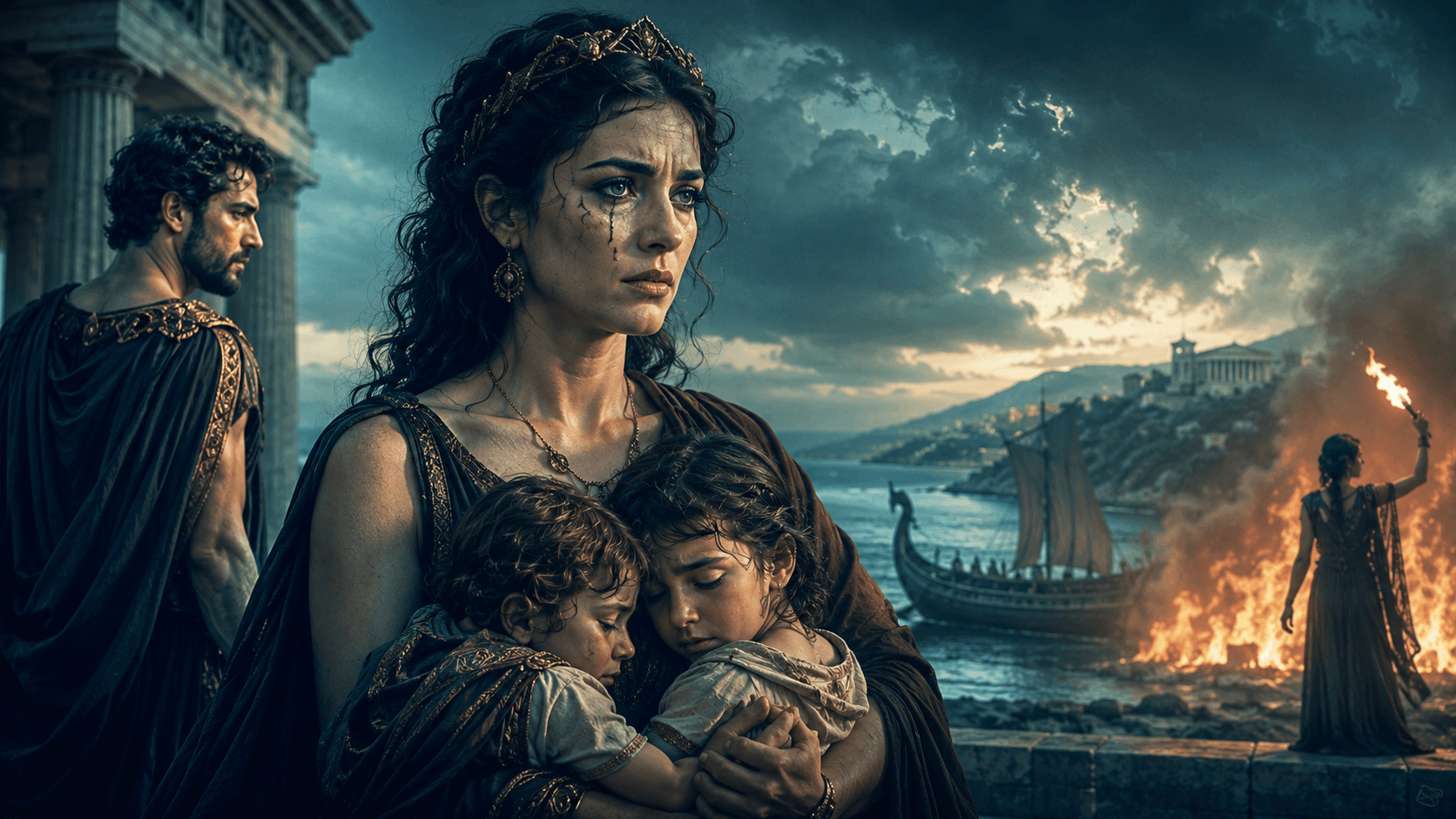
But to understand what Medea did, you must first understand who she was and what they did to her. Because this story doesn't start with a woman who goes crazy for no apparent reason.
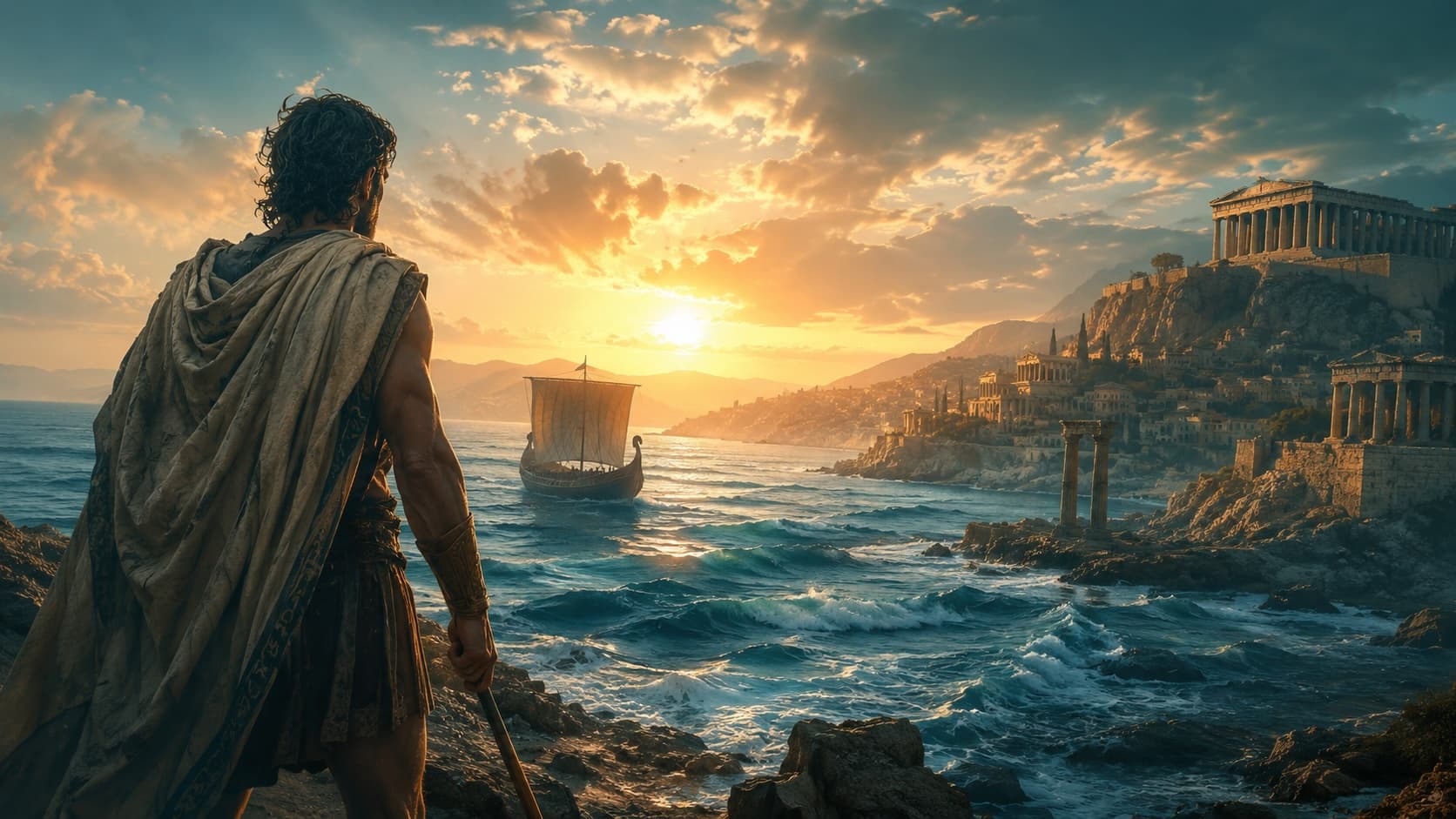
First, he got Polyphemus drunk on concentrated wine he had brought with him, filling the cup generously and refilling it several times. When the giant, in his drunkenness, asked his name so he could reward him with a gift, Odysseus answered...
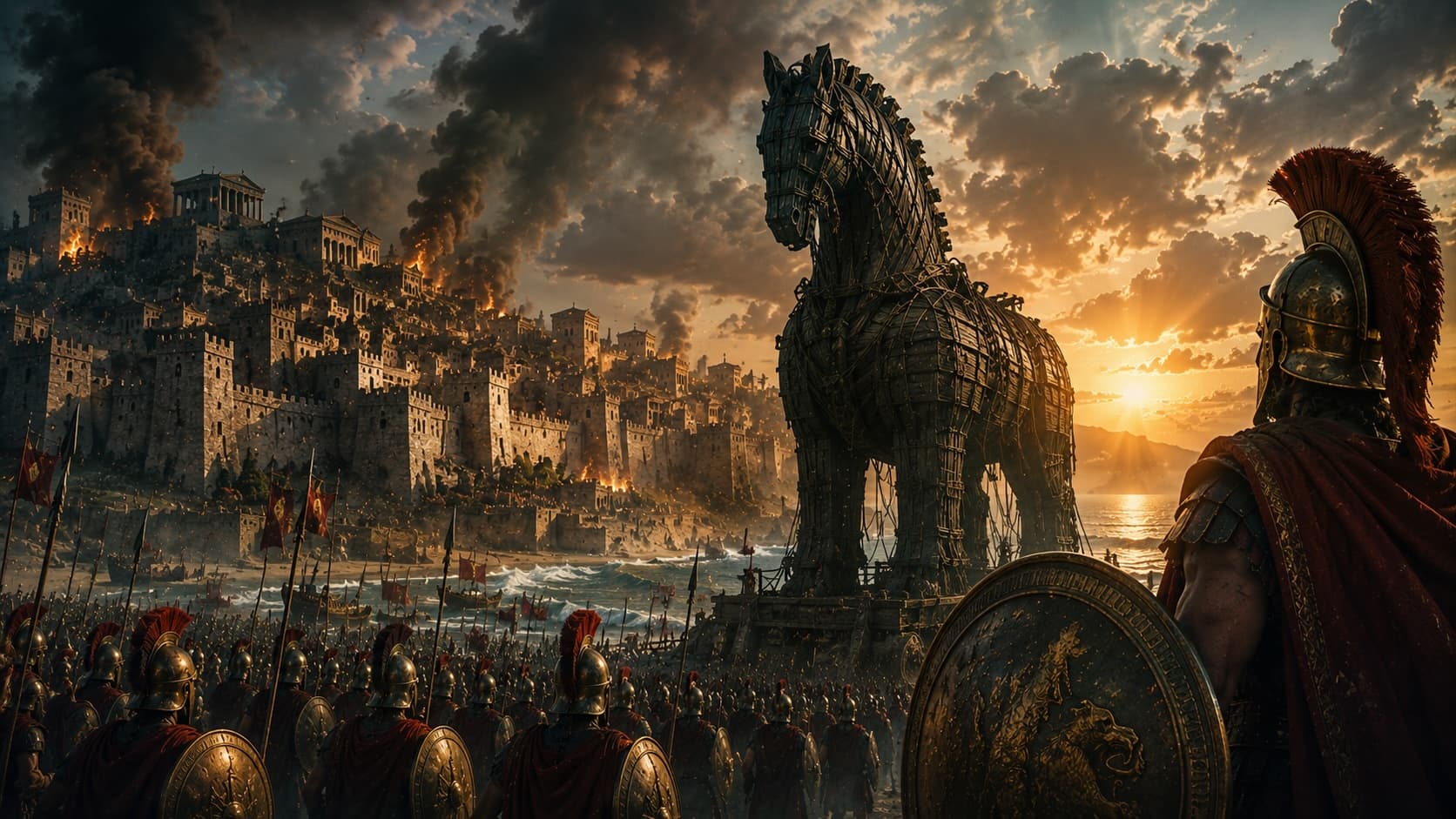
An arrow to the heel, shot by the man who started it all and guided by a god carrying a grudge. That was how Achilles died. Then came the horse, the night, and the fall of Troy. Then Homer: the poet who turned fifty days of that war into the most widel...