
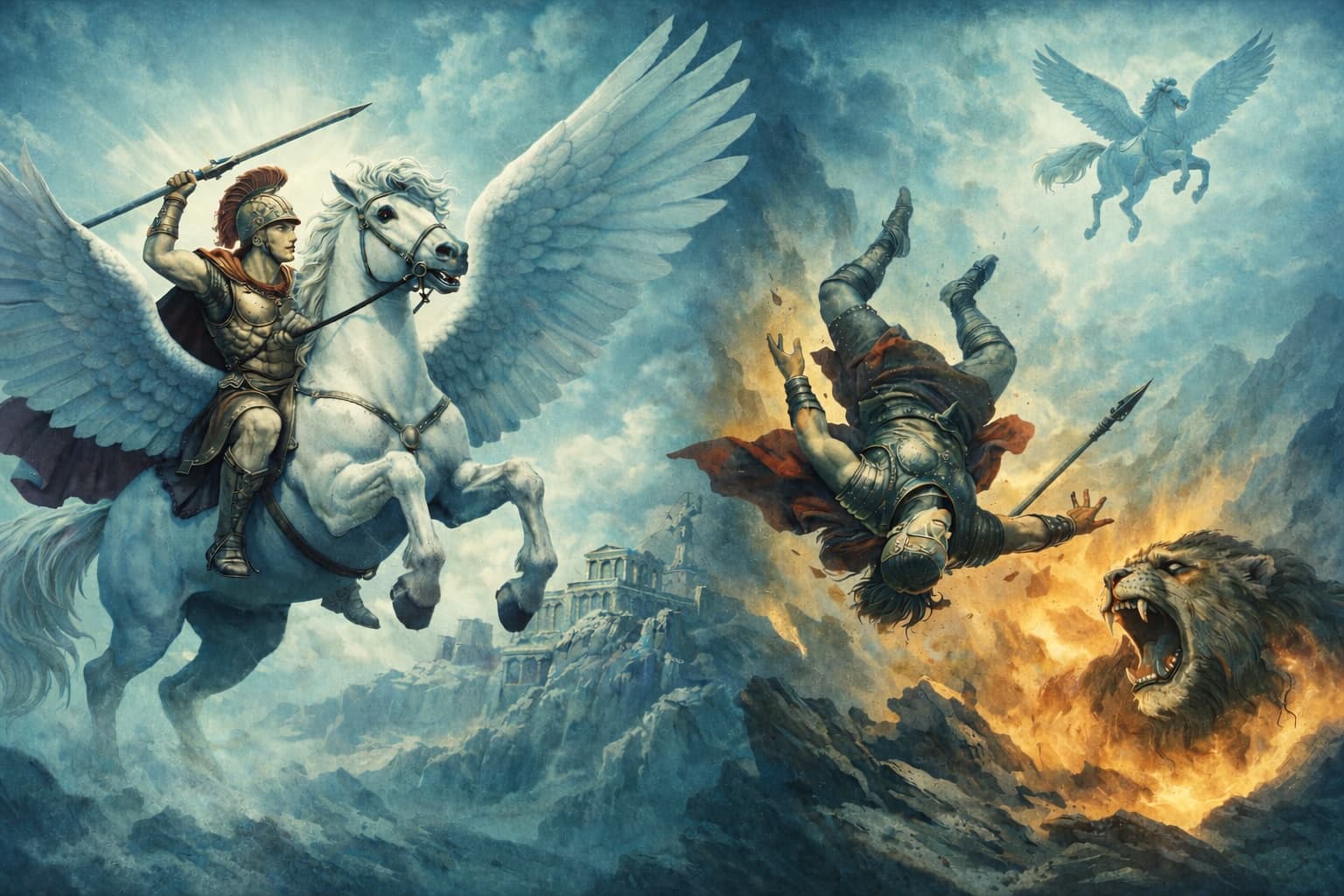
Bellerophon and Pegasus: Glory and the Fall
 Andres Aguilar
There's a moment in anyone's life when everything is going right. Everything. Work is good, money is there, people like you, projects are taking off. And in that moment — right there, when everything is aligned — a little voice appears inside you that ...
There's a moment in anyone's life when everything is going right. Everything. Work is good, money is there, people like you, projects are taking off. And in that moment — right there, when everything is aligned — a little voice appears inside you that says: "What if I aim even higher?" Not a little higher. A lot higher. All the way. The impossible.
> That little voice is what destroyed Bellerophon.
And the most incredible thing about his story isn't that he fell. It's that before he fell, this man accomplished things no human being had ever pulled off. He tamed the most famous winged horse in Greek mythology, killed one of the most terrifying monsters in all the myths, survived traps that would have finished off anyone else, and became the most celebrated hero of his generation. But he was missing one thing. One thing the Greeks knew well and that we still haven't fully learned: knowing when to stop.
Today I'm telling you the complete story of Bellerophon and Pegasus. Fair warning — it doesn't end well. But the journey to the end is so good it's worth every minute.
A Complicated Starting Point
Bellerophon was born in Corinth, one of the most important cities of ancient Greece, located on that isthmus connecting northern Greece to the Peloponnese. His father was Glaucus, king of the city — though some versions say his real father was Poseidon, god of the sea. This ambiguity around parentage is very typical for Greek heroes: there's always a god somewhere in the family tree to explain why someone is so exceptional. In Bellerophon's case, the connection to Poseidon will make a lot of sense later, since the god of the sea was also the creator of horses. So if Poseidon was his father, the bond with Pegasus would be no coincidence.
But before we get to Pegasus, there's a dark episode that sets the whole story in motion. As a young man, Bellerophon killed someone. The most widely told versions say he killed his own brother, though in some variants the victim was another man from Corinth. The identity of the victim varies depending on which poet you're reading, but what doesn't vary is the consequence: killing someone in ancient Greece left a stain that followed you forever. You became miasma — impure, contaminated by the crime.
To cleanse that stain, Bellerophon had to go into exile and find someone to purify him through religious rituals. King Proetus of Tiryns agreed to do it, welcomed him into his palace, and performed the purification. So far, so good. The problem came afterward, with Stheneboea, the king's wife.
The Potiphar's Wife Motif: A Universal Story
And here comes one of the most interesting episodes in the myth, because this moment has been told before. Long before. The situation involving Bellerophon, Proetus, and Stheneboea is almost identical to that of Joseph and Potiphar's wife in the Old Testament. A married woman falls for a young and handsome man. The man rejects her. The woman, wounded and humiliated, accuses him before her husband of having tried to seduce her. The husband, furious, decides to get rid of the young man.
> This narrative structure appears in cultures so different and so far apart from each other that scholars call it "the Potiphar's wife motif."
Stheneboea told Proetus that Bellerophon had tried to seduce her — or even assault her. And Proetus, who couldn't kill a purified guest because that too was a sacred violation, found a more elegant solution. He wrote a letter to Iobates, king of Lycia — his own father-in-law — asking him to get rid of the messenger. Then he ordered Bellerophon to deliver the letter in person.
In other words: he handed him his own death warrant and told him to carry it himself.
The Poisoned Letter and the Impossible Mission
Bellerophon traveled to Lycia knowing nothing of what the message said. Iobates received him with full honors, feasted him for nine days, offered him generous hospitality. Only on the tenth day did he open the letter and read it. And there he faced the same problem as Proetus: killing a guest was a sacrilege. It couldn't be done directly.
So Iobates came up with another solution. If he couldn't kill him outright, he could send him off to die on his own.
And he assigned him an impossible mission.
The Chimera: A Monster Built from Horror
If there's a monster in Greek mythology that has everything a monster should have, it's this one. The Chimera had the head of a lion, the body of a goat, and the tail of a serpent or dragon, depending on who's describing it. And to round out the package, it breathed fire. It was the offspring of Typhon and Echidna — basically the parents of horror in Greek mythology, whose children included the Lernaean Hydra, Cerberus, the Sphinx, the Nemean Lion, and several others who regularly appear in the labors of heroes. The Chimera lived in Lycia, right in Iobates's territory, and had been terrorizing the region for years.
Iobates told Bellerophon: go and kill the Chimera.
The logic was simple: no one had been able to defeat that monster, and this fire-breathing, lion-headed beast would take care of the inconvenient guest without the king having to get his hands dirty.
Pegasus Enters the Story
Bellerophon knew he needed help. He went to consult a seer named Polyidus, who told him that before attempting anything, he should go to Athena's temple and ask the goddess for guidance. Bellerophon went, fell asleep in the temple — or entered a state of sacred trance, depending on the version — and in that state had a vision. Athena appeared to him and placed something in his hands: a golden bridle. A magical bit capable of taming the most untamable horse in the world.
And the most untamable horse in the world was Pegasus.
Pegasus was no ordinary horse. He was the son of Poseidon and Medusa, born from the blood that poured from Medusa's neck when Perseus decapitated her. He sprang directly from a Gorgon's body, from that dark and powerful blood, and from his very first moment he was free. No one had ever ridden him. He lived wild, roaming the skies, drinking from sacred springs. The spring of Pirene, in Corinth, was one of his favorites — and that's exactly where Bellerophon found him.
With the golden bridle Athena had given him, Bellerophon approached Pegasus. And the horse let the bit be placed on him. Just like that, with almost no resistance. As if he had been waiting for that moment. Some interpreters see in this the idea that the right hero and the right instrument recognize each other — that there is an affinity between them that goes beyond domination by force.
> It's not that Bellerophon subdued Pegasus: it's that Pegasus chose Bellerophon.
The Battle Against the Chimera
The battle against the Chimera is one of those moments where Greek mythology shows its most cinematic side. Bellerophon, riding Pegasus, attacked the monster from the air. The Chimera couldn't reach him. It breathed fire, but the winged horse dodged the flames easily. And Bellerophon — according to one of the most ingeniously told versions — used a spear tipped with lead. When he drove it into the monster's mouth, the lead melted in the Chimera's fire and choked it from within.
It's an extraordinary image: the monster destroyed by its own fire. Its greatest power turned into its undoing.
Chained Missions and Iobates's Surrender
Bellerophon returned victorious. Iobates couldn't believe it. He had sent this young man to certain death and the guy came back smiling. So he sent him on more missions. First he dispatched him against the Solymi, a warrior people of the region. Bellerophon defeated them. Then he sent him against the Amazons — those legendary warriors who appear so many times in Greek myths and who represented everything Greek society found threatening and inverted: women who fought, who governed, who needed no men. Bellerophon defeated them too.
Finally, Iobates tried something more direct: he set an ambush with his best soldiers to kill Bellerophon on his way back. Bellerophon defeated them all.
At that point, Iobates understood that this was no ordinary man. There was something divine about him, or at least something protecting him beyond the human. Faced with that overwhelming evidence, the king did what any reasonable person would: he gave up. He showed Bellerophon the letter from Proetus, told him everything that had happened, apologized, offered him his daughter Philonoe as his wife, and half the kingdom of Lycia as a dowry.
From condemned to death to inheriting a kingdom. Bellerophon's rise was as vertical as his fall would be.
Hubris: When Success Fools You
He lived well in Lycia. He had children. He was a respected king. His deeds were told throughout Greece. He was the most famous living hero of his era. And there, at that peak of fulfillment, the little voice came back.
What if I can do more?
What if I can reach Olympus?
There's a concept in Greek mythology and philosophy that is absolutely central to understanding not just this story but nearly all of Greek culture: hubris. The Greek word usually translated as "pride" or "arrogance," but which actually means something more specific and more dangerous.
> Hubris isn't simply being vain or thinking you're better than everyone else. It's the concrete act of overstepping the limits that belong to you as a mortal. It's trying to occupy the place of the gods.
The Greeks were very clear about this: there was an order to the cosmos. The gods were above, humans below, and that division was non-negotiable. You could be the bravest, the smartest, the strongest of all men. But you were still human. And the moment you forgot that condition and began to act as if your achievements placed you on the level of the gods, the gods themselves would remind you — harshly — of who you were.
Bellerophon had killed the Chimera. He had defeated entire peoples. He had tamed Pegasus. What was the next logical step in his mind? To climb Olympus. Literally. To ride Pegasus all the way to the home of the gods and sit among them.
The Gadfly and the Fall
Zeus saw him coming. The story goes that he sent a gadfly that stung Pegasus at the worst possible moment. The horse reared, Bellerophon lost his balance, and he fell.
He fell from a height the narrative doesn't specify in feet but which, symbolically, was the distance between humanity and the divine. An immeasurable distance.
And he survived. That is what makes Bellerophon's story so peculiar and so painful. He didn't die in the fall. He landed in a place called the Aleian plain — which in Greek means something like "the fields of wandering" or "the fields of error," a region between Cilicia and Syria whose very name seems chosen to mark his fate. And there he lived out the rest of his days.
Alone. Wandering. Blind — according to some versions, the fall cost him his sight. Without Pegasus, who flew free toward Olympus and ended up as the horse that carried Zeus's thunderbolts. Without his kingdom, without his family, without his glory. With only the memory of what he had been and the awareness of what he had attempted.
Homer mentions him in the Iliad, almost in passing, describing Bellerophon wandering alone across the fields, shunned by men, consumed by his own ruin. It's one of the saddest images in all of Greek epic poetry: the greatest hero reduced to a ghost of himself, rejected even by human company.
Why Did the Greeks Tell This Story?
Not to discourage ambition. The Greeks adored their heroes precisely for their ambition, for their ability to push past the ordinary. Achilles, Heracles, Perseus — all of them are deeply ambitious, all of them push the limits of what it means to be human. Ambition itself is not what the myths punish.
> What they punish is the confusion between being exceptional and being divine.
Bellerophon had divine help his whole life. Athena gave him the bridle. Poseidon, if he was his father, connected him to the horse. The gods were on his side in all his great deeds. But he interpreted that divine assistance as a sign that he himself was divine. And that logical leap was his undoing.
There's something very contemporary in this, isn't there? Think of anyone you know — or have watched from the outside — who went through an incredible streak of success. An entrepreneur who turns everything he touches to gold, an athlete who wins year after year, an artist who keeps piling up recognition. And sometimes, at some point in that streak, something shifts. Success stops being the result of hard work and favorable conditions, and starts to feel like a confirmation of personal superiority. It's no longer "I got lucky and I worked hard" — it becomes "I'm different, I'm special, the normal rules don't apply to me." And at that moment, more often than not, the unraveling begins.
The Greeks put that pattern into myth twenty-five hundred years ago because they saw it repeat in the people around them. Hubris wasn't an abstract philosophical concept — it was a pattern they watched play out in real life. In politicians who thought they were untouchable, in generals who overestimated their armies, in leaders who confused accumulated power with divine permission to do anything.
The myth of Bellerophon was, among other things, a collective warning.
Pegasus, Hippocrene, and Inspiration
There's a curious detail about Pegasus worth telling on its own, because the story of the winged horse has its own interesting branches.
Pegasus, after letting Bellerophon fall, flew to Olympus and became the carrier of Zeus's thunderbolts. But before that final destination, there's a story involving the Muses and Mount Helicon. The myth says that when Pegasus struck the ground with his hoof on that mountain, he caused a sacred spring to burst forth — Hippocrene, which in Greek literally means "horse's spring." And that spring had magical water: whoever drank from it received poetic inspiration.
So Pegasus, in addition to being the hero's steed, was the unintentional creator of artistic inspiration. Every time the ancient Greeks spoke of the muse that inspired them, there was a thread of connection running back to that winged horse and that spring on Mount Helicon.
This is why, even today, Pegasus appears in advertisements, logos, and symbols for creative companies and publishers. The winged horse became the universal symbol of imagination, inspiration, and creative freedom. One very well-known oil company has used it as its logo for decades. There's an enormous irony in that — but symbolism travels and adapts.
The Linguistic Legacy
What also travels and adapts is the name of the Chimera. Today, when we talk about something chimerical, we mean something impossible, illusory, unachievable. The chimera became the metaphor for the unattainable dream, the goal that seems real but always slips away. And in biology, a chimera is an organism that has cells from two different genetic sources — basically a being made of parts from different origins, just like the original monster.
The linguistic legacy of these myths is remarkable once you start looking.
The Tragic Flaw, Not the Evil Nature
Let's come back to Bellerophon for a moment, because there's something about his story that I don't think gets said enough.
This man was not wicked. He was not arrogant from the start. In many ways he was an exemplary hero: brave, generous with those who helped him, capable of facing the impossible without breaking. The conspiracies of Stheneboea and Proetus were not his fault. The impossible missions from Iobates were not his choice — they were imposed on him. And he completed them all with grace.
The problem wasn't that he was a bad person. The problem was that he accumulated so much success that he lost perspective. And that makes him a far more tragic character than if he'd simply been vain from the beginning. Because deep down, Bellerophon's hubris is understandable. After everything he'd lived through, after killing the Chimera while riding a horse that sprays fire, after defeating entire armies — how could you not think you were capable of anything?
The Greeks understood that. That's why the story isn't a simple moral judgment. It's not "he was bad and got what he deserved." It's something more nuanced: "he was extraordinary, and it was precisely the extraordinary nature of his story that also undid him."
There's a Greek word for this too: hamartia, which Aristotle used to describe the tragic hero's fatal flaw. It's not wickedness — it's an error. An error of judgment, of perspective, of reading the situation. The tragic hero doesn't fall because he's a villain: he falls because he has a blind spot, and that blind spot is proportional to his greatness.
> In Bellerophon's case, his greatness was so vast that his blind spot encompassed nothing less than the entire sky.
A Story That Hits Close to Home
Bellerophon's story never received the same prominence in later tradition as those of Heracles, Achilles, or Odysseus. He's a hero who burns bright and fades fast in the literary canon. Pindar mentions him, Homer names him, but there's no epic dedicated entirely to him the way other heroes have.
And yet his story is perhaps the cleanest, the most precise in its lesson. There are no moral ambiguities here like in Odysseus, who lies and manipulates but is the hero anyway. There are no excesses of violence like in Heracles, who killed his own family in a fit of madness sent by Hera. Bellerophon is pure: pure glory, pure fall, pure consequence.
That's why it's worth telling. That's why, in a certain way, this story hits closer to home than many others.
We all know that moment when success starts to feel like a license to operate beyond the rules. We all know the temptation of believing that because something worked out well many times, there are no longer any limits. And we all know, to some degree, the way that illusion eventually crashes into reality.
Bellerophon rode Pegasus and climbed higher than any human had ever gone. And at the highest point, when Olympus seemed within reach, a small insect stung the horse.
A gadfly. Not a divine thunderbolt, not an epic battle. A gadfly.
> Sometimes the limits of the world aren't imposed on you by a war. They're imposed by the smallest, simplest things in nature.
Related episodes
But to understand what Medea did, you must first understand who she was and what they did to her. Because this story doesn't start with a woman who goes crazy for no apparent reason.
First, he got Polyphemus drunk on concentrated wine he had brought with him, filling the cup generously and refilling it several times. When the giant, in his drunkenness, asked his name so he could reward him with a gift, Odysseus answered...
An arrow to the heel, shot by the man who started it all and guided by a god carrying a grudge. That was how Achilles died. Then came the horse, the night, and the fall of Troy. Then Homer: the poet who turned fifty days of that war into the most widel...