
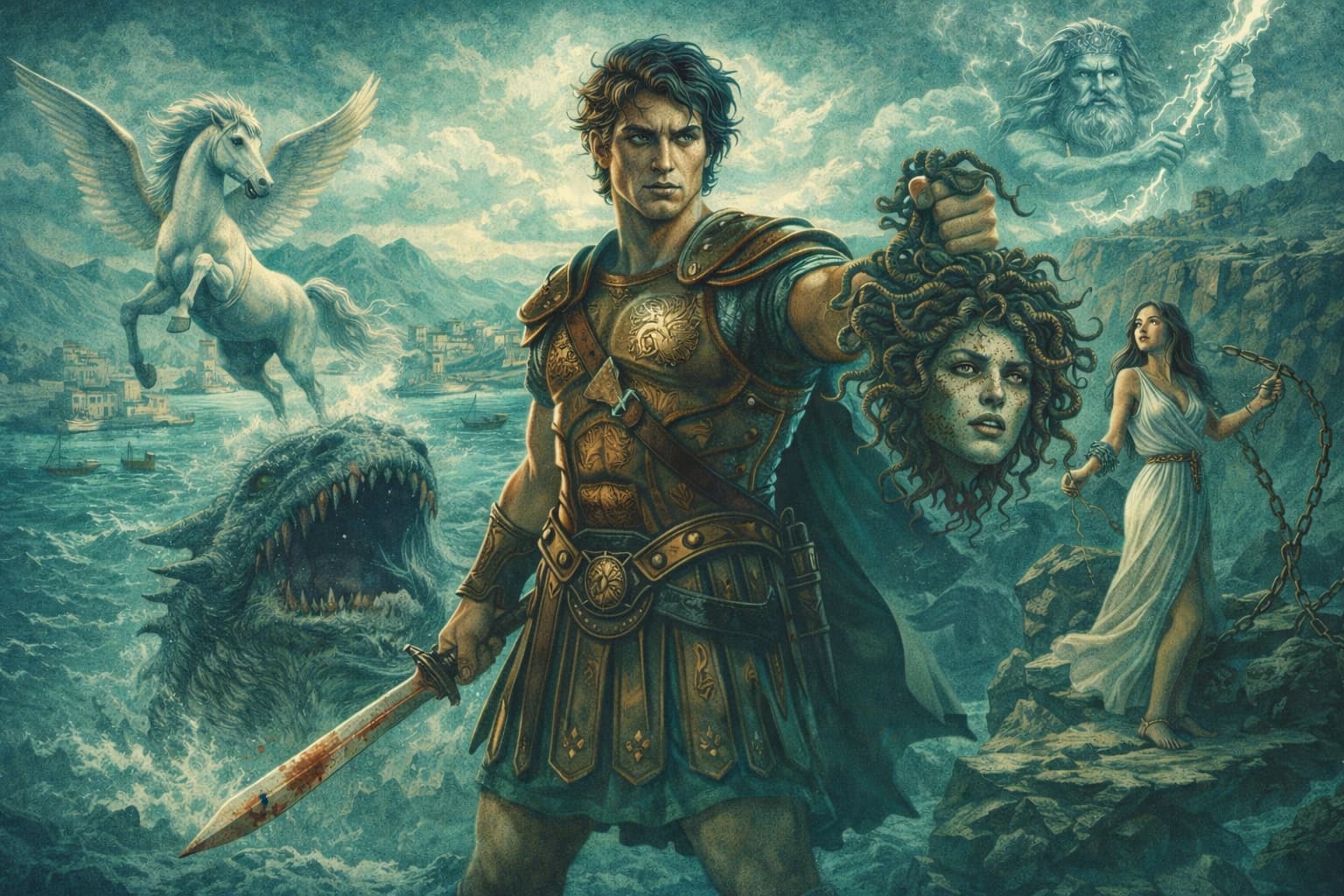
Perseus: The First Great Hero
 Andres Aguilar
Perseus is the prototype — the hero before the word hero existed. He was born from a prophecy that a king tried to thwart by locking away his own daughter, grew up not knowing who he was, and ended up fulfilling exactly the fate nobody wanted. Monsters...
There's a story the Greeks told centuries before Rome existed, before anyone wrote the Iliad, before almost everything we call "Western civilization." It's the story of a man born from a shower of gold, who cut the head off a monster that could turn you to stone with a single glance, and who then rescued a princess chained to a rock in the middle of the sea. If that sounds like a fairy tale, it's because basically every fairy tale in the Western world traces back to this.
> Perseus wasn't just a hero. He was the original mold. The prototype. Number one.
In this article we begin with who many scholars consider the first great hero of Greek mythology: Perseus. Fair warning: this story has everything. A paranoid king, a mother who suffers more than anyone should, a god who literally rains down as precious metal, monsters, vengeful goddesses, a princess in danger, and an ending that blends glory with a twist you won't see coming.
It All Starts with Fear
To understand Perseus, you first have to understand Acrisius. Acrisius was the king of Argos, one of the most important cities in ancient Greece, located in the Peloponnese — that peninsula hanging off the south of Greece. He was a king like many others: powerful, proud, and deeply terrified of losing what he had.
Acrisius's problem was that he had no sons. Only a daughter, Danaë, who by all accounts was extraordinarily beautiful. In the ancient Greek world, having no male heir was nearly a political catastrophe. So Acrisius did what all Greek kings did when they needed answers: he went to the Oracle at Delphi.
The Cursed Prophecy
The Oracle at Delphi was basically the Google of antiquity, but with cryptic answers and a lot of laurel smoke. There a priestess called the Pythia would fall into a trance, supposedly inspired by the god Apollo, and deliver prophecies. And the prophecy Acrisius received was devastating: he would never have sons, but his daughter Danaë would. And that grandson of his would be the one to kill him.
That's where all the trouble started.
Acrisius had several options. He could have accepted his fate with dignity, as heroes do in Greek tragedies. He could have had an honest conversation with his daughter. He could have adopted an heir. But no. Acrisius chose the path of total panic and decided that if he locked Danaë away so she couldn't have contact with any man, the problem would solve itself.
The Bronze Chamber
He had an underground bronze chamber built. No windows, no exterior doors — just a small opening in the ceiling to let in some light and air. There he locked up his own daughter. The story doesn't tell us how long Danaë spent in there, but it does tell us that the plan failed miserably. Because Acrisius had forgotten something fundamental: if a god wants something, no amount of bronze will stop him.
Zeus and the Shower of Gold
Zeus, king of Olympus, lord of the thunderbolt, god of gods, looked down at Danaë from on high and fell in love. Or at least that's what the Greeks said. Zeus had a long history of falling suddenly and intensely in love with mortal women, which for the women in question tended to be a combination of honor and serious trouble.
But Danaë was locked in an underground bronze chamber. How was Zeus supposed to get in? The answer the Greeks gave to this dilemma is one of the most poetic and strange images in all of mythology: Zeus transformed himself into a shower of gold that slipped through the ceiling opening and reached Danaë.
Now, there are several interpretations of this. Some modern scholars say the "shower of gold" was really a metaphor for the gold used to bribe a guard. Others say it's a poetic description of sunlight. But the most interesting version — the one the Greeks took most literally — is that Zeus took the form of this golden, gleaming natural phenomenon to bypass the confinement. Whatever the case, the result was that Danaë became pregnant.
The Chest at Sea
When Acrisius found out, his first instinct was to kill his daughter. But killing your own daughter was one of those acts that even in ancient Greece didn't go over well. Fear of divine retribution, of the Erinyes who punished the shedding of family blood, held him back. So he chose another way to get rid of the problem: he put Danaë and the newborn baby in a wooden chest and threw them into the sea.
This is something that appears often in the mythology of the ancient world, and in real historical accounts too: abandonment to the waters as a way of delegating fate to the gods. You're not the one doing the killing. It's the sea, chance, the gods. You wash your hands — literally.
> Prophecies, in Greek mythology, are absolutely indestructible. The harder you try to escape them, the closer you get to fulfilling them.
Danaë and the baby Perseus didn't die. The chest washed ashore on the island of Seriphos, where it was found by a fisherman named Dictys.
Seriphos: Growing Up on the Wrong Island
Dictys was a good man. He took them in, cared for them, fed them, and gave them a home. Perseus grew up on Seriphos as a strong, brave young man with a deep loyalty to his mother, who had suffered so much to protect him.
But Seriphos had a king, and that king was Dictys's brother: Polydectes. And Polydectes was the exact opposite of his brother. He was ambitious, cruel, and capricious. The moment he saw Danaë, he wanted her for himself — not as a guest, not as a free citizen. He wanted her as a wife, in the most possessive sense of the word.
Danaë refused. Again and again. And Perseus, by now a teenager, protected his mother as best he could. This infuriated Polydectes, who came to see Perseus as the main obstacle to his plans.
The Boast That Changed Everything
So Polydectes hatched a plan. He announced he wanted to marry another woman, Hippodamia, and organized a banquet to which he invited all the nobles of the island. In those days the custom was for each guest to bring a gift for the future groom, usually horses — a display of wealth and loyalty.
Perseus, who had neither horses nor wealth, arrived at the banquet and when asked what gift he brought, said something that changed his life forever: "Bring whatever you want, king. Even the head of Medusa if you ask for it." It was teenage bravado. One of those things you say without thinking.
Polydectes took him at his word immediately.
Medusa was one of the most terrifying beings in Greek mythology. She was one of the three Gorgons — monstrous creatures with snakes instead of hair, bronze claws, fangs, and wings. But what made her particularly deadly was her gaze: anyone who looked directly into her eyes was turned to stone on the spot. The caves and cliffs around her lair were full of statues that had once been humans or animals who made the mistake of crossing her path.
Polydectes knew perfectly well that sending Perseus to fetch that head was sending him to his death. That was exactly what he wanted.
The Help of the Gods
And here is where the story gets truly interesting. Because Perseus was the son of Zeus, and that meant he wasn't completely alone.
Athena: The Goddess with a Personal Score to Settle
Athena, goddess of wisdom and strategy, appeared before Perseus. Athena had a personal reason to hate Medusa: according to the most widely told version of the myth, Medusa had originally been a beautiful woman, a priestess in Athena's own temple. Poseidon, the god of the sea, violated her inside the temple itself. Athena, furious but unable to punish another Olympian god, transformed Medusa into the monster everyone knows. It was a terrible injustice, and many modern readings of the myth pause on this point.
> Medusa wasn't born a monster. She was made into one.
But in the context of Perseus's mission, Athena was his ally. Together with Hermes, the messenger of the gods, she gave him instructions and tools to survive.
The Graeae, the Shared Eye, and the Magic Weapons
First, they told him that before going after Medusa he had to find the Graeae. The Graeae were three old women who shared a single eye and a single tooth among them. They lived in darkness, somewhere at the edge of the world. They were the sisters of the Gorgons and knew where to find them. Perseus had to steal their eye while they were passing it from hand to hand and use it as a bargaining chip for the information.
Then he needed the right weapons. The Nymphs of the North — the Hesperides in some versions — guarded three essential objects: winged sandals that would let him fly, the helmet of Hades that would make him invisible, and a magic satchel in which to carry Medusa's head without its power remaining active. Hermes lent him his adamantine curved sword — a divine, indestructible metal. And Athena gave him her shield, polished like a mirror.
The shield was the key. Perseus couldn't look at Medusa directly. But he could use the reflection in the shield to locate her and strike without being turned to stone.
This technical detail fascinates me because it reveals something very sophisticated in Greek mythological thinking: the idea that to defeat a terrifying monster, you sometimes can't face it head-on. You have to find the indirect angle — the approach that lets you act without destroying yourself in the process.
The Head of Medusa
Perseus found the Graeae and stole their eye at exactly the right moment of the handoff, when none of the three had it. He forced them to reveal the way. The old women, furious and blind, had no choice. He returned their eye and continued on his way.
He reached the Gorgons' lair at night, while they slept. All three sisters slept there: Stheno, Euryale, and Medusa. Only Medusa was mortal. The other two were immortal — if he woke them, there was no escape.
With the winged sandals, Perseus hovered above the ground to make no sound. With the helmet of Hades, he was invisible. He saw only the reflection in his polished shield. And when he had Medusa in his sights, he brought the sword down in one clean, precise movement.
He decapitated her without looking at her. The head fell, and Perseus immediately tucked it into the satchel without touching it directly.
Pegasus and Chrysaor: Two Births from the Severed Neck
But from Medusa's neck, two things were born in that instant. This is one of those details most people don't know: from the severed neck of Medusa sprang Pegasus — the white winged horse that became one of the most famous symbols in all mythology — and Chrysaor, a warrior born already fully grown and wielding a golden sword. Both were the children of Poseidon and Medusa, conceived when he violated her. They had been trapped inside her, waiting to be born.
The immortal sisters awoke at the noise. But Perseus, invisible under the helmet of Hades, escaped flying on the winged sandals before they could find him.
Andromeda: The Rescue Nobody Planned
On the flight back to Seriphos, Perseus passed over the coast of Ethiopia. And what he saw from the air stopped him cold.
A young woman was chained to a rock in the sea. Waves crashed against her. And on the horizon, approaching slowly, something enormous moved beneath the water.
The story of Andromeda is, in many ways, the first tale of the damsel in distress and the hero who rescues her. But it has an interesting twist. Andromeda was guilty of nothing. The one who had made the mistake was her mother, Queen Cassiopeia of Ethiopia, who had the colossal arrogance to declare that her daughter was more beautiful than the Nereids, the sea nymphs. The Nereids complained to Poseidon, who sent a sea monster called Cetus to devastate the coast. The oracle consulted by King Cepheus, Andromeda's father, said the only way to calm the monster was to sacrifice the princess.
And there was Andromeda. Chained. Waiting for death.
Perseus swooped down. According to some versions of the myth, he first spoke to the parents and negotiated: if he killed the monster, he would marry Andromeda. The desperate parents agreed. Perseus attacked Cetus from the air, using Medusa's head at a key moment in the fight to petrify it, and killed it. He freed Andromeda. They married.
The Banquet That Ended in Statues
But the Ethiopian story has one more complication: Phineus, Andromeda's uncle, to whom she had been promised before all this, showed up at the wedding banquet with an army to claim her. Perseus, outnumbered, pulled out Medusa's head and turned Phineus and nearly all his soldiers to stone. There's something almost darkly comic about the image — Perseus using Medusa as a multi-purpose weapon throughout his entire journey home.
The Return and Justice
Back on Seriphos, Perseus found that things had gotten much worse. Polydectes, convinced Perseus was dead, had intensified his pursuit of Danaë, who had been forced to take refuge in Dictys's temple for protection.
Perseus went straight to the palace. Polydectes, no doubt in disbelief, laughed at him. Until Perseus pulled Medusa's head out of the satchel and turned him and all his courtiers to stone.
Dictys, the good fisherman who had pulled them from the sea, became the new king of Seriphos. The crowning of the just man over the corrupt one. A clean ending — the kind that Greek mythology doesn't always deliver.
Perseus returned the borrowed weapons. He gave the sandals, the helmet, and the satchel back to the gods who had lent them. Medusa's head he gave to Athena, who placed it at the center of her shield or aegis — the divine armor she wore in battle. Medusa, even in death, continued to be a powerful weapon in the goddess's hands.
The Prophecy That Could Not Be Avoided
Then came Argos. Perseus traveled to his homeland to find his grandfather Acrisius — perhaps to reconcile, perhaps to confront him. The versions differ. But Acrisius, terrified of the prophecy, fled Argos the moment he heard Perseus was coming.
He took refuge in Larissa, a city to the north, where athletic games were being held. Perseus, traveling through, arrived at Larissa too. He entered the games. He competed in the discus throw. And the discus flew off course into the crowd and struck an old man who was watching from the side.
The old man was Acrisius.
> The prophecy was fulfilled. Not in a battle, not in a dramatic duel. In a sports accident.
Perseus was devastated, because the accounts say he had no intention of harming his grandfather. But prophecies in Greek mythology don't distinguish between intention and outcome. Fate doesn't negotiate.
Perseus didn't want to inherit Argos after that, because he felt it would be dishonorable to rule the city whose king had died by his hand — even accidentally. He swapped kingdoms with another king, Megapenthes, and stayed to rule Tiryns, another city in the Peloponnese. He also founded Mycenae, according to some versions of the myth — the city that centuries later would become the center of power in Bronze Age Greece.
The Legacy: More Than a Story
Perseus is not just an entertaining story about monsters and heroes. He is the template on which nearly every hero story that came after was built. Heracles, Jason, Theseus — all of them repeat variations of the same pattern that Perseus established: the hero of divine origin who must prove himself by facing the impossible, who receives supernatural help but also brings his own abilities to bear, and whose victory carries a cost or consequence that makes him human.
A Cosmic Comic Strip in the Sky
The story of Perseus also left a literal astronomical mark. The constellations of Perseus, Andromeda, Cassiopeia, Cepheus, Cetus, and Pegasus are all in the sky, forming a kind of cosmic comic strip that the Greeks could read by looking up. Eratosthenes, the Greek astronomer who calculated the circumference of the Earth with astonishing precision, wrote about these constellations in the third century BCE. The story of Perseus literally drew the sky.
Medusa as an Eternal Symbol
And Medusa, who began as a monster, became one of the most complex and endlessly reused symbols in the history of art. From antiquity to today she appears on shields, in architecture, in paintings, in tattoos, in fashion logos. Caravaggio painted a Medusa of terrifying expressiveness. Cellini cast Perseus holding her head in bronze — a sculpture that still stands in Florence today. The image never aged.
The Questions That Stay Alive
What makes Perseus's story powerful is that it contains questions that remain relevant today. What do we do with the fear of destiny? Can we escape what's written? Is it possible to be brave without being reckless? And what happens when your victory carries a cost you never expected?
Acrisius spent his whole life running from a prophecy and died exactly because of it. Medusa was turned into a monster by an injustice that was not her fault. Perseus killed his grandfather by accident, in the most ordinary possible moment, in the middle of a sporting event. Greek mythology rarely gives you clean victories. There's always something that pays. There's always a crack in the triumph.
> These aren't stories where the good guy wins and the bad guy loses and everything wraps up neatly. They're stories where human beings — even heroes — are caught between their own choices, the consequences of others' actions, and a fate that doesn't ask whether you agree.
Perseus did everything right. He was brave, he was smart, he was loyal. And he still ended up with his grandfather's death on his hands. Not from malice. From pure inevitability.
That was Perseus. The first of the great heroes, the one who set the mold, who drew the sky, and left a Medusa's head as a gift for a goddess.
Related episodes
But to understand what Medea did, you must first understand who she was and what they did to her. Because this story doesn't start with a woman who goes crazy for no apparent reason.
First, he got Polyphemus drunk on concentrated wine he had brought with him, filling the cup generously and refilling it several times. When the giant, in his drunkenness, asked his name so he could reward him with a gift, Odysseus answered...
An arrow to the heel, shot by the man who started it all and guided by a god carrying a grudge. That was how Achilles died. Then came the horse, the night, and the fall of Troy. Then Homer: the poet who turned fifty days of that war into the most widel...