
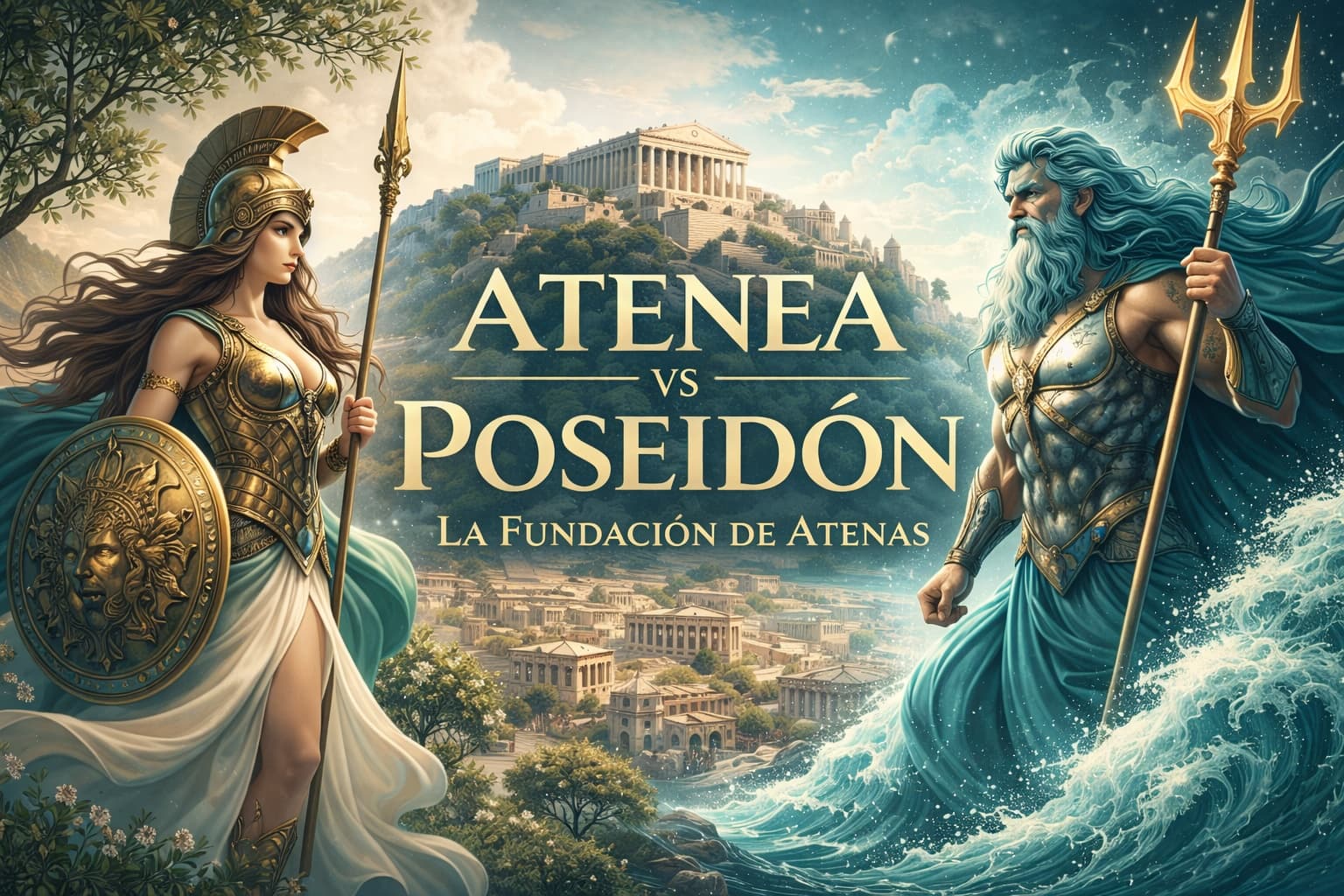
Athena vs. Poseidon: The Founding of Athens
 Andres Aguilar
Two gods. One city. And a competition that would define the destiny of an entire civilization.
Two gods. One city. And a competition that would define the destiny of an entire civilization.
Before Athens was the cradle of democracy, before Socrates walked its streets questioning everything in sight, before the Parthenon gleamed under the Mediterranean sun, there was a dispute between two deities who wanted exactly the same thing: to be the master of the most coveted place in the Greek world. And the way that dispute was settled says a great deal about what the Greeks thought of power, of wisdom, and about what kind of god they wanted as their protector.
Today we're diving into one of the most fascinating stories in all of Greek mythology: the showdown between Athena and Poseidon for control of Athens. Worth saying upfront: this is not just a beautiful story to tell children. There's politics, there's divine ego, there's a jury trial, and there's a decision that the Greeks understood as foundational to their entire culture.
Let's start from the beginning.
A Nameless City at the Heart of Attica
Once upon a time — and when we say "once upon a time," we're talking about the days when gods still mingled in human affairs without much hesitation — there was a city that had no name yet. It sat in a region of Greece that we now call Attica, on a peninsula looking out toward the Aegean Sea.
It was a geographically privileged location: it had an acropolis — a high rocky hill, perfect for building a protected city that would be difficult to attack — access to the sea, and fertile land in the surrounding area. In short, it was a geographical gem.
And when something is a gem, the powerful fight over it. That was always the case, in the world of mortals as much as in the world of gods.
The Contenders: Two Deities, Two Opposite Natures
Poseidon: The Force of the Sea
Poseidon arrived first. Or at least that's what some versions say. The god of the sea — that imposing, impulsive figure, trident in hand, with a well-documented tendency toward enormous fits of rage — set his eyes on that territory and basically declared "this is mine."
Poseidon was one of the three brothers who had divided the world among themselves after defeating the Titans. Zeus got the sky, Hades got the underworld, and Poseidon got the seas. But the seas don't grant power over dry land, and Poseidon always wanted more. He was that kind of character — never satisfied with what he'd been given in the division. In fact, in several Greek myths, Poseidon appears conspiring against Zeus, competing for cities like Corinth or the island of Aegina, and getting into conflicts with nearly all his fellow Olympians. He was not a god of compromise or calm conversation. He was pure force, unbridled temper, and a need for expansion that found no natural limits.
Athena: Strategic Intelligence
At the same time, Athena also set her sights on that hill. Athena, the goddess of wisdom, strategy, craftsmanship, and intelligent warfare — not the brutal, bloody kind, which was Ares's territory — saw the potential of that place and staked her own claim to it.
Athena was no ordinary goddess. She was the daughter of Zeus and the Titaness Metis, and her birth is itself a very singular story worth telling in detail: Zeus swallowed her mother while she was pregnant because a prophecy said that Metis's child would be more powerful than its father, and Athena was born directly from Zeus's head, fully armed and ready for battle. So from day one, this goddess carried an extraordinary backstory and a character entirely equal to it.
The Rules of the Contest
When two deities of that caliber claim the same territory, you can't simply file a deed at a registry office. The conflict had to be resolved another way. And this is where the story gets truly interesting.
The inhabitants of the region — the first settlers of what would become that great city — found themselves caught in the middle of two divine claims. It was the will of the gods themselves — or according to some versions, Zeus's direct decision — that established the rules of the game: there would be a contest. Each god would offer the city a gift, and the mortals — or the gods themselves assembled as a sort of tribunal — would judge which gift was more valuable and important for the community's future. Whoever won would keep the city and the eternal devotion of its people.
Simple in theory.
Poseidon's Gift: The Saltwater Spring
Poseidon went first. To understand his choice, you have to grasp something fundamental about this god: he thought big, he thought in terms of power, he thought in terms of force. His gift had to be impressive, imposing — something that unmistakably showed who he was.
So he climbed to the top of the Acropolis, raised his trident — that three-pronged spear that was his most recognizable symbol — and drove it into the rock with the full force of the god of the ocean.
The result was a genuine miracle. From the stone burst a spring of water. Right there on dry rock, on a hilltop, water. The impact on everyone present was enormous. Water meant life, survival — something every city urgently needed. Poseidon stood there, trident in hand, completely convinced he had won before the other side had even stepped up.
But there was a detail Poseidon, in his arrogance, had failed to consider: the water that sprang from the rock was salty. It was seawater — useless for drinking, useless for irrigating crops, basically useless for everyday human life. A visually stunning spectacle, no doubt. A practical gift, absolutely not.
Athena's Gift: The First Olive Tree
Now it was Athena's turn.
The goddess approached the rock, made her own gesture of power, and from the earth grew a tree. An olive tree. Not exactly the most dramatic display in the world, at first glance. A tree. Poseidon probably relaxed, thinking that was nowhere near competition for the aquatic spectacle he'd just put on.
But there was the key: the olive tree was no ordinary tree for the Greeks. It was a source of oil for cooking, for lighting homes with oil lamps, for anointing the body. Olive wood was hard and durable — perfect for building tools and boats. Olives were nutritious food available year-round. A single well-tended olive tree could live for thousands of years — and here comes the truly remarkable detail: there are olive trees in Greece that experts estimate are over two thousand five hundred years old and are still bearing fruit — producing generation after generation.
Athena hadn't given them a tree. She'd given them an entire economy, a sustainable system of life.
The Verdict: Wisdom Beats Strength
The jury deliberated. The versions vary depending on which source you consult, because the Greeks told their myths in different ways depending on the region and the era. In some versions, it was the gods of Olympus themselves who judged the outcome. In others, it was King Cecrops, the first mythical king of the region — a being half human and half serpent according to the oldest descriptions — who had to decide the fate of his people.
And there's a particularly interesting version that says all the inhabitants of the city voted, men and women alike, and that the olive tree won by a single vote: the women, who were more numerous at the time, all voted for Athena.
This last version carries a pretty significant political twist, which we'll get to shortly.
Whatever the exact process, the verdict was clear: Athena won. The olive tree beat the spring. Practical wisdom beat the display of raw power. And the city took the name of its new patron goddess: Athens.
Poseidon's Reaction
And Poseidon? He did what he always did when he lost something or felt slighted: he reacted disproportionately. The god of the sea sent floods over Attica, destroying crops and farmland. He took his revenge on the mortals for choosing his rival. Not exactly the behavior of a gracious loser.
This trait of Poseidon — punishing mortals when he feels offended or disrespected — shows up in countless Greek myths and is practically his signature as a character.
The Deeper Meaning of the Choice
The most fascinating thing about this myth is what the Greeks — enormously reflective about their own stories — identified in it.
Poseidon's saltwater spring was spectacular. It was power in its most obvious, direct, visible form. Cosmic force manifested in nature. The kind of thing that leaves the observer speechless. And yet it was useless. It was a gift that impressed but didn't feed you, that astonished but couldn't sustain life over the long term.
Athena's olive tree was humble by comparison. There was no drama, no gesture of immeasurable power. It was a tree. But that tree would sustain the economy of an entire civilization for centuries. Olive oil was one of the most important export products of the ancient world. Athens grew wealthy largely through the olive oil trade. The entire Mediterranean adopted the olive culture. And according to the myth, it all began with that first tree planted on top of the Acropolis.
The Athenians' choice was not merely aesthetic or accidental. It was a declaration of collective values: we prefer practical wisdom to a show of force. We prefer what sustains us over time to what impresses us in the moment. It was, in a real sense, a foundational political act. And it's no coincidence that the civilization that made that choice is the same one that later developed philosophy, science, democracy, and theater as we know them.
The Women's Vote and the Rights They Lost
Let's go back to the version of the myth where the women voted for Athena and decided the outcome by their majority. This version appears in the Roman writer Augustine of Hippo's work The City of God, citing earlier Greek sources. According to this account, Poseidon was not only furious about losing — he was furious because women had been the ones to tip the scales.
The political reaction of the men of the city was revealing: to appease the god of the sea and avoid his wrath, they imposed three punishments on women as penance. Women would lose the right to vote. Their children would take the father's name, not the mother's. And women themselves would no longer be recognized as full citizens.
Let's stop here for a moment. We're looking at a myth that serves to explain — or rather to justify — why Athenian women lost their political rights. A myth that says, in essence: "they voted well, they chose correctly, but we took their vote away anyway because their decision made the men uncomfortable — men who wanted to stay on Poseidon's good side." It's one of the most revealing anecdotes about Athenian society you could find, perfectly hidden inside an apparently beautiful founding myth.
The very city that chose a goddess as its patron, the very city that built one of the most beautiful temples in the ancient world in that goddess's honor — the Parthenon, whose name comes from the Greek for "temple of the virgin," because Athena was a virgin, a goddess who submitted to no man or god — was also the same city that kept its real women without political rights for centuries. The contradiction is enormous, and some Greek thinkers pointed it out in their own writings, even if they didn't necessarily question it fully.
The Parthenon, Phidias, and the Artist's Irony
One detail worth highlighting: the Parthenon we can see today on the Acropolis of Athens was built in the fifth century BCE, during Athens's so-called Golden Age, under the statesman Pericles. Inside it stood a monumental statue of Athena made by the sculptor Phidias, considered one of the greatest artists of all antiquity. The statue stood roughly twelve meters tall and was covered in ivory and gold.
It was so extraordinarily valuable that Phidias himself was accused of stealing some of the gold meant for the work. He was jailed, and died in prison. A pretty dark story for the man who had created one of the wonders of the ancient world.
What's also striking is that Phidias didn't just create the statue of Athena in the Parthenon — he also made the enormous statue of Zeus at Olympia, considered one of the Seven Wonders of the Ancient World. An artist who gave form to two of the most powerful gods on Olympus, and who ended his days imprisoned on charges of dishonesty. If that's not a Greek irony, it's hard to find a better one.
Why Did the Greeks Need This Myth?
A question that always comes up when studying these stories is: why did the Greeks need this kind of explanation for the origin of their most important city? Why not simply point to some settlers who founded it in such-and-such a year and leave it at that?
The answer has to do with something very deep about how ancient cultures built their collective identity. For the Greeks, having gods involved in the origin of a city wasn't just a literary flourish. It was an assertion that the city had a cosmic purpose, that it had been chosen, that there was something about it that transcended the merely human. It was a way of saying: we are not just any city. We were the battleground of two great gods, and wisdom itself chose to live among us.
And that narrative worked for centuries. The Athenians built their collective identity around the figure of Athena. They called her Athena Polias — Athena, protector of the city. They celebrated the Panathenaia, a large-scale religious festival held every four years — comparable to the Olympic Games but with a religious and cultural focus — during which a new robe woven by the city's best craftswomen was brought to the goddess.
The Panathenaic procession is depicted in the friezes of the Parthenon, the relief sculptures that decorated the temple and that today are partly in the British Museum in London and partly in the Acropolis Museum in Athens. That split is, incidentally, a whole story of cultural disputes and diplomatic tensions that deserves its own article.
Athena and Poseidon in the Odyssey: The Pattern Repeats
This tension between Athena and Poseidon doesn't end with the founding of the city. There's another famous myth where the two come into direct conflict: that of the hero Odysseus, protagonist of the Odyssey, protected by Athena and hunted by Poseidon simultaneously throughout his very long journey home.
Odysseus takes ten years to return to Ithaca after the Trojan War, and much of that time is spent at sea — Poseidon's absolute domain. The god of the sea never forgave Odysseus for blinding his son, the Cyclops Polyphemus. Athena, on the other hand, deeply admired Odysseus's intelligence and cunning — exactly the values she embodied — and protected him at every possible turn.
The Odyssey is, among other things, a story about two gods fighting over the fate of a mortal, and that mortal survives through wisdom rather than brute force. The pattern repeats: Athena and strategic intelligence against Poseidon and destructive impulse.
Greek culture used these two gods as mirrors of two radically different ways of engaging with the world and with power. And what's fascinating is that the Greeks didn't choose one over the other in absolute terms: Poseidon was also worshipped, respected, and feared. The difference was one of hierarchy: what kind of force do we want as the guardian of our city, the keeper of our home, the one who gives its name to our institutions? And the Athenians, with all the complexity and contradiction that defined them, chose wisdom.
The Legacy: What's Left of All This in the Present
Quite a bit more than we might imagine.
The olive tree remains a major political symbol. The olive branch, which inherits this symbolism directly from the Greeks, is the universal symbol of peace that we know today. The United Nations emblem has two olive branches framing the map of the world. When modern Olympic winners are given an olive wreath — a conscious tribute to the ancient tradition — it carries a symbolic weight rooted in this very myth.
If you've ever wondered why the international symbol of peace is a plant, now you have the answer: it comes from Athena, from that contest at the top of the Acropolis, from a choice the Athenians made three thousand years ago.
The name Athens survived everything. It survived the Roman conquest, which changed the goddess's name to Minerva but respected the city's name. It survived centuries of Ottoman rule. It survived wars, empires, and revolutions. Today it is still the capital of Greece, one of the oldest continuously inhabited cities in the entire world. And it still carries its goddess's name.
The next time you use olive oil for cooking, the next time you see the United Nations flag, the next time you stand before a statue of a woman wearing a helmet and carrying a shield — you'll be able to recognize something very ancient looking back at you. Great civilizations don't build themselves. They are built on decisions, on values, on the choice — conscious or not — of what kind of power we want to guide us.
The Athenians, when they chose the olive tree over the saltwater spring, were choosing the kind of city they wanted to be. And that choice resonated through time in a way none of them could ever have anticipated.
Related episodes
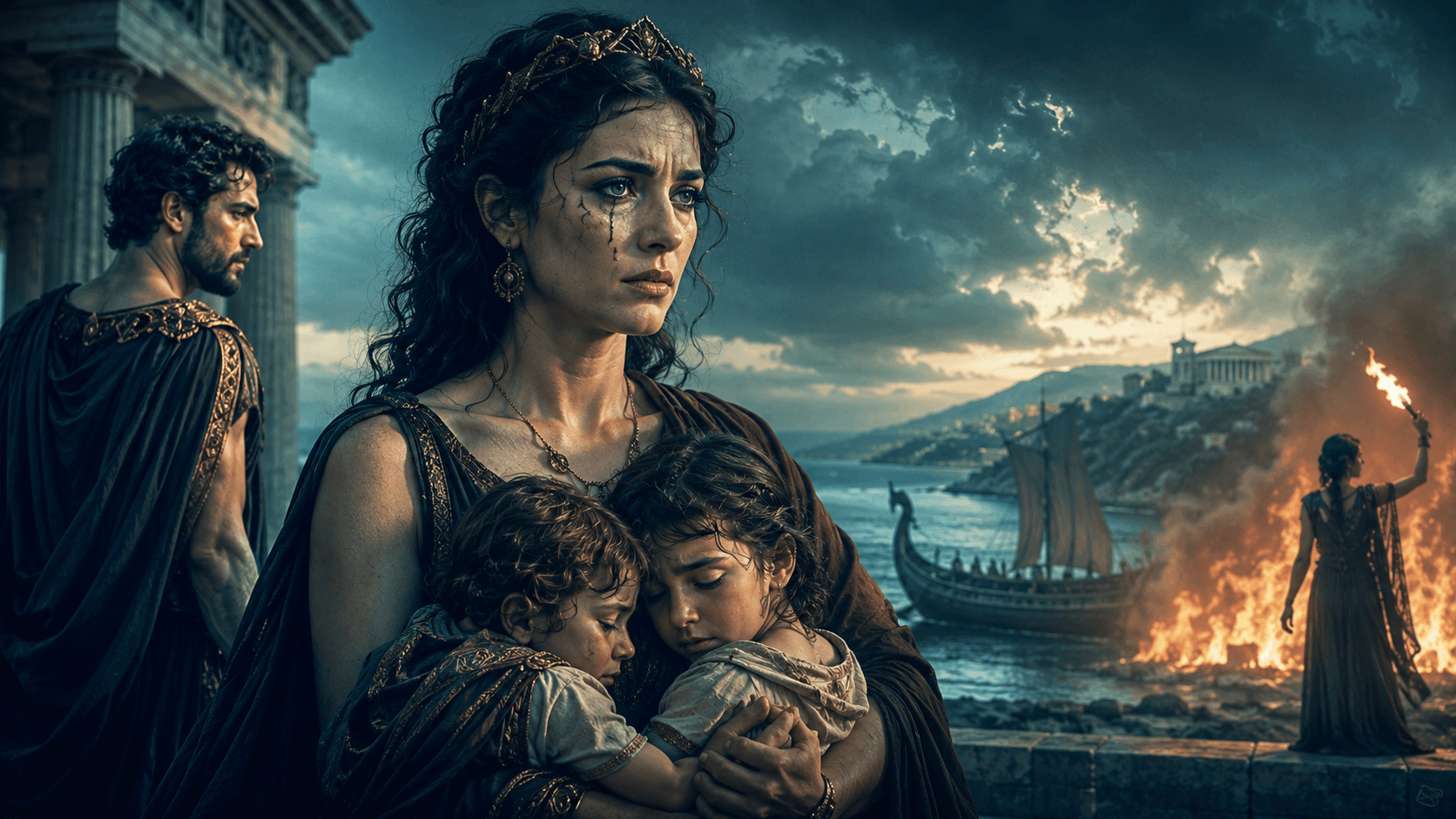
But to understand what Medea did, you must first understand who she was and what they did to her. Because this story doesn't start with a woman who goes crazy for no apparent reason.
First, he got Polyphemus drunk on concentrated wine he had brought with him, filling the cup generously and refilling it several times. When the giant, in his drunkenness, asked his name so he could reward him with a gift, Odysseus answered...
An arrow to the heel, shot by the man who started it all and guided by a god carrying a grudge. That was how Achilles died. Then came the horse, the night, and the fall of Troy. Then Homer: the poet who turned fifty days of that war into the most widel...