
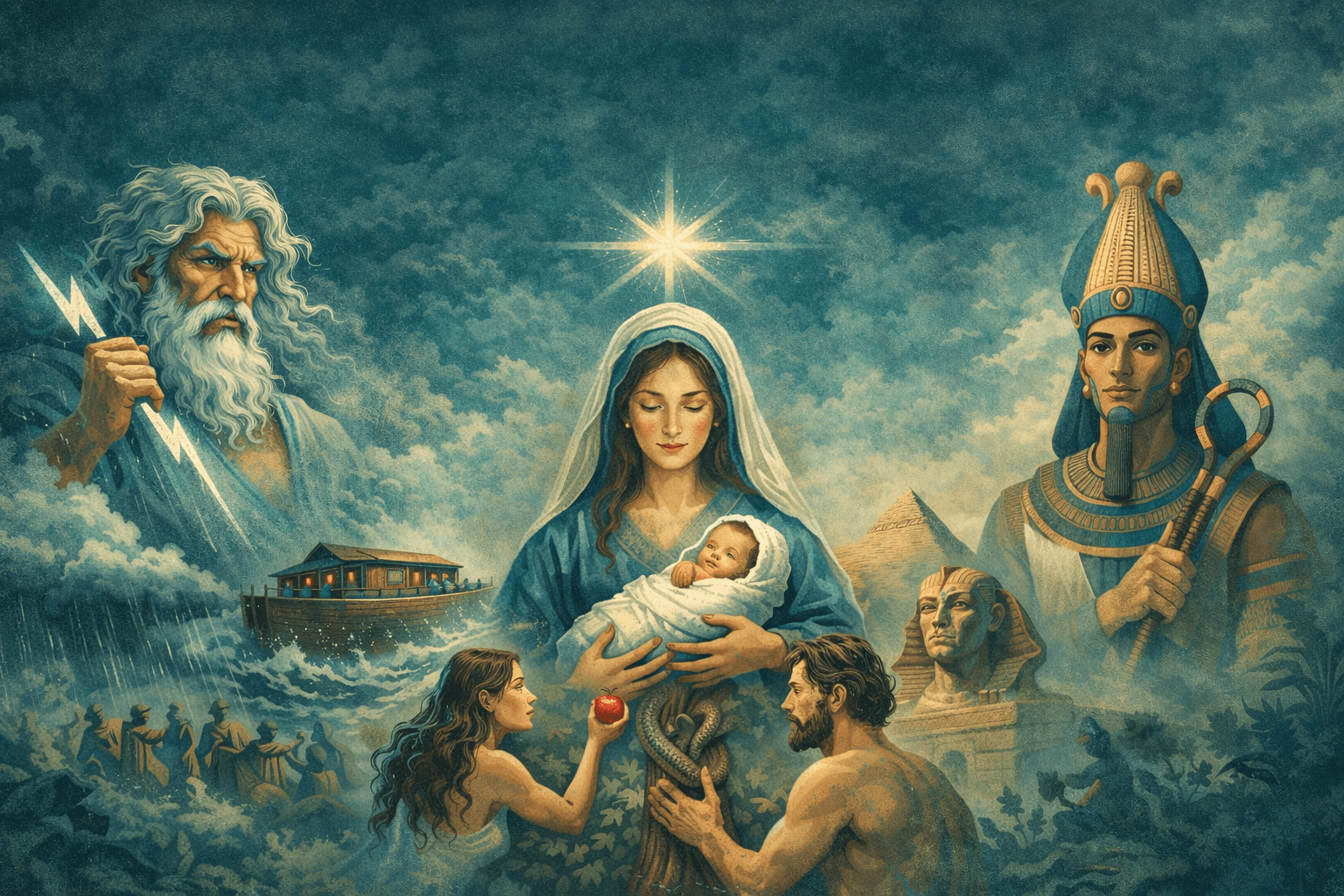
When the Gods Change Their Names: Greek Mythology and Christianity
 Andres Aguilar
Why do so many biblical stories look suspiciously like Greek, Mesopotamian, or Egyptian myths? From Tartarus becoming hell to universal floods, divine virgins, and tempting serpents, the connections are everywhere. In this article we trace the similari...
Why do so many biblical stories look suspiciously like Greek, Mesopotamian, or Egyptian myths? From Tartarus becoming hell to universal floods, divine virgins, and tempting serpents, the connections are everywhere. In this article we trace the similarities that show how Christianity absorbed elements from the traditions that came before it.
A Scene in Second-Century Rome
Picture this scene: it's the year 150 AD, and you're walking through the streets of Rome. You pass a temple where people are praying to Demeter, goddess of agriculture, asking for a good harvest. Two blocks down, another group is praying to Isis, the Egyptian goddess, for exactly the same thing. And on the next corner, a small group of newly converted Christians is asking for blessings on their fields. Three religions, three different gods, but all doing basically the same thing: seeking supernatural help to survive another year.
This is where history gets interesting, because those Christians — who within a couple of centuries would end up dominating the entire empire — didn't arrive with a completely new catalog of ideas. They brought something revolutionary, yes, but they wrapped it in packaging everyone else already recognized. And today we're going to talk about exactly that: how Christianity, the religion that eventually became the largest in the Western world, borrowed, adapted, and reframed a whole lot of elements from the traditions that came before it.
> All religions are daughters of their time and place.
The Same Tools for Explaining the Inexplicable
Here's the thing: a lot of people look back and laugh at the Greeks for believing in some guy with a lightning bolt living on a mountain, or in a ferryman who takes you across a river of fire. It seems quaint, ancient, almost childlike. But then they don't connect the dots when their own religious tradition talks about an underground place full of fire and eternal torture, or a giant sea monster representing primordial chaos. The reality is that human beings have always used the same tools to explain the inexplicable: good and evil, death, suffering, hope. What changes are the names and the details, but the structure — the skeleton of the story — is surprisingly similar.
Tartarus and Hell: The Same Cosmic Prison
Let's start with the most obvious place: hell. When a modern Christian thinks about hell, they probably picture an underground place, dark, full of fire, where the wicked go to suffer for eternity under the supervision of some malevolent entity. Sounds terrible, right? Well, for the ancient Greeks, Tartarus was exactly that. Tartarus wasn't simply the underworld, because the Greek underworld — Hades — was more or less neutral, a place where almost everyone went after death regardless of whether they'd been good or bad. Tartarus was different. It was the cosmic prison, the dungeon of the universe, located so deep beneath the earth that Homer says a bronze anvil would take nine days to fall from the surface to reach it.
And who ended up in Tartarus? The worst of the worst. The Titans, after losing the war against the Olympian gods. Sisyphus, rolling his boulder for eternity. Tantalus, suffering endless thirst and hunger right next to the food and water he could never reach. It was the place of eternal punishment, of endless torture. The Greeks didn't emphasize fire as the main element, but they did emphasize absolute darkness, unbreakable chains, and suffering specifically designed for each condemned soul.
Now let's jump forward a few centuries. Early Christianity needed to explain to people what happened to the wicked after death. When they translated the sacred texts into Greek, they used words the audience already knew. In the Greek New Testament you'll find three different words translated as "hell": Gehenna, Hades, and — in Second Peter — Tartaros. Literally, the text says God cast the rebellious angels into Tartarus. That's not a metaphor. It's the same Tartarus from mythology.
From Hades to the Medieval Satan
Speaking of Hades the character: the Greeks saw him as the god of the underworld, the one who got stuck with the worst job when the cosmos was divided up. He wasn't evil — he was more like a bureaucrat, an administrator of souls. Christianity didn't directly copy Hades as a character, but it did inherit the narrative structure of someone in charge of the realm of the dead.
> The medieval Satan owes far more to the Greco-Roman imagination than to the original Hebrew scriptures.
Leviathan and the Monsters of Chaos
And while we're talking about beasts, we can't leave out Leviathan. This creature appears in the book of Job as a gigantic sea monster, a primordial chaos beast. But that idea isn't original. The Mesopotamians had Tiamat, the Canaanites had Lotan, the Greeks had countless sea monsters — from the Lernaean Hydra to Typhon. All these Mediterranean cultures used giant sea monsters to represent chaos, the uncontrollable, the forces of nature that terrified ancient civilizations.
Virgins Who Give Birth: A Shared Story
Let's move on to virgins who give birth. The story of the virgin birth of Jesus is central to Christianity. Now, the Greeks and Romans were very comfortable with this type of story. Zeus impregnating mortals in all sorts of creative ways. Perseus born from Danaë locked in a tower. Heracles, son of Zeus and a mortal woman. The Romans said Romulus and Remus were the sons of the god Mars and a Vestal Virgin. The Egyptians had Horus, conceived miraculously by Isis. In many cultures, when you wanted to mark someone as special, you gave them a miraculous birth.
Gods Who Die and Rise Again
And speaking of miraculous births, let's talk about resurrections. Jesus dies, descends into the underworld, rises on the third day. But stories of gods who die and come back are ancient. The Eleusinian Mysteries were based on Persephone descending into the underworld and returning each spring. Dionysus is torn apart and resurrected. Osiris in Egypt dies, is reassembled, and rises as lord of the underworld. When Christianity appeared with its resurrection story, it wasn't inventing the concept — it was offering its own version of a deeply rooted idea.
The Saints: The Pantheon Under New Management
The cult of saints is basically the Greco-Roman pantheon under new management. The Greeks had major and minor gods, divinized heroes, local spirits. Athena protected Athens; there were gods for every river and every city. Christianity offered specialized saints: Saint Christopher for travelers, Saint Lucy for eyesight, Saint Anthony for finding lost things. Many Christian churches were literally built on top of pagan temples, and many saints have biographies suspiciously similar to the gods they replaced.
Borrowed Solar Symbolism
The solar symbolism is borrowed too. Jesus is born on December 25th, a date that coincided with the birth of Mithras, the sun god. The Greeks and Romans were obsessed with the sun as a divine symbol. When Christianity adopted that date and started using golden halos, it was borrowing the visual language that people already understood. Even the word "Sunday" carries the name of the sun.
And the Greek Elysian Fields — a perfect place for heroes — became the model for the Christian heaven. A place of perfect beauty, without death or pain. Basically the Elysian Fields with angels instead of Greek heroes.
Specific Narratives That Repeat
But let me tell you something that genuinely blows my mind: there are many more specific stories that repeat across traditions. And I'm not just talking about broad concepts like heaven or hell — I mean concrete narratives that are almost identical.
The Universal Flood
Let's start with the universal flood. Everyone knows the story of Noah: God decides to wipe out corrupt humanity with a flood, tells Noah to build an ark, brings animals in pairs, it rains for forty days, the water covers everything, eventually the ark lands on a mountain, and Noah and his family repopulate the earth. Familiar story. Now, the Greeks had the exact same story with Deucalion and Pyrrha. Zeus decides to destroy corrupt humanity of the Bronze Age with a flood, warns Deucalion to build a wooden chest, it rains for nine days, the water covers everything except the mountaintops, the chest lands on Mount Parnassus, and Deucalion and Pyrrha repopulate the earth by throwing stones that turn into people. The details are different, but the structure is identical. And that's not even mentioning the Mesopotamian Epic of Gilgamesh, which has the same story a thousand years before the biblical version.
> The flood is not an original Judeo-Christian story. It's a Near Eastern myth that Judaism adapted.
Plagues as Divine Punishment
The plagues are also interesting. In Exodus, God sends ten plagues upon Egypt to force Pharaoh to free the Hebrews: water turned to blood, frogs, lice, flies, livestock disease, boils, hail, locusts, darkness, death of the firstborn. That sounds very specific and unique, right? But the Greeks also had stories of gods sending plagues to punish cities or kings who had offended them. Apollo sends a plague upon the Greek army at the beginning of the Iliad because Agamemnon dishonored his priest. Artemis sends a giant boar to destroy the fields of Calydon because the king forgot to make sacrifices to her. The idea of divine punishment through sequential natural disasters was part of the narrative repertoire of all these cultures.
Serpents and Dragons
Let's talk about the serpent as a symbol of evil. In Genesis, the serpent tempts Eve, she and Adam eat the forbidden fruit, and the serpent is cursed to crawl on the ground forever. The serpent as a symbol of deception and evil runs throughout the Bible, culminating in the apocalyptic dragon in Revelation. Now, in Greek mythology, Apollo has to kill the serpent Python to establish his oracle at Delphi, representing the triumph of order over primordial chaos. In many Mediterranean cultures, serpents and dragons represented chaotic, dangerous forces that had to be defeated. It's no coincidence that Saint George slaying the dragon is basically indistinguishable from Perseus killing the sea monster or Apollo killing Python. It's the same archetype with different names.
Man Made from Clay
The story of man made from clay is universal. Genesis says God formed Adam from the dust of the earth. In Greek mythology, Prometheus creates humans by mixing earth with water. In Egyptian myths, the god Khnum molds humans on a potter's wheel using clay. In Mesopotamian traditions, the gods mix clay with the blood of a sacrificed god to create humans. All these cultures independently arrived at the same metaphor: we come from the earth, and to the earth we return.
The Death of Pan and the Crucifixion
Here's a specific connection that is genuinely unsettling: when the Gospels narrate the crucifixion, they say there were three hours of darkness over all the land, from noon until three in the afternoon. Now, there is a historical record from Plutarch, the Greek historian, that describes how when the god Pan died, there were signs in the sky and a supernatural announcement. In fact, there is a tradition suggesting that the "death of the great Pan" and the crucifixion of Jesus occurred around the same time, and some early Christians interpreted the death of Pan as the end of paganism and the beginning of Christianity. It's as if a cosmic passing of the torch was happening — the old god dying so the new one could be born.
Giants of a Former World
Giants are another fascinating example. In Genesis 6, the Nephilim are mentioned — giants who existed when "the sons of God came in to the daughters of men." They're described as mighty warriors of antiquity. The Greeks had plenty of giants: the Titans, the Giants who fought against the Olympian gods, the Cyclopes. Beings of superhuman size and strength who existed in primordial times and represented an earlier, wilder, more chaotic era. In both traditions, giants are remnants of a former world that must be overcome for current civilization to arrive.
The Sacrifice of the Son
The sacrifice of Isaac is narratively very similar to the sacrifice of Iphigenia in Greek mythology. God asks Abraham to sacrifice his son Isaac on a mountain, Abraham is willing to do it, and at the last second an angel stops his hand and a ram appears to be sacrificed in his place. In the Greek version, Agamemnon must sacrifice his daughter Iphigenia so the fleet can sail to Troy, and he is about to do it when — in some versions — the goddess Artemis replaces her with a deer at the last moment. It's the same structure: a parent willing to sacrifice their child out of divine obedience, a last-minute supernatural intervention, an animal substitute. Both stories explore the theme of extreme obedience and the cost of faith.
Towers and Mountains to the Sky
The Tower of Babel has its Greek parallel in the story of the Giants stacking mountains. In Genesis, humans try to build a tower reaching to heaven, God punishes them by confusing their languages and scattering them. In Greek mythology, the Giants stack mountains on top of one another to try to reach Olympus and attack the gods; Zeus defeats them with lightning bolts. Same idea: humans or mortal beings attempting to reach the divine realm through physical construction, divine punishment for arrogance. It's the archetype of pride punished.
Divine Healers and Resurrections
The miracles of healing and raising the dead that Jesus performs in the Gospels aren't unique either. Asclepius, the Greek god of medicine, was so good at healing that he started raising the dead. Zeus had to strike him down with a lightning bolt because he was upsetting the natural order. Elijah and Elisha in the Old Testament had already raised dead children before Jesus. Apollonius of Tyana, a philosopher contemporary to Jesus, also has miracles and healings attributed to him. The divine healer who could restore life was a recognizable type of figure in the ancient world.
Forbidden Fruit and Forbidden Knowledge
And one last one I find fascinating: the Tree of Knowledge of Good and Evil in Eden has parallels with multiple Greek myths about forbidden fruits or forbidden knowledge. The golden apples of the Hesperides' garden that grant immortality and are zealously guarded. Prometheus stealing divine fire to give it to humans and being eternally punished for it. Pandora opening the box that contains all the evils of the world out of curiosity. All these stories share the same moral: there is knowledge or power that humans shouldn't have, and seeking it brings punishment and terrible consequences.
These Are Not Coincidences
These ten similarities — from floods to forbidden trees — reveal something important: they are not coincidences. They are the result of cultures that share geography, history, and similar narrative needs. Stories migrate, adapt, and get reinterpreted. Judaism and later Christianity emerged in the same cultural world that produced these other mythologies, and naturally shared narrative tools.
Now, I know what some people are thinking: "You're saying Christianity is just recycled mythology." No. What I'm saying is that no religion appears in a vacuum. Christianity emerged in the Greco-Roman world, spread through that world, and naturally absorbed elements from the cultures it interacted with.
The Irony of Looking at the Past
What I find fascinating — and a little ironic — is how many people can look at Greek myths as quaint old stories while holding structurally similar beliefs themselves.
> A guy rolling a boulder for eternity seems ridiculous to them, but condemning souls to a hell of eternal fire seems reasonable. Zeus transforming into a swan seems absurd, but an angel announcing a virgin pregnancy seems sacred.
I'm not saying one thing is more valid than the other. I'm saying both are expressions of the human need to find meaning, to connect with something greater. The Greeks did it with their gods on Olympus. Christians do it with their triune God. The narrative tools are similar because we're answering the same fundamental questions.
Chapters of the Same Book
The important thing is to maintain the intellectual humility to recognize this. To understand that our beliefs, whatever they may be, are part of a larger human conversation about the divine. That the Greeks believing in Zeus and Christians believing in Yahweh are fundamentally doing the same thing: trying to make sense of a universe that sometimes seems to have none.
So the next time someone laughs at the Greeks for believing in Cerberus, the three-headed dog, remember that their own tradition probably has angels with six wings covered in eyes, or demons with hooves, or some equally fantastic image. And that's fine — those images are the tools we use to talk about the ineffable.
Greek mythology and Christianity are part of the same human search. One no longer has active believers and is considered mythology. The other has billions of believers and is considered living faith. But in the grand sweep of human history, they are two chapters of the same book.
Related episodes
But to understand what Medea did, you must first understand who she was and what they did to her. Because this story doesn't start with a woman who goes crazy for no apparent reason.
First, he got Polyphemus drunk on concentrated wine he had brought with him, filling the cup generously and refilling it several times. When the giant, in his drunkenness, asked his name so he could reward him with a gift, Odysseus answered...
An arrow to the heel, shot by the man who started it all and guided by a god carrying a grudge. That was how Achilles died. Then came the horse, the night, and the fall of Troy. Then Homer: the poet who turned fifty days of that war into the most widel...