
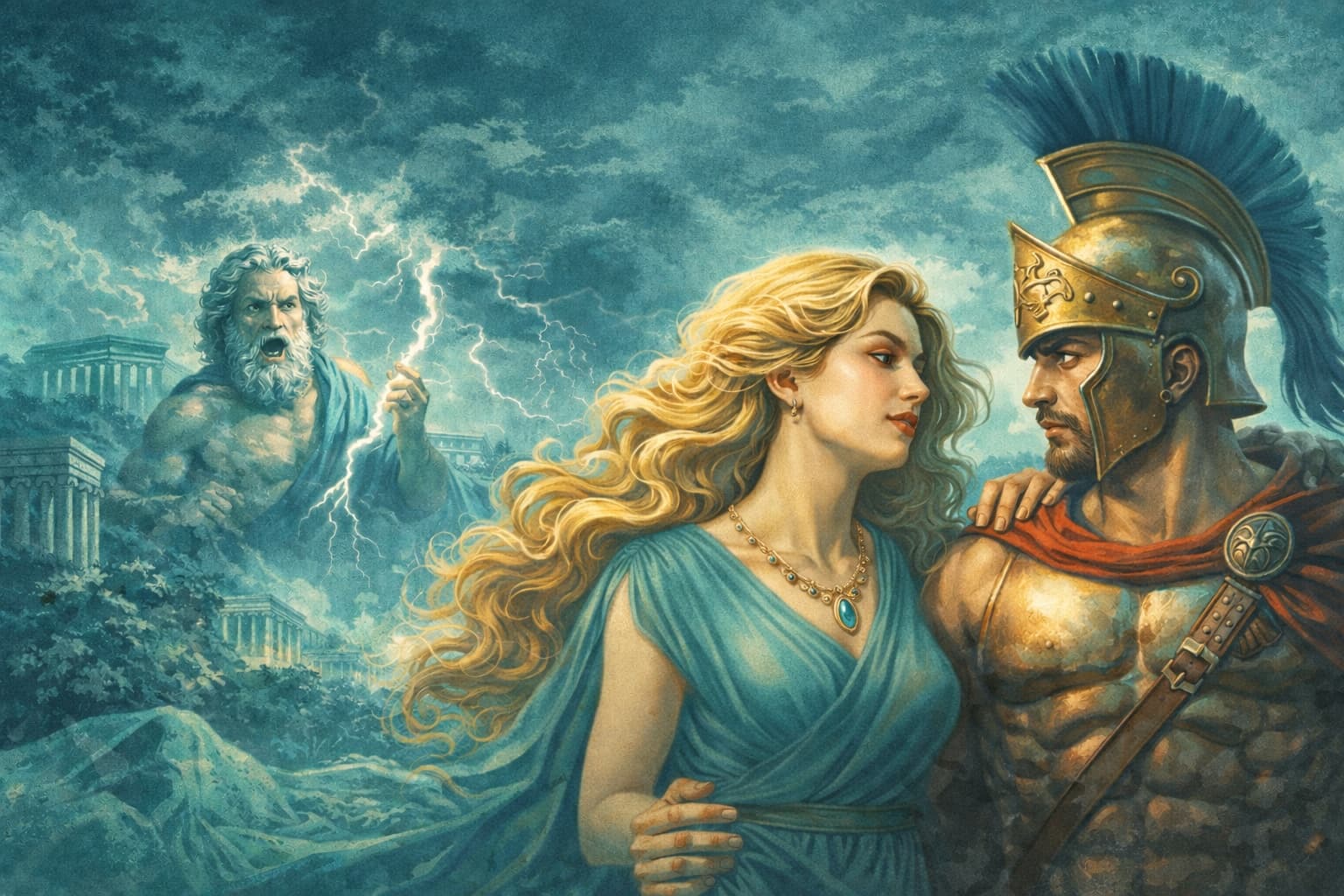
Aphrodite, Ares, and the Olympian Scandal
 Andres Aguilar
Zeus married Aphrodite, goddess of love, to Hephaestus the smith of Olympus — thinking that would prevent trouble. It didn't. What followed was a trap, a magical net, and a scene that left the immortal gods collapsed in laughter. The story of the most ...
In the history of Olympus there were many scandals, but none quite as juicy as the day the gods gathered to watch two of the most powerful immortals caught in bed together. Naked. Wrapped in a magical net impossible to break. And best of all: with a live audience. Today we're talking about Aphrodite, Ares, and the most ingeniously cuckolded husband in all of Greek mythology.
The Birth of Aphrodite: The Irresistible Goddess
Before we get to the scandal itself, we need to understand the players. Let's start with her — the goddess of love, beauty, and desire: Aphrodite. Her birth is already a story that deserves its own episode, but here's the quick version. When Cronus castrated his father Uranus and threw the severed parts into the sea, Aphrodite was born from the foam that formed when they hit the water.
She emerged from the sea near Cyprus — already an adult, already perfect, already irresistible. She appeared as the living embodiment of everything that can make a mortal or a god lose their mind. And here comes the first problem in our story: when she arrived on Olympus, every god wanted her for himself. Zeus, the boss of Olympus, quickly realized this was going to end badly.
> Aphrodite appeared as the living embodiment of everything that can make a mortal or a god completely lose their head.
Think about it for a second. You've got Poseidon, who was not exactly famous for his self-control. There was Apollo, the god of masculine beauty. Hermes, with his weakness for romantic conquests. And there was Ares, who was already losing his mind over Aphrodite. The situation was a ticking time bomb.
The Forced Marriage to Hephaestus
So Zeus made a decision that, in hindsight, was pretty cruel: he married Aphrodite off to Hephaestus, the god of fire and the forge. Now, Hephaestus was brilliant — a craftsman without equal, capable of creating wonders nobody else could imagine. He forged Zeus's lightning bolt, Poseidon's trident, the weapons of the gods. But there was one detail: he wasn't exactly the heartthrob of Olympus. And on top of that, he had a complicated family history.
Hera, his mother, had thrown him off Olympus when he was born because she found him ugly. Yes — the goddess of marriage threw her own son off a cliff. Hephaestus fell for an entire day before crashing on the island of Lemnos, where he was left lame for life. He eventually returned to Olympus, but he was always the outsider, the one who didn't fit the aesthetic of physical perfection that characterized the other gods.
Picture the scene: the most beautiful goddess in the universe married to the ugly blacksmith of Olympus. Zeus basically said "you're marrying Hephaestus and that's that," and Aphrodite didn't have much say in the matter. On Olympus, when the boss spoke, everyone obeyed. There was a twisted logic to it all: Hephaestus was safe, he wouldn't cause political problems.
But Zeus underestimated one thing: you can't force love. And you definitely can't expect someone like Aphrodite — the living personification of desire itself — to settle for a passionless marriage.
Ares: Pure Muscle and Testosterone
And here's where our other protagonist enters: Ares, the god of war. If Hephaestus was the brains, Ares was pure muscle and testosterone. Tall, powerfully built, aggressive, impulsive, violent. He was everything Hephaestus was not. While Hephaestus spent his days at his forge creating incredible things, Ares spent his time picking fights, stirring up conflict, reveling in chaos. He wasn't the god of strategic warfare — that was Athena. Ares was war in its most brutal, most primitive, most bloody form.
The Greeks didn't have much love for Ares. In the Iliad, Homer describes him as a cowardly god who cries when he gets wounded. There's a scene where Diomedes — a mortal hero — wounds him in battle and Ares goes running back to Olympus in tears. Even his own father Zeus tells him he's the most hateful of all the gods on Olympus.
But there was one thing Ares had going for him: Aphrodite couldn't resist him. Because she hadn't chosen her husband — she'd been forced into the marriage. She was trapped in a union she'd never wanted. And when Ares showed up, with all his wild energy, Aphrodite found the exact opposite of her married life.
> Love and war. Beauty and violence. They seem like opposites, but the Greeks understood there was a deep connection between these concepts.
There's something fascinating about this pairing. The passion that makes you fall head over heels in love is the same one that makes you fight with ferocity.
The Secret Romance and Their Children
The romance between Aphrodite and Ares wasn't a one-night affair. It was a long, passionate, and fairly brazen relationship. They met in secret — or so they thought. They had several children together: Eros, the god of erotic love; Deimos and Phobos, terror and fear, who accompanied their father into battle; and Harmonia, who was ironically the goddess of harmony.
But let's get back to the main scandal. Because there's a big difference between having a secret romance and getting caught in the worst possible way.
Helios, the Solar Gossip
The one who caught them was Helios, the god of the sun. Makes sense, right? The guy drove his chariot of fire across the sky every day and saw absolutely everything that happened on earth and on Olympus. It was impossible to hide anything from Helios. Nothing escaped his sight.
One day, while making his daily circuit, he spotted Aphrodite and Ares together in Hephaestus's house. In his bed. In the middle of the act. Helios went straight to Hephaestus and told him everything. Imagine getting that news. Your wife — the most beautiful goddess in the universe — is cheating on you with the god of war in your own house, in your own bed. The humiliation was total.
The Craftsman's Revenge
But Hephaestus didn't react the way any impulsive god would have. He didn't go rushing in to confront them, didn't make a scene on the spot, didn't grab his hammer to smash Ares's skull. Hephaestus was a craftsman — someone who solved problems with intelligence and skill. His whole life he'd had to compensate for his physical disability with ingenuity. And he decided to use exactly those talents to get revenge in a way nobody would ever forget.
He went to his forge and worked in secret. He created a magical net — so fine it was invisible, so strong that not even the gods could break it. He wove it from a special metal only he knew how to make, and he infused it with magic, with all his skill and all his pain. Every knot in that net carried years of humiliation, of knowing that his wife despised him.
> It was vengeance converted into art, pain transformed into ingenuity.
The net was a masterpiece. Invisible as air, but stronger than adamantine. Hephaestus designed it to be triggered by the weight of two bodies on the bed, to close automatically and inescapably.
When he finished, he carefully installed it around his marriage bed. A perfect trap, invisible, waiting for just the right moment.
The Trap Snaps Shut
Hephaestus pretended to go on a trip. He told Aphrodite he had business to attend to in Lemnos and would be away for several days. He said goodbye, left Olympus, and Aphrodite walked right into the trap exactly as Hephaestus had planned. Because here's something to understand: Aphrodite was so sure of herself, so used to getting away with everything, that she suspected nothing.
The moment Hephaestus was gone, Aphrodite sent for Ares. They finally had the place to themselves — they could be together without a care in the world. Or so they thought. Ares arrived at a gallop from his temple, thrilled at the opportunity.
They went to the bedroom, got into bed, and the moment they began doing what they were doing, the net activated. It closed around them like a spider catching flies, wrapped them completely, immobilizing them in the most compromising position possible. Ares's arms around Aphrodite, their bodies entwined, with no way to separate, no way to cover themselves.
They tried to free themselves, obviously. Ares was war personified — he had the strength of a thousand armies. He'd ripped castle doors off their hinges with his bare hands. But Hephaestus's net was perfect. The harder they struggled, the tighter it became. Aphrodite tried to use her magic, but the net was immune. Hephaestus had designed it specifically to resist every kind of divine power.
They were completely trapped, naked, in a situation that left absolutely nothing to the imagination.
The Public Spectacle
And then Hephaestus appeared. He hadn't gone anywhere — he'd just been hovering near Olympus, waiting for the right moment. He walked into his bedroom and found them exactly as he had planned. But he didn't stay quiet about it. Hephaestus wanted public justice. He wanted everyone to know what had happened.
He called all the gods of Olympus. He summoned them to his house to see with their own eyes what his wife and Ares had done. He bellowed with a voice like thunder. And here comes one of the most interesting details: the only ones who showed up were the male gods. The goddesses, out of modesty or female solidarity, stayed home.
Hera didn't go — probably because she knew all too well what it was like to have an unfaithful husband. Athena didn't appear either. Artemis, the virgin goddess, was definitely not going to witness that. But the male gods came in full force.
The scene must have been something else. Zeus, Poseidon, Apollo, Hermes — all the heavyweight names on Olympus gathered in Hephaestus's bedroom, staring at Aphrodite and Ares trapped in the net, completely naked. Homer recounts in the Odyssey that the gods laughed nonstop, cracked jokes, and commented among themselves like they were watching a show.
Hermes's Joke
Apollo, ever direct, asked Hermes whether he'd be willing to be in that position — exposed in front of everyone — if it meant being with Aphrodite. And Hermes, with all the nerve in the world, said yes: even with triple the chains and everyone watching, he'd happily be there with the goddess of love. The gods laughed even harder. It was the joke of the millennium.
Zeus was probably standing there with an ironic smile — him, who had cheated on Hera countless times. Poseidon, who was no model of fidelity himself, watched with interest. Apollo delivered sarcastic commentary.
Ares's Humiliation and Aphrodite's Cold Fury
Ares, meanwhile, was experiencing something he had probably never felt before: absolute shame. The god of war, the most violent of all, was completely humiliated in front of all his peers. He couldn't fight, couldn't shout credible threats, couldn't escape. He could only lie there, naked and trapped, the butt of everyone's jokes.
Aphrodite was furious too, but her fury was different — colder, more calculated. She knew that eventually she'd get out of there, and when she did, there would be consequences. In later myths, Aphrodite would make Helios fall hopelessly in love with a mortal, causing him all kinds of grief. The Greek gods always got their revenge.
Poseidon's Intervention
Hephaestus, while displaying his magical net, was demanding formal justice. He wanted Zeus to return all the wedding gifts. Essentially he wanted to annul the marriage and get his investment back. He talked about his honor, about how he had been betrayed.
Poseidon finally stepped in. He was probably starting to feel uncomfortable. He told Hephaestus to release the lovers and personally guaranteed that Ares would pay the appropriate compensation. It was a significant promise, coming from Poseidon.
Hephaestus agreed, though he asked a reasonable question: what if Ares didn't pay up? Poseidon said he would pay in his place.
Hephaestus released the net with a gesture of his hand. And Aphrodite and Ares shot out of there faster than arrows. The goddess fled to Cyprus to purify herself and recover from the humiliation. Ares headed straight for Thrace, probably looking for some battle to restore his pride. Nothing like a bit of violence to make yourself feel better.
The Love That Didn't Break
But here's something interesting: despite the whole scandal, Aphrodite and Ares kept seeing each other. Their relationship didn't end with Hephaestus's trap. They kept meeting, kept having children, kept loving each other in their chaotic way. Public humiliation didn't kill their love — it just made them more careful.
The marriage between Aphrodite and Hephaestus was never formally dissolved. They remained married in name, though they lived completely separate lives. Hephaestus kept working at his forge, creating wonders. And Aphrodite kept being Aphrodite, having romances with gods and mortals alike.
What the Myth Tells Us About the Greeks
This myth tells us a great deal about how the Greeks viewed marriage, love, and desire. Marriage was more of a political arrangement than a matter of feelings. Nobody expected automatic fidelity, but they did expect discretion. Aphrodite and Ares's problem wasn't so much that they loved each other — it was that they were careless, that they caused a public scandal.
It's also interesting to note the different reactions of the gods. The males showed up to watch, laughed, cracked jokes. But the goddesses kept their distance. Perhaps they understood better than anyone what it meant to be in a marriage you didn't choose.
The story of Hephaestus's trap became enormously famous throughout Greece. It appears in Homer's Odyssey, where a bard tells the tale to entertain the guests of King Alcinous. The Greeks loved this story because it had everything: sex, deception, clever revenge, public humiliation, and the gods behaving in a very human way.
The Triumph of Ingenuity Over Brute Force
And speaking of the gods' humanity, this myth also reveals something deeper. Hephaestus — the god who physically didn't fit the Olympian ideal, who had been rejected by his own mother, the unwanted husband — finally had his moment of absolute victory. He used his intelligence, his unique skill, to prove that you don't need physical beauty or military power to command respect.
> Ares had the muscles, Aphrodite had the beauty, but Hephaestus had something neither of them could match: creative ingenuity.
His revenge was perfect, elaborate, artistic in its execution. He didn't kill anyone, didn't cause destruction — he simply revealed the truth in the most spectacular way possible.
In ancient Greek art, this scene was depicted countless times: on vases, in Pompeian murals, in sculptures. Artists loved this moment because it combined eroticism with humor, morality with transgression.
"Hephaestus's Nets": An Expression That Survived Centuries
And here's a fact that might blow your mind: from Aphrodite comes the word "aphrodisiac" — those substances or foods supposedly capable of increasing sexual desire. The ancient Greeks associated everything related to attraction and desire with this goddess. But there's more. In ancient Greece, when someone got caught in an embarrassing situation they couldn't escape from — especially involving love — people said they had fallen into "the nets of Hephaestus." The expression became so common it entered everyday speech. It was like saying "caught red-handed," Greek-style.
There was even a custom in some Greek cities where blacksmiths and craftsmen, in honor of Hephaestus, had a special day on which they were allowed to play elaborate pranks on adulterous couples in town. It was a kind of carnival where ingenuity and cleverness triumphed over brute force. Greek philosophers also used this myth in their teachings about justice. Plato mentions it in his dialogues as an example of how intelligence can be a more lasting form of power than physical strength or superficial beauty.
The Legacy Through the Centuries
The legacy of this myth lived on for centuries. In Roman literature, Ovid took it up in his Metamorphoses. In the Renaissance, painters like Tintoretto, Rubens, and Velázquez recreated the scene. The image of the trapped lovers became a universal symbol of discovered adultery.
There's something universally compelling about this story. The love triangle where brains beat out brawn, where the betrayed husband responds not with violence but with cunning, where the powerful are publicly humiliated. It's a story of poetic justice.
And thinking about it, this story is still completely relevant today. We're still fascinated by celebrity love scandals, we still consume gossip about who's cheating on whom. The Greek gods were like the celebrities of their era, and their scandals were discussed in the agora the same way we discuss them on social media today.
The difference is that the Greeks didn't pretend their gods were morally perfect. The gods were powerful and immortal, but also petty, jealous, vengeful, lustful, and tremendously complicated. They were like humans with superpowers — and that's what made them so interesting.
A Story Without Redemption
Aphrodite never apologized. Ares showed no genuine remorse. They went on with their lives, perhaps a bit more careful. Hephaestus had his spectacular revenge but didn't win back his wife — and truthfully didn't really want her back. Everyone kept on being exactly who they were, because in Greek mythology, characters don't fundamentally change.
This Olympian scandal reminds us that even the most powerful beings can be caught by their own desires, that intelligence can be more powerful than brute force or physical beauty, and that in love, war, and revenge, timing and strategy are everything.
Related episodes

But to understand what Medea did, you must first understand who she was and what they did to her. Because this story doesn't start with a woman who goes crazy for no apparent reason.
First, he got Polyphemus drunk on concentrated wine he had brought with him, filling the cup generously and refilling it several times. When the giant, in his drunkenness, asked his name so he could reward him with a gift, Odysseus answered...
An arrow to the heel, shot by the man who started it all and guided by a god carrying a grudge. That was how Achilles died. Then came the horse, the night, and the fall of Troy. Then Homer: the poet who turned fifty days of that war into the most widel...