
Dionysus: The God Who Was Born Twice
 Andres Aguilar
Dionysus arrived late to Olympus, was born twice through divine accident, and built a cult that blended euphoria with terror. He was the god of wine, yes — but also of theater, collective madness, and that strange territory where civilization and the w...
There's a Greek god who arrived late to the Olympian party, who was born twice, who drove people mad, who was the god of wine but also of theater, and who has one of the most disturbing and fascinating cults in all of antiquity. A god the Greeks needed as much as they feared. Today we're talking about Dionysus, and fair warning: this story has everything — mothers incinerated, babies sewn into thighs, women tearing lions apart with their bare hands, and the origin of Western theater. So get comfortable, because here we go.
The Birth That Changed Everything
The story of Dionysus begins with a romance that, like so many in Greek mythology, ends in tragedy. Zeus — who never learned his lesson — falls in love with Semele, a mortal princess from Thebes. And when I say he falls in love, I mean it, because this wasn't just another one of his thousand flings. Semele becomes pregnant, and this is where Hera, Zeus's wife, enters the picture with that special talent she had for making the lives of her husband's lovers absolutely miserable.
Hera's Trap
But this time, instead of going straight for violence, Hera plays it smarter. She disguises herself as an old woman, befriends Semele, and plants a seed of doubt in her mind: are you sure your lover is really Zeus? Because anyone can claim to be the king of the gods, right? And she suggests that Semele ask Zeus to appear to her in his true form, in all his divine glory, to prove it.
Semele falls for it. She asks Zeus to grant her a wish, and he — in love and not thinking clearly — swears by the River Styx that he'll give her whatever she asks. When the gods swore by the Styx, there was no going back, not even for Zeus. So Semele asks him to reveal himself as he truly is. Zeus is horrified because he knows what's going to happen. He begs her to ask for something else, but it's too late. A vow is a vow.
The First Birth: From Semele's Womb
When Zeus reveals himself in his full divine form — lightning, thunder, and the entire power of the universe — Semele, being mortal, cannot survive it. She is incinerated on the spot. But here's the key: she was six months pregnant. Zeus, in a desperate act, rescues the baby from his mother's ashes and does something that sounds completely insane: he cuts open his own thigh and sews the baby inside so it can complete its gestation.
The Second Birth: From Zeus's Thigh
That's why Dionysus is the god who was born twice. First from the womb of his mortal mother, Semele, and then from the thigh of his divine father, Zeus. This double birth makes him something unique in the Greek pantheon: a god with one foot in the mortal world and one foot in the divine. He is not completely Olympian like Athena or Apollo, but he is not mortal either. He is something in between, something liminal, and that ambiguity will define his entire cult.
The Complicated Childhood of a God
Once he is born for the second time, Zeus has a problem: where does he hide this baby so Hera doesn't find him and destroy him? Because Hera was still furious, obviously. Zeus first entrusts him to the nymphs of Mount Nysa to raise him in secret. These nymphs will later be rewarded by being transformed into a constellation, the Hyades.
The Madness Sent by Hera
But Hera finds out anyway and sends madness down upon him. This is where the story gets darker. Dionysus, as a child or young adolescent depending on the version, is seized by madness and begins to wander the world aimlessly. This is not a mild confusion — it's savage, animalistic, terrifying madness.
Zeus tries to save him again and transforms him into a kid goat to hide him better. That's why Dionysus will always be associated with goats and billy goats, and why his followers dress in animal skins. Finally, Zeus gets the goddess Rhea — his own mother — to cure Dionysus of the madness. Rhea was an expert in purification rituals and ecstatic cults, so she was the right one to help.
The Journey That Makes Him a God
Once cured, Dionysus doesn't go straight to Olympus to claim his place. Instead, he embarks on an epic journey throughout the known world. He travels through Egypt, Syria, Phrygia in Asia Minor, and makes it all the way to India. And on this journey he does something revolutionary: he teaches humanity the cultivation of the vine and the production of wine.
Wine as Civilization
But hold on — for the Greeks, wine wasn't just alcohol for getting drunk. Wine was culture, was civilization. The Greeks always mixed wine with water before drinking it. Drinking pure wine was considered barbaric, something only savages would do. Wine mixed with water in the right proportion was what separated civilized men from brutes.
The Dionysian Thiasus
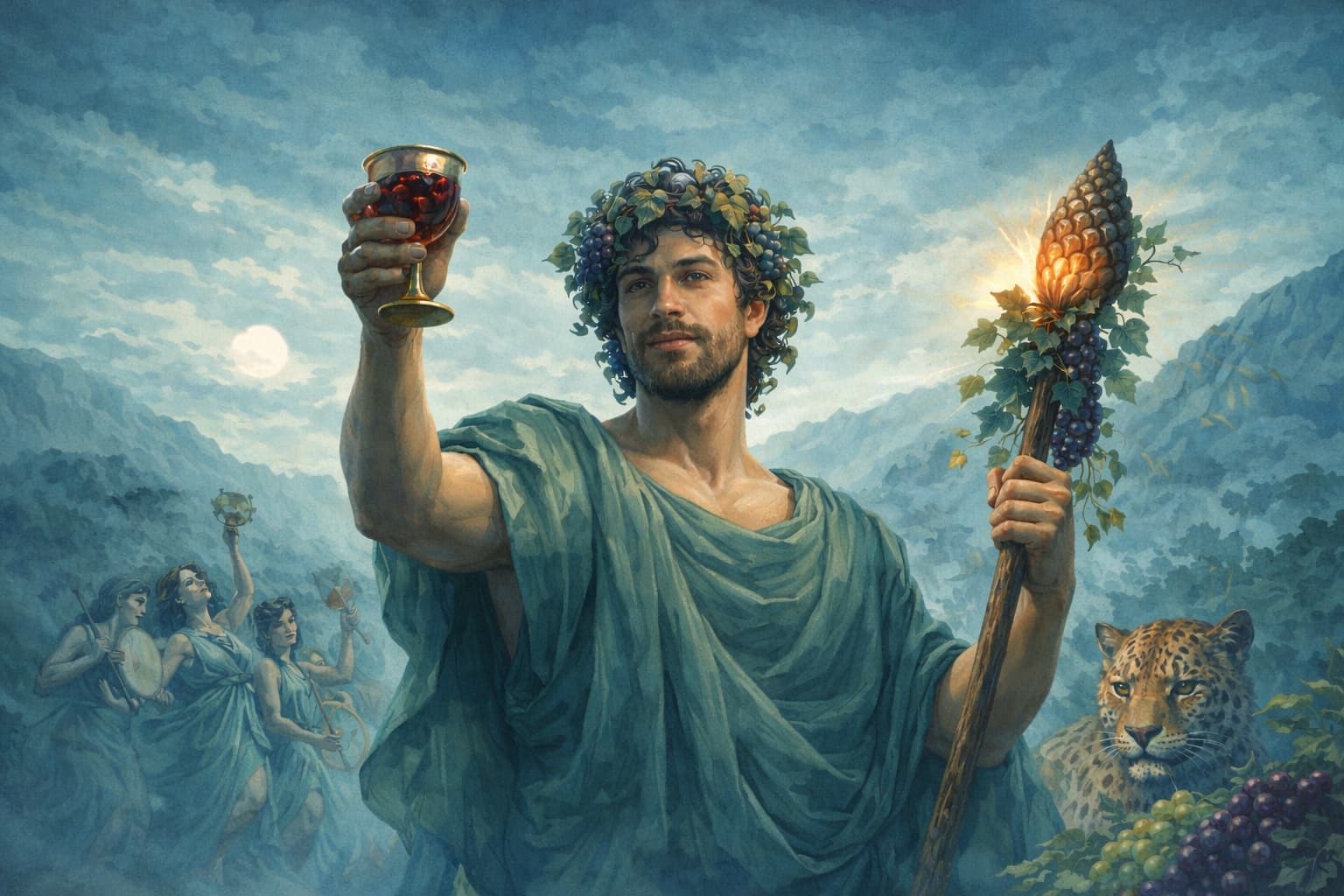
Dionysus spreads this knowledge wherever he goes, but he doesn't do it alone. He's accompanied by a particular retinue: satyrs — those half-man, half-goat creatures, always drunk and lustful — and the Maenads, human women possessed by the god and in a state of religious ecstasy. This group forms what is called the Dionysian thiasus, and it's an image that appears again and again in Greek art: Dionysus advancing, surrounded by this wild company, conquering the world not with weapons but with wine and ecstasy.
A God Who Must Prove His Divinity
Here's something fascinating: Dionysus is the only Olympian god who has to prove his divinity, who has to fight for his place. The other gods simply are. But Dionysus has to travel, has to demonstrate that he is a god, has to face rejection and resistance.
The Troubled Return to Greece
When Dionysus returns to Greece, things don't go as he'd hoped. City after city, the rulers refuse to recognize him as a god and ban his cult. And this is where a series of brutal stories unfold about what happens when you say no to Dionysus.
The Tragedy of Pentheus
The most famous is that of Pentheus, the king of Thebes — the very city where his mother Semele had been born. Pentheus is Dionysus's cousin, but he doesn't believe he's a god. He thinks this whole business with wine and women dancing on the mountain is dangerous, immoral, a threat to the social order. So he bans the cult.
Dionysus doesn't react obviously. He doesn't hurl thunderbolts or cause earthquakes. His revenge is more twisted. He drives all the women of Thebes mad, including Agave, Pentheus's own mother. These women go up to Mount Cithaeron in a Dionysian trance, and Pentheus, curious, follows them to spy. Dionysus makes the women believe that Pentheus is a lion, and his own mother, in her madness, tears him apart with her bare hands. When Agave comes to her senses, she is holding her son's head, convinced it is the head of a hunted lion.
This story — which we know mainly through Euripides's tragedy The Bacchae — is one of the most disturbing in all of Greek mythology. It shows the dark side of Dionysus, the side the Greeks understood perfectly: religious ecstasy and madness are separated by a very thin line.
Others Who Resisted: Lycurgus and the Daughters of Minyas
But Pentheus wasn't the only one who pushed back. There's also the story of Lycurgus, the king of Thrace, who attacked the nurses of Dionysus and tried to expel the god from his territory. Dionysus took refuge in the sea with the goddess Thetis, but later got his revenge. He drove Lycurgus mad, and in his delusion Lycurgus killed his own son with an axe, believing he was pruning grapevines. The land became barren under his reign, and his own people eventually tore him apart.
And there's another story — the daughters of King Minyas, who refused to participate in the rituals of Dionysus. They preferred to stay home, weaving, taking care of their domestic chores. Dionysus drove them mad, transformed their looms into vines, and they ended up dismembering the son of one of them, believing he was a deer. Afterward he transformed them into bats. The message was clear: you cannot ignore Dionysus.
The Maenads: Women Out of Control
Let's talk a bit more about the Maenads because they are fundamental to understanding Dionysus. The name comes from mainesthai, meaning to be mad or frenzied. The Maenads were ordinary Greek women who, when they participated in the rituals of Dionysus, entered a state of divine possession.
The Ritual on the Mountain
They would go up to the mountain, at night, leaving behind their roles as wives and mothers. They dressed in animal skins, carried the thyrsus — a staff topped with a pine cone — and danced until exhaustion. In this trance-like state, they were believed to have superhuman strength. They could tear animals apart with their bare hands, nurse wolf cubs or fawns, make wine and milk spring from the earth simply by striking it with the thyrsus.
Liberation and Danger
For a society like ancient Greece, where women lived sheltered and controlled lives, this cult was revolutionary and terrifying at the same time. Dionysus offered women a space where they could be free, wild, powerful. But that freedom came at a price: total loss of control, the possibility of committing terrible acts in a state of divine possession.
The Greeks didn't quite know what to do with this. On one hand, they recognized that the cult of Dionysus was necessary, that something in human nature needed this escape, this release valve. On the other hand, it terrified them. And with good reason.
The Love of Dionysus and Ariadne
But Dionysus is not all punishment and madness. He also has one of the most touching love stories in Greek mythology. After all his travels and conquests, Dionysus arrives on the island of Naxos and finds Ariadne, completely alone, weeping on the beach.
Theseus's Abandonment
Ariadne's story is tragic. She had helped Theseus defeat the Minotaur in Crete, giving him the thread that allowed him to find his way out of the labyrinth. She escaped with him, leaving behind her family, her kingdom, everything. But Theseus — that hero who wasn't so heroic in his treatment of women — abandoned her on Naxos while she slept. She woke up alone on a deserted island, betrayed by the man she loved.
The Rescue and Immortality
That's when Dionysus appears and falls in love with her instantly. Not like Zeus, who would show up, seduce someone, and disappear. Dionysus marries Ariadne, gives her a golden crown made by Hephaestus, and when she dies, Zeus transforms her into an immortal and places her crown in the sky as a constellation — the Corona Borealis. It's a story of redemption, of something beautiful arising after betrayal and abandonment.
This relationship humanizes Dionysus. It shows him capable of genuine love, of commitment, of caring for someone. He's not just the wild and disturbing god — he's also the god who rescues an abandoned woman and makes her his immortal wife.
The God of Theater
But Dionysus is not just wine, madness, and love. He is also the god of theater, and here comes one of the most important contributions of Greek culture to Western civilization. The theatrical festivals in Athens — the City Dionysia and the Lenaia — were religious events dedicated to Dionysus.
Transformation Through the Mask
Why is the god of wine also the god of theater? Because theater, like wine, transforms you. When you put on a mask in the Greek theater, you stop being yourself and become someone else. That transformation, that possibility of being another person for a while, is deeply Dionysian.
Greek actors wore enormous masks that amplified their voices and allowed them to play multiple characters in the same play. Changing masks meant changing identity. And all of this took place in the context of a religious ritual in honor of Dionysus.
The Birth of Western Theater
The Greek tragedies — those plays by Aeschylus, Sophocles, and Euripides that we still read today — premiered at these festivals. Thousands of people gathered in the theater, a sacred space, to watch stories of gods and heroes. And at the end of the festival, there was a competition. Playwrights competed, there were judges, the best was awarded a prize.
Think about it: all of Western theater — everything that came after, Shakespeare, Molière, Ibsen, Chekhov — was born from these festivals in honor of Dionysus. Every time you go to the theater, you're participating in a ritual that is more than two thousand five hundred years old, and that began as a way to honor the god of wine and transformation.
The Foreign God
There's something else about Dionysus that makes him unique among the Olympians: he was always considered a foreign god, one who came from outside. Even though he was technically the son of Zeus and had been born in Greece, his cult had elements that weren't typically Greek. They came from Phrygia, from Thrace, from the East.
Incorporating Outside Elements
The Greeks themselves saw him as someone who brought something new, something unsettling, something that challenged the established order. And this is reflected in his myths. Dionysus is always arriving somewhere, always being rejected at first, and always eventually imposing himself — usually in a violent way.
This characteristic of being a foreign god is important because it reveals something fascinating about Greek culture: its capacity to incorporate elements from other cultures. The Greeks weren't as closed off as we sometimes think. They adopted gods, rituals, and ideas from other civilizations and made them their own. Dionysus is the perfect example of this.
Wine as a Double Symbol
Let's return to wine for a moment, because it is central to understanding Dionysus. Wine in ancient Greece was a complex beverage, with multiple and contradictory meanings.
Civilization and Danger
On one hand, it was civilization. The symposium — that gathering of men where watered wine was drunk, philosophy was debated, and poetry was recited — was the heart of Greek culture. It was where political alliances were forged, where young men were educated, where democracy was practiced on a small scale.
But on the other hand, wine was dangerous. It could lead to loss of control, to violence, to irrational behavior. The Greeks knew perfectly well the dangers of alcoholism and excess. That's why they insisted so much on mixing it with water, on drinking in moderation, on following the proper rituals.
The Dionysian Duality
Dionysus represents that duality of wine. He is the god who brings culture and civilization by teaching the cultivation of the vine. But he is also the god of wild intoxication, of reckless abandon, of madness. The Greeks understood that both things were connected — that you couldn't have one without the possibility of the other.
The Cult in Practice
The actual Dionysian rituals that ordinary Greeks practiced were probably less extreme than what the myths describe. There were processions with singing, banquets with wine, dances. Greek women participated in female rituals in honor of Dionysus, but probably without tearing animals apart with their bare hands.
Religious Ecstasy
Even so, the element of ecstasy — of stepping outside yourself — was real. The Greeks used wine, music, dance, and probably other stimulants to reach altered states of consciousness. In these states, they felt that the god possessed them, that they stopped being themselves for a moment.
This was important in a society where everything was so highly regulated. The Greeks valued self-control, reason, moderation. Apollo, the god of light and reason, embodied that ideal. But they also understood that human beings need the opposite. They need to get lost, to lose control, to be irrational sometimes. And for that, there was Dionysus.
Nietzsche and the Dionysian
Friedrich Nietzsche, the nineteenth-century German philosopher, understood this perfectly. In his book The Birth of Tragedy, he speaks of the Apollonian and the Dionysian as two fundamental forces in art and in life. The Apollonian is order, form, clarity. The Dionysian is chaos, emotion, intoxication. And according to Nietzsche, you need both. Greek tragedy — the greatest art that culture produced — was born from the combination of these two forces.
Dionysus in Art
Representations of Dionysus in Greek art are fascinating because they change dramatically over time. In archaic art, he is painted as an older man, bearded, dignified, serious. He holds a cup of wine, is surrounded by vines, and carries an air of authority.
The Visual Transformation
Then, in the classical and Hellenistic periods, he transforms. He becomes younger, almost feminine, androgynous. He is beautiful, with long hair, naked or semi-naked. This transformation reflects different aspects of the god. The young and beautiful Dionysus is the god of pleasure, sensuality, and sexual ambiguity. The older Dionysus is the god of wine as a civilizing gift, as part of culture.
Characteristic Scenes
One of the most famous images is his birth from Zeus's thigh. On Greek vases you see him emerging already fully formed — like Athena from Zeus's head, but from the thigh. It's a strange, unique scene that emphasizes the extraordinary nature of his birth.
Then there are the scenes of his retinue, the thiasus. Drunk satyrs, dancing Maenads, Dionysus reclining in his chariot pulled by panthers or leopards. These are images of controlled chaos, of celebration, of life overflowing.
The Legacy That Lives On
Dionysus didn't stay in ancient Greece. The Romans adopted him as Bacchus, and the Roman Bacchanalia became so scandalous that in 186 BCE the Roman Senate was forced to ban them. Apparently they had gotten completely out of hand — with orgies and all — and the state considered them a threat to public order.
From the Renaissance to Modernity
In the Renaissance, Dionysus or Bacchus became a popular subject for artists. Caravaggio painted a young and sensual Bacchus offering a cup of wine, with a slightly provocative expression. Titian painted Bacchus and Ariadne, showing the moment Dionysus encounters Ariadne on the island of Naxos and falls in love with her. It's pure dynamism, movement, color.
And in modern times, the figure of Dionysus continues to fascinate. You find him in literature, in film, in psychology. Carl Jung spoke of the Dionysian archetype as part of the collective unconscious. The countercultural movements of the sixties and seventies, with their emphasis on liberation, ecstasy, and psychedelic experiences, had a great deal of the Dionysian about them.
Dionysus in the Present
Today, every time we talk about letting yourself go, about losing control in a positive way, about celebrations that break from the norm, we are invoking Dionysus without realizing it. Every glass of wine we drink, every play we watch, every music festival where we dance until we lose all sense of time — all of that carries something of that Greek god who was born twice.
The Necessary Balance
What makes Dionysus so important in the Greek pantheon is that he represents something fundamental about the human condition. We cannot be purely rational, controlled, and civilized all the time. We need spaces to be irrational, to lose control, to connect with something more primitive and wild in ourselves.
Greek Wisdom
The Greeks understood this better than many cultures that came after them. They didn't try to suppress that need — they ritualized it. They gave it a sacred space, specific dates, a religious context. That way you could be Dionysian for a time, within a controlled framework, and then return to your orderly, Apollonian life.
When societies try to completely repress that Dionysian impulse, what usually happens is that it explodes in worse, more destructive ways. The Greeks, wise as they were, gave it a legitimate place. That's why Dionysus is on Olympus, even if he's the strangest, most ambiguous god, the one who arrived last. Because he was necessary.
And on that note, we wrap up today's look at Dionysus — the god who was born twice, the god of wine, theater, ecstasy, and madness. A god who reminds us that being human also means losing control sometimes, transforming yourself, being someone else for a while.
Related episodes
But to understand what Medea did, you must first understand who she was and what they did to her. Because this story doesn't start with a woman who goes crazy for no apparent reason.
First, he got Polyphemus drunk on concentrated wine he had brought with him, filling the cup generously and refilling it several times. When the giant, in his drunkenness, asked his name so he could reward him with a gift, Odysseus answered...
An arrow to the heel, shot by the man who started it all and guided by a god carrying a grudge. That was how Achilles died. Then came the horse, the night, and the fall of Troy. Then Homer: the poet who turned fifty days of that war into the most widel...