
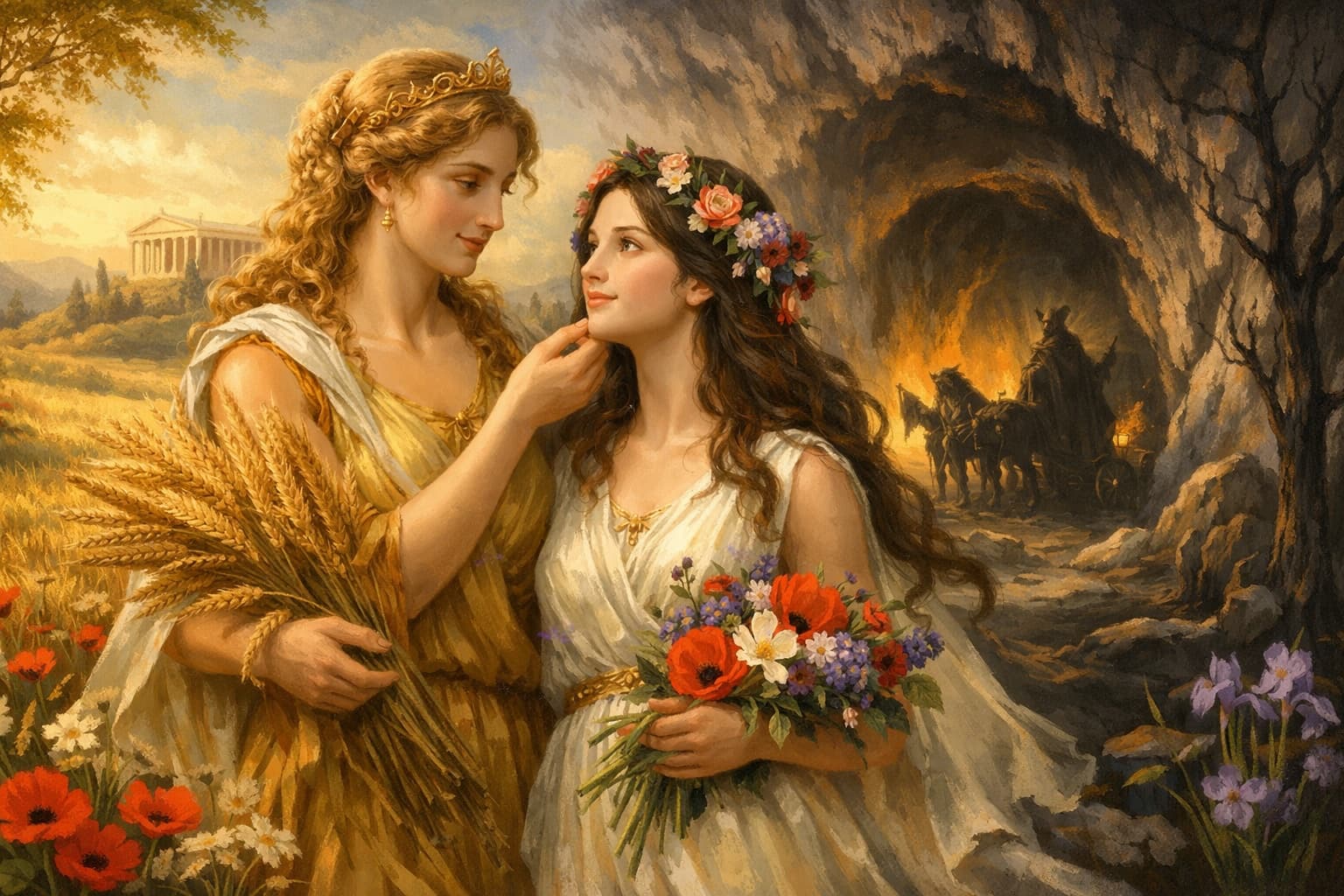
Demeter and Persephone
 Andres Aguilar
Every year the earth dies and is reborn — and the ancient Greeks knew exactly why. A goddess of grain lost her daughter to the king of the underworld, and in her grief she stopped the harvests, froze the earth, and refused to let anything grow until he...
Introduction: A Winter Without a Scientific Explanation
You're in ancient Greece. It's the dead of winter, it's cold, nothing is growing. Your neighbor asks you why the earth is dead and you have no idea about the Earth's axial tilt, you know nothing about elliptical orbits or astronomy. What do you tell them? The Greeks had an answer, and it's one of the most beautiful and tragic stories in all of mythology: the story of a mother who lost her daughter and, in her grief, paralyzed the entire world.
Today we're talking about Demeter and Persephone — a myth that is simultaneously an explanation of the cycle of seasons, a meditation on maternal love, and a reflection on death, loss, and change. And as you'll see, this story has more layers than an onion.
Demeter: The Goddess of Agriculture
Let's start at the beginning. Demeter was one of the twelve Olympian deities, sister of Zeus, Hades, and Poseidon. She was the goddess of agriculture, of the harvest, of everything that grows from the earth. The Greeks revered her because, literally, whether they ate or not depended on her. In an agricultural society like ancient Greece, Demeter was no minor goddess — she was absolutely essential. Without her blessing, there was no wheat, no barley, no bread. And without bread, everyone died.
Festivals were held in her honor all across Greece, especially the Thesmophoria — celebrations exclusive to women that prayed for the fertility of the land and of people. She was a goddess of the common people, not just the elite. Farmers prayed directly to her because their relationship with her was personal and urgent. A bad harvest wasn't just an economic problem — it was literally a matter of life and death.
Persephone: The Maiden of the Fields
Now, Demeter had a daughter, Persephone, also known as Kore, which means "the maiden." She was a beautiful, joyful young woman who spent her days in the fields picking flowers with her friends, the nymphs. The relationship between the two of them was extraordinarily close. In many artistic representations they appear together, as if they were two aspects of the same force: Demeter the mother earth, Persephone the youth of nature.
The Abduction: When the Earth Opened
And this is where the trouble starts. Hades, the god of the underworld — Zeus and Demeter's brother — lived alone in his dark kingdom beneath the earth. He ruled the dead, but he himself wasn't dead, just terribly lonely. And one day, while making his rounds through the upper world, he sees Persephone in a meadow picking flowers. And he falls in love. Not in a normal way — he becomes obsessed. He wants Persephone to be his wife, the queen of the underworld.
The Narcissus Trap
And what does he do? Well, Hades wasn't exactly a romantic. He didn't bring her flowers, didn't ask her to dinner, didn't write her poetry. He did what several Greek gods did when they wanted something: he took it by force. One day, while Persephone was in a meadow picking flowers, she spotted a particularly beautiful narcissus. Some versions say that Zeus or Gaia herself caused that specific flower to grow as a trap. She bent down to pick it and at that moment the earth split open. From the depths, Hades emerged in his chariot pulled by black horses, grabbed her, and dragged her to the underworld before anyone could do anything.
Zeus's Role
Versions of the myth vary on whether Zeus — Persephone's father and Hades's brother — was aware of this plan or had even approved it. Some versions say yes, that Zeus gave his blessing to the marriage without consulting Demeter. Which, from our modern perspective, is horrifying — but in the Greek context it wasn't so unusual. Marriages were arranged between men; women didn't have much say in the matter.
A Mother's Desperate Search
Now, imagine being Demeter. Your daughter goes out for a walk like any other day and simply vanishes. No body, no reliable witnesses, no explanation. Just a terrible absence. The nymphs who were with Persephone heard a scream, but by the time they arrived, she was gone.
Nine Days and Nine Nights
Demeter lost her mind with grief. She set aside all her divine responsibilities and devoted herself entirely to searching for her daughter. She roamed the entire world with lit torches, asking everyone she encountered if they had seen Persephone. For nine days and nine nights she searched without rest, without eating, without drinking, consumed by despair.
Helios Reveals the Truth
And here comes an interesting detail: in her search, Demeter encounters Hecate, the goddess of magic and witchcraft, who tells her she heard Persephone's scream but didn't see who took her. So the two of them go to consult Helios, the god of the sun, who sees everything from the sky. And Helios tells her the truth: Hades took Persephone to the underworld with Zeus's permission.
The Divine Strike: The World's First Winter
When Demeter finds out, her grief turns to fury. She's furious at Zeus, furious at Hades, furious at all the gods. And she does something drastic: she abandons Olympus, resigns from her divine duties, and goes to live among mortals in disguise as an old woman. It's a divine strike. If the gods can take what she loves most without consequences, she can take what they need.
The Earth Becomes Barren
While Demeter is on strike, things happen. The earth stops producing. Crops wither, seeds don't germinate, trees bear no fruit. It's the world's first winter. Humans start dying of hunger, and when humans die, there are no sacrifices for the gods. The gods start to worry, because without sacrifices, without worship, they too begin to weaken.
The Power of a Mother
Zeus sends messengers to Demeter, one after another. He offers her gifts, honors, anything she wants. But she refuses flat out. Her position is clear: she will not allow anything to grow until her daughter is returned. And here we see something remarkable: Demeter is one of the few figures in Greek mythology who directly defies Zeus and wins. Not through military power, not through political cunning, but through the force of maternal love and her willingness to destroy everything if she doesn't get what she wants.
The Episode at Eleusis: The Baby in the Fire
In the meantime, Demeter had arrived in Eleusis, a city near Athens. There, disguised as an old woman, she was taken in by the royal family. She told them she was a refugee from Crete, and they hired her as a nursemaid for their infant prince, Demophon. And here there's a fascinating sub-story that reveals Demeter's character.
The Attempt at Immortality
Demeter grew fond of the baby. So much so that she decided to make him immortal. How? Every night, in secret, she anointed the baby with ambrosia and held him in the fire to burn away his mortal parts. It was her way of compensating for the loss of Persephone: if she couldn't have her own daughter, at least she could create another immortal being.
But one night, the baby's mother, Metanira, walked into the room and saw the old woman holding her son in the fire. She let out a shriek of terror. Demeter, furious at the interruption, revealed her true divine form. She was beside herself with rage and explained what she had been doing. The process was interrupted and the baby couldn't be made immortal. As compensation, Demeter taught Triptolemus, the family's older son, the secrets of agriculture, and ordered him to spread that knowledge throughout the world.
The Birth of the Eleusinian Mysteries
She also established at Eleusis the Eleusinian Mysteries — secret rituals that promised initiates a better life after death. It was her gift to humanity, but also her way of processing the trauma.
Persephone in the Underworld: Sadness and Resistance
But let's go back to Persephone. While her mother was desperately searching the upper world, she was in the underworld — sad, frightened, refusing to eat or drink. The Greek underworld wasn't exactly the Christian hell, but it wasn't a cheerful place either. It was a gray, dim kingdom where the souls of the dead wandered like shadows.
Hades, in his twisted way, was in love with her and tried to console her, to convince her that his kingdom wasn't so bad, that she could be happy there as queen. He showed her his riches — all the precious gems and metals found beneath the earth. But Persephone wanted none of it. She missed her mother, missed the sun, the flowers, the world of the living.
The Pomegranate Seeds: The Inevitable Bargain
Zeus, seeing the situation spiral out of control — mortals dying, gods losing worshippers — decided to intervene. He ordered Hades to return Persephone. Hades agreed, but he did something clever: before letting her go, he offered Persephone some pomegranate seeds.
The Trap of the Underworld
Now, in Greek mythology there was a fundamental rule: if you ate anything from the underworld, you were bound to it forever. Persephone — in some accounts out of innocence, in others because she couldn't bear the hunger any longer, in others because Hades tricked her — ate six pomegranate seeds. The moment she did, she sealed her fate.
The Agreement: Six Months Above, Six Months Below
When Hermes, the messenger of the gods, arrived to bring Persephone home, Hades smiled. Yes, he could take her — but since she had eaten from the underworld, she had to return. A deal was struck: Persephone would spend six months of the year with her mother in the upper world, and six months with Hades in the underworld. One pomegranate seed for each month she would spend below.
The Reunion and the Eternal Cycle
When Persephone finally reunited with Demeter, the reunion was overwhelming. Demeter embraced her daughter with an intensity that shook the earth, and in that instant the world bloomed again. The fields filled with flowers, the trees bore fruit, seeds germinated. It was spring.
The Origin of the Seasons
But Demeter's joy was short-lived when she learned that Persephone had eaten the pomegranate seeds and would have to return to the underworld. Demeter accepted the arrangement reluctantly because she had no choice, but she established a pattern that would last forever: when Persephone is with her in the upper world, the earth blossoms — it is spring and summer. When Persephone must descend to the underworld, Demeter grieves, and it is fall and winter. The earth goes barren, the leaves fall, everything dies temporarily. The world reflects the emotional state of the goddess.
The Deeper Meanings of the Myth
This myth is brilliant because it does several things at once. First, it explains the seasons in a way that any Greek could understand and feel emotionally. Winter isn't a meteorological accident — it's a mother's grief for her absent daughter. Spring isn't a climatic shift — it's the joy of reunion.
Loss of Innocence and the Passage to Adulthood
But the myth also speaks to universal themes. It speaks of the loss of innocence, the inevitable passage from youth to adulthood, the separation between parents and children. Persephone starts out as Kore, the maiden — a young, innocent girl picking flowers. She ends up as Persephone, queen of the underworld, a powerful and feared figure. It's a story of transformation, of forced and painful growth.
Marriage in Ancient Greece
From a certain angle, it's also a story about marriage in ancient Greece. Young women were torn from their homes, from their mothers, and sent to live with men they barely knew. It was a symbolic death of their former life, a descent into the unknown. And like Persephone, they had to learn to inhabit two worlds.
The Eleusinian Mysteries: The Best-Kept Secret
The Eleusinian Mysteries that Demeter established were among the most important religious rituals in ancient Greece. For more than a thousand years — from around 1500 BCE to the fourth century CE — thousands of people traveled to Eleusis to be initiated into these mysteries. And here's the fascinating part: nobody knows exactly what happened during those rituals. The initiates took an oath of secrecy so strong that virtually no detailed records exist. Revealing the secrets was punishable by death.
What We Know About the Rituals
What we do know is that the rituals involved reenacting Persephone's descent into the underworld and her return. Initiates fasted, walked in procession from Athens to Eleusis, drank a special brew called kykeon, and underwent experiences that were said to reveal the secrets of life and death to them.
Many initiates — including philosophers like Plato and Cicero — described the experience as profoundly transformative, as something that removed their fear of death. Cicero wrote that the Mysteries taught not only how to live happily, but how to die with better hope.
The Theory of a Psychoactive Kykeon
There are modern theories suggesting the kykeon may have contained psychoactive substances derived from ergot, a fungus that contains compounds similar to LSD. This would explain the mystical experiences initiates reported. But this is speculation — the truth is we simply don't know for certain.
A Democratic Ritual
And notice how interesting this is: the Mysteries were completely democratic by the standards of the time. Anyone who spoke Greek and didn't have blood on their hands could be initiated, regardless of whether they were rich or poor, free or enslaved, male or female. In a society as stratified as ancient Greece, this was revolutionary. There was something in this myth of mother and daughter, of loss and reunion, that touched something so deep in the human heart that it transcended all social barriers. A Roman emperor and an Athenian peasant could stand side by side at Eleusis, sharing the same mystical experience, united by this story of maternal love and hope in the face of death.
The Universal Power of the Myth
What is undeniable is the power this myth held. Demeter and Persephone were not just explanations of natural phenomena — they were symbols of universal human experiences: the unconditional love of a mother, the pain of separation, the inevitability of change, the hope of reunion.
The Evolution of the Story
And the myth evolved over time. In later versions, Hades's role is softened. In some accounts, Persephone eventually falls in love with her husband and becomes a just ruler of the underworld. In others, she is depicted as an ambiguous figure: sweet and maternal when above ground, but cold and formidable when she governs the realm of the dead.
Two Identities, Two Worlds
There's one detail I find particularly interesting: in the underworld, Persephone holds real power. She judges souls, decides fates, intercedes with Hades. She is a respected authority. Above, with her mother, she becomes Kore again — the daughter. It's as if she has two identities. And anyone who has ever had to navigate different roles in their life can identify with that.
The Cultural and Artistic Legacy
The legacy of this myth is enormous. You find it in art from every era: Greek and Roman sculptures, Renaissance paintings. Bernini created a dramatic sculpture of the abduction of Persephone where you can see the terror on her face and Hades's fingers pressing into her flesh.
In Modern Literature
In literature, the myth never stopped being relevant. The American poet Louise Glück won the Nobel Prize in 2020 in part for her reinterpretation of the myth in her book Averno, where she uses the story to talk about depression, loss, and rebirth.
In Psychology
In modern psychology, the myth has been used to explore the mother-daughter relationship — how daughters need to separate from their mothers to become complete people, but how that separation always causes pain for both.
In Our Everyday Culture
And if you think about it, the myth is still alive in our culture. Every time we say someone "went through hell" to describe a traumatic experience, every time we talk about cycles of death and rebirth, we're using concepts that come from this story.
Even the pomegranate became an enduring symbol. In many Mediterranean cultures, it represents fertility and death. In Christian art, it sometimes appears in the hands of the child Jesus, symbolizing resurrection.
Why This Myth Still Resonates
What I find most powerful about this myth is that, unlike many other Greek stories about heroes conquering monsters or gods punishing mortals, this one is fundamentally about love, about loss, about how we keep going when the worst happens. Demeter doesn't kill anyone, doesn't go to war. Her struggle is entirely emotional — it's a mother's pain — and that pain has the power to change the world.
And Persephone, torn from her life, forced to grow up too fast, eventually finds a way to exist in both worlds. This is not a happy story in the fairy-tale sense. It's a story about accepting what you cannot change, about finding power where you seem to have none, about learning to live with loss without letting it destroy you.
Universal Experiences
That's why this myth resonated for thousands of years and still resonates today. Because all of us experience losses that change us. All of us have to let go of things we love. All of us have to grow even when we don't want to. All of us know that descent into darkness.
And the promise of the myth is that after winter always comes spring. That after separation comes reunion, even if temporary. That pain, no matter how intense, is not permanent. That there are cycles, not straight lines, and what is lost can, in some form, return.
Conclusion: Stories That Give Meaning to Suffering
The ancient Greeks didn't have our science, but they had something equally valuable: stories that gave meaning to suffering, that turned pain into something significant and shared, that found beauty even in tragedy. They understood that sometimes we need myths not to explain how things work technically, but to explain how they feel, what they mean to us.
And there you have it: the story of Demeter and Persephone, the myth that explains why we have seasons — but that is really about so much more. It's about love that doesn't give up, about change we cannot avoid, about pain that transforms, about finding a way to keep going even when the world seems dark. It's about mothers and daughters, about separation and reunion, about losing innocence and gaining wisdom.
Related episodes
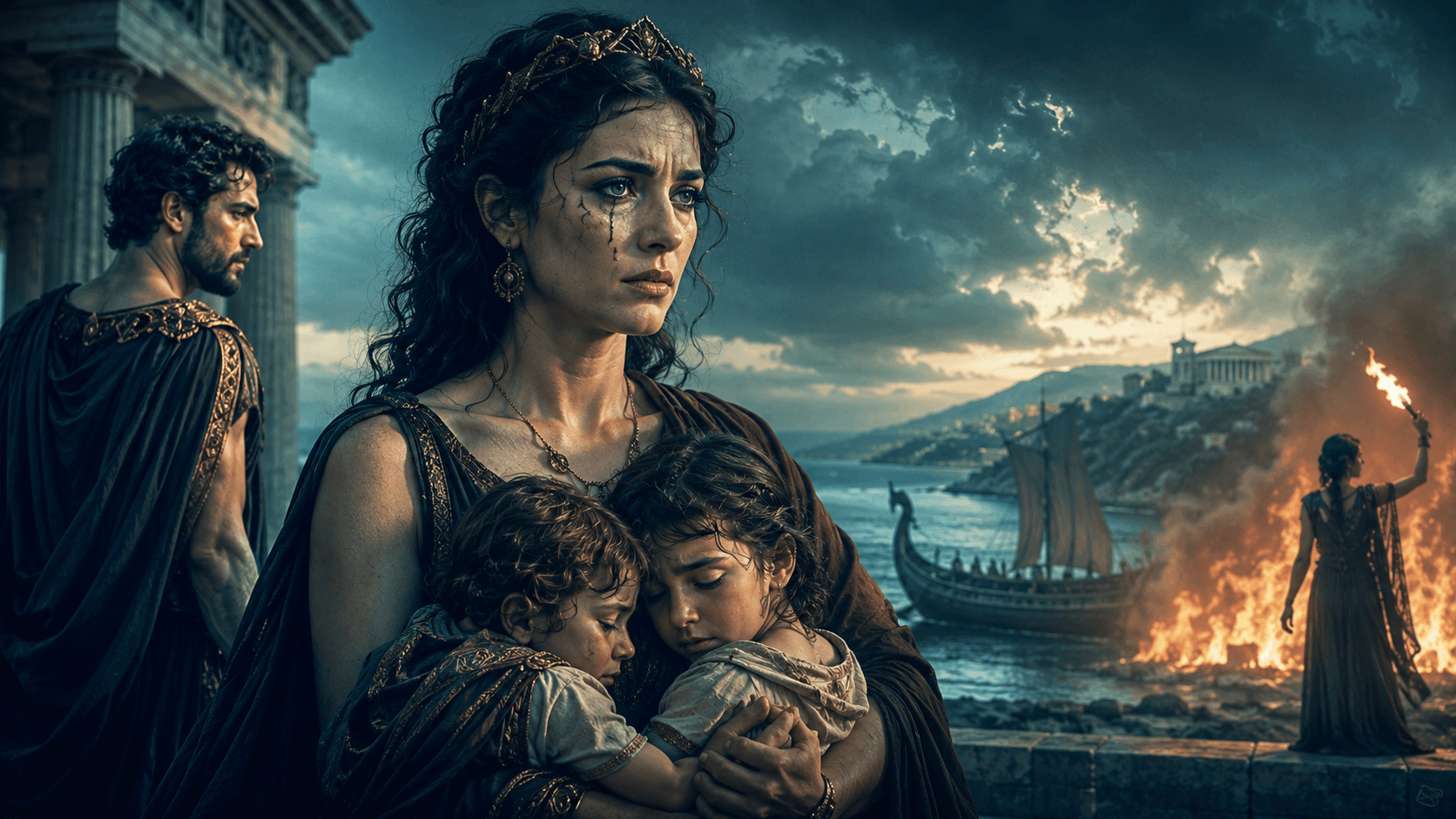
But to understand what Medea did, you must first understand who she was and what they did to her. Because this story doesn't start with a woman who goes crazy for no apparent reason.
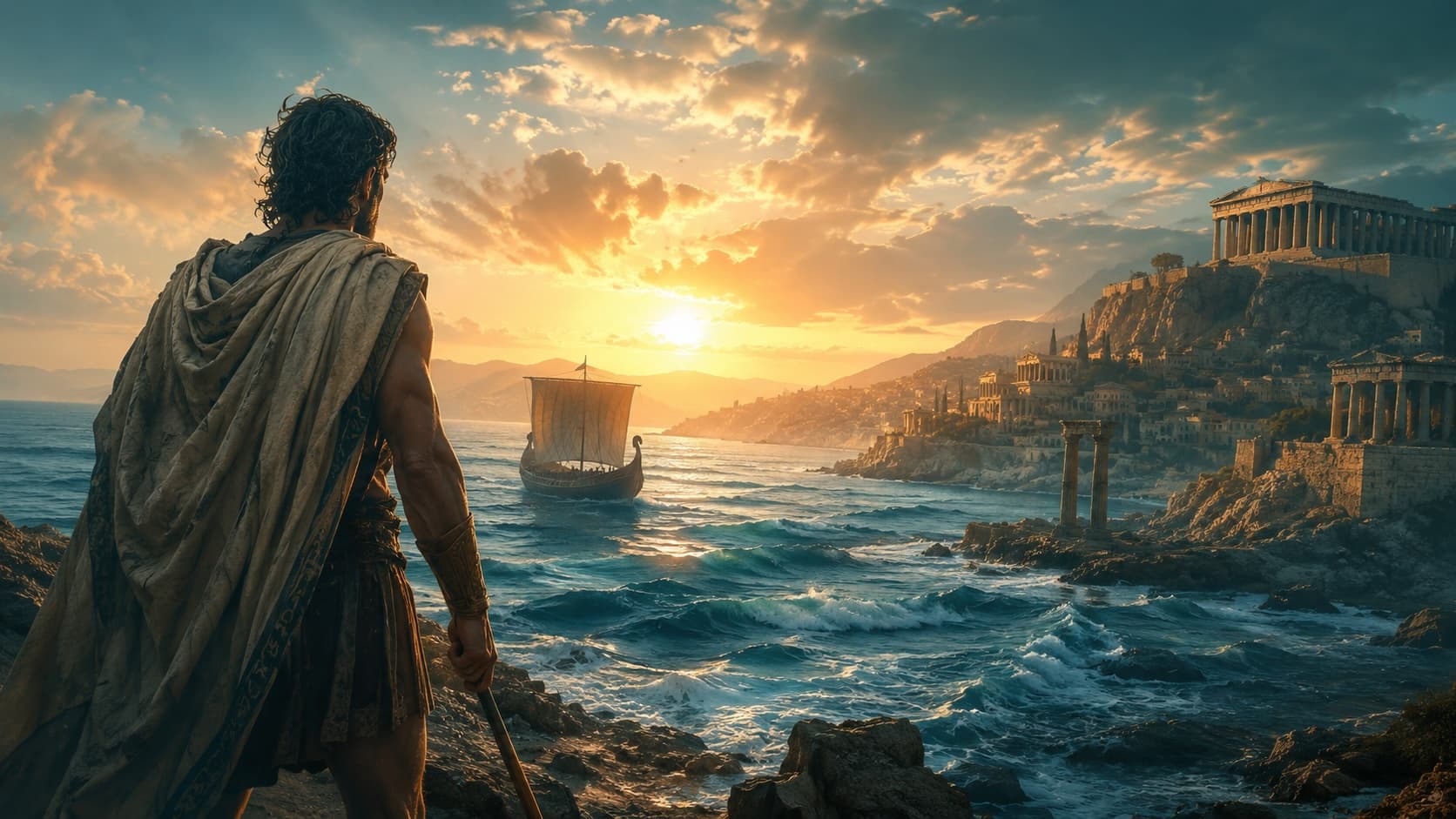
First, he got Polyphemus drunk on concentrated wine he had brought with him, filling the cup generously and refilling it several times. When the giant, in his drunkenness, asked his name so he could reward him with a gift, Odysseus answered...
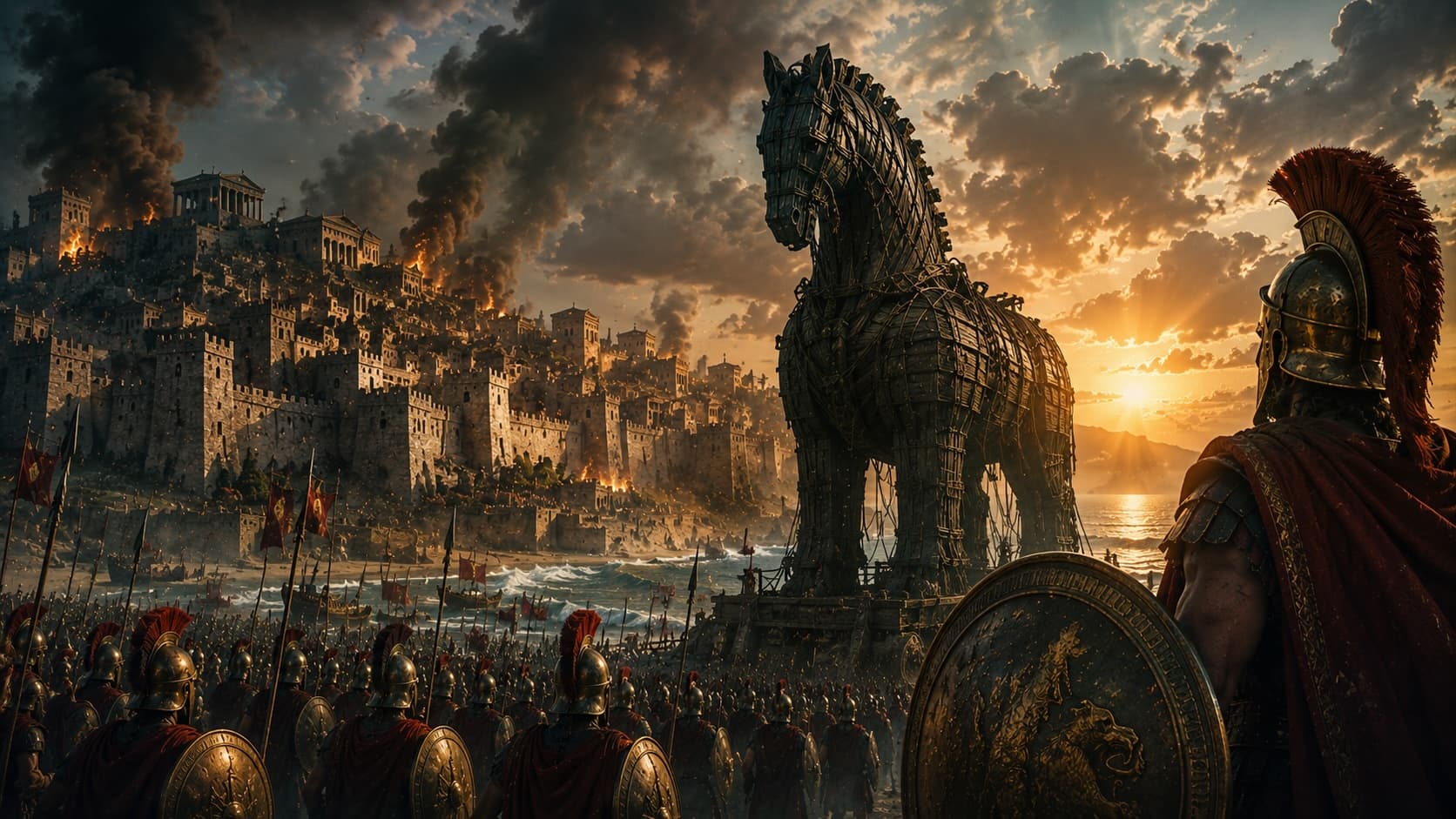
An arrow to the heel, shot by the man who started it all and guided by a god carrying a grudge. That was how Achilles died. Then came the horse, the night, and the fall of Troy. Then Homer: the poet who turned fifty days of that war into the most widel...