
The Flood of Deucalion
 Andres Aguilar
Long before Noah, the Greeks had their own story of a god who grew fed up with humanity and decided to wipe it from the map. Deucalion and his wife Pyrrha were the only survivors, and what they did afterward to repopulate the world is one of the strang...
You're standing on top of a mountain, looking down, and where there used to be cities, cultivated fields, temples, and roads, there is now only water. Miles and miles of murky water stretching to the horizon. No screams, no lights, no smoke from campfires. Just silence. All of humanity has just been wiped off the map in a matter of days. And you, along with your partner, are literally the only two people alive on the entire planet. What would you do? How would you rebuild the whole world from scratch?
This isn't the plot of a Hollywood disaster movie. This is exactly what happened to Deucalion and Pyrrha according to the ancient Greeks, and today we're diving headfirst into the myth of the Greek Great Flood — a story that has everything: angry gods, ignored prophecies, a father saving his son, and an ending that involves throwing rocks over your shoulder. Yes, you read that right. Rocks.
Floods Across Ancient Cultures
Let's start at the beginning. The Greeks had their own version of the great flood, and even though today when we hear "flood" we automatically think of Noah and his ark, the truth is that almost every ancient culture has a story about a massive flood that wipes out humanity. The Mesopotamians had Utnapishtim in the Epic of Gilgamesh, the Hindus have Manu, the Aztecs had their own version, and so on. But today we're sticking with the Greek version, because it has certain details that make it special and genuinely fascinating.
Who Were Deucalion and Pyrrha
Let's start with Deucalion. He was no ordinary character. He was the son of Prometheus — yes, that Prometheus, the one who stole fire from the gods and gave it to humans. So Deucalion came from a family that, let's say, didn't have the best relationship with Zeus. His wife was Pyrrha, daughter of Epimetheus and Pandora — yes, the same Pandora of the box. Basically, these two were connected to all the major troublemakers in Greek mythology.
Zeus's Wrath: Why He Decided to Destroy Humanity
Now, why did Zeus decide to send a flood and wipe out all of humanity? The accounts vary a bit, but the most common version is that Zeus was fed up. The Bronze Age humanity — the one that existed at the time — had become arrogant, violent, and unjust. They didn't respect the gods, they didn't respect each other, everything was chaos and wickedness. Zeus, who was never exactly known for his patience, decided enough was enough: this humanity was broken and it was time to start over.
The Story of Lycaon: The Last Straw
There's a specific story that's sometimes told about why Zeus made this drastic decision. Zeus came down to Earth disguised as a traveler — as he liked to do to spy on mortals — and visited King Lycaon of Arcadia. This guy Lycaon was known for being cruel and suspicious, and when Zeus arrived at his palace, Lycaon suspected his visitor wasn't an ordinary mortal. So to test whether he was really a god, he did something absolutely horrific: he killed a prisoner, cooked his flesh, and served it to Zeus for dinner.
Zeus, obviously, didn't fall for it — he's a god. He saw through it immediately, flew into a rage unlike anything before, transformed Lycaon into a wolf on the spot (that's another story), and decided that if humans had sunk to this level of depravity, they didn't deserve to keep existing. Right then and there he made his decision: universal flood.
Prometheus's Warning
But here's where Prometheus enters the picture. Even though he was chained to that rock, suffering his eternal punishment, Prometheus still cared about humanity. After all, he had been their benefactor, their protector. And now his own son, Deucalion, was on Earth, about to be swept away along with everyone else. So Prometheus, somehow, managed to warn Deucalion. The accounts vary on exactly how — whether it was through a dream, or a messenger — but the point is that Deucalion got the message: a flood is coming, build an ark.
Building the Ark
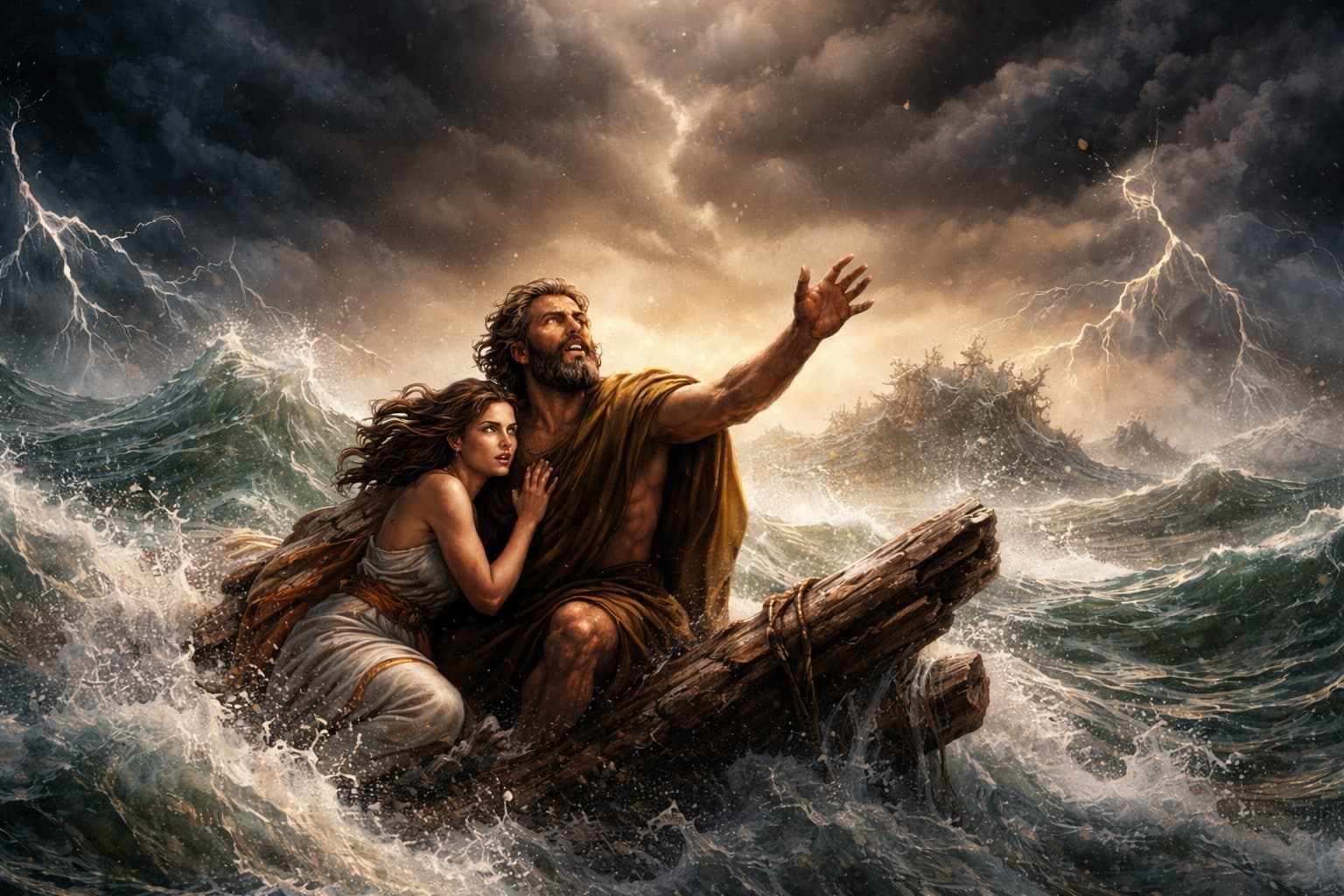
And Deucalion listened. He built a kind of enormous chest, a floating box, and loaded it with provisions, seeds, everything necessary. He climbed in with Pyrrha, his wife, and they waited. And when Zeus opened the floodgates of heaven and unleashed the rains, when Poseidon stirred the seas and the rivers overflowed, when the mountains began to disappear beneath the water, Deucalion and Pyrrha were floating in their ark, safe.
Nine Days of Flood
For nine days and nine nights it rained without stopping. The entire land was covered. Whole cities disappeared. The temples, the houses, the fields — everything lay under meters and meters of water. All of humanity drowned. There was no escape for anyone. Just that chest floating in the middle of an infinite ocean, with two people inside, watching their entire world cease to exist.
The Ark Comes to Rest on Mount Parnassus
Finally, the waters began to recede. The chest, after floating for days, came to rest on the summit of Mount Parnassus, one of the few things that still jutted above the water. It's worth noting something important here: Mount Parnassus was sacred to Apollo and the Muses, located in central Greece, near Delphi. It's no coincidence that the ark ended up right there. The Greeks loved this kind of symbolism: the place where humanity was preserved was the very place dedicated to poetry, prophecy, and knowledge.
An Empty World: Total Desolation
When they finally climbed out of the chest, Deucalion and Pyrrha found themselves in an empty world. Absolute silence. No birds singing, no dogs barking, no human voices. Nothing. Just the two of them, standing on a mountain, looking out at total desolation. And here comes one of the most human moments in the entire myth: they broke down and cried. They had no idea what to do. How were they supposed to repopulate the entire world? How could two people alone build a civilization from scratch?
Consulting the Oracle
So they did what any Greek would do in that situation: they went to consult an oracle. They made their way down to the temple of Themis, the Titaness of divine justice, because the Oracle of Delphi didn't exist yet at that point. They asked what they should do, how they could repopulate the Earth. And the oracle's response was cryptic, as always: "Cover your heads and throw the bones of your mother over your shoulders."
Decoding the Riddle
Imagine the confusion. The bones of their mother? Pyrrha was horrified. She was thinking literally — digging up the bones of her mother Pandora and throwing them around. That was sacrilegious, horrifying, unthinkable. But Deucalion, who had clearly inherited some of his father Prometheus's cleverness, thought it through more carefully. "Wait," he said, "our mother is the Earth. The bones of the Earth are stones."
That makes total mythological sense. The Earth — Gaia — was the primordial mother of everything. Her bones would be the rocks, the solid structure of the world. So Deucalion and Pyrrha covered their heads as the oracle had said, picked up stones from the ground, and threw them over their shoulders without looking back.
The Miracle: Stones Become People
And here's where the magic happens: the stones that Deucalion threw kept turning into men. The stones that Pyrrha threw kept turning into women. One by one, the stones hit the ground and transformed into human beings. That is how the new humanity was born — the humanity of the Iron Age, our humanity. That's why, according to the Greeks, we are hard and resilient: because we come from stone. We are not soft like the earlier generations. We have to be, because we live in a hard era.
The Poetic Meaning
This part of the myth strikes me as brilliant because it's pure poetry. The Greeks were saying something profound about human nature. We are not delicate, we are not perfect — we are rough and tough like rock. And there's also something beautiful in the idea that men and women were created equally, in the same way, through the same process. There's no hierarchy in the creation, just different stones becoming different people.
Direct Descendants: The Origin of the Hellenes
Deucalion and Pyrrha also had children the natural way, of course. They had Hellen, who became the ancestor of all Greeks — the Hellenes. Hellen had sons who in turn became the founders of the great Greek tribes: Dorus for the Dorians, Xuthus for the Ionians and Aeolians, and so on. Basically, all of Greek genealogy, all of their ethnic identity, traces back to Deucalion and Pyrrha. They are the patriarchs and matriarchs of Hellenic civilization after the flood.
Comparisons with Other Flood Myths
Now, it's impossible to talk about this myth without mentioning the obvious similarities to other flood stories, especially that of Noah in the Judeo-Christian tradition. The resemblances are truly striking: a righteous man who is warned by a deity, builds an ark, survives with his family, the waters cover the entire Earth, the ark comes to rest on a mountain, and then repopulation follows. Even the detail of sending out a bird to see if the waters have receded appears in some Greek versions, though not all.
Copies or Cultural Convergence?
Does this mean one story copied the other? Probably not directly. The reality is more complex and more interesting. Flood myths appear in cultures all around the world because catastrophic floods were real and terrifying events. Every civilization that settled near great rivers or coastlines experienced devastating floods from time to time. And when things like that happen, people search for explanations, create narratives, and those narratives are passed down and evolve over time.
The Mesopotamian Precedent
The Mesopotamian flood story in the Epic of Gilgamesh is older than both the Greek and Biblical versions. And it makes sense, because Mesopotamia sat right between the Tigris and Euphrates — two enormous rivers that flooded regularly. Those floods could be apocalyptic for the cities of the region. So it's no surprise they developed a powerful myth about a flood that destroys the world.
The Greek Adaptation
The Greeks probably took elements from stories circulating throughout the eastern Mediterranean, adapted them to their own cultural context, gave them their own gods and heroes, and created their unique version. That's what cultures do: they borrow ideas, transform them, make them their own. And the result is a myth with universal elements — divine punishment and renewal — but also specifically Greek details, like the oracle, the stones that become people, and the connection to Mount Parnassus.
The Ages of Humanity
What's fascinating is that this myth also speaks to how the Greeks understood their own history. For them, there had been earlier ages of humanity, each progressively worse than the one before. First the Golden Age, where everything was perfect and humans lived like gods. Then the Silver Age, a bit worse. Then the Bronze Age, which was violent and terrible, and which Zeus destroyed with the flood. And finally our era, the Iron Age — hard and difficult, but what remained after everything else was erased.
Pessimism with Hope
This scheme of declining ages isn't unique to Greece either. It appears in many ancient cultures. It's a way of explaining why life is so difficult, why there is so much suffering, why the gods seem so distant. The mythological answer is: because we live in the last era, the worst era, after everything better has already been destroyed. It's pessimistic, yes, but it also offers something like comfort. If we are like stone, if we come from that hard material, then we can endure whatever comes.
The Role of Prometheus: Love That Transcends Punishment
And there's another aspect of the myth worth mentioning: the role of Prometheus. Here we have a god — or a Titan, more precisely — who is being punished for eternity by Zeus, yet still manages to save his son. It's an act of parental love that transcends divine punishment. Prometheus had already shown that he loved humanity more than his own comfort when he gave them fire. Now he shows that he loves his son more than his own safety, because warning Deucalion surely didn't go over well with Zeus.
The Cosmic Tension
This tension between Prometheus and Zeus is central to Greek mythology. Prometheus represents intelligence, foresight, and care for humanity. Zeus represents power, order, but also rage and punishment. And caught in the middle of this cosmic tension between the two, humanity manages to survive — not through pure divine favor, but because someone cared enough to warn us, to give us a chance.
The Symbolism of the Names and the Wine
Here's a detail I love: the name Deucalion means roughly "new wine sailor" or something along those lines, depending on how you interpret it. And the name Pyrrha means "red" or "reddish," probably referring to the color of her hair. But look at how interesting this gets: after the flood, Deucalion was the first to make sacrifices to Zeus, giving thanks for their salvation. And according to some versions, he was the first to cultivate the vine and make wine after the flood. There's an obvious parallel with Noah, who also grew vineyards after the flood according to Genesis.
Wine as a Bridge Between Humans and Gods
Wine in the ancient world wasn't just an alcoholic beverage. It was central to religion, to rituals, to social life. It was what connected humans to the gods in symposia and libations. So the fact that Deucalion reinvented wine after the flood is symbolically significant. He didn't just repopulate humanity — he also restored the relationship between humans and gods through ritual.
The Divine Response: Partial Regret
Some versions of the myth say that Zeus, after witnessing Deucalion's sacrifice and his devotion, felt a degree of regret about having been so drastic. It's not that Zeus admitted he was wrong — the Greek gods rarely do that — but he decided this new humanity deserved a chance. He gave them his blessing to multiply and fill the Earth again.
The Importance of Mount Parnassus
There's also the geographic angle. Mount Parnassus wasn't chosen at random. It sat directly above what would later become Delphi, the most important oracle in all of Greece. It was the center of the world for the Greeks, the place where Apollo prophesied through the Pythia. So tying the rebirth of humanity to that sacred location gave the myth tremendous weight. It was like saying: Greek civilization, with all its values, its gods, its culture, was born here, in this holy place, after everything else was destroyed.
The Pilgrim's Experience
And think about it from the perspective of someone living in ancient Greece. When you traveled to Delphi to consult the oracle, you weren't just visiting an important temple. You were standing on the exact spot where Deucalion and Pyrrha rebuilt humanity. It was a constant reminder of the power of the gods and the fragility of human existence.
Divine Justice and Moral Order
This myth also tells us a great deal about how the Greeks thought about fate and divine justice. Zeus destroyed humanity because it was wicked, but he saved Deucalion because he was righteous. He wasn't an arbitrary god, at least not in this case. There was a moral logic behind his actions. If you were good, pious, and just, you had a chance. If you were like Lycaon, you were going to face a terrible punishment.
A Universe with Moral Order
This idea that the gods punish collective wickedness but save the righteous is reassuring in a way. It implies that the universe has a moral order, that not everything is chaos and divine caprice. Though of course, the Greeks weren't naive. They had plenty of stories where the gods were unjust, capricious, or outright cruel. But in this particular myth, there's a sense of justice that feels almost modern.
Contemporary Resonance
Today, when we think about global catastrophes, we think about climate change, pandemics, nuclear war. These are our own modern floods — existential threats that could erase everything we know. And the story of Deucalion resonates because it speaks to that fundamental anxiety: what happens if everything is destroyed? How do we start over? Who decides who gets saved?
The Greek Answer: Preparation and Intelligence
The Greek answer is beautiful in its simplicity: the ones who survive are those who listen to the warnings, who prepare, who build their ark when everyone else is ignoring the signs. And then, when the world ends and you're standing on a mountain with your partner staring into the void, you have to be creative. You have to correctly interpret the cryptic messages, and you have to be willing to put in the work of rebuilding from zero.
Active Heroism, Not Passive
This is not a passive myth where the heroes simply receive salvation. Deucalion has to build the ark. He has to interpret the oracle. He has to throw the stones. He has to make sacrifices to the gods. He's active, he makes decisions, he uses his intelligence. And that is very Greek. Greek heroes are not magically saved — they have to work for their survival.
The Immortality of Myths
And here we are, thousands of years later, still telling this story. Because in the end, myths don't die. They adapt, they transform, they keep resonating. Each generation finds something new in them, something that speaks to their own fears and hopes.
Conclusion: Destruction and Renewal
The flood of Deucalion reminds us that everything can end, but that everything can also begin again. That something new can emerge from total destruction. That two people with enough courage and a little divine help can rebuild the entire world. And that sometimes, the simplest solutions — like throwing stones over your shoulder — can be the most powerful.
So the next time you see it raining hard, remember Deucalion and Pyrrha floating in their chest for nine days and nine nights, waiting for the storm to pass. And remember that after every flood, there is always an opportunity to start over.
Related episodes
But to understand what Medea did, you must first understand who she was and what they did to her. Because this story doesn't start with a woman who goes crazy for no apparent reason.
First, he got Polyphemus drunk on concentrated wine he had brought with him, filling the cup generously and refilling it several times. When the giant, in his drunkenness, asked his name so he could reward him with a gift, Odysseus answered...
An arrow to the heel, shot by the man who started it all and guided by a god carrying a grudge. That was how Achilles died. Then came the horse, the night, and the fall of Troy. Then Homer: the poet who turned fifty days of that war into the most widel...