
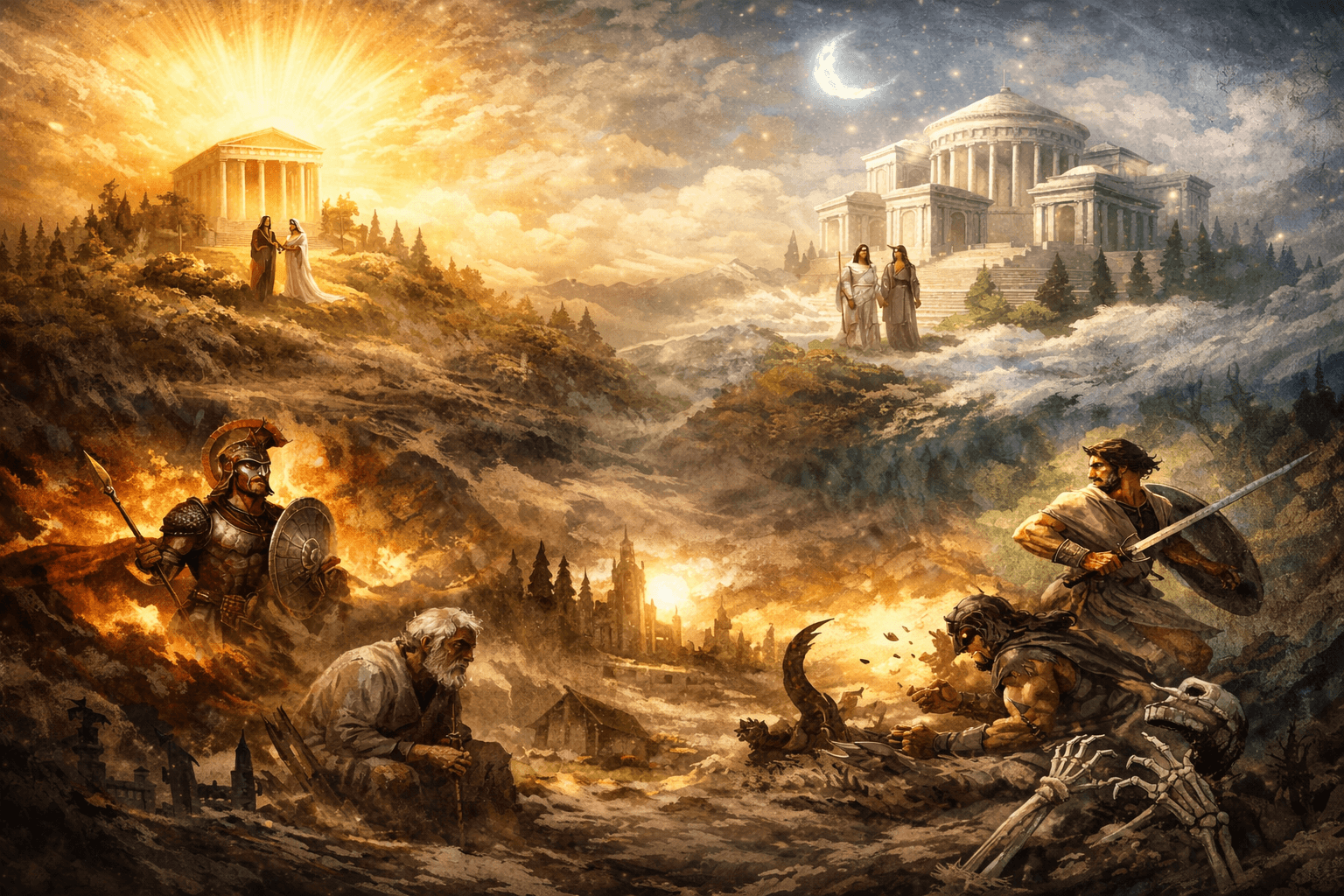
The Five Ages of Humanity
 Andres Aguilar
The poet Hesiod had a theory about why life is so hard: it wasn't always this way. Before us there were four humanities, each worse than the last, until we arrived at ours — the Iron Age, the most miserable of all. It's a philosophical myth disguised a...
The ancient Greeks had bad news for us: we live in the worst era of all time. That's not pessimism — it's cosmology. According to them, there were four humanities before ours, and every single one of them failed. The first lived without labor, in eternal peace, like immortal gods. The last, the Bronze Age, was so violent that it wiped itself out without Zeus having to lift a finger. And we, the ones alive right now, won the booby prize: the Iron Age, the era of constant suffering, relentless toil, and never-ending injustice. Hesiod, the poet who tells us all of this in the eighth century BCE, doesn't sugarcoat it: he wishes he had died before being born into this age. Welcome to the worst possible moment in cosmic history.
Today we're going to talk about the Five Ages of Humanity, one of those myths that really makes you think. It's not a story about heroes slaying monsters or gods hurling thunderbolts out of jealousy. It's something deeper, more philosophical, but told with that particular gift the Greeks had for explaining why the world is the way it is. And above all, why life is so hard.
The Golden Age
Let's start at the beginning. The Golden Age.
There was a time, long, long ago, when the world was ruled by Cronus. Yes, the Titan that Zeus would eventually overthrow and cast into Tartarus — but that comes later. Back then, Cronus was king of the universe, and things worked in a completely different way. It was as if the cosmos itself was set to a different configuration.
The humans of the Golden Age lived like gods. That's not an exaggeration — it's literal. They lived as if they were immortal. They didn't age, didn't get sick, didn't know pain or sorrow. Their bodies stayed young and strong forever. They spent their days in endless celebration, eating, dancing, enjoying each other's company. The concept of enemies or conflict didn't exist. Everything was harmony.
And here's the best part: they didn't have to work. The earth produced food on its own — abundant, delicious, without anyone having to break their back plowing or planting. Trees bore fruit all year round, wheat grew by itself, honey dripped from the trees. No bills to pay, no early mornings, no stress. Paradise, basically. A life of pure leisure, in the best sense of the word.
When they finally died — because yes, they did eventually die, but in the most peaceful way imaginable, like falling asleep after a full life, without pain, without illness, simply closing their eyes and that was it — they became benevolent spirits. Daimons, which has nothing to do with demons in the Christian sense. They were protective spirits who watched over humans and kept an eye on justice. They roamed the earth invisibly, protecting the good and punishing the wicked. Even after death, they were still good, still serving a positive function in the world.
This age ended when Zeus overthrew Cronus. Not because humans did anything wrong — don't miss that detail. It wasn't a punishment. It was simply that the order of the universe changed. The Titanomachy, that epic war between gods and Titans, reconfigured everything. Zeus took power, and with him came a new era, with new rules.
The Silver Age
The humans of this second generation weren't nearly as fortunate. For starters, they took a hundred years to grow up. A hundred years as children, living with their mothers, never maturing, playing, with no responsibilities whatsoever. And when they finally reached adulthood, when they finally grew up, they only lived a little longer — just a few decades. It was as if their whole lives were childhood, and adulthood was just a blink.
But that wasn't the real problem. The real problem was that this generation was foolish. There's really no other way to put it. They were arrogant, constantly fighting with each other over the pettiest things, unable to live in peace. And worst of all, they didn't honor the gods. They didn't bring offerings, didn't make sacrifices, didn't build temples. They basically ignored the Olympian gods — acted as if Zeus and company didn't exist, or worse, as if they didn't matter.
Zeus, who was never exactly known for his patience, watched all of this from Olympus and grew angrier and angrier. Until finally he'd had enough. He wiped them out. Just like that. Erased them from the map with a divine decree. But even then, since they'd had their good moments, since they hadn't been completely evil, he transformed them into underground spirits. Not as noble as those of the Golden Age, but not evil or punished either. They ended up in a kind of limbo, inhabiting the earth below, receiving certain honors from mortals but without the glory of their predecessors.
The Bronze Age
And then we arrive at the Bronze Age, and this is where things get really heavy.
Zeus created a third generation of humans, and these people were pure concentrated violence. Hesiod describes them as terrible, strong, obsessed with war. They lived to fight. Their homes were made of bronze, their weapons were bronze, their armor was bronze, even their farming tools were bronze. Everything was bronze. And their hearts were too — hard and cold as metal.
They barely farmed. They didn't eat bread, the civilized food par excellence for the Greeks. Just meat, like beasts. They were enormous, powerful, unbeatable in battle, with a physical strength that surpassed anything before or after. They were born practically wearing armor. Their only joy was war, conquest, destruction.
The thing is, since war was all they cared about — since they had no other purpose in life beyond killing and conquering — they eventually killed each other. Zeus didn't even need to intervene. He didn't send a plague or a flood. They wiped themselves out in their own senseless wars, in battles that grew more brutal until no one was left. And when they died, they went straight to Hades, without honors, without becoming protective spirits, without anything. They simply vanished into the darkness of the underworld, nameless, without glory, without anyone to remember them.
It's a haunting image, isn't it? A humanity so consumed by violence that it doesn't even need divine punishment. It punishes itself. Self-destructs. Zeus literally didn't have to do anything — he just watched as this generation erased itself from the map through its own stupidity and brutality.
The Age of Heroes
But here Hesiod does something interesting. He breaks the pattern of decline for a moment and inserts a fourth age that was, technically, better than the one before it. The Age of Heroes.
This is the age of the characters we all know. Achilles with his unstoppable rage, Hector defending Troy, Heracles and his twelve impossible labors, Theseus slaying the Minotaur, Jason pursuing the Golden Fleece, Perseus cutting off Medusa's head. The great heroes of the Greek epics, the ones who appear in all the stories we grew up with.
Zeus created this generation and they were mortal, yes, but more just and noble than those of the Bronze Age. They were brave, they sought glory but also justice. They fought wars, of course — those were still violent times — but they were wars with purpose, with honor, with rules. The Trojan War wasn't simply a bloodbath; it was an epic conflict with causes and consequences, with heroes on both sides fighting for something they believed in. Same with the quest for the Golden Fleece, or the Twelve Labors of Heracles.
Many of these heroes died in battle, it's true. They fell defending just causes or chasing impossible glory. But some — the most noble, the most exceptional — were taken by Zeus to the Islands of the Blessed, a paradise at the edges of the world, beyond the ocean, where they lived in eternal peace, free from worry, enjoying a personal second Golden Age. A kind of divine retirement for those who had been extraordinary enough in life, heroic enough to deserve an eternal reward.
It's interesting that Hesiod includes this age at all. It completely breaks with the narrative of progressive decline. If everything had been getting worse, why is there suddenly an improvement? But it makes sense when you think about the context. Hesiod was writing for an audience that knew Homer's stories inside and out, that venerated those heroes as models of human excellence. He couldn't say that Achilles or Heracles were worse than the brutes of the Bronze Age who only knew how to destroy. That would have been sacrilege, an insult to his entire culture. So he puts them in as a breath of fresh air, a moment of nobility, a special generation before the final fall.
The Iron Age
Because after the heroes, we arrive at our own time. The Iron Age.
And let me tell you, Hesiod does not hold back when describing our era. He flat-out says he wishes he had died before being born into this age, or that he could have been born later, because living in the Iron Age is miserable. His words are harsh, unfiltered: men never rest from toil and suffering during the day, nor from corruption during the night. The gods send them constant hardships, one after another, without relief.
In this age — which is our age — life is pure effort with no guaranteed reward. You have to work to eat, sweat to survive, and even then there's no certainty it'll be enough. Families fight over inheritances, children disrespect their parents, parents are disappointed by their children. People don't keep their word, contracts aren't honored, violence is everywhere. Justice barely exists, and when it does, it serves whoever can pay for it. The good suffer and the wicked prosper. Nobody honors the person who does what's right — everyone cheers for whoever succeeds, no matter how they got there.
But Hesiod goes further, much further. He says things will get even worse. That a time will come when babies are born with gray temples — a sign that even youth will be stolen, that there won't even be that brief period of joy and energy. Brothers will hate each other, guests will betray their hosts, friends will stab each other in the back for the smallest gain.
And then will come the final moment: Aidos, the goddess of shame and dignity, and Nemesis, the goddess of just retribution, will abandon the earth and return to Olympus, leaving humans completely alone, without any moral guidance, without any restraint. And when that happens, when even the last traces of divine decency abandon us, nothing will save us from total suffering. It will be the end of any hope.
Dark, isn't it? Very dark. But there's something realistic about it too. Hesiod was writing from the experience of a man living through a difficult period. The Greece of his time, the period historians call the Greek Dark Ages, was fragmented, there were conflicts between cities, and life for a farmer like him was hard. He had to deal with a brother who had cheated him legally, with corrupt judges who accepted bribes. He wasn't being pessimistic just for the sake of it. He was describing what he saw, what he lived every day.
What Does All This Mean?
Now, what does all this mean? Why did the Greeks tell this story? Why was there any need to create such a depressing myth?
First, it's a way of explaining human suffering without resorting to personal guilt. The Greeks didn't have the concept of original sin like Christianity does. They didn't believe we were condemned for something Adam and Eve did, that we carried inherited guilt. But they still needed an explanation for why life was so hard, why you had to work so much for so little. And this myth provides it: we're not the first — we're the last. We inherited the worst moment in cosmic history. It's not our personal fault, but there's not much we can do about it. This is the age we were dealt.
Second, it's a call to virtue in the face of hopelessness. Hesiod is telling his audience: look, I know things are bad, I know it's unfair, I know the good don't always win and the wicked often go unpunished. But you still have to behave well. You still have to be just, work hard, respect the gods, keep your word. Because if you stop doing that — if you become like those of the Bronze Age, if you surrender completely to violence and selfishness — everything will get worse. At least by maintaining virtue there's a chance things won't completely fall apart.
And third, there's a very strong implicit social critique. Hesiod was writing Works and Days partly as a message to his brother Perses, who had cheated him in a dispute over their father's inheritance, bribing local judges to take more than his share. The myth of the ages is a way of saying: what you're doing, this injustice, this corruption, is part of what's rotting the world. It's part of what drags us further and further into the Iron Age. The gods are watching, and even if they don't intervene now, even if they let you win this battle, there will eventually be consequences.
The Influence of the Myth
What's fascinating is that this myth had a tremendous influence across the centuries. It didn't stay locked away in Greece, buried in an ancient poem. The Romans adopted it completely. Ovid, in his Metamorphoses, tells a nearly identical version, adapting it to Roman sensibilities while keeping the structure and message intact. The idea of a lost Golden Age, of a better past, became a recurring theme throughout all of Western literature, from antiquity through the Renaissance and beyond.
Even today, without realizing it, without having ever read Hesiod, we use this narrative constantly. Every time someone says "things used to be better," they're repeating Hesiod's myth almost word for word. Every time we idealize the past, when we say values have been lost, that people used to be more honest, more hardworking, more respectful — when our grandparents tell us everything was different in their day — we're falling into that same nostalgia for a Golden Age that probably never existed.
Because here's the thing, and it's important to understand: Hesiod was being pessimistic, yes, but he was also using a very powerful literary device. The Greeks of his era probably didn't live worse than those of previous generations. In fact, in many ways they lived better. They had better technology, better social organization, more resources. But it's deeply human to idealize the past. It's deeply human to think that things were better back then, that we showed up late to the party.
And yet there's something valuable in this myth beyond the pessimism. It's not just a cosmic complaint. It's also a brutal but honest acknowledgment that life is hard, that work is necessary, that not everything will turn out well, that justice doesn't always triumph. But that it's still worth trying to be just, to be good, to do things right.
Hesiod doesn't promise that things will improve if you behave well. He's not selling a fantasy of guaranteed rewards. He doesn't say that if you work hard you'll get rich, or that if you're honest everyone will respect you. He actually says the opposite: in the Iron Age, the good suffer, the honest lose, the hardworking break their backs for nothing. But he still tells you to try. To do it anyway. Because the alternative — becoming violent, dishonest, unjust — only accelerates the fall toward that final moment when even the goddesses of shame and justice abandon us.
It's a complex, nuanced message for a myth that seems simple on the surface. And I think that's why it still resonates twenty-five centuries later. Because all of us, at some point in our lives, feel like we're living in the worst possible era. That everything is going backwards. That humanity is lost, that values have disappeared, that nobody respects anything. And this myth says: yeah, maybe, you're probably right — but you still have to keep going. You still have to try to be better, even if only for yourself, even if no one else values it.
One Final Thought
One last interesting thing before we wrap up: some modern scholars believe that Hesiod was describing, in mythological form, real changes in human history. The Golden Age might be a distorted cultural memory of hunter-gatherer societies, before the development of agriculture, when human groups were small and life — though short — was less stressful. The Bronze Age might reflect the historical development of bronze weapons and the rise of organized warfare between cities and kingdoms. The Iron Age would be his own present, with more effective iron weapons, more destructive wars, and increasingly complex conflicts.
I don't know if Hesiod thought of it that way — almost certainly not — but it's interesting how the myth can also be read as a veiled chronicle of human evolution. Of how we went from living in small, relatively peaceful groups where everyone knew each other, to building complex civilizations with professional armies, large-scale wars, and all the organized violence that implies.
Conclusion
At the end of the day, the myth of the Five Ages is about loss. About nostalgia for something we may never have had but miss anyway. About the feeling that something fundamental broke at some point in history and we don't know how to fix it, or whether it can be fixed at all. But it's also about human resilience. About pressing forward even when you know you're living in the worst of times. About trying to be good even when the world tells you it's not worth it, that the good always lose.
And that — that tension between the most brutal pessimism and a stubborn, almost irrational hope, between acknowledging that things are bad but choosing to do good anyway — is something deeply human. That's why this myth, told nearly three thousand years ago by a Greek farmer who felt cheated by his brother and was living through a time that seemed impossible, still speaks to us today with the same force.
Related episodes
But to understand what Medea did, you must first understand who she was and what they did to her. Because this story doesn't start with a woman who goes crazy for no apparent reason.
First, he got Polyphemus drunk on concentrated wine he had brought with him, filling the cup generously and refilling it several times. When the giant, in his drunkenness, asked his name so he could reward him with a gift, Odysseus answered...
An arrow to the heel, shot by the man who started it all and guided by a god carrying a grudge. That was how Achilles died. Then came the horse, the night, and the fall of Troy. Then Homer: the poet who turned fifty days of that war into the most widel...