
Prometheus
 Andres Aguilar
Prometheus was a Titan who sided with Zeus, helped humanity more than any other being in history, and ended up condemned to an eternal punishment that defies any definition of cruelty. His story isn't just about fire — it's about knowledge, power, and ...
Prometheus stole fire from the gods to give it to humans, and Zeus condemned him to have an eagle devour his liver every single day for all eternity. The story of the Titan who gave us civilization and paid the most brutal possible price for helping us.
Some stories don't begin with heroes — they begin with disobedience. With someone who crosses a line they weren't supposed to cross. Prometheus is one of those stories. He didn't steal gold or conquer territory: he stole fire. And with that act, he changed the relationship between gods and humans forever.
In this episode we're going to walk through the myth of Prometheus, the Titan who defied Zeus, delivered fire to humanity, and paid an eternal punishment for doing so. But beyond the myth itself, we'll look at what that fire really symbolizes, why this story still feels so relevant, and what it tells us about knowledge, progress, and the price of challenging power.
The Titan Who Thought Before He Acted
Prometheus was no ordinary god. He was a Titan, which meant he belonged to the generation before the Olympian gods. The Titans had ruled the cosmos before Zeus and his siblings overthrew them in an epic war known as the Titanomachy. Most of the Titans ended up locked away in Tartarus — basically the darkest basement in the universe.
But Prometheus, and here's the interesting part, had sided with Zeus during the war. Why? Because Prometheus means "he who thinks ahead," and he had calculated that Zeus was going to win. His brother Epimetheus, whose name means "he who thinks after the fact," wasn't quite so sharp. This difference between the two brothers turns out to be central to the whole story: while Prometheus is always thinking three steps ahead, Epimetheus is constantly making mistakes.
The Creation of Humanity
After the war, Prometheus is in good standing with Zeus and gets an important assignment: creating the living creatures that will inhabit the earth. Together with Epimetheus, he's tasked with shaping animals and humans. According to some versions of the myth, Prometheus literally forms the first humans from clay, mixing earth with water and breathing life into them. He makes them in the image of the gods — upright, gazing toward the sky. From the very beginning, humans were special to Prometheus.
Epimetheus's Mistake
But a problem arises. Epimetheus, true to his name, goes ahead and distributes all the gifts among the animals without thinking about the humans. He gives claws to some, speed to others, thick fur for the cold, wings for flight. When it's the humans' turn, there's nothing left. Humans are left naked, vulnerable, with no natural defenses. They're the weakest creatures in all of creation.
Prometheus looks at his creations and feels something that the Olympian gods rarely feel: compassion. He sees these fragile beings, exposed to every danger, and decides they need something to compensate — something that will make them different. So he makes a decision that will change everything: he'll give them fire.
Fire: More Than a Tool
In the ancient world, fire wasn't just a tool for cooking or keeping warm. Fire was knowledge, civilization, power. It was the difference between being just another creature in nature and being something entirely different.
With fire, humans no longer had to depend completely on the sun. They could have light after it set. They could have warmth when winter came. Fire separated gods from beasts. Animals fear fire, but humans can control it, tame it, carry it from place to place.
It was literally the power to transform matter: to take something raw and cook it, to take metal and reshape it, to take darkness and turn it into light. Zeus understood this perfectly. That's why the divine fire was kept on Olympus, out of mortals' reach. It wasn't divine stinginess — it was maintaining the order of the universe, where each species had its place.
The Theft
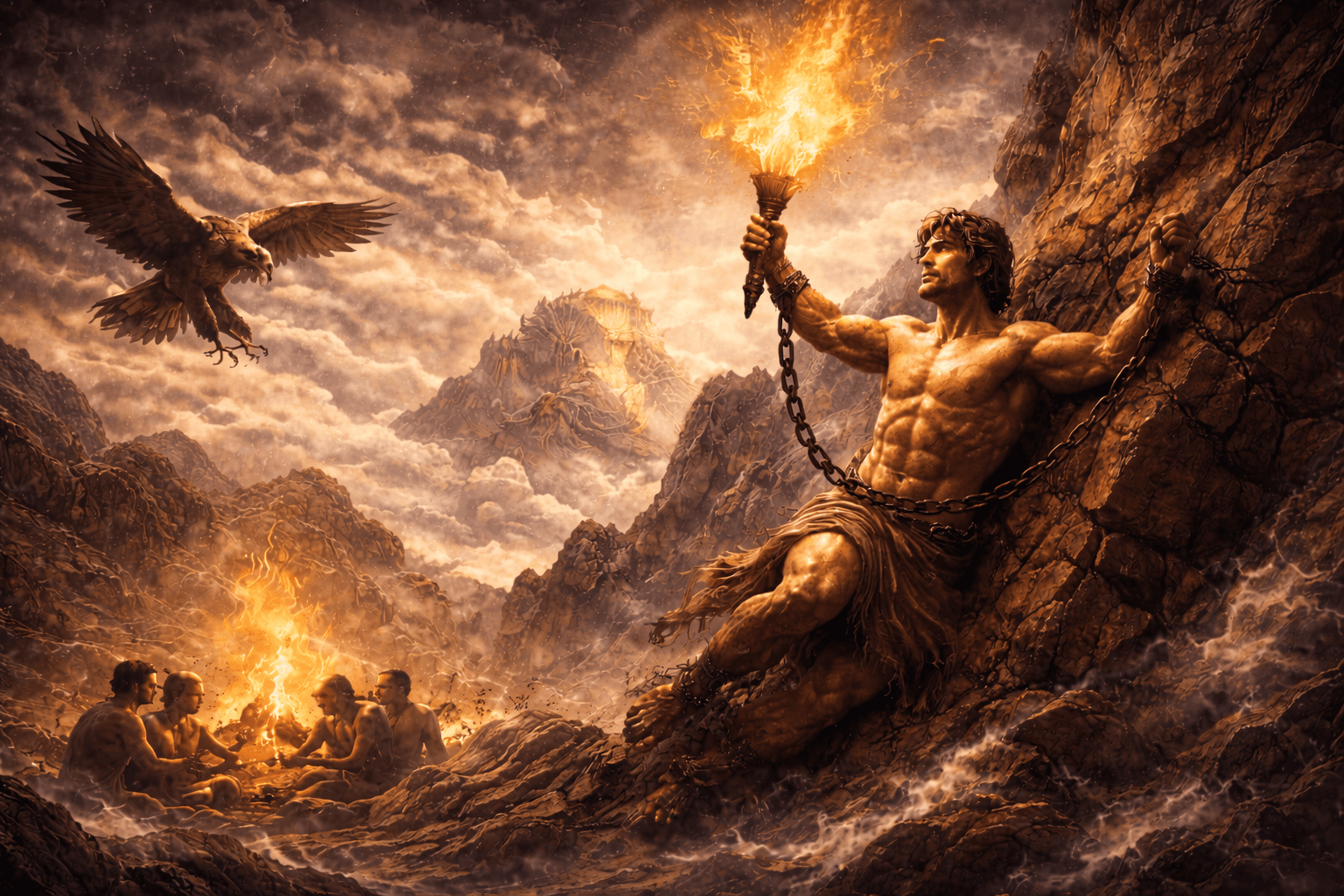
Prometheus doesn't ask Zeus for permission. He just climbs up to Olympus, waits for the right moment, and steals a spark of the sacred fire. According to the most famous version, he hides it inside the hollow stalk of a fennel plant — that plant that grows everywhere around the Mediterranean. Picture the scene: a Titan descending from Olympus with a branch secretly carrying the seed of all human civilization.
He gives fire to humans and everything changes. Humans learn to cook, which allows them to eat more foods and develop larger brains. They learn to work metals, to create tools and weapons. They learn to stay warm through winter. Fire gives them light in the darkness, protects them from wild beasts. But more than anything, fire gives them something fundamental: independence.
Zeus's Fury
When Zeus realizes what happened, he's furious. And there's something deeper than a simple robbery going on here. Prometheus didn't just take fire away from the gods — he gave humans the capacity to be something more than mere playthings of fate. He made them capable of creating, of transforming their environment, of challenging the established order. And for an all-powerful god like Zeus, that is unforgivable.
The Deception of the Sacrifices
The theft of fire wasn't the first run-in between Prometheus and Zeus. There had already been a conflict over sacrifices.
In the Greek world, when you made a sacrifice to the gods, you had to decide which parts of the animal you gave to them and which parts you kept for yourself. Prometheus, always looking out for humans, sets a trap. He slaughters an ox and divides it into two portions. In one he puts all the good meat, but covers it with the animal's stomach — which looks disgusting. In the other he puts the bones, but covers them with glistening fat that looks delicious.
He tells Zeus to choose which portion he wants for the gods. Zeus, naturally, picks the one that looks better: the bones covered in fat. Then he realizes he's been tricked. From that day on, in every Greek sacrifice, humans burned the bones and fat for the gods and kept the meat for themselves. Prometheus had once again benefited humans at the gods' expense.
The Eternal Punishment
When Zeus discovers the theft of fire, he's already doubly furious. The punishment he devises is brutal. He orders Hephaestus, the smith god, to chain Prometheus to a rock in the Caucasus Mountains. Not ordinary chains — unbreakable chains, forged with the same magic used to craft the world itself.
But Zeus isn't satisfied with that. Every day he sends a giant eagle — daughter of the monsters Typhon and Echidna — to devour Prometheus's liver. Because Prometheus is immortal, his liver regenerates each night, so the punishment can repeat forever. Thirty thousand years of this torment, day after day, without rest, without respite, without the slightest hope that it will end.
The Significance of the Liver
Why the liver specifically? The Greeks believed the liver was the seat of the emotions and of life itself. It wasn't just any organ — it was the vital center of a being. Having your liver devoured was like having your soul ripped out every single day.
There was something else: the Greeks had observed that the liver has a unique ability to regenerate — something modern medicine confirmed centuries later. Somehow, they already knew. They had noticed that a person could survive severe liver damage in ways they couldn't with other organs.
Imagine waking up every morning knowing exactly what's going to happen. No surprises, no variation. The eagle arrives, always at the same hour. The pain is always the same. Then, during the night, while your body regenerates, you have time to think, to remember, to anticipate the next day. It's torture both physical and psychological.
Pandora: The Punishment for Humanity
Zeus doesn't just punish Prometheus. He punishes all of humanity for daring to accept the gift of fire. And he does it in the most twisted way imaginable: by creating the first woman.
In the original myth, the humans Prometheus had created were all male. Women didn't exist. Zeus decides that humanity needs a permanent punishment, something to make their lives more complicated. So he orders Hephaestus to create Pandora.
Pandora's Gifts
Pandora is beautiful. All the gods give her a gift: Aphrodite gives her beauty, Athena teaches her to weave, Hermes gives her the power of speech and of cunning. But Zeus gives her something special: a box — or in some versions, a jar — and tells her that under no circumstances should she ever open it. Then he sends her as a gift to the humans.
And who does she go to? To Epimetheus, Prometheus's brother — the one who never thinks things through. Prometheus had warned him a thousand times: don't accept any gift from Zeus. But when Epimetheus sees Pandora, he forgets every warning. He welcomes her into his home, marries her, and then everything falls apart.
The Box Is Opened
Pandora, driven by the curiosity that was also given to her, eventually opens the box. Out pour all the evils that afflict humanity: disease, old age, hard labor, pain, grief, death. All of it scatters throughout the world. The only thing left inside the box is hope. The Greeks had a rather pessimistic view of hope — sometimes they saw it as just another evil, because it makes you suffer by making you wait for things that may never come.
It's a powerful story — and also deeply sexist if you look at it through modern eyes. The idea that women are a punishment is something many versions of the myth repeat, especially in Hesiod's texts. But it's important to understand this in context: the Greeks were trying to explain why life was so hard, why suffering existed. And they explained it with this myth of a lost golden age, when humans lived without problems, before fire and Pandora arrived.
The Secret That Keeps Prometheus Alive
Meanwhile, Prometheus remains chained to his rock. Centuries pass, millennia pass. The eagle comes every day, tears open his abdomen, feeds on his entrails. And Prometheus doesn't repent. There's something heroic and at the same time tragic in his suffering. He knew what was going to happen, he knew the price he would pay, and he chose to help humans anyway.
Here another fascinating detail of the myth appears. Prometheus holds a secret — something Zeus desperately needs to know. There is a prophecy about a son who will be more powerful than his father and will dethrone Zeus, just as Zeus dethroned his father Cronus, and Cronus dethroned his father Uranus. It's a cycle that seems destined to repeat forever. And Prometheus knows who the mother of that future son will be.
The Power of Knowledge
Zeus offers Prometheus his freedom in exchange for this secret. But Prometheus refuses. It's his only card, his only form of leverage. If he reveals the secret, he loses all influence, all possibility of negotiating. So he stays silent, enduring the torment day after day, while Zeus visits and tries to squeeze the information out of him.
This dynamic is narratively brilliant. The tortured has power over the torturer. The punished has something the punisher desperately needs. It's a complete inversion of the logic of power — and it shows that Prometheus, even chained, even suffering, is still the one who thinks ahead, still the strategist.
The Liberation
Eventually, according to most versions, Prometheus is freed. And it's none other than Heracles — the most famous hero in all of Greek mythology — who does it. Heracles is completing his twelve labors, or in some versions is on a later adventure, and passes through the Caucasus Mountains. He sees Prometheus chained, hears his story, and decides to help. He kills the eagle with an arrow and breaks the chains.
But Zeus needed to save face. He couldn't simply forgive Prometheus outright, because that would show weakness. So he has Prometheus wear a ring made from part of his chains, set with a piece of rock from the Caucasus. That way, technically, Prometheus is still bound to the rock, still serving his punishment — even though he's now free to move around.
The Fate of the Secret
And the secret of the prophecy? The versions differ. Some say Prometheus reveals that the goddess Thetis is the one who will bear a son more powerful than his father, and so Zeus arranges for her to marry a mortal, Peleus, instead of sleeping with her himself. That son will be Achilles, the greatest warrior of the Trojan War — but since he's the son of a mortal, he poses no threat to Zeus. Others say Prometheus takes the secret with him to eternity.
The Deeper Meaning of the Myth
These myths weren't just entertainment for the Greeks. They were ways of understanding the world, of processing deep truths about human existence.
Rebellion and Sacrifice
Prometheus represents rebellion against the established order. He represents sacrifice for a greater good — the idea that sometimes you have to defy authority when that authority is unjust. The Greeks, who valued order and obedience to the gods so deeply, also had this myth that celebrates someone who disobeys for a noble cause.
The Price of Progress
Fire is a perfect metaphor for knowledge and technology. Once humans have fire, there's no going back. You can't unlearn how to make fire. And fire is dangerous — it can destroy as easily as it creates. It can cook your food or burn your house. It can give you light or blind you. It's an ambiguous power, like all knowledge.
This myth speaks directly to the price of progress. Humans gain civilization, gain power, but lose innocence. They gain the ability to transform the world, but also gain the responsibility and the consequences of their actions. And Prometheus pays the price for giving them that power.
Prometheus Through History
It's impossible to talk about Prometheus without mentioning how this myth has echoed through history.
Literature
Mary Shelley subtitled her novel Frankenstein "The Modern Prometheus," because Dr. Frankenstein, like the Titan, creates life and then suffers the consequences of playing God.
The Romantics of the nineteenth century adored Prometheus. For them he represented the rebel artist, the genius who suffers for his art, the visionary punished for being ahead of his time. Lord Byron wrote a poem where Prometheus is the perfect symbol of the human spirit defying the gods. Percy Shelley wrote an entire play, Prometheus Unbound, reimagining the myth with an ending of reconciliation and peace.
Philosophy and Politics
Even Karl Marx saw in Prometheus a symbol of revolutionary struggle. The preface to his doctoral thesis mentions Prometheus as the patron saint of philosophy — the one who dares to defy the heavenly powers for the good of humanity.
The Technological Age
Every time humanity takes a major technological leap — from nuclear energy to artificial intelligence — we come back to Prometheus. We ask ourselves: are there forms of knowledge we shouldn't seek? Are there fires we shouldn't steal?
We live in a Promethean age. Every technological innovation is a new fire we're stealing. Genetic engineering, artificial intelligence, nuclear energy — these are all fires we've taken without fully knowing what consequences they'll have. And like Prometheus, sometimes we pay the price for our progress.
The Lessons of the Myth
Unbreakable Conviction
Prometheus doesn't repent. That's crucial. He could give up, could curse the humans for not appreciating his sacrifice, could tell Zeus: "You were right, humans didn't deserve fire." But he doesn't. He holds his position for thirty thousand years. That speaks to an absolute conviction in the value of humanity.
Intelligence Versus Power
Zeus has the power — he has the lightning bolts, he has the throne of Olympus. But Prometheus has intelligence — the ability to see the future, to plan, to guard secrets. The myth shows us that intelligence, even when it can't defeat power directly, can resist it. It can find cracks, it can survive.
Think Before You Act
The contrast between Prometheus and Epimetheus is another lesson. One thinks before acting, the other after. One plans, the other improvises. One saves humanity, the other condemns it by accepting Pandora. The Greeks are telling us something obvious but important: think before you act. Consider the consequences.
Suffering with Purpose
Prometheus's punishment is horrible, but it isn't meaningless. He chose this — he knew what was coming. His suffering has meaning because it's for something greater than himself. It's an idea that will resonate through many philosophical and religious traditions: suffering can make sense if it's for a just cause.
Final Reflection
The story of Prometheus keeps speaking to us today because it touches something essential about the human condition. We are the species that plays with fire — literally and figuratively. We're the ones who push limits, who seek knowledge even when it's dangerous, who rebel against fate.
Like Prometheus, we sometimes pay terrible prices for our progress. But also like Prometheus, we keep going. We don't regret having learned to make fire, even though that same fire has burned cities. We don't regret science, even though it's also given us atomic bombs. We keep searching, keep creating, keep stealing fires from Olympus.
The myth of Prometheus is a story about courage, about rebellion, about the price of knowledge, and about what it truly means to be human. Because to be human is to carry the fire that Prometheus gave us — to have the capacity to change our own destiny, even though that comes with responsibilities and consequences.
The next time you light a candle, turn on a stove, see any flame — remember Prometheus. Remember the Titan who spent thirty thousand years chained to a rock because he believed humans deserved a chance. Because that fire we use every day, literally and figuratively, someone paid an enormous price so that we could have it.
Related episodes
But to understand what Medea did, you must first understand who she was and what they did to her. Because this story doesn't start with a woman who goes crazy for no apparent reason.
First, he got Polyphemus drunk on concentrated wine he had brought with him, filling the cup generously and refilling it several times. When the giant, in his drunkenness, asked his name so he could reward him with a gift, Odysseus answered...
An arrow to the heel, shot by the man who started it all and guided by a god carrying a grudge. That was how Achilles died. Then came the horse, the night, and the fall of Troy. Then Homer: the poet who turned fifty days of that war into the most widel...