
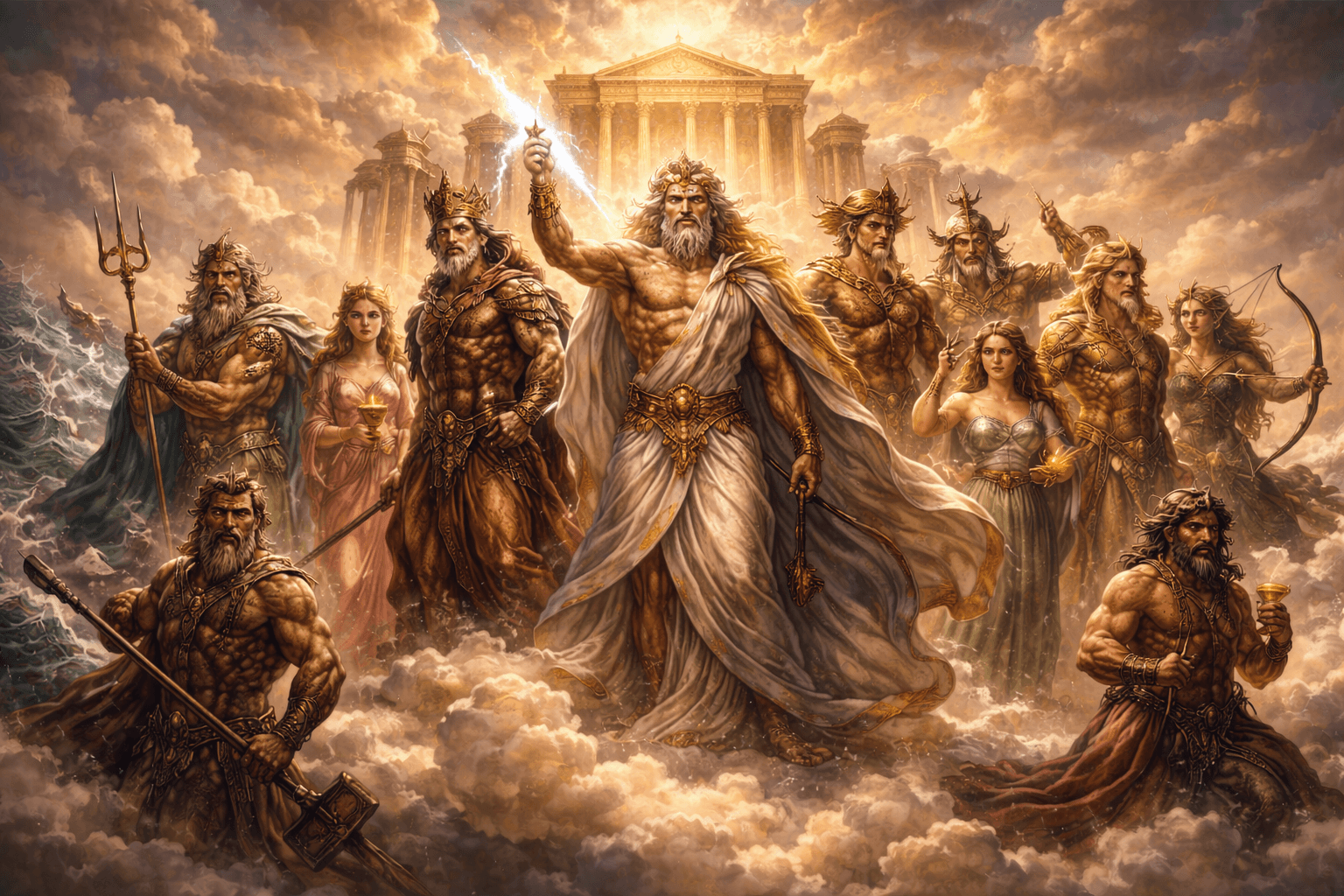
The Twelve Olympian Gods: The New World Order
 Andres Aguilar
The twelve Olympians took over after dethroning the Titans. Well, twelve more or less — because nobody could ever agree on the exact list. Zeus the serial cheater, Hera the jealous wife, gods who were imperfect and powerful. Humans with superpowers who...
The twelve Olympians took over after dethroning the Titans. Well, twelve more or less — because nobody could ever agree on the exact list. Zeus the serial cheater, Hera the jealous wife, gods who were imperfect and powerful. Humans with superpowers who invented the Western world.
If you were in ancient Greece — say, around 450 BCE — and you asked any random person on the street who ran the universe, they'd look at you like you had two heads and say: "The twelve Olympians. Obviously." But here's where it gets interesting. Ask five different people which twelve, and you'll get five different lists. Not because they don't know, but because Greek mythology was never as tidy as we've been led to believe. Today we're going to talk about these gods — how they came to power after a brutal war against their own parents, and why the new order they established on Mount Olympus ended up shaping not just Greek religion but much of how we understand the world to this day.
How they got there: the quick version
Before we dive into the twelve, let's quickly recap how they got there. The Titans were the previous generation, led by Cronus — a paranoid control freak who swallowed his children at birth because a prophecy told him one of them would overthrow him. Zeus survived because his mother Rhea swapped him out for a rock, and when he grew up he came back, freed his siblings from his father's stomach, and kicked off the Titanomachy: ten years of war between the young Olympians and the old Titans. With help from the Cyclopes and the Hecatoncheires, Zeus and his crew won, locked the Titans away in Tartarus, and divided up the universe. Zeus got the sky, Poseidon got the sea, and Hades got the underworld.
The earth was left as neutral ground where all three could move freely. And that's where the new order begins — the system of government the Greeks called the twelve Olympian gods.
Who were the twelve? (The official list nobody followed)
So who were these twelve? Here's the messy part I mentioned up front. The most widely accepted list — the one you find in most ancient texts — includes Zeus, Hera, Poseidon, Demeter, Athena, Apollo, Artemis, Ares, Aphrodite, Hephaestus, Hermes, and Dionysus. But right away we have a problem: Hades was one of the three big winners of the war, one of the brothers who helped take down Cronus, and yet he's not on the official list. Why? Because Hades lived in the underworld, not on Olympus — so technically he wasn't an Olympian god, even though he was hugely important. And in some versions, instead of Dionysus, Hestia appears on the list. She was the goddess of the hearth and one of the older sisters. The story goes that Hestia voluntarily gave up her seat to Dionysus to avoid a conflict, because having exactly twelve gods mattered to the Greeks. It was a perfect, complete number. Twelve like the months of the year, twelve like the constellations of the zodiac.
Zeus: the boss who couldn't keep it in his pants
Let's start with the boss himself: Zeus. This guy was the god of the sky, thunder, and lightning, and basically the one in charge of gods and mortals alike. The Greeks saw him as the god of order and justice — which is honestly pretty ironic considering he was a serial womanizer who spent more time chasing nymphs and mortal women than actually governing the universe. But the Greeks didn't expect their gods to be morally perfect. Zeus had the thunderbolt as his weapon, and when he lost his temper, he really lost it — hurling lightning from Olympus and splitting the sky open. His symbol was the eagle, and his sacred tree was the oak. The Greeks had shrines to him everywhere, but the most important was at Olympia, where the Olympic Games were held every four years in his honor. That's right — the original Olympics were basically a religious festival for Zeus.
Hera: the jealous wife
Right alongside Zeus was Hera, his wife and sister. Yes, you read that right — they were siblings. The Greek gods had no problem with that. Hera was the goddess of marriage and family, which is supremely ironic because she spent most of her time hunting down Zeus's lovers and the illegitimate children he fathered all over the place. Hera was jealous, vengeful, and had one hell of a temper. But for the Greeks, she represented legitimate marriage and family stability. Her symbol was the peacock — all those eyes in the feathers supposedly representing her constant watch over Zeus. Poor woman, honestly.
Poseidon: the hot-headed lord of the sea
Poseidon, Zeus's brother, controlled all the seas and oceans. He was second in power after Zeus, and he had a temperament as volatile as the waves. When he was in a good mood, the sea was calm. When he was angry, he unleashed storms and earthquakes. Yes, earthquakes. The Greeks believed Poseidon struck the earth with his trident and that's what caused tremors — which is why they called him the Earth-Shaker. He lived in a golden palace on the ocean floor and rode a chariot pulled by sea horses. Sailors prayed to him before every voyage, because crossing him meant certain shipwreck.
Demeter: the one who controls the seasons
Demeter was the goddess of agriculture and the harvest. Without her, there was no food — so she was absolutely vital for survival. Her most famous story is the abduction of her daughter Persephone by Hades. When Persephone was taken to the underworld, Demeter fell into such a deep depression that she stopped doing her job. Plants stopped growing, crops died, and humans started starving. Eventually a compromise was reached: Persephone would spend six months in the underworld with Hades and six months above with her mother. And that, according to the Greeks, is how the seasons came to be. When Persephone is below, Demeter is sad and autumn and winter arrive. When Persephone returns, Demeter is happy and spring and summer begin.
Athena: the one born from a headache
Athena is one of my favorite characters. She was the goddess of wisdom, military strategy, and craftsmanship. What's wild about Athena is that she was born directly from Zeus's head. The story goes that Zeus had a terrible headache, so he asked Hephaestus to split his skull open with an axe. And out came Athena — fully grown and armed for war. She was the protector of Athens, the city that bears her name. The Athenians built the Parthenon in her honor, which is still standing up on the Acropolis. Athena was a virgin goddess — she never married and had no children — and she represented rational intelligence and just warfare, as opposed to her brother Ares, who was nothing but mindless, brutal violence.
Ares: the god nobody liked
Speaking of Ares — he was the god of war, but the raw, bloody, chaotic kind. The Greeks respected him because war was a fact of life, but they didn't love him. He was violent, aggressive, and impulsive. In the Iliad, Homer actually portrays him as something of a coward who turns tail when things get rough. He had an affair with Aphrodite, goddess of love, who was married to Hephaestus. When Hephaestus found out, he set a trap and caught them in bed with an invisible net. Then he invited all the gods on Olympus to come see the spectacle. Just imagine the humiliation.
Aphrodite: the beauty that started wars
Aphrodite, goddess of love, beauty, and desire. There are two versions of her birth. One says she was Zeus's daughter. The other — the better one — says she was born from the sea foam after Cronus cut off Uranus's genitals and threw them into the ocean. From the foam Aphrodite emerged, floating on a shell. She was irresistibly beautiful — so much so that she caused conflicts among gods and mortals alike. She had a magic girdle that made anyone who saw her fall in love with her. The Trojan War — that ten-year conflict that inspired the Iliad — started basically because three goddesses, including Aphrodite, got into a fight over a golden apple inscribed "for the most beautiful."
Apollo: the god who did everything
Apollo was the god of the sun, music, poetry, medicine, and prophecy. Your classic multitasker. He played the lyre better than anyone, healed diseases but could also bring plagues with his arrows. He had a famous oracle at Delphi, where a priestess called the Pythia would fall into a trance and deliver prophecies in his name. Kings and generals came from all across the Greek world to consult the oracle before making major decisions. Apollo also represented the Greek ideal of male beauty: athletic, harmonious, perfect. He was Artemis's twin brother.
Artemis: the wild huntress
Artemis was the goddess of the hunt and the wild. She was Apollo's twin sister, but in many ways they were opposites. Where Apollo represented light and reason, Artemis represented the wild and the instinctual. Like Athena, she was a virgin goddess, and she protected young women and animals. She hunted with a bow and arrows and had a following of nymphs who accompanied her. If a man ever saw her naked, he paid dearly for it. The hunter Actaeon stumbled upon her bathing by accident, and she turned him into a stag. His own dogs tore him apart without recognizing him.
Hermes: the clever trickster
Hermes was the god of travelers, merchants, thieves, and messengers. He was the only god who could move freely between Olympus, the earth, and the underworld. He escorted the souls of the dead to the underworld and carried messages from Zeus to gods and mortals. He wore winged sandals and a winged helmet, and carried a staff with two entwined serpents — called the caduceus. He was clever, resourceful, and a total trickster. On the very first day of his life, he had already stolen Apollo's cattle. When confronted, he invented the lyre using a tortoise shell and gave it to Apollo as compensation. Apollo was so enchanted by the instrument that he forgave the theft.
Hephaestus: the imperfect craftsman
Hephaestus was the god of fire and metalworking. He was the blacksmith of the gods, the one who forged all the weapons and armor on Olympus. He was the only Olympian god who was physically imperfect. He was lame, and there are two versions of why. One says he was born that way and that Hera, embarrassed to have a deformed son, threw him off Olympus. The other says he was born perfect, but Zeus hurled him off Olympus for defending Hera during an argument, and the fall left him lame. Despite his physical disability, he was extraordinarily skilled. He created the gods' palace, the automatons that served in his workshop, and even the first mortal woman — Pandora — on Zeus's orders.
Dionysus: the god who was born twice
And finally, Dionysus — god of wine, ritual madness, and ecstasy. He was the youngest of the Olympians and the only one whose mother was a mortal. His mother was Semele, a princess who died when Hera — jealous as ever — tricked her into asking Zeus to reveal himself in his full divine form. Zeus agreed, appeared as pure lightning, and Semele was incinerated. Zeus rescued the fetus of Dionysus and sewed him into his thigh until he was born. That's why Dionysus is said to have been born twice. He was the god of liberation, of losing control, of intoxication and theater. His followers, the Maenads, fell into trances where they danced, screamed, and — legend has it — tore animals apart with their bare hands. Dionysus represented everything Apollo was not: chaos, uncontrolled emotion, the irrational.
Imperfect gods: humans with superpowers
These twelve gods, with all their virtues and flaws, their fights and their alliances, made up the Olympian pantheon. What's interesting is that the Greeks didn't see them as perfect, omnipotent beings the way Christianity sees God. They were powerful, yes — immortal, yes — but they had the same emotions and weaknesses as humans. They fell in love, got jealous, took revenge, made mistakes. They were basically humans with superpowers. And that made them more relatable, more real for ordinary people.
The new order: imperfect but functional
The new order the Olympians established after defeating the Titans wasn't perfect. There were intrigues, fights, and affairs all over the place. Zeus constantly had to mediate between gods squabbling over influence and territory. But it was an order, a structure. Each god had their domain, their responsibilities, their sphere of influence. And humans could call on them depending on their needs. Going sailing? Pray to Poseidon. Need a good harvest? Offer sacrifices to Demeter. Going to war? Ask Athena for strategy or Ares for brute force, depending on your style.
Temples and festivals: religion as a social event
Temples to these gods were scattered all across Greece. Every city had its own patron deity. Athens had Athena, Corinth had Aphrodite, Delphi had Apollo. Religious festivals were massive events that lasted for days. The Olympics, the Panathenaea, the Dionysia. These weren't just religious ceremonies — they were social, political, and cultural events. Athletic competitions were held, plays were performed, poetry was recited. Religion was woven into every aspect of Greek life.
The legacy that never died
And here's something I find fascinating: this system of twelve gods, with all their stories and characters, ended up shaping all of Western culture. The Romans adopted these gods and changed their names. Zeus became Jupiter, Poseidon became Neptune, Aphrodite became Venus. But they were the same gods with the same stories. And when Christianity arrived, many of the functions of these gods were transferred to the saints. You can't have twelve gods, but you can have twelve apostles. You can't pray to the god of the sea, but you can pray to Saint Elmo, patron of sailors.
To this day we use words and concepts that come directly from these gods. When you describe something as titanic, you're referencing the Titans. When you call someone narcissistic, you're citing the myth of Narcissus. Brands use these names all the time. Nike — goddess of victory. Ajax — hero of the Trojan War. Even the planets carry the names of Roman gods who are just the Greek versions in disguise.
Ancient superheroes
The legacy of the twelve Olympians isn't just in mythology textbooks. It's in art, literature, film, and comics. Every time you watch a superhero movie, you're watching a modern version of these stories. Beings with extraordinary powers who use those powers for good or for ill, who have personal conflicts, who fall in love, who make mistakes. Same concept, adapted for our time.
What were these gods actually for?
What I find most interesting of all is that the Greeks created a religious system that didn't promise salvation or eternal life. There was no heaven or hell in the Christian sense. When you died, you went to the underworld — and that was that. Being good or bad didn't change your final destination much. So what were these gods actually for? They were for explaining the world, for making sense of chaos. Why are there storms? Because Poseidon is angry. Why are there seasons? Because Demeter is grieving. Why does evil exist? Because Pandora opened the box. It was a way of understanding the incomprehensible — of naming the forces that controlled their lives.
And they also served as models of behavior, even if that sounds strange given how badly these gods behaved. But the stories of the Olympians taught lessons. They showed you the consequences of excessive pride, the importance of hospitality, the danger of defying the gods. When you read Greek mythology not as religion but as literature, you realize it's a mirror of the society that created it. The Greeks projected onto their gods all their virtues and all their flaws.
The real Olympus
Mount Olympus is still there, in northern Greece. You can actually hike it if you want — there are trails. Obviously you're not going to find Zeus throwing lightning bolts at the summit, but it's an impressive place. The ancient Greeks had a good eye for scenery. And when you're up there, with clouds all around and the landscape stretching out as far as you can see, you understand why they thought the gods lived there. It's exactly the kind of place that inspires awe, that makes you feel small in the face of something far greater than yourself.
A turning point in human thought
The twelve Olympian gods represent a turning point in the history of human thought. They mark the moment when people stopped seeing the gods as abstract natural forces and started seeing them as persons — with stories, families, personalities. This shift made possible a richer, more complex kind of storytelling. And that storytelling is the foundation of our entire Western literary tradition. Homer, the Greek playwrights — all of it flows from these myths.
So the next time lightning splits the sky, or you find yourself standing by the ocean, or you wonder why love and war exist at all — think of these twelve. More than two and a half thousand years ago, the Greeks invented this pantheon to explain the world. And it worked so well, and gave them so many incredible stories, that we're still telling them today. That's the power of a great myth: it doesn't have to be true to be real.
Related episodes
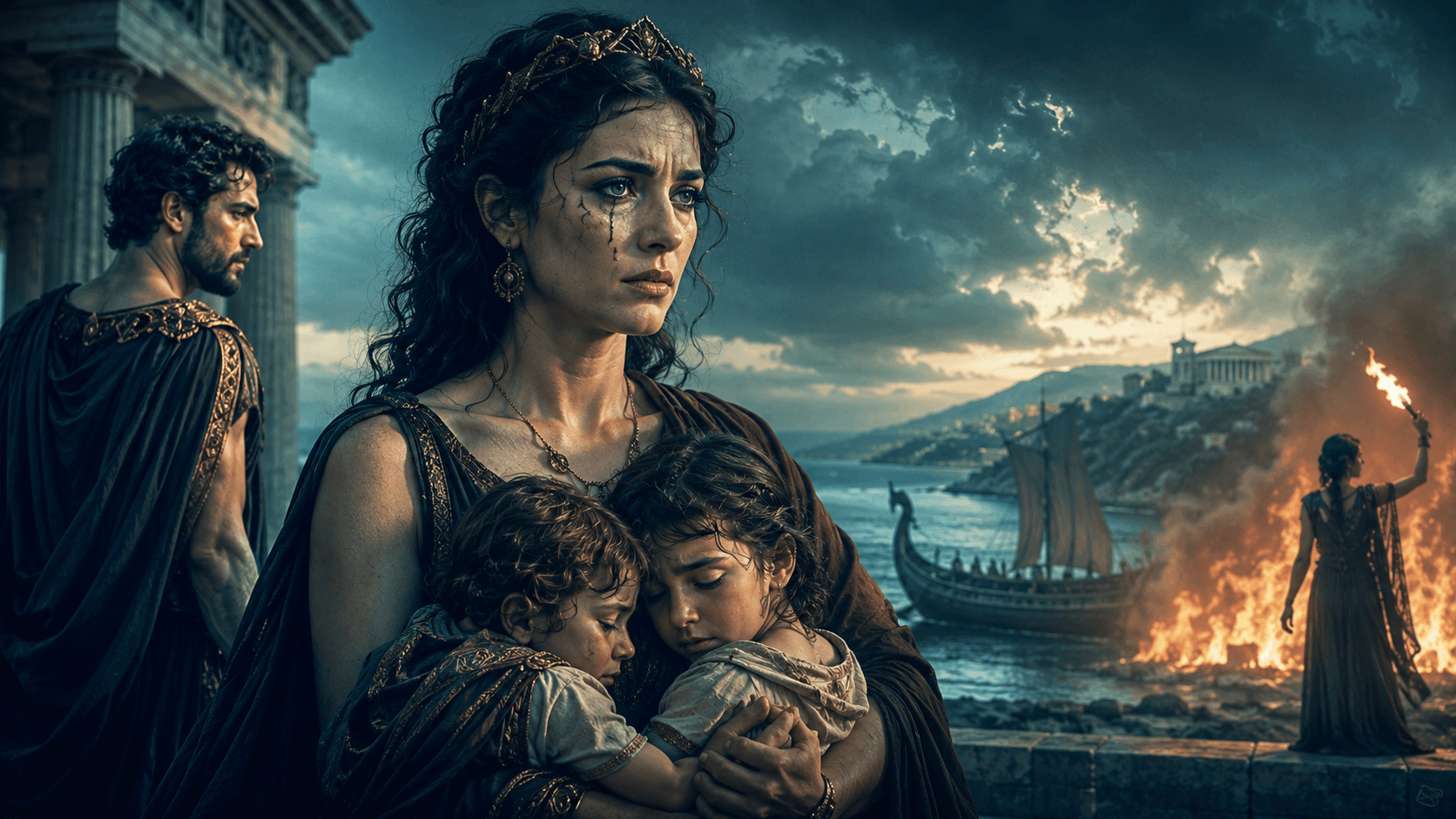
But to understand what Medea did, you must first understand who she was and what they did to her. Because this story doesn't start with a woman who goes crazy for no apparent reason.
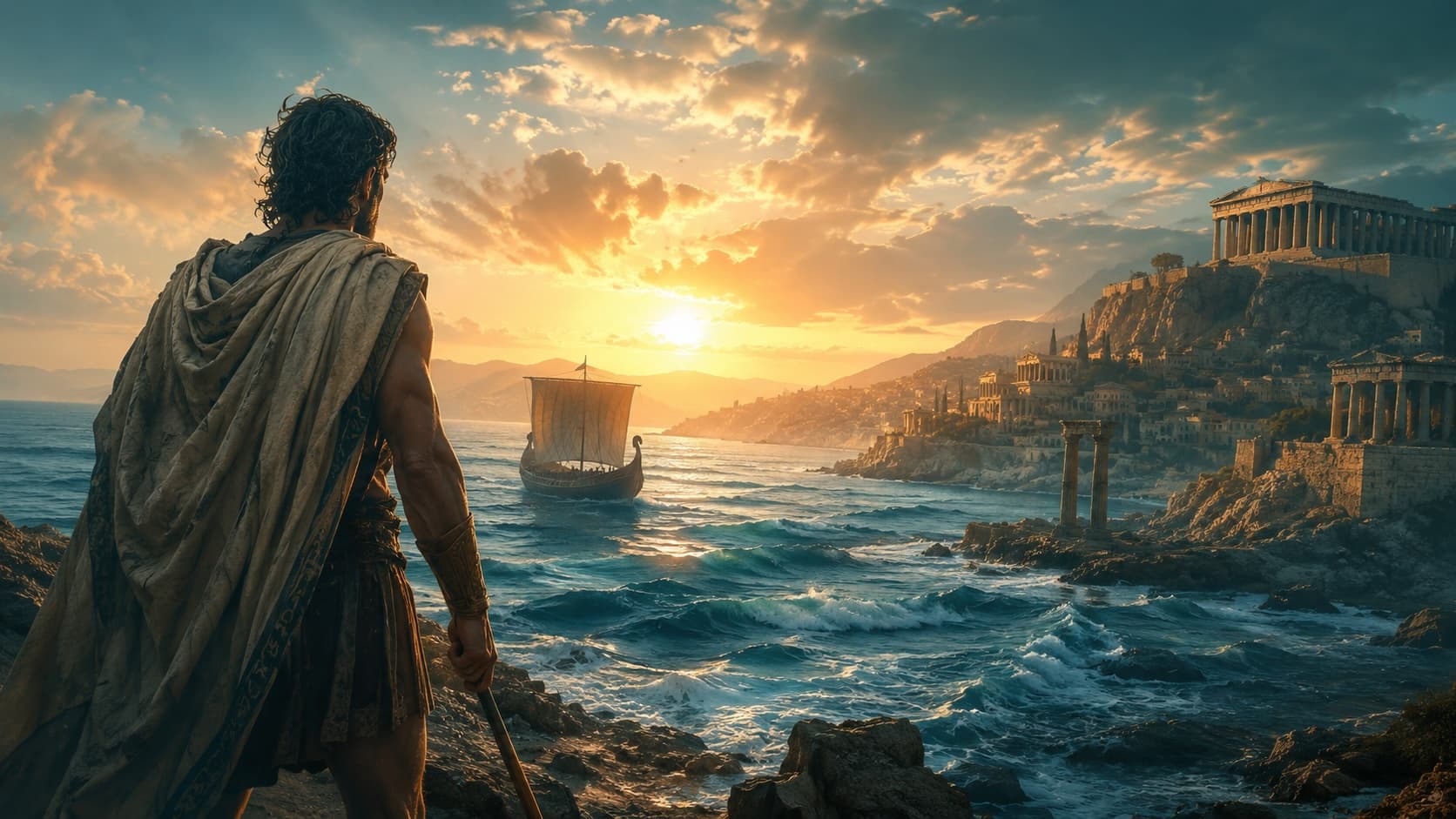
First, he got Polyphemus drunk on concentrated wine he had brought with him, filling the cup generously and refilling it several times. When the giant, in his drunkenness, asked his name so he could reward him with a gift, Odysseus answered...
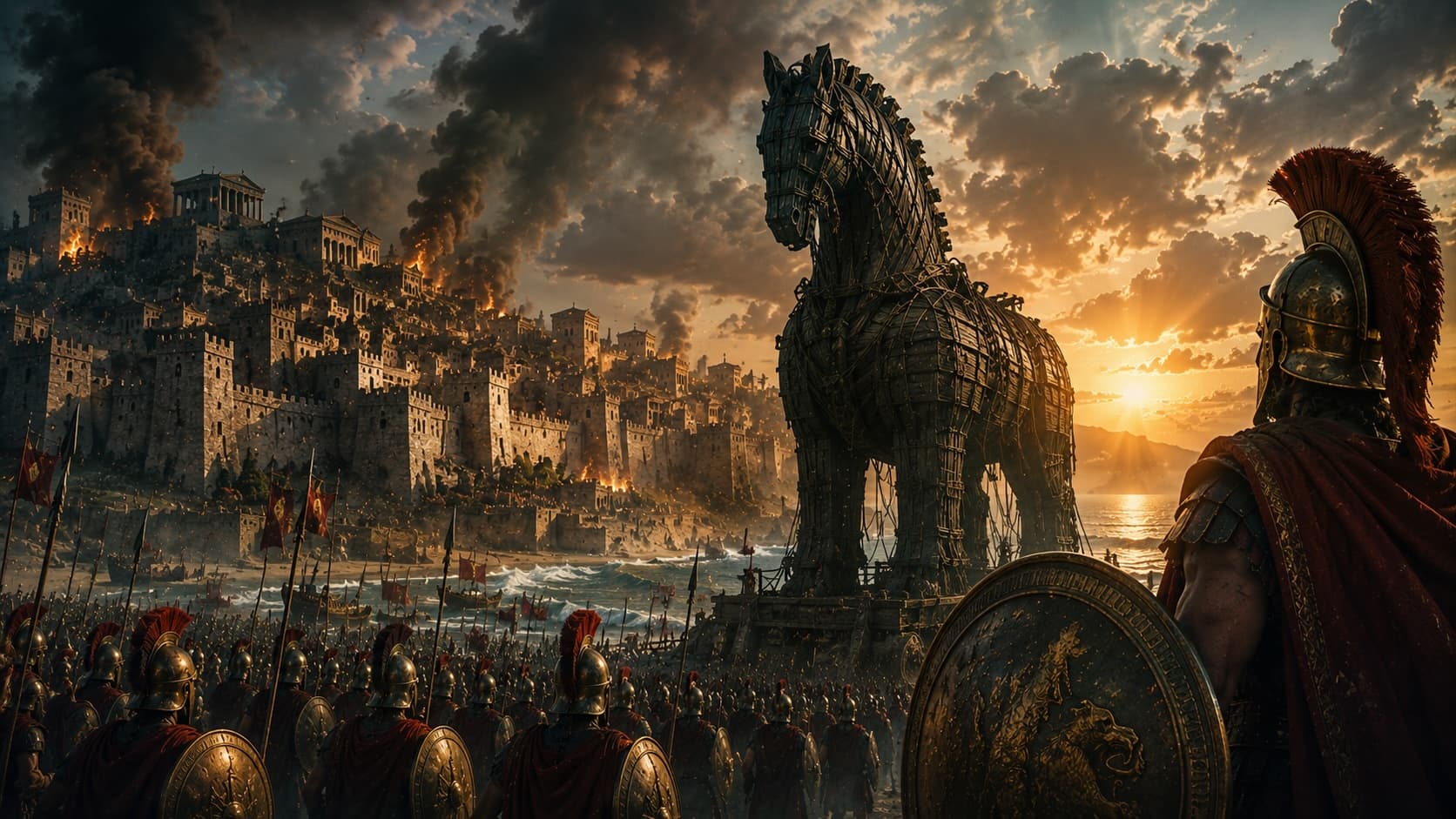
An arrow to the heel, shot by the man who started it all and guided by a god carrying a grudge. That was how Achilles died. Then came the horse, the night, and the fall of Troy. Then Homer: the poet who turned fifty days of that war into the most widel...