
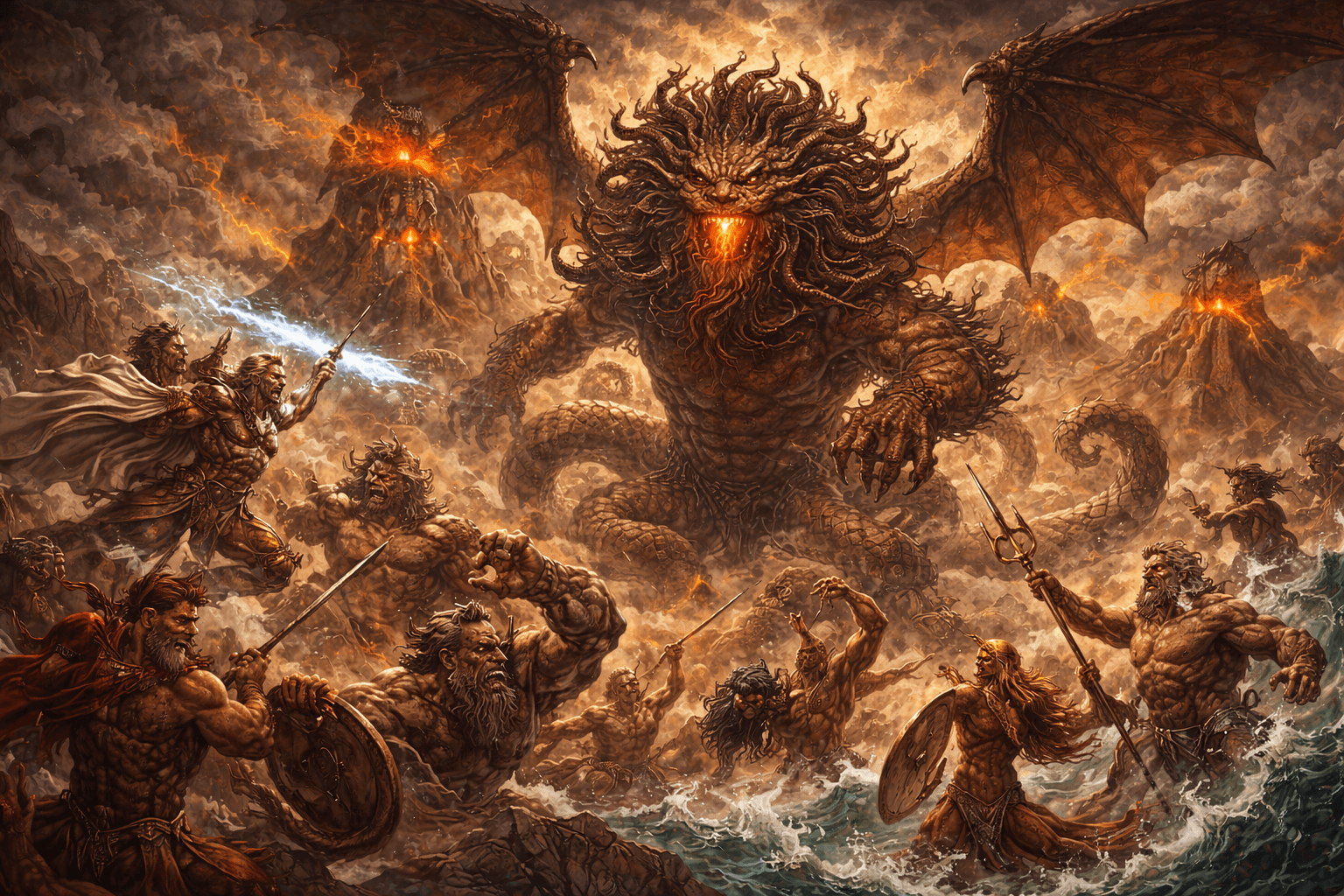
The Gigantomachy
 Andres Aguilar
Zeus had just won the most brutal war in history and thought his reign was untouchable. He was wrong. His own grandmother — the Earth itself — decided to get revenge by creating an army of monstrous giants born from primordial violence. And when that w...
Zeus won against his father, but his grandmother Gaea decided to get even — first by creating the Giants, then by unleashing Typhon, the most terrifying monster the universe had ever seen. The story of how Zeus discovered that winning the throne is easy. Keeping it is the hard part.
You just won the most brutal war in history. You dethroned your father, locked up an entire generation of primordial gods in the darkest corner of the universe, and made yourself the absolute king of the cosmos. You sit down on your throne thinking you can finally catch your breath — that order has been established, that your power is beyond question. And then you find out your grandmother is angry with you. Not the kind of angry where your grandmother scolds you for not visiting enough. Angry enough to create an army of monstrous giants specifically designed to destroy you. Welcome to Zeus's life after the Titanomachy.
Here's the thing: the war against the Titans was not the end of Zeus's problems. It was barely the beginning. After that epic victory that took ten years, Zeus thought he had secured his reign forever. But the cosmos had other plans. And his own family, it turned out, was not at all happy with how things had shaken out. What came next were two threats that endangered not just Zeus's throne, but the very existence of the Olympian order. First came the Gigantomachy — the war against the Giants. And then came something even worse: Typhon, the most terrifying monster that had ever existed.
These two stories are fascinating because they show us something important: power is never secure. Even after you win the biggest war you can imagine, there's always someone waiting to challenge you. And in Zeus's case, that someone was literally his own family.
Gaea's revenge: the Giants are born
Let's start with the Gigantomachy. To understand this war, we need to understand who created the Giants and why. And that means looking at Gaea — the Earth herself, Zeus's grandmother. Gaea had actually helped Zeus during the Titanomachy. In fact, it was she who advised him to free the Cyclopes and the Hecatoncheires. But after Zeus won, Gaea watched how he treated her children, the Titans. He locked them in Tartarus, in the deepest darkness, condemned to suffer for all eternity. And Gaea, as the mother of the Titans, did not forgive that.
So she decided to create a new generation of warriors. Not just any warriors. The Giants were immense, monstrous beings, born specifically to make war on the Olympian gods. Gaea produced them using the blood that had fallen on her when Cronus castrated Uranus. Yes, we're back to the most traumatic moment in the creation of the cosmos. That blood, mixed with the earth, gave rise to the Giants. They were literally born from primordial violence.
The Giants were nothing like the Titans. The Titans were gods — immortal, powerful, but with divine form. The Giants were something else. They were enormous, yes, but also partly bestial. Many had serpents instead of legs. Some had hundreds of arms. They were the embodiment of chaos and brutality. And each one of them was nearly immortal — almost impossible to kill.
The prophecy: the gods need mortals
Here's one of the most interesting details in this whole story: there was a prophecy. And prophecies in Greek mythology always come true. Always. No matter how hard you try to prevent them. The prophecy said that the Giants could not be defeated by the gods alone. To overcome them, the Olympians would need the help of a mortal. A human hero would have to deliver the killing blow to each Giant for them to truly die.
This is brilliant storytelling, because it places humanity at the center of the survival of the divine order. The gods, for all their power, weren't enough. They needed mortals. And the hero Zeus chose for this role was Heracles — better known in his Roman version as Hercules.
Heracles was Zeus's son, so he was technically a demigod. He was the strongest hero who ever lived, famous for his twelve labors and his extraordinary physical power. And in the Gigantomachy, he became the key piece in the Olympian victory.
The battle: mountains as projectiles
The battle was epic. The Giants attacked Olympus itself, trying to scale the home of the gods. They grabbed entire mountains and hurled them toward the sky. Picture the scene: these monstrous beings, with serpents for legs, lifting mountains like pebbles and launching them at Olympus. The entire cosmos shook again, just as it had during the Titanomachy.
The gods responded with everything they had. Zeus hurled his thunderbolts from the sky. Poseidon used his trident to break apart entire islands and throw them at the Giants. Apollo, god of the sun and archery, fired arrows that never missed. His twin sister Artemis did the same. Athena, goddess of wisdom and strategic warfare, fought with intelligence and ferocity. Dionysus used his vines to entangle the Giants. Even Hestia, goddess of the hearth who generally avoided conflict, had to get involved.
But every time a god seriously wounded a Giant, Heracles had to show up and deliver the final blow with his poisoned arrows. He had dipped his arrows in the blood of the Hydra — a venom so potent that even the Giants couldn't resist it. A rhythm developed in the fighting: a god weakened the Giant, and Heracles finished him off.
Legendary individual battles
There were some memorable one-on-one showdowns. Athena fought Enceladus, one of the most powerful of the Giants. The battle was so intense that Athena finally lifted the entire island of Sicily and dropped it on him, crushing him beneath it. Enceladus was buried under the island, and according to tradition, every time Mount Etna erupts, it's because Enceladus is still struggling to escape.
Poseidon chased the Giant Polybotes all the way to the island of Cos. There he tore off a chunk of the island with his trident and threw it on top of him, creating what is now the small island of Nisyros. The Giant was buried under the rocks — another threat neutralized.
Hermes, the messenger of the gods and one of the cleverest of the Olympians, used Hades's helmet of invisibility — the very one the Cyclopes had forged during the Titanomachy — to kill the Giant Hippolytus. Apollo and Artemis, working as a team the way only twins can, brought down the Giant Otus with their perfectly aimed arrows.
But the most memorable fight was probably Heracles against Alcyoneus. This Giant was special because he was immortal as long as he touched the soil of his homeland. Heracles figured this out and dragged him off his native ground. Once Alcyoneus lost contact with that specific earth, he became vulnerable — and Heracles was able to kill him. It's a detail that shows the kind of cunning this war required. It wasn't just brute force.
The battle lasted less time than the Titanomachy, but it was just as brutal. And in the end, the Olympians triumphed again. The Giants were defeated, many of them buried under islands or mountains, condemned to an existence underground. And for the second time, Zeus and his family defended the Olympian order against an existential threat.
Typhon: when Gaea stopped holding back
But Gaea wasn't done. If the Giants hadn't been enough to topple Zeus, she would create something worse. Something so terrible that even the gods would tremble at the sight of it. And so Typhon was born.
Typhon wasn't just another monster. He was the embodiment of primitive chaos — the destructive forces of nature with no restraint. He was, in Hesiod's words, the most terrible being that had ever existed. And when you read the descriptions of Typhon, you understand why.
Picture a monster so large that his head brushed the stars. He had a hundred dragon heads that breathed fire. Flames shot from his eyes. When he stretched his arms, they could reach from east to west. Instead of fingers, he had serpents. And from his mouths came terrible sounds — sometimes the bellowing of a bull, sometimes the roar of a lion, sometimes the barking of dogs. It was as if every frightening sound in nature poured out of him at once.
Gaea had produced him with Tartarus, the personification of the deepest abyss of the underworld. So Typhon was literally the son of the Earth and the Abyss. He represented everything civilization feared: chaos, senseless destruction, the end of order.
When the gods ran
When Typhon emerged and headed for Olympus, something incredible happened. Something that had never happened before: the gods panicked. Not controlled, dignified panic. Real panic. According to some versions of the myth, the gods fled. They transformed into animals and escaped to Egypt. Zeus was left alone to face the monster.
This detail matters because it shows us that Zeus, despite being king of the gods, was also afraid. He wasn't invincible. He wasn't all-powerful. He was powerful, yes — but Typhon was something he had never encountered before. And he had to face it anyway.
Zeus vs. Typhon: the personal battle
The fight between Zeus and Typhon was personal in a way the previous wars hadn't been. No armies, no allies. Just Zeus against embodied chaos. Zeus hurled his thunderbolts, one after another, but Typhon kept coming. They finally clashed hand to hand — and here the versions of the myth diverge somewhat.
According to some versions, Typhon achieved the unthinkable: he defeated Zeus. He tore out the sinews from Zeus's hands and feet, leaving him completely helpless. Then he hid the sinews in a cave guarded by the she-dragon Delphyne. Zeus was paralyzed, unable to move. The king of the gods had been beaten.
But then Hermes entered the picture again — the clever god. Hermes, along with Pan, managed to recover Zeus's sinews. There's something almost comic about this image: the most powerful beings in the universe needing to get their tendons returned like stolen property. But that's Greek mythology for you — it mixes the epic with the bizarre without batting an eye.
Mount Etna: eternal prison of chaos
Once Zeus had his sinews back, and with them his strength, the battle resumed. And this time Zeus wasn't going to make any mistakes. He chased Typhon all the way to Sicily — the same island where Athena had buried Enceladus. And there, Zeus lifted the entire Mount Etna and hurled it at Typhon, burying him forever beneath it.
According to tradition, Typhon is still alive under Mount Etna. Every time the volcano erupts, it's Typhon trying to escape — spitting fire and ash in his eternal rage. Every earthquake in Sicily is Typhon shifting beneath the ground. The monster never died. He was simply trapped, contained but never eliminated.
This is an important difference from the Titanomachy and the Gigantomachy. Zeus couldn't actually kill Typhon. He could only lock him away. Chaos, the myth seems to tell us, can never be fully destroyed. It can only be controlled, contained, kept in check with constant vigilance.
Typhon's legacy: a family of nightmares
Typhon had also left descendants before being defeated. With his partner Echidna, the mother of all monsters, he had fathered some of the most fearsome creatures in Greek mythology. The Lernaean Hydra, that multi-headed serpent Heracles had to destroy. The Nemean Lion, with its impenetrable hide. Cerberus, the three-headed dog guarding the gates of the underworld. The Chimera, that hybrid of lion, goat, and serpent. The Sphinx, who tormented Thebes with her riddles. All these monsters that Greek heroes would later have to face were the children of Typhon.
So even though Typhon was defeated, his legacy endured. The chaos he represented would keep showing up in different forms. Greek heroes would spend generations fighting against Typhon's descendants, confronting chaos again and again in battles that were smaller but no less important.
The fragility of order
What's so fascinating about these two wars — the Gigantomachy and the battle against Typhon — is what they tell us about the nature of power and order. Zeus had won the throne in the Titanomachy. He had established a new order. But that order was always under threat. There was always something or someone trying to bring it down. And Zeus had to constantly defend it.
This is very different from other mythologies. In many religious traditions, once the supreme god establishes order, that order is eternal and unquestionable. But not in Greek mythology. Here, order is fragile — constantly challenged. The gods have to fight to maintain it. And that fight never really ends.
There's something very human in this. It reflects our actual experience of how power works in the world. No matter how strong your position, there are always challenges. There are always threats. Social, political, even personal order requires constant upkeep. It's not something you establish once and then forget about. It's something you have to defend every day.
Family: your greatest ally and your worst enemy
And there's also this theme that the threats come from within your own family. Gaea, who had helped Zeus against Cronus, became his enemy. She created not one but two armies to destroy him. In Greek mythology, family is both your greatest support and your greatest potential threat. Loyalties shift, resentments build, and what was an alliance can turn into enmity.
The Greeks projected their own anxieties and tensions through these myths. The Gigantomachy was often interpreted as a metaphor for civilization versus barbarism, order versus chaos. Greek temples were decorated with friezes depicting the battle against the Giants. The Parthenon in Athens had an entire section dedicated to it. It was a way of saying: we are like the Olympian gods, defending civilized order against the forces of chaos.
The chaos that never dies
And Typhon represented something even more primordial. Not just social or political chaos, but the chaos of nature itself. Volcanoes, earthquakes, destructive storms — all those forces humanity cannot control. The myth tells us that even the gods, with all their power, can barely contain these forces. They don't eliminate them. They just hold them in check.
There's an interesting humility in this. The Greeks didn't pretend that humanity — or even the gods — had total control over the world. They acknowledged that there are forces greater, older, more powerful than themselves. And that the best we can do is keep them under control as well as possible, knowing that at any moment they could break free again.
The end of the great wars
After defeating Typhon, Zeus was finally able to consolidate his reign. There would be no more large-scale wars against his rule. The challenges he would face afterward were of a different kind: family conflicts with Hera, political intrigues among the gods, interventions in mortal affairs. But never again would he face an existential threat to his rule like the Giants and Typhon had represented.
It's interesting that these last two great threats came so quickly after the Titanomachy. Zeus had barely had time to sit down on his throne before he had to defend it again. And then again. As if the cosmos itself were testing him, making sure he truly deserved to be king of the gods.
And Zeus passed the test. Not easily, not without help, not without moments of genuine danger. But in the end, he and the Olympians prevailed. The order they had established survived. And that order would last, according to Greek mythology, until the end of time.
The irony of the endless cycle
But here's the final irony: Zeus himself was part of the cycle that had begun with Uranus. Uranus feared being overthrown by his children — and was overthrown by Cronus. Cronus feared being overthrown by his children — and was overthrown by Zeus. And Zeus, too, heard prophecies that a son of his would overthrow him. In fact, that's why he swallowed his first wife Metis when she was pregnant — because he'd been told that the child she carried would dethrone him. From that union, as it happened, no son was born; instead Athena emerged fully grown from Zeus's head, a way of sidestepping the prophecy — but also of perpetuating the cycle of paranoia.
Zeus lived with that fear. After fighting his father, after the Giants, after Typhon, after everything he had done to defend his throne, he knew that someday someone might come to take it from him. But that never happened — at least not in the myths that have come down to us. Zeus remained king of the gods until the Olympian cult itself faded with the rise of Christianity.
The lessons of the great wars
What these stories leave us with is something powerful. They speak to us about the fragility of order, the persistence of chaos, the need to defend what we value. They remind us that power is always contested, that you can never let your guard down, that threats can come from where you least expect them — even from your own family.
And they also speak to us about resilience. Zeus faced impossible challenges and survived. The Olympians, working together, with the help of mortal heroes, defended their world against enemies who seemed unbeatable. It's a story about not giving up, about fighting on even when everything seems lost.
These battles — the Gigantomachy and the fight against Typhon — close the cycle of the great cosmic wars of Greek mythology. After this, the conflicts would be smaller, more personal. But these three wars — the Titanomachy, the Gigantomachy, and the battle against Typhon — defined the order of the Greek universe. They established who ruled, how they ruled, and just how fragile that rule was.
And with that, we've covered the Gigantomachy and Typhon — the last great threats to the Olympian order. Zeus and the gods proved they could defend their world, but they learned that world would always be under threat, that chaos never truly rests.
Related episodes
But to understand what Medea did, you must first understand who she was and what they did to her. Because this story doesn't start with a woman who goes crazy for no apparent reason.
First, he got Polyphemus drunk on concentrated wine he had brought with him, filling the cup generously and refilling it several times. When the giant, in his drunkenness, asked his name so he could reward him with a gift, Odysseus answered...
An arrow to the heel, shot by the man who started it all and guided by a god carrying a grudge. That was how Achilles died. Then came the horse, the night, and the fall of Troy. Then Homer: the poet who turned fifty days of that war into the most widel...