
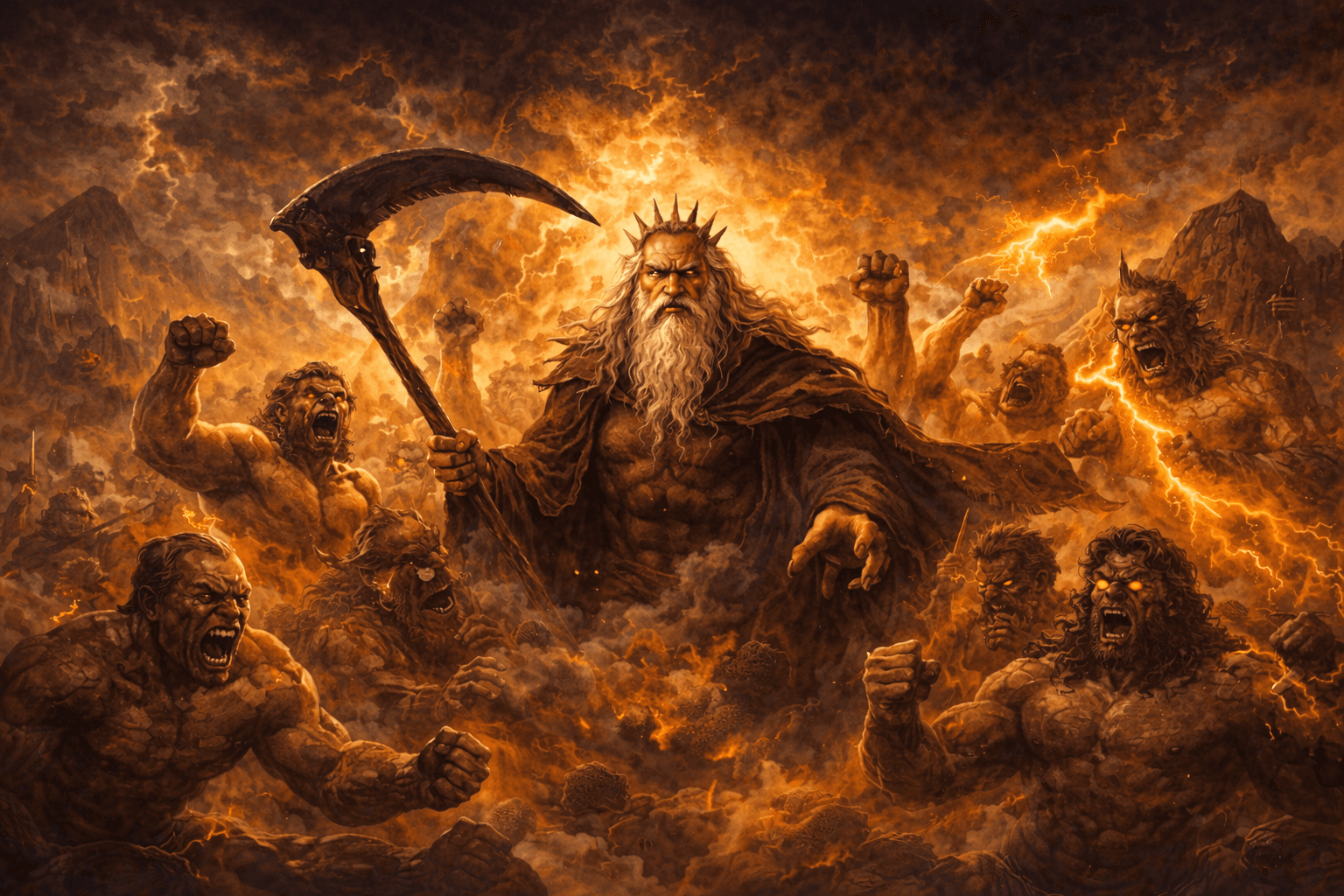
The Titans and the Reign of Cronus
 Andres Aguilar
Before Zeus and the Olympians, the universe belonged to the Titans — twelve primordial gods born from the union of Sky and Earth, who ruled the cosmos during the era the Greeks called the Golden Age. But power always comes at a price, and the story of ...
Picture a father so obsessed with holding onto power that every time his wife gives birth, he grabs the newborn and swallows it whole. Just like that — no hesitation, no guilt, no second thoughts. Your oldest brother: swallowed. Your oldest sister: swallowed. And so on down the line until it's your turn. Sounds like a horror movie, right? Well, that's exactly the story of Cronus, king of the Titans, and I promise you it's one of the most twisted family stories in all of Greek mythology. And that's really saying something.
In the previous episode we saw how the cosmos was born — how Gaea, Tartarus, and Eros emerged from the primordial Chaos, and how Gaea created Uranus, the Sky, to be her equal and her mate. Today we're looking at what happened next, and I'll warn you right now: things got very, very dark. We're going to meet the Titans, that first generation of gods who ruled the universe before Zeus and the Olympians. And above all, we're going to dig into the story of Cronus — the Titan who overthrew his father in the most brutal way imaginable, then ruled over what the Greeks called the Golden Age. But as you'll see, even a golden age can't last forever when paranoia and fear take hold of power.
The children of Gaea and Uranus: one unconventional family
Let's go back to Gaea and Uranus. As we established last time, Gaea had created Uranus on her own — no partner needed — and then joined with him. And this union was enormously fertile. They had children. Lots of children. The first were the twelve Titans: six male and six female. The males were Oceanus, Coeus, Crius, Hyperion, Iapetus, and Cronus. The females were Tethys, Theia, Themis, Mnemosyne, Phoebe, and Rhea. These names might not mean much to you right now, but some of them will be crucial throughout Greek mythology.
Oceanus, for instance, was the personification of the river the Greeks believed encircled the entire earth. Not the ocean as we think of it today, but a massive circular river that marked the boundary of the known world. Mnemosyne was the personification of memory, and she'll later become the mother of the Muses. Themis was divine justice, the cosmic order. And Cronus — well, Cronus was the youngest of them all, but also the most cunning, the most ambitious, the one willing to do whatever it took to seize power.
The monsters nobody wanted
But here's the thing: Gaea and Uranus didn't only have the Titans. They also had other children — and these children were considerably stranger, more monstrous. After the Titans came the Cyclopes: three brothers named Brontes, Steropes, and Arges. These guys were giants with a single eye in the middle of their foreheads, but they were incredibly skilled craftsmen. They were the cosmic blacksmiths — the ones who would later forge Zeus's thunderbolt, Poseidon's trident, and Hades's helmet of invisibility.
And after the Cyclopes came the Hecatoncheires — which literally means "the hundred-handed ones." Three brothers: Cottus, Briareus, and Gyges. Picture monstrous giants with fifty heads and a hundred arms each. They were basically living war machines, so powerful that even the gods were afraid of them.
The worst father in the cosmos
Now here's where the story turns ugly. Because Uranus looked at the Cyclopes and the Hecatoncheires and was horrified. They were too strange, too powerful, too dangerous. So Uranus made a decision that would cost him everything: he locked them away. He shoved them back inside Gaea's body, deep in the darkness, imprisoned. Hesiod says Uranus "exulted in his wickedness," which gives you a pretty clear picture of what kind of father this guy was.
And Gaea, as you can imagine, was furious. These were her children, and her husband had crammed them back inside her, causing her tremendous pain. She felt the weight of these giants trapped within her, the suffering of her imprisoned children. And she began to plot revenge.
But there's more: Uranus gave Gaea no rest. He was constantly covering her, pressing down on her completely, never letting up. It's a deeply disturbing image if you think about it — the Sky pressing eternally down on the Earth, no space between them, allowing nothing to grow or develop. A suffocating embrace, a totally toxic relationship where one of them had all the control.
Gaea's revenge: the flint sickle
So Gaea decided to act. She created a new material, something that had never existed before: gray flint, an incredibly hard stone. With that flint she forged a massive sickle, a huge curved blade with sharp teeth. Then she gathered her Titan children and laid out her plan. She needed one of them to take the sickle and castrate Uranus the next time he came down to lie with her.
Picture the scene: Gaea presenting this drastic plan to her children, asking them to mutilate their own father. The eleven older Titans were terrified. Not one of them had the nerve. This was their father, after all. He was the Sky itself. How do you go after the Sky? But Cronus, the youngest, stepped forward. Hesiod says he had a "crooked mind" — which basically means he was ruthless and cunning enough to do what had to be done.
The most brutal act in mythology
Cronus took the sickle and hid. He waited. And when Uranus descended to cover Gaea, stretching his full body over her, Cronus came out of hiding and in one savage motion cut off his father's genitals. Just like that, one stroke. And then, as if that weren't horrific enough, he flung them backward over his shoulder.
And then something incredible happens. Because from the blood of Uranus that fell onto Gaea, new beings were born. From the drops arose the Erinyes — those goddesses of vengeance who hunt down anyone who commits crimes against their own family. Also born from that blood were the Giants, a race of enormous warriors who will later wage war against the gods. And the Meliae nymphs, spirits of ash trees. It's as if the violence of this act generated a new wave of creation — but a creation marked by blood and conflict.
The birth of Aphrodite: beauty from violence
And the genitals of Uranus that Cronus had thrown away fell into the sea. As they floated on the waves, white sea foam began to form around them. And from that foam, Aphrodite was born — the goddess of love and beauty. See the irony? From the most violent and brutal act imaginable comes the goddess of love. From the castration of the Sky comes perfect beauty. The Greeks understood that creation and destruction are intimately connected — that something sublime can emerge from something horrible.
Uranus, bleeding and mutilated, withdrew forever. He pulled away from Gaea and retreated upward, keeping his distance. He would never again oppress the Earth. But before he left, he cursed Cronus. He told him that one of his own children would overthrow him someday, just as he had overthrown his father. This is the first appearance of a theme that will be absolutely central to Greek mythology: the cycle of violence between generations, the son who defeats the father, over and over again.
The Golden Age: when the monster ruled well
With Uranus out of the picture, Cronus became the new ruler of the cosmos. He was king of the Titans, lord of the universe. And this is what the Greeks called the Golden Age, or the Reign of Cronus. You need to understand something important here: for the Greeks, this was the best time that had ever existed. It was an era of abundance, peace, and happiness.
During the reign of Cronus, the earth produced food without anyone needing to work it. No plowing, no planting, no harvesting — food simply grew. There were no wars, no conflicts, no suffering. Humans lived like gods, free from worry and pain. It was basically the earthly paradise of Greek mythology.
But here's what's interesting: why would an era ruled by a guy who castrated his father be considered a golden age? There are different interpretations. Some historians think it represents a nostalgia for an idealized past — that feeling that "things used to be better." Others believe it symbolizes a state of nature before civilization brought its complications. And some see a subtle critique in it: even under the best possible government, there is violence at the origin, darkness in the foundations.
Marriage and the curse
Cronus married his sister Rhea, one of the Titanesses. The incest among gods wasn't a problem for the Greeks — you have to understand that. Gods didn't follow the same moral rules as humans. They were entities of a different order. And Cronus and Rhea began to have children — lots of children. These children would become the Olympian gods we all know: Hestia, Demeter, Hera, Hades, Poseidon, and Zeus.
But this is where Cronus transforms from enlightened ruler into monstrous father. Because he hadn't forgotten Uranus's curse. He knew that one of his children would dethrone him someday. And Cronus, who had seized power in the most violent way possible, was not about to lose it. So he made a terrible decision: every time Rhea gave birth, he grabbed the baby and swallowed it whole.
The father who devoured his children
You read that right. He swallowed his children. Alive. Hestia, the firstborn: swallowed. Demeter: swallowed. Hera: swallowed. Hades: swallowed. Poseidon: swallowed. One after another, Cronus devoured his own children to prevent the prophecy from coming true. He did it systematically, without hesitation, with absolute cold-bloodedness.
Imagine being Rhea. Every time she got pregnant, she knew what was going to happen. She knew she'd carry this baby for nine months, endure the labor, and then watch her husband eat the child. It was a nightmare. And after five times, Rhea had had enough.
The stone trick
When she became pregnant with her sixth child, Rhea went to her parents for help. She went to Gaea and Uranus, asking for advice, asking them to help her save this baby. And they told her exactly what to do. They sent her to Crete — that island in the middle of the Mediterranean — to give birth there in secret.
Rhea traveled to Crete and in a cave on Mount Ida she gave birth to Zeus. She hid him there, safe and protected. Then she wrapped a large stone in swaddling clothes and brought it to Cronus. "Here is your child," she said. And Cronus, without looking twice, without suspecting a thing, grabbed the wrapped stone and swallowed it.
Think about that for a second. Cronus was so paranoid, so consumed by his obsession with avoiding the prophecy, that he didn't even check whether what he was swallowing was actually a baby. All that mattered to him was eliminating the threat. It's a pathetic image: the all-powerful king of the universe fooled by a rock in a blanket.
Zeus: the secret child of Crete
Meanwhile, Zeus grew up in Crete. Different versions of the myth tell the story differently. Some say he was nursed by a magical goat named Amalthea. Others say the nymphs of the forest raised him. Some versions tell of the Curetes — warrior spirits or guardians — who danced and clashed their spears against their shields so the noise would cover the baby's cries and Cronus wouldn't hear him. In any case, Zeus grew up strong, powerful, and above all: free.
The revenge of the cupbearer: the cosmic vomit
When he was old enough, when he was ready, Zeus returned. He went back to Cronus's palace — but in disguise. He posed as a cupbearer, a servant who poured drinks. And he gave Cronus a special potion, a mixture prepared by the Titaness Metis, goddess of cunning. This potion was an emetic — something that would make Cronus bring back up everything he had swallowed.
Cronus drank the potion and his body convulsed. And he began to vomit. First came the stone he had swallowed thinking it was Zeus. Then, one by one, out came his children. Poseidon, Hades, Hera, Demeter, Hestia. All alive, all grown, all furious. Because here's another stunning detail: the gods are immortal. They can't die. So these kids had been trapped inside their father's stomach for years, decades — conscious, waiting.
The Titanomachy: ten years of cosmic war
And so begins the Titanomachy, the war between the Titans and the Olympian gods. Zeus freed his siblings, then descended to Tartarus and freed the Cyclopes and the Hecatoncheires — those monsters Uranus had imprisoned so long ago. And together they all joined forces to fight against Cronus and the Titans.
This war lasted ten years. Ten years of cosmic battle, massive destruction, absolute chaos. The Cyclopes forged weapons for the new gods: the thunderbolt for Zeus, the trident for Poseidon, the helmet of invisibility for Hades. The Hecatoncheires hurled entire mountains as if they were pebbles. It was a war that shook the very foundations of the universe.
The fall of the tyrant
In the end, the Olympians won. They defeated the Titans, including Cronus. And Zeus made a decision: he locked Cronus and most of the Titans away in Tartarus — that deep abyss we talked about in the first episode. He condemned them to eternal imprisonment in the darkest place in the cosmos. The Hecatoncheires became their jailers, making sure they never escaped.
But there are different versions of what specifically happened to Cronus. Some traditions say he was sent to the Isles of the Blessed, a kind of paradise where he ruled over the virtuous dead — the heroes who had lived well. It's as if the Greeks couldn't quite make up their minds whether Cronus was a monstrous villain or a legitimate ruler unjustly overthrown. Both things could be true at the same time.
Cronus and the time that devours
This brings us to something fascinating about Greek mythology: there's no single official version of the stories. Different cities, different poets, different eras had their own variations. For some, Cronus was a monstrous tyrant who got what he deserved. For others, he was the ruler of a golden age who was betrayed by the ambition of the next generation. Both could be true simultaneously.
What is clear is that the story of Cronus is fundamentally about power and fear. Cronus gained power in the most violent way possible — by castrating his father. And then he spent his entire reign in terror of losing it, to the point of devouring his own children. It's a classic Greek tragedy: the fear of losing power guarantees that you'll lose it.
And there's something deeper here too — something about the nature of time. Because the name Cronus is connected to the Greek word "chronos," which means time. The Romans later identified him with Saturn, which is where we get the word "saturnine," meaning melancholic, dark. Time devours all things. Time consumes its own children. Every moment that passes is swallowed by the next. It's an incredibly powerful metaphor.
The philosophical and artistic legacy
Later Greek philosophers were fascinated by Cronus. Plato discussed him in his dialogues as a representative of a different era, a time when the relationship between gods and humans was entirely different. The Stoics saw in the cycle of Uranus, Cronus, and Zeus a representation of larger cosmic cycles — destruction and renewal.
And this story resonated across all of Western culture. The Romans adapted these myths, changing names but keeping the essence. Saturn devouring his children became an iconic image, painted by artists for centuries. Goya made an absolutely terrifying version in the nineteenth century, showing Saturn as a savage monster devouring one of his children's bodies. It's one of the most disturbing paintings ever created.
Hope inside the tragedy
But there's also something hopeful in this story. Because in the end, the tyrant falls. The one who rules through fear loses. Zeus and his siblings represent a new order — an order based on something beyond paranoia and violence. Not that Zeus is perfect; we'll see in future episodes that he has his own serious problems. But at least he represents the possibility of change, of things being different.
And Rhea — the mother who refused to lose another child, who had the courage to deceive her all-powerful husband — is the quiet hero of this story. Without her, Zeus would never have been born. The universe would have stayed under Cronus's rule. Sometimes the most important act of resistance doesn't come from brute force, but from the determination and cunning to protect what you love.
The Titans who survived
The Titans, beyond this war, are fascinating figures. Each one represented some fundamental aspect of reality. Hyperion was the primordial light, and his children were Helios the Sun, Selene the Moon, and Eos the Dawn. Iapetus was the father of Prometheus, the Titan who would later steal fire and give it to humans. Oceanus and Tethys governed the waters and had thousands of children — every river and stream in the world.
These primordial beings don't completely disappear after the Titanomachy. Some of them keep their roles. Helios still drives his chariot of the sun across the sky. Rivers still flow. The cosmos needed these fundamental forces to keep functioning. Zeus couldn't simply eliminate them. He had to reach some kind of agreement, some kind of balance.
Lessons from an eternal myth
And this tells us something about how the Greeks understood power and governance. Winning the war wasn't enough. You had to establish a workable order, a system that could sustain itself. Zeus would spend most of his reign not just fighting external threats, but negotiating, making alliances, distributing responsibilities. Absolute power without structure collapses. Cronus learned that the hard way.
So, to close out this story of the Titans and Cronus, let's think about the lessons the Greeks drew from these myths. Lesson one: violence breeds more violence. Uranus imprisons his children, Cronus castrates him, Cronus devours his children, Zeus overthrows him. It's a cycle that only breaks when Zeus establishes a more stable order. Lesson two: fear of the future destroys you in the present. Cronus was so obsessed with preventing his downfall that he did exactly the things that guaranteed it. Lesson three: you can't stop change. Time moves forward, new generations replace old ones, the cosmos evolves. Resisting that is pointless.
And there's a fourth lesson, more subtle: origins are always complicated. The Golden Age of Cronus began with an act of brutal violence and ended with betrayal and war. Nothing is as simple as it looks. Even the best of times have dark roots. Even the worst tyrants have their supporters. History is complicated, and the Greeks weren't afraid to show that complexity.
Alright, that wraps up the story of the Titans and the reign of Cronus. In the next episode we'll look at what happened after the Titanomachy — how Zeus established his rule, how he divided the universe between himself and his brothers, and how he faced the first threats to his new order. Because winning the war is just the beginning. Keeping the peace and governing justly is a whole lot harder.
Related episodes
But to understand what Medea did, you must first understand who she was and what they did to her. Because this story doesn't start with a woman who goes crazy for no apparent reason.
First, he got Polyphemus drunk on concentrated wine he had brought with him, filling the cup generously and refilling it several times. When the giant, in his drunkenness, asked his name so he could reward him with a gift, Odysseus answered...
An arrow to the heel, shot by the man who started it all and guided by a god carrying a grudge. That was how Achilles died. Then came the horse, the night, and the fall of Troy. Then Homer: the poet who turned fifty days of that war into the most widel...