
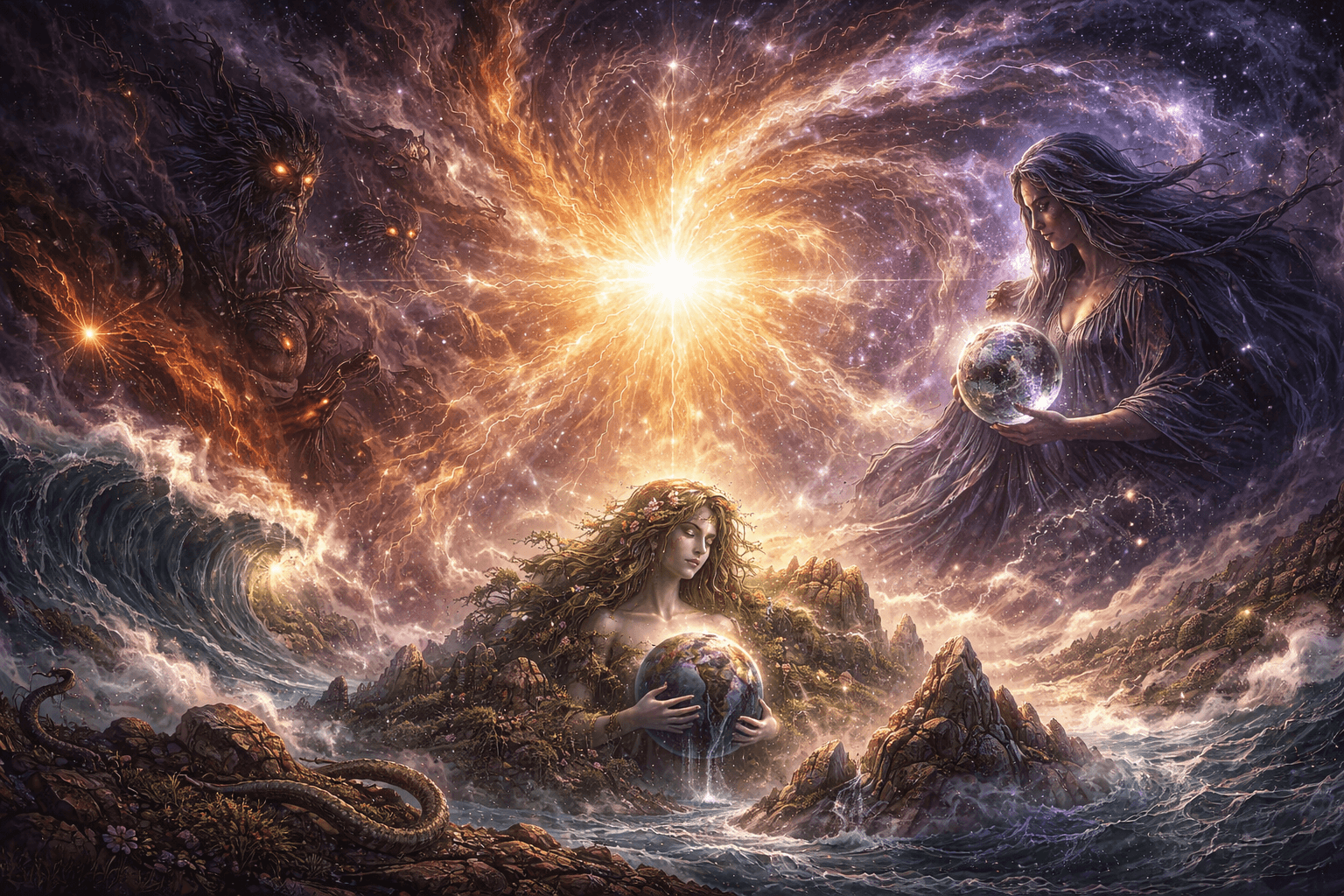
Chaos and the Birth of the Cosmos: When Everything Was Nothing
 Andres Aguilar
Before the universe, there was Chaos — the primordial void from which everything was born. In this episode we explore how the ancient Greeks explained the mysterious leap from absolute nothingness to the creation of the cosmos.
Before the universe, there was Chaos — the primordial void from which everything was born. In this episode we explore how the ancient Greeks explained the mysterious leap from absolute nothingness to the creation of the cosmos.
The question that changed everything
Let me ask you something: what was there before everything existed? Before there was earth, sky, sea — before the gods, before time itself. What would you say? The ancient Greeks asked themselves that same question more than two and a half thousand years ago, and the answer they came up with is so mind-blowing that we're still thinking about it today. Because they didn't say that in the beginning there was an all-powerful god who snapped his fingers and created everything. No. They said that in the beginning there was Chaos. And when I say Chaos, I don't mean the mess your room is on a Sunday afternoon. I mean something far deeper, stranger, and harder to wrap your head around.
Hesiod and the Theogony: the book of origins
When we talk about the origin of the cosmos in Greek mythology, we're talking mainly about what Hesiod tells us in his Theogony. Hesiod was a Greek poet who lived around the eighth century BCE, roughly the same era as Homer. The guy was basically a shepherd who wrote verse, and one day he decided to write the definitive story of how the gods came to be. And he started, as you'd expect, at the very beginning.
Chaos: the primordial void
The Theogony opens with a statement that stops you in your tracks: "In the beginning, there was Chaos." And here's where it gets interesting, because our word "chaos" comes directly from ancient Greek — but it doesn't mean quite what we think. When we say "this is chaos," we mean disorder, confusion, a total mess. But for the Greeks, Chaos was something else entirely. It was the primordial void, the abyss, the infinite darkness. It was literally nothing — and at the same time it was the space where everything could emerge. Think of it as pure potential, like a blank canvas before the artist puts down the first brushstroke.
Hesiod doesn't tell us that Chaos was created by anyone. It simply existed. Full stop. There's no creator, no divine will behind it. Chaos just is — and it's the first thing that is. This idea is revolutionary when you compare it to other ancient cosmogonies, where there's always a god or a conscious force that kicks things off. Not here. Here everything begins with a void that was made by no one.
Gaea: the first solid matter
But here's where it gets wild: from Chaos, with no planning, no intention behind it, other primordial beings begin to emerge. And the first one — the most important of all — is Gaea. Gaea is the Earth, but not earth as in the ground you walk on. Gaea is Earth with a capital E: a living, conscious, powerful entity. She is the mother of everything that exists. The Greeks imagined her as a goddess of broad chest, solid, stable, eternal.
And here's something I find brilliant: Gaea doesn't emerge from Chaos as a daughter in the traditional sense. The texts use a word that's more like "arose" or "manifested." It's as if Chaos, in its infinite void, suddenly condensed to a point — and that point was Gaea. Like when you stare at the night sky and a star gradually becomes visible where there was nothing before. Gaea is the first concrete something, the first place, the first solid matter in a universe that until that moment was pure emptiness.
The three pillars of the cosmos: Gaea, Tartarus, and Eros
Along with Gaea, two other primordial beings emerge who are fundamental to understanding everything that follows. One is Tartarus, and the other is Eros. These three — Gaea, Tartarus, and Eros — are like the pillars on which all of reality is built.
Tartarus: the basement of the universe
Let's start with Tartarus, because he's fascinating and slightly terrifying at the same time. Tartarus is the deepest abyss that exists — even deeper than the underworld. Picture the darkest, most remote, most unreachable place you can imagine. A place so deep beneath the earth that, according to Hesiod, a bronze anvil would take nine days to fall from the surface down to it. Nine straight days of falling. It's basically the basement of the universe, the place where the enemies of the gods will eventually be locked away — rebel Titans, forces that threaten the cosmic order.
But Tartarus isn't just a place. He's also a being, a conscious entity. The Greeks didn't draw such a sharp line between a space and what inhabits it. Tartarus is the abyss and the abyss is Tartarus. And later in the story he'll have offspring — he'll father terrible monsters. But we'll get to that in other episodes.
Eros: way more than Cupid
Now we come to Eros, and this is where things get really interesting — because Eros is probably the most mysterious and most powerful of these primordial beings. When you hear "Eros," you probably think of Cupid: that chubby little winged baby with a bow and arrow who goes around matchmaking. But that Eros is a much later version, very Roman, very tamed. The primordial Eros that Hesiod talks about has nothing to do with that.
This Eros is a fundamental cosmic force. He is the drive toward union, desire, the attraction that makes things come together and create new things. Without Eros, the universe would be a collection of separate elements floating in the void, never touching. Eros is what makes procreation possible, what makes creation and combination possible. He's the glue of the cosmos. And notice how important that makes him: he appears at the same time as the earth and the abyss. Because without desire, without attraction, without that impulse to join together, nothing else could exist.
Later Greek philosophers were obsessed with Eros. Plato wrote entire dialogues trying to understand what love is, what desire is, how this force that drives us toward other beings actually works. And they always came back to this idea: Eros isn't just romantic or sexual attraction. It's much broader than that. It's the impulse that makes two things come together to create a third. It's the generative force of the universe.
From darkness to light: Erebus and Nyx
So we have the initial picture: Chaos, the primordial void. From it emerge Gaea, the solid and fertile earth; Tartarus, the deep and dark abyss; and Eros, the force of attraction and desire that makes everything that follows possible.
But the story doesn't end there. Because Chaos, that primordial void, also directly produces two more beings: Erebus and Nyx. Erebus is darkness — the primordial shadows — and Nyx is Night. I know what you're thinking: aren't those basically the same thing? Well, for the Greeks there were subtle differences. Erebus is more like darkness as a substance, as an element. Nyx is Night as time — the recurring period of the absence of light.
And here's something great: Erebus and Nyx come together — because Eros is already doing his work — and from that union are born Aether and Hemera. Aether is the pure air of the upper sky, that luminous atmosphere where the gods will live. Hemera is Day. See what happened? From darkness and night came light and day. It's as if the universe is finding its balance. Out of the total darkness of the beginning, luminous elements start to emerge.
Uranus: when the Earth created the Sky
Meanwhile, Gaea doesn't sit still. Because Gaea is the mother of all mothers, and her function is to generate, to create, to populate the cosmos. The first thing she does — entirely on her own, with no partner — is produce Uranus. Uranus is the Sky, the starry sky that covers all the earth. Hesiod says Gaea created Uranus "equal to herself" so that he would cover her completely and be the eternal home of the gods.
Think of it this way: before Uranus there was only earth and void above. Now there is earth and sky. The universe is taking shape, organizing itself. Gaea also produces, without a partner, the Mountains and Pontus. The Mountains are exactly that — the earth's elevations, sacred places, refuges. And Pontus is the barren Sea, the primordial water that surrounds the land.
Now, Gaea didn't create Uranus just for company. She created him also as a mate. And here we start to get into interesting territory, because Gaea and Uranus will have children — lots of children — and these children will be the first generations of gods proper. The first children of Gaea and Uranus are the Titans, twelve in total: six male and six female. Among them are Oceanus, Cronus, Rhea, Themis, and several others we'll get to know better in future episodes.
Primordial beings vs. gods: not the same thing
There's something important I want you to understand here: these first beings — Chaos, Gaea, Tartarus, Eros, Uranus — are not gods in the way Zeus, Athena, or Apollo will later be. These are primordial beings, fundamental forces of the cosmos. They're more abstract, more elemental. They represent basic aspects of reality: the void, the earth, the sky, desire. It's only with the Titans, and then with their children the Olympian gods, that we'll get deities with defined personalities, complex stories, and human emotions.
An elegantly simple cosmogony
What fascinates me about this Greek cosmogony is how elegant it is. There's no omnipotent creator deciding to build a universe. There's a process that feels almost natural, almost inevitable. From the void comes matter. Matter organizes itself into earth, sky, and sea. The force of attraction emerges to make things combine. And from those combinations arise beings that are increasingly complex and increasingly specialized. It's almost like a theory of evolution applied to the gods.
And there's something else I love about it: the Greek universe doesn't have a happy beginning. It's not a Garden of Eden where everything is perfect until it goes wrong. No. From the very start there is conflict, darkness, terrible abysses. Tartarus is there from almost the beginning. Darkness is just as primordial as light. The Greeks understood that the cosmos is not a totally ordered and safe place — it's a place where opposing forces coexist, where order and chaos are in constant tension.
The cultural context: a Greek answer to a universal question
You might be wondering: why did the Greeks imagine the origin of the universe this way? Well, you have to understand the context. The ancient Greeks were sailors, merchants, warriors. They were constantly exposed to different cultures and different ideas. They knew the cosmogonies of Egypt, Babylon, and Persia. And they took elements from all of them — but mixed them with their own sensibility.
The Egyptians, for example, had a cosmogony where in the beginning there was a primordial ocean called Nun, and from that ocean a mound of earth emerged where the first god was born. The Babylonians had the Enuma Elish, where the universe arises from a conflict between two primordial gods, Tiamat and Apsu. The Greeks borrowed ideas from here and there, but transformed them into something uniquely their own.
What makes the Greek cosmogony special is that it's rational in a certain sense. It follows a logic. First the void, then matter, then the organization of that matter into recognizable elements. It's a sequence you can follow, that makes sense, that you can debate. And in fact, later Greek philosophers debated it endlessly.
From myth to philosophy
The pre-Socratics — those thinkers of the sixth and fifth centuries BCE like Thales, Anaximander, and Anaximenes — were obsessed with the question of origins. What is the primordial element everything is made of? Thales said it was water. Anaximenes said it was air. Anaximander proposed something called the "apeiron" — the indefinite or infinite. And all of them were in dialogue with these mythological ideas. They were trying to translate myth into philosophy, poetry into logic.
But here's something I don't want you to miss: these stories were not just abstract philosophical speculation for the Greeks. They were sacred. Hesiod's Theogony was recited at religious festivals. The Greeks prayed to Gaea and made sacrifices to her. They swore oaths by the river Styx, which was one of the rivers of the underworld, a child of the first generation of gods. These myths structured their understanding of the world and their place in it.
A genealogy that connected everyone
And one more thing: these myths gave the Greeks a divine genealogy. They could trace lines from Chaos and Gaea all the way to Zeus and the Olympians, and from there to the heroes, and from there to themselves. Many aristocratic Greek families claimed to descend from some hero or god. It was a way of legitimizing power, of connecting with the sacred, of feeling like they were part of a cosmic story that began with the primordial void.
Gods that are immanent, not transcendent
Now, there's something else I have to tell you about these primordial beings: they don't disappear after creating the universe. They're not like the Judeo-Christian God who creates the world and then watches from the outside. Gaea plays an active role throughout all of Greek mythology. She conspires, she helps her grandchildren against her own children, she creates monsters to defend her descendants. Tartarus becomes the place where the enemies of the gods are locked away. Eros continues to be the force that moves everything.
This points to a fundamental characteristic of the Greek gods that applies from these primordial beings all the way down to Zeus himself: they are immanent, not transcendent. They exist in the world, they are part of the world, they are not above it looking down from the outside. Gaea literally is the earth you walk on. Uranus literally is the sky you see when you look up. The Greeks didn't separate the divine from the natural. Everything was part of one interconnected reality.
Why this still matters today
And that interconnectedness is fundamental to understanding why these stories are still relevant today. Because even though we have a scientific understanding of the origin of the universe — even though we know about the Big Bang and the formation of galaxies and planets — we're still wrestling with the same fundamental questions the Greeks asked: Why does something exist rather than nothing? What is desire? What fundamental forces structure reality?
Modern scientists talk about four fundamental forces: gravity, electromagnetism, the strong nuclear force, the weak nuclear force. The Greeks talked about Gaea, Eros, Uranus, Tartarus. The language changed, but the search is the same: understanding what the universe is made of and how it works.
And there's something poetic in the idea that everything started with Chaos, with emptiness. Because modern cosmology also speaks of a fluctuating quantum vacuum from which the universe emerges. It's not so different, when you think about it. In both cases, there's something deeply mysterious at the origin — something that defies our understanding, something that can only be named poetically, something that will always be, in some sense, Chaos.
Summary: the sequence of origins
So, to wrap up this introduction to the Greek cosmos, let me recap what we've covered. In the beginning was Chaos, the primordial void. From Chaos arose the first beings: Gaea the Earth, Tartarus the Abyss, and Eros the Desire. From Chaos also came Erebus the Darkness and Nyx the Night, who produced Aether the Upper Sky and Hemera the Day. Gaea, on her own, created Uranus the Starry Sky, the Mountains, and Pontus the Sea. And then Gaea and Uranus came together to produce the first generation of gods proper: the Titans.
This is the foundation, the bedrock of everything we're going to explore in this series. Because from these Titans the Olympian gods will be born. And those gods will create humans. And humans will have heroes who will live incredible adventures. But all of it — every last bit of it — starts right here, with Chaos and the birth of the cosmos.
Cosmogonies of the world: we're all asking the same question
If you feel like this origin story has parallels in other cultures, you're right. Almost every ancient civilization has its own cosmogony, its own story about how it all began. The Norse had Ginnungagap, the primordial void between ice and fire. The Chinese had Pangu, the giant who separated sky from earth. The Hindus have multiple cosmogonies, some with infinite cycles of creation and destruction. What's fascinating is that all these cultures — without any communication with each other — felt the need to explain the origin. It's as if the question is hardwired into the human psyche: where did we come from?
The mystery that endures
And the Greek answer, with its Chaos and its primordial beings, is particularly powerful because it doesn't pretend to have all the answers. The Greeks left room for mystery, for the unknown. Chaos is not explained — it simply is. And maybe that's the deepest lesson of all: that at the origin of everything there is something that escapes our understanding, something we can only name poetically, something that will always be, in some sense, Chaos.
I hope you enjoyed this tour through the birth of the cosmos as the ancient Greeks saw it. In the next episode we're diving straight into the story of Uranus and Gaea — and you'll see it was anything but a happy marriage. We're talking castration, betrayal, Titans locked inside the earth, and the rise of the first great ruler of the gods: Cronus.
Related episodes
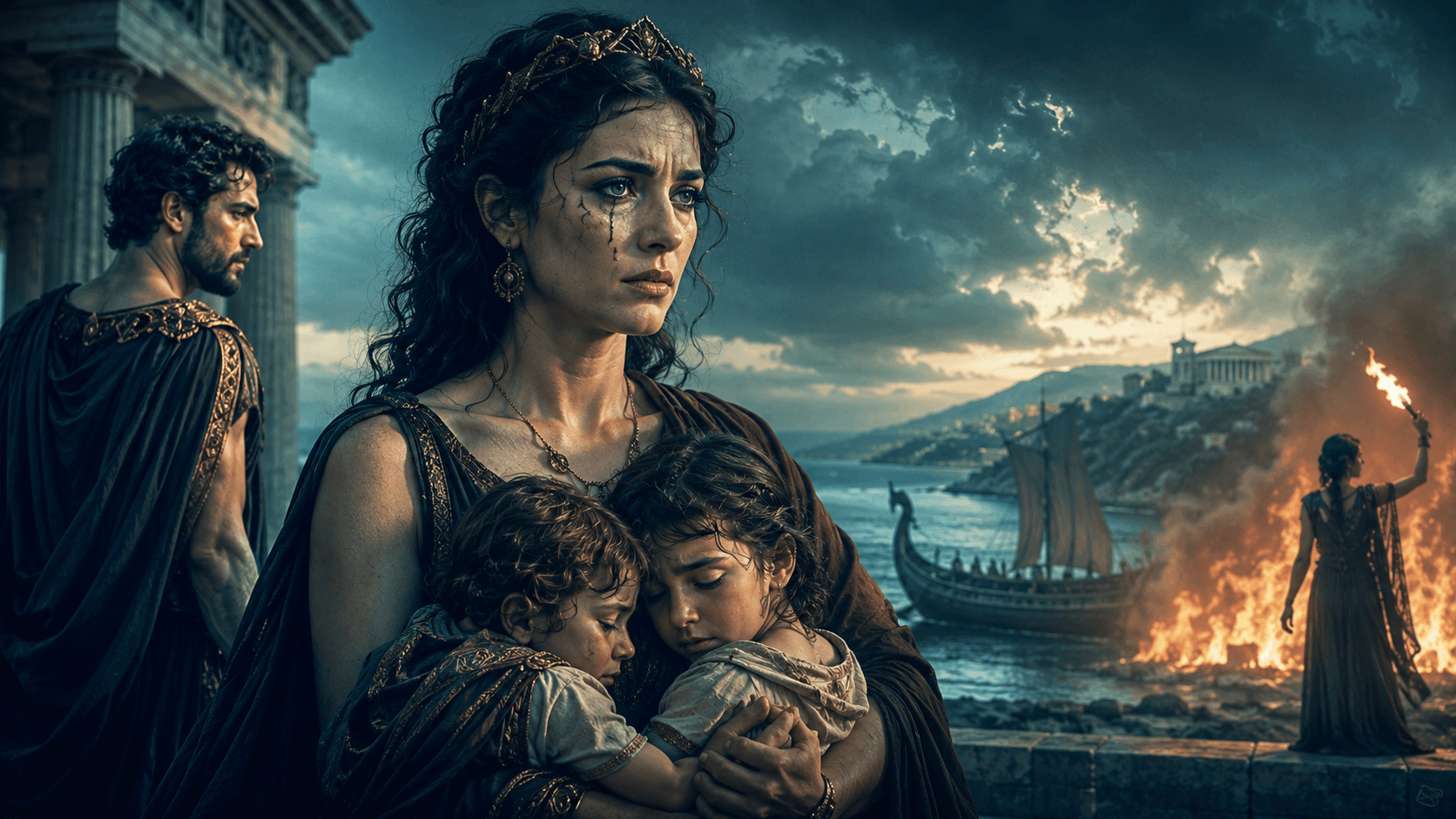
But to understand what Medea did, you must first understand who she was and what they did to her. Because this story doesn't start with a woman who goes crazy for no apparent reason.
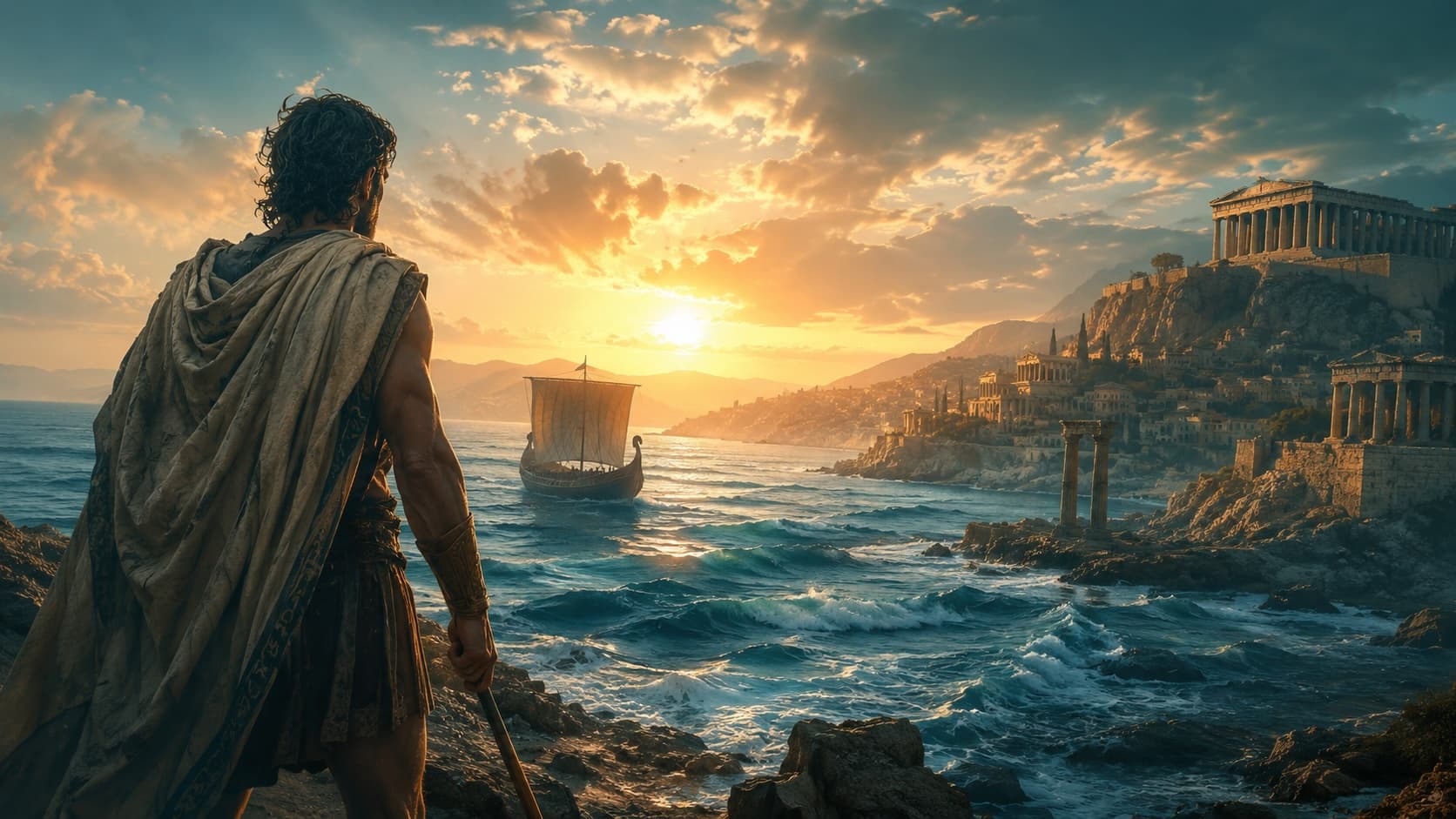
First, he got Polyphemus drunk on concentrated wine he had brought with him, filling the cup generously and refilling it several times. When the giant, in his drunkenness, asked his name so he could reward him with a gift, Odysseus answered...
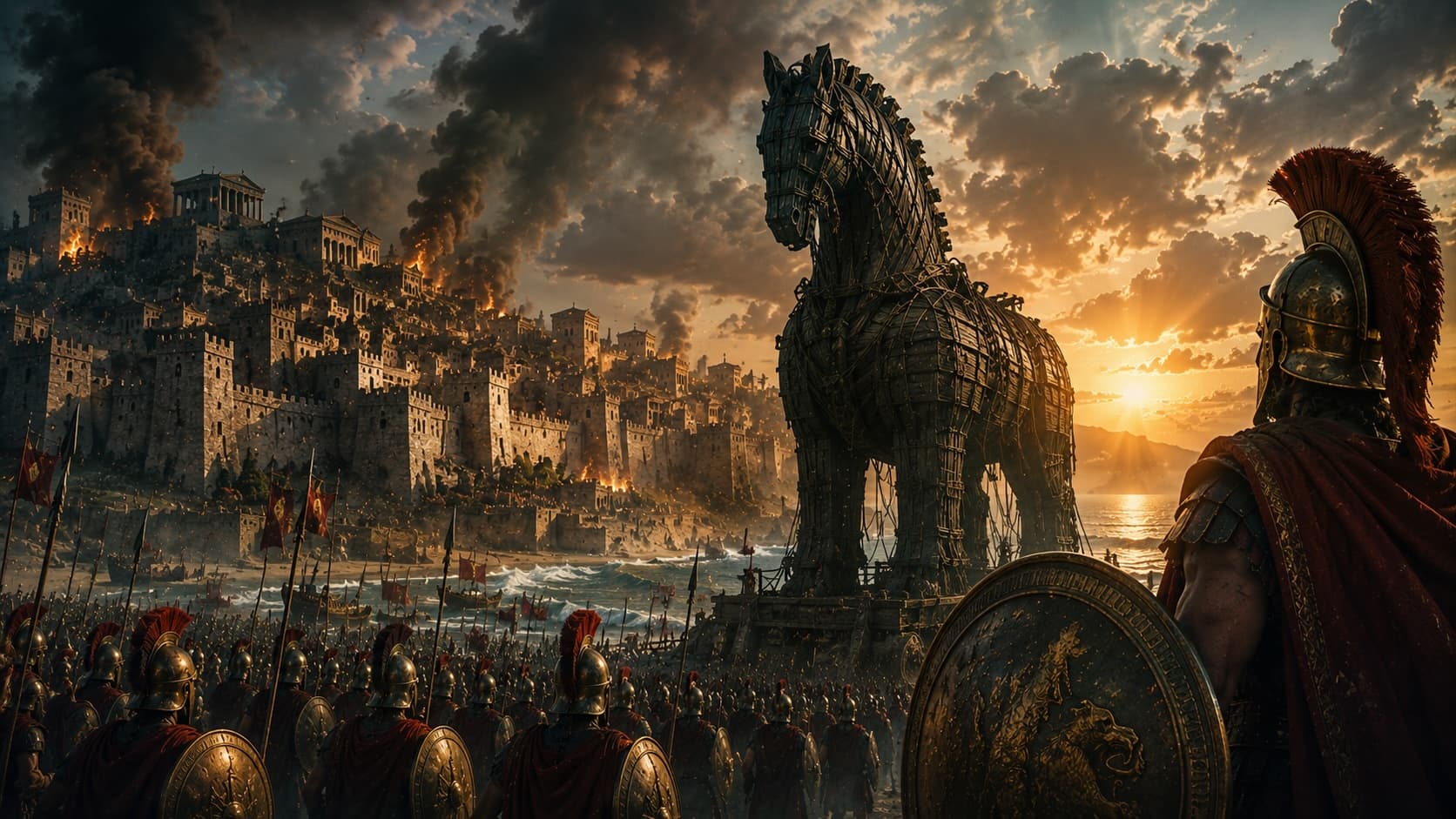
An arrow to the heel, shot by the man who started it all and guided by a god carrying a grudge. That was how Achilles died. Then came the horse, the night, and the fall of Troy. Then Homer: the poet who turned fifty days of that war into the most widel...