
The Vikings
 Andres Aguilar
No horned helmets. No mindless barbarians. The Vikings who terrorized the coasts of Europe were also the traders who built the first Russian cities, the explorers who reached North America five centuries before Columbus, and the settlers who shaped Eng...
In 793, a group of men arrived by boat at a monastery in northern England. The monks thought they were merchants. They weren't. What happened next changed Europe forever.
The attack on Lindisfarne was so brutal and so sudden that the chronicles of the time described it as if the apocalypse had arrived. The Vikings entered the monastery, killed several monks, looted every piece of gold and silver in the church, set the building on fire, and left. Fast, efficient, devastating. And that was just the beginning. Over the next three hundred years, the Vikings terrorized, traded, and colonized territory stretching from the coast of Canada to the gates of Constantinople. Few peoples in history left such a deep mark in such a short time.
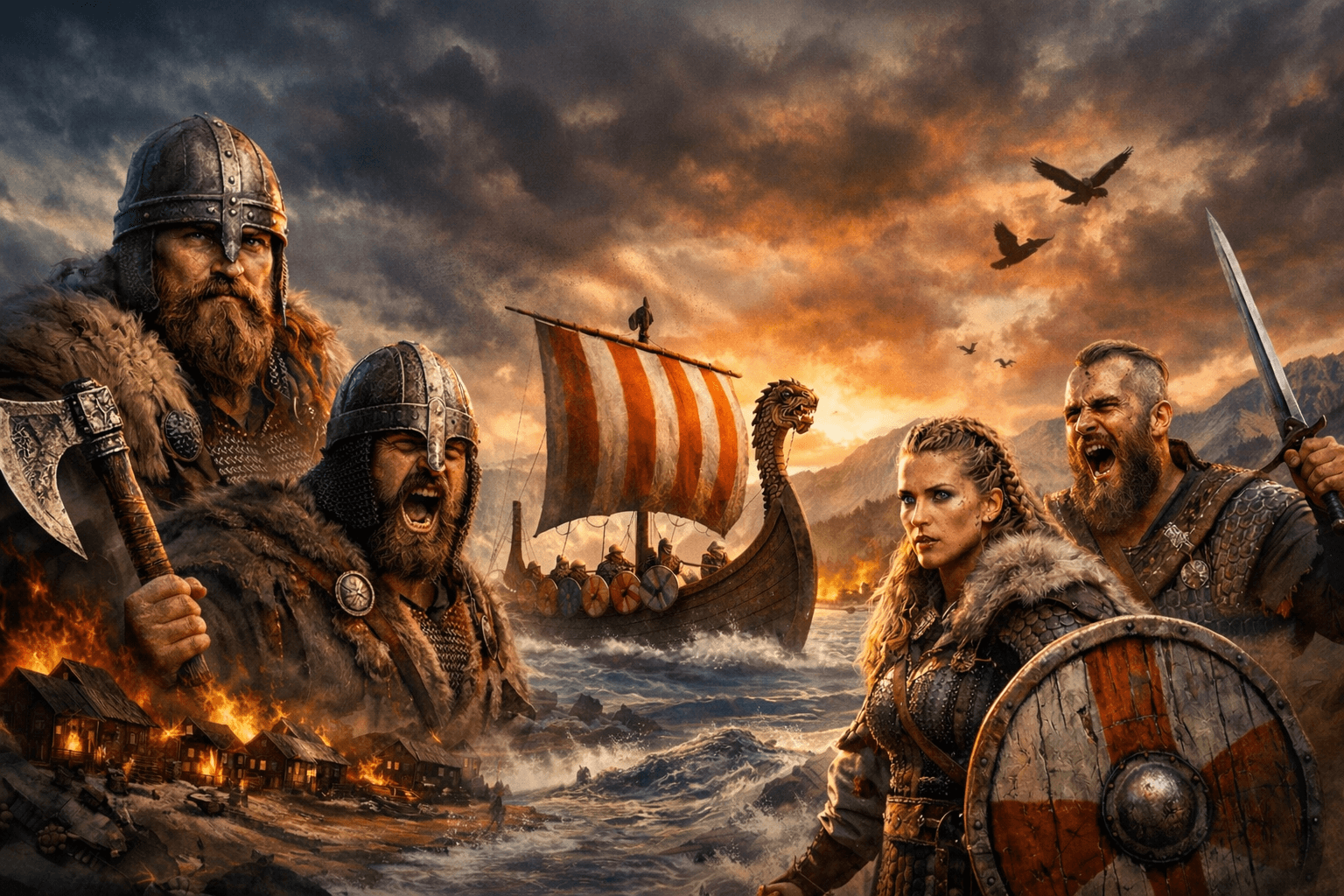
But before diving into that story, it's worth dismantling the myth. Because when most people think of Vikings, they picture brutal barbarians in horned helmets — dirty, drunk, incapable of anything other than destruction. Nearly all of that is false. Let's start with the helmets: Vikings never wore horned helmets. It's a 19th-century invention, the product of Romantic operas and nationalist paintings that needed an exotic image for their Nordic heroes. Real Viking helmets were simple, conical, sometimes with a metal nose guard. Horns would have been a serious liability in combat — they'd catch on everything, give your opponent leverage, and send your helmet flying at the first blow. Reality was functional. The myth was spectacular. We went with the myth.
The People of the Sea
The Vikings were Scandinavian — primarily Norwegian, Swedish, and Danish. They lived in cold territories with abundant forests, fjords, and very little arable land. The population was growing, and there wasn't enough soil to go around. Some decided to seek their fortunes elsewhere. And they had the perfect tool to do it.
Viking ships are probably the greatest technological achievement of the early medieval era. They called them drakkar — meaning dragon — because many bore carved dragon heads on the prow, designed to intimidate both human enemies and the spirits of the sea. They were long, narrow, and shallow-drafted: they could cross the open Atlantic but also navigate inland rivers to cities hundreds of miles from the coast. No other naval power of the era had anything comparable in terms of versatility — not the English, the Franks, or the Arabs.
The construction was remarkably sophisticated engineering. Overlapping oak planks, riveted with iron fasteners and sealed with tar, produced a flexible hull. It bent with the waves rather than resisting them rigidly, which made it far more durable in rough seas. The keel sat so shallow that it needed less than three feet of water to sail. These ships could literally beach themselves on any shoreline. A typical Viking ship measured between sixty and one hundred feet long and carried between thirty and sixty people. The largest war vessels transported up to eighty warriors. They had square sails for wind and oars for when the wind died or maneuvering was needed. A crew of forty men could row for hours without stopping. And when they reached a coast, they simply ran aground, did what they came to do, and left. No ports, no infrastructure, no permission required from anyone. They were the guerrilla fighters of the sea.
The question of why they started raiding has more than one answer. First, because they could — they had technology and skills no one else possessed. Second, because Western Europe was fragmented and relatively defenseless. After the fall of the Roman Empire, the continent was a patchwork of small kingdoms where monasteries and coastal villages had no serious fortifications. They were easy targets. And third, because in Viking culture, reputation and wealth were earned through bold acts and successful expeditions. Coming home from a voyage with gold and silver was the definition of social achievement. Not trying was a form of cowardice that the community made no effort to conceal.
The Terror That Reorganized Europe
The attack on Lindisfarne in 793 was an extraordinary psychological blow to European Christendom. Monasteries were sacred places, theoretically protected by God. The fact that pagans could come and pillage them without any immediate divine retribution was profoundly unsettling. The chronicles of the time overflow with laments about divine wrath and punishment for the sins of men. For the Vikings, however, it was simply good business: monasteries held gold, silver, and valuable relics — and they were undefended.
After Lindisfarne, the attacks multiplied. The coasts of England, Ireland, Scotland, and France began suffering raids with a regularity that generated constant fear and a prayer recited in churches across Europe: "From the fury of the Northmen, deliver us, O Lord." The phrase is not apocryphal — it appears in period sources and captures with precision the state of mind of coastal communities. The Vikings didn't sail in winter, because the risk was too great. But when good weather came, every coast was vulnerable. No one knew where they would appear: they could strike anywhere along hundreds of miles of shoreline, vanish before any response could be organized, and show up again the following week, three days' sail away.
Monasteries began building watchtowers. Some communities relocated inland. Coastal towns erected defenses. But it was difficult to protect against something so unpredictable and mobile. The Viking threat, paradoxically, accelerated the political organization of Western Europe. Charlemagne and his successors built early warning systems and coastal fortresses. In England, King Alfred the Great unified the Anglo-Saxon kingdoms precisely to withstand the Danish pressure. The external threat forced an internal cohesion that would otherwise have taken far longer to develop. Without the Vikings, the political map of medieval Europe would have looked very different.
The Vikings weren't just raiders. They were also colonizers, traders, and explorers. The same drive that led them to attack Lindisfarne would carry them to America five hundred years before Columbus.
More Than Raiders: Colonizers and Traders
As the decades passed, the nature of the Viking presence in Europe shifted. Quick raids gave way to permanent settlements. In England, they established the Danelaw — a vast region under Scandinavian control. York became Jorvik, a thriving Viking city with thousands of inhabitants, active markets, craftspeople, and a functioning economy. This was no military camp; it was a full city with all the social complexity that implies.
In France, something even more interesting happened. A Viking chieftain named Rollo, who had been raiding the French coast for years, sat down to negotiate with King Charles the Simple in 911\. The deal was straightforward: I'll stop attacking you if you give me land. Charles agreed and granted him the region that has been called Normandy ever since — the name meaning, precisely, "land of the Northmen." Rollo converted to Christianity, swore loyalty to the king, and founded what would become the Duchy of Normandy. A century and a half later, his descendants would conquer England under the leadership of William the Conqueror. The Vikings — now transformed into Normans, fully integrated into the Christian feudal structure — ended up achieving through statecraft what they hadn't been able to accomplish as pagan raiders.
Rollo's story perfectly illustrates Viking adaptability. He was a warrior who had terrorized the French coast for years. But when a more interesting alternative to continued raiding was placed on the table, he took it without hesitation. The story goes that when he had to kiss the king's foot as a symbol of vassalage, rather than kneeling, he simply lifted the king's foot up to his mouth, nearly sending Charles tumbling backward. It was his way of communicating something precise: I accept the deal — but I don't completely bow down. Pride had its own language.
In the east, the Swedish Vikings — known as Varangians — took an entirely different direction. They sailed down the great rivers of Eastern Europe, following the Volga and Dnieper south, and reached both Constantinople and Baghdad. They traded furs, slaves, amber, and honey in exchange for silk, spices, and silver. Constantinople was the capital of the Byzantine Empire, the richest city in the world at the time. The Byzantine emperors, recognizing the military value of these northern men, incorporated them as elite guards: the Varangian Guard was a corps of Scandinavian mercenaries who served as the emperor's personal protection. Norwegians and Swedes working as bodyguards in what is now Istanbul. It's a reminder that the medieval world was far more connected than the standard narrative usually suggests.
The Varangians also founded cities in the east. Novgorod and Kyiv were established by Viking traders and warriors who, over time, intermarried with the local Slavic populations. The word "Russia" likely derives from "Rus," which is what these eastern Vikings were called. In a very real sense, Russia was founded by Scandinavians. It's one of those historical ironies that's hard to believe until you check the sources.
America, Five Hundred Years Earlier
The most extraordinary chapter of Viking exploration, however, lies across the Atlantic. The Vikings reached America around the year 1000, half a millennium before Christopher Columbus. This is not speculation or legend: it is an archaeologically confirmed fact. The site of L'Anse aux Meadows in Newfoundland, Canada, contains the remains of a Viking settlement — houses, tools, and everyday objects that carbon dating precisely places in that period. There is no ambiguity possible.
The chain of exploration that carried Leif Erikson to America is itself a story of accumulated discovery. In the late 9th century, Norwegian Vikings colonized Iceland, a volcanic island in the middle of the North Atlantic, previously uninhabited. It was harsh but offered grazing land for cattle, abundant fishing, and space. The settlers arrived, built farms, and created their own society. In Iceland, they founded the Althing around the year 930 — an assembly where free men gathered annually to debate laws, resolve disputes, and make collective decisions. It was a primitive but genuine form of self-governance, one of the earliest parliamentary institutions in history.
In 982, a man named Erik the Red was exiled from Iceland for murder — the Icelanders had laws against that sort of thing, though the line between a legal dispute and physical violence was often blurry. Erik explored westward and found an enormous land covered mostly in ice, with some green areas in the southern fjords. He returned to Iceland and persuaded hundreds of people to emigrate there. The name he chose for the territory — Greenland — was a deliberate marketing strategy: it sounded more appealing than "mostly frozen wasteland." It worked. The Viking colonies in Greenland lasted nearly five hundred years.
From Greenland, Erik's son Leif Erikson continued exploring westward and reached what today is Newfoundland. They called the place Vinland — land of vines — because they found wild grapes. They attempted to settle, but they were too far from Scandinavia to receive reinforcements or supplies, and the local inhabitants — likely Indigenous peoples of the region — did not welcome them. There was conflict. The Vikings eventually abandoned the settlement. But they got there. They crossed the North Atlantic in wooden boats, without a magnetic compass, navigating by the sun, the stars, and accumulated knowledge of how the sea behaved. It remains an impressive feat of seamanship by any measure.
The Society That Produced Them
To understand the Vikings, you have to understand that the vast majority of them never set foot on a warship. The image of the warrior raiding European coasts is real, but it describes a minority. Most Vikings were farmers. They grew barley and rye, raised cattle, sheep, and pigs. They fished. Farms were communal, with extended families living together in long wooden houses with thatched roofs and a central fire that served simultaneously for cooking and heating. Smoke escaped through holes in the roof. It was dark and uncomfortable, but it worked through winters that could last for months.
The social structure had three tiers: jarls were the nobility and leaders; karls were free men, farmers, and craftspeople; and thralls were enslaved people. The Vikings held slaves, captured during raids, and either sold or integrated them into the domestic economy. It was an integral part of the system, not an anomaly. Enslaved people could eventually purchase their freedom, but it was a long and difficult road.
Women held a relatively strong position compared to other European societies of the time. They could inherit property, file for divorce, and manage farms during the long absences of men on expeditions. Some women were völvas — seers or priestesses with a special social status. And there is archaeological evidence of women warriors: female graves have been found containing weapons and armor. They were not the norm, but they existed, and the figure of the valkyries in Norse mythology has some grounding in that reality.
Most Vikings were farmers, not warriors. They were devoted parents who also enslaved strangers. They were poets who composed epic sagas and fighters who killed without hesitation. Human complexity, no filter.
The Gods and the Heroic Death
The Viking religion was polytheistic and possessed a narrative vitality that has few parallels in European mythology. Odin was the chief god, god of war, wisdom, and death, depicted as an old man with one eye (he had sacrificed the other to drink from the well of wisdom) and two ravens who brought him news from across the world. Thor was the god of thunder and protector of humanity, the most popular among ordinary people — and his name survives in the English word Thursday, literally "Thor's day." Freya was the goddess of love and fertility, and her name lives in Friday. Loki was the god of trickery, a perpetual troublemaker and catalyst of crises. Wednesday comes from Woden, another name for Odin. We use these names every week without a second thought — casually invoking the names of pagan Norse gods every time we check our calendars.
Vikings had no temples in the architectural sense. They worshipped at sacred outdoor sites: forests, springs, mountains. They made animal sacrifices and, according to some sources, occasionally human sacrifices in rituals of special importance. The godi were the priests who led ceremonies and transmitted the oral tradition. The major religious celebrations followed the cycle of the seasons: Yule at the winter solstice, which over time blended with Christian Christmas until the two became practically indistinguishable.
Their view of death was particularly striking. Warriors who died bravely in battle went to Valhalla — a great hall presided over by Odin, where they ate, drank, and fought eternally, awaiting Ragnarök: the final battle in which gods and men would fight together in a cosmic apocalypse. It was not a promise of eternal rest but of perpetual action. It fit perfectly with a culture that valued doing over contemplating.
The Hávamál, a poem from the Poetic Edda, contains a line that summarizes Viking philosophy with remarkable economy: cattle die, kinsmen die, one dies oneself — but the fame of good deeds never perishes. They didn't believe in eternal life for everyone. They believed that what endured was the reputation you built while alive, the stories others would tell about you. And that bet paid off — because here we are, more than a thousand years later, still telling their stories.
The conversion to Christianity was gradual and, in many cases, violent. Harald Bluetooth of Denmark converted around 960; Olaf Tryggvason of Norway did so around 995 and imposed the faith on his subjects by methods that left little room for dissent. Pagan temples were destroyed, and resisters executed. It was a forced cultural transformation. By the year 1100, Scandinavia was officially Christian, though the old beliefs persisted in rural communities for a long time afterward.
The End of an Era and the Legacy That Persists
The Viking Age ends conventionally in 1066 — a year that concentrates the close of a period in an almost symbolic way. The Anglo-Saxon King Edward of England had died without a clear heir. Harold Godwinson crowned himself king, but Harald Hardrada of Norway also claimed the throne and invaded with a Viking army. Godwinson defeated him at the Battle of Stamford Bridge in September, the last great Viking invasion on English soil. But three weeks later, William of Normandy — a Viking descendant but by then fully integrated into French feudal culture — crossed the English Channel with his army and defeated Godwinson at Hastings. The original Vikings had lost their last great battle. Their Norman descendants had just won the biggest one.
There is a legend about Stamford Bridge that captures the Viking spirit with a precision that's hard to improve on. It is said that a single Scandinavian warrior stood on the bridge crossing the River Derwent and single-handedly held the passage against the entire English army. He killed forty soldiers before someone had the idea of climbing into a barrel, floating under the bridge, and stabbing him from below. Whether it happened exactly that way is impossible to verify. But the fact that this was the story told about the final moments of the Viking Age says something about how contemporaries understood these men.
By that point, the Vikings, who had settled in England, France, Ireland, and Eastern Europe, had been mixing with local populations for generations. They had adopted Christianity, local languages, and feudal structures. Scandinavia had organized itself into stable kingdoms with institutions similar to those of the rest of Europe. The era of the sea raiders had ended, absorbed into the broader history of the continent.
The legacy, however, is enormous. Millions of people in northern Europe have verifiable Viking ancestry through modern genetic analysis. Cities they founded still exist: Dublin was a Viking settlement, as were many coastal cities in England and Scotland. In the English language, hundreds of everyday words have Norse origins — sky, window, knife, egg, ugly, and happy. Modern English is partly the result of the collision between Anglo-Saxon and Old Norse in medieval England.
Archaeology in recent decades has substantially expanded what we know. For a long time, knowledge of the Vikings depended on chronicles written by Christian clergy — who had obvious reasons to describe them as demons — and on the Icelandic sagas, which romanticized them. Excavations in the 20th and 21st centuries revealed a more nuanced picture: complete ships preserved in burial mounds, like the extraordinary Oseberg ship in Norway; tools, weapons, jewelry, and food remains that allow everyday life to be reconstructed with previously impossible precision. Ancient DNA analysis shows migration routes, reveals who they intermarried with, and maps how they moved across the world. It is remarkable what modern science can tell us about people who lived a thousand years ago.
Popular culture, meanwhile, has a relationship with the Vikings that swings between homage and distortion. TV series, films, video games, and novels keep them vividly present with an intensity no other medieval people can match. Part of that interest is genuine historical enthusiasm. Part of it is the same romanticization that has always existed — horned helmets included. The real Vikings were more complicated than the one-dimensional heroes or villains who populate our screens. They were farmers who sometimes raided and sometimes traded. They were devoted parents who also enslaved strangers. They were poets who composed sagas of considerable beauty and warriors who killed with cold efficiency. They were human beings, with all the contradiction that entails.
The Icelandic sagas — written centuries after the Viking Age but drawing on much older oral material — offer the best window into that mentality. They are not military chronicles: they are stories of families, of disputes over honor, of vendettas that pass through generations, of voyages to the edge of the known world. They blend history with mythology in ways that make it difficult to draw a clear line between the two. Egil's Saga, Njál's Saga, the Volsung Saga — these are extraordinary works of literature in their own right, independent of their historical value.
What they ultimately convey is a worldview that feels strangely contemporary: life is short and unpredictable, reputation is the only thing that lasts, and the only reasonable response to that condition is to act with courage. It's not a sophisticated philosophy. But it's a coherent one. And it clearly resonated — because here we are, more than a thousand years later, telling their stories and using their gods' names to label the days of our week.
Related episodes
In 1871, Paris experienced 72 days of radical rule; Versailles crushed him in Bloody Week. Ideas and violence that marked the modern left.
When Rome fell in 476, the Roman Empire kept on existing — for another thousand years, with its capital at Constantinople. That empire almost no one remembers was the bridge between the ancient and modern worlds, the guardian of the Greek texts that fu...
The Eiffel Tower wasn't Eiffel's idea, it was painted red, it was despised by France's greatest writers, and it came within years of being torn down. The man whose name it bears was facing fraud charges when it opened. This is the story of how the worl...