
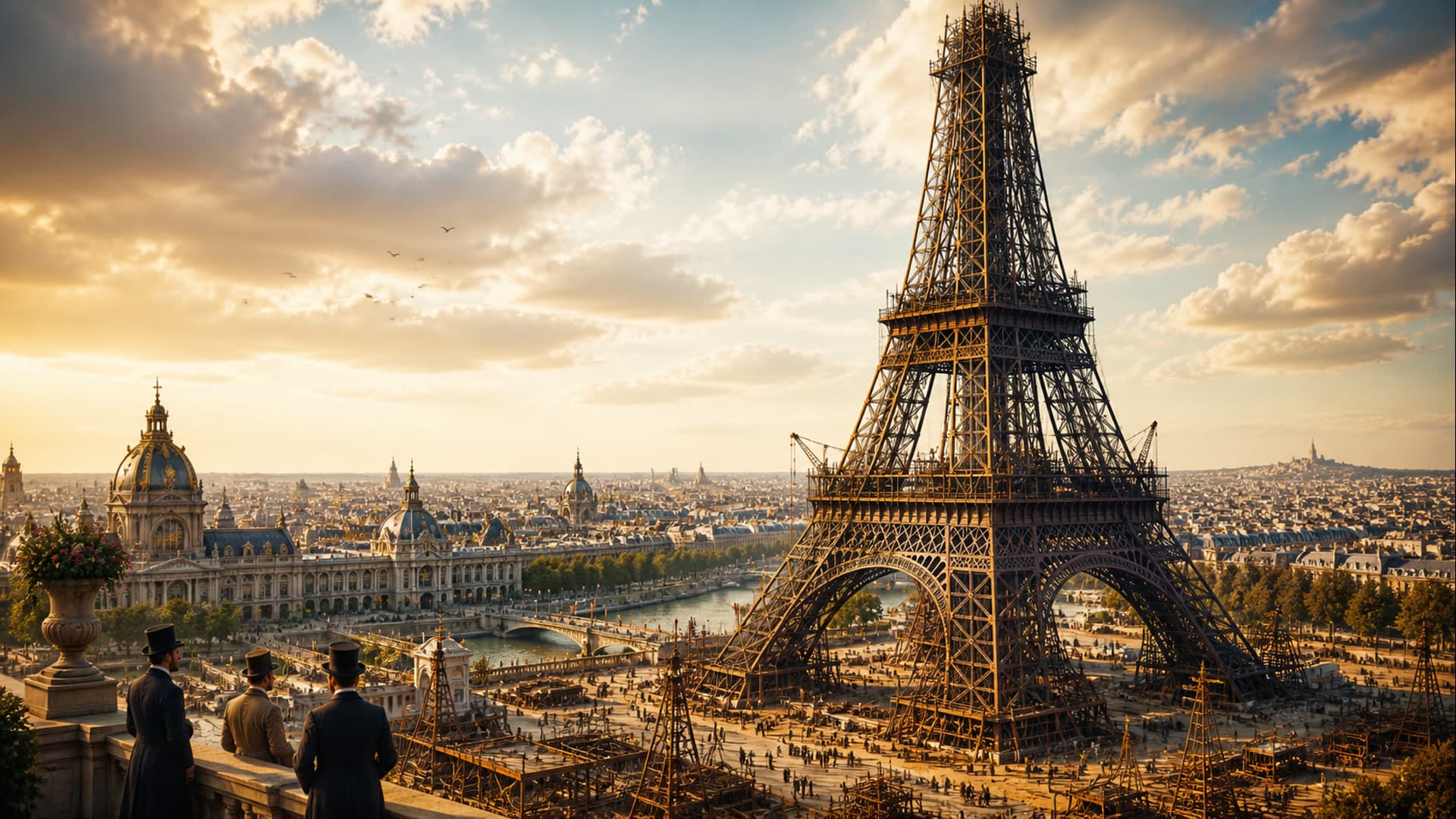
The Eiffel Tower
 Andres Aguilar
The Eiffel Tower wasn't Eiffel's idea, it was painted red, it was despised by France's greatest writers, and it came within years of being torn down. The man whose name it bears was facing fraud charges when it opened. This is the story of how the worl...
The Eiffel Tower was not Gustave Eiffel's idea. It was the idea of two engineers who worked at his company.
The money from the scandal that destroyed his name was what saved his greatest creation.
On January 30, 1889, while Paris was preparing to celebrate the centennial of its Revolution with the greatest World's Fair in history, the man who gave the world's tallest structure its name was a broken man. Gustave Eiffel — the most famous engineer in France — had just been formally charged with fraud and corruption in the Panama Canal scandal. His reputation, built over decades of brilliant bridges and structures, was in ruins. The press was calling him a thief. Half of Paris wanted to demolish his tower and the other half wanted to throw him in prison. The story of the Eiffel Tower is not just the story of a monument. It's the story of an idea that wasn't Eiffel's, a corruption scandal that nearly destroyed its creator, a structure that was painted red and that everyone wanted torn down. And yet here we are, more than a hundred and thirty years later, and that tower is still standing, welcoming seven million visitors a year. But to understand how it got there, you have to start at the beginning. And the beginning doesn't start with Eiffel.
The Idea That Was Born on a Napkin
Here's a detail that pretty thoroughly upends the heroic lone-genius narrative. The Eiffel Tower was not Gustave Eiffel's idea. It was the idea of two engineers who worked at his company: Maurice Koechlin and Émile Nouguier. In June 1884, these two men were in the office of the Eiffel company discussing the upcoming 1889 World's Fair and came up with the idea of a three-hundred-meter tower. Koechlin made a first sketch on a napkin — basically a pyramidal iron pylon with four legs. It was more of a technical drawing than a work of art, rough, functional, with no aesthetic grace whatsoever — but the idea was there: a metal tower twice as tall as anything human beings had ever built.
They showed it to Eiffel, and the boss's initial reaction was not exactly enthusiastic. He said something like "fine, keep working on that." He didn't dismiss it, but he didn't get excited about it either. Koechlin and Nouguier understood they needed to make the idea more visually appealing, so they brought in Stephen Sauvestre, the company's architect, to give the project aesthetic form. Sauvestre was the one who added the decorative arches at the base, the glass pavilions on the first floor, the elegant curved lines that everyone today associates with the tower. He transformed a functional skeleton into something that could aspire to be beautiful. The leap from Koechlin's napkin sketch to Sauvestre's design is enormous — like going from an engineering diagram to a work of architecture.
When Eiffel saw Sauvestre's version, he got excited. But he did something more: he bought the patent rights from Koechlin and Nouguier for a sum that isn't entirely clear from the historical records. Legally, the idea became his. And from that point on, all the official history speaks of "the Eiffel tower," not the "Koechlin and Nouguier tower." Koechlin and Nouguier didn't publicly object, continued working at the company, and actively participated in the construction — but their names disappeared from the popular narrative. This doesn't mean Eiffel contributed nothing. He was crucial to the project: he put his name, his reputation, his management ability, his company, and his money behind it. Without Eiffel, those two engineers would never have gotten the government to approve such a wild idea. But the original concept, the idea itself, the first stroke on that napkin — that was theirs. The history of engineering is full of cases like this: the person who has the idea and the person who has the means to execute it are rarely the same person.
> The history of engineering is full of cases like this: the person who has the idea and the person who has the means to execute it are rarely the same person.
The Fair of the Century and a Wounded France
France needed the 1889 World's Fair the way a drowning man needs a rope. The country was still recovering from a humiliating defeat against Prussia in 1871. It had lost the war in just a few months, in a deeply shameful way. Emperor Napoleon III was captured in battle, the army collapsed, and the Prussians marched down the Champs-Élysées as conquerors. France had to surrender Alsace and Lorraine — two rich provinces — and pay a war indemnity of five billion francs. National pride was shattered. The Third Republic that emerged afterward was politically unstable, rocked by scandals and constant changes of government, with a pervasive feeling of decadence and humiliation. They needed something big, something spectacular, something that would unite the country and show the world that France was still a first-rate technological and cultural power. And what better than a monumental exposition, right on the centennial of the Revolution that had given them their identity as a nation.
World's Fairs in the nineteenth century were gigantic events — the technological showcase of the world, where countries competed to display the most impressive things they had. London had set the bar extremely high with the Crystal Palace in 1851. Paris needed something that surpassed everything that had come before. A public competition called for proposals for a three-hundred-meter tower on the Champ de Mars. More than a hundred projects were submitted — some completely deranged: a giant guillotine as a tribute to the Revolution, a colossal lighthouse, a monumental sprinkler that would water all of Paris. Eiffel's project won, in part because it was the only one that demonstrated with detailed calculations that it could actually be built within the required timeframe.
Eiffel put a significant portion of his own money into it. The French government gave him one and a half million francs, but the total cost was six and a half million. The other five million came from Eiffel himself, in exchange for a twenty-year operating license. After that, the tower would become property of the city of Paris, which could demolish it if it wished. It was an enormous financial risk. Eiffel was betting his fortune that the tower would generate enough money from ticket sales to recoup the investment.
A Red Tower That All of Paris Hated
And then they started building it. On January 28, 1887, construction began — and with it, the protests. A group of France's most famous artists and intellectuals published an open letter of fury in the newspaper Le Temps: "We — writers, painters, sculptors, architects, passionate lovers of the unspoiled beauty of Paris — protest with all our strength against the erection of this useless and monstrous Eiffel Tower at the heart of our capital." The signatories included Guy de Maupassant, Alexandre Dumas fils, Charles Garnier the architect of the Opera, and Charles Gounod the composer. They called it the metal asparagus, the belfry skeleton, the disgrace of Paris.
And here's a visual detail most people don't know: the tower was not the color we see today. When it was inaugurated, it was painted a dark Venetian red — an intense reddish color, almost like rust but more vibrant. It was red. The tower we now associate with an elegant, understated brown was, in its first years, a structure of bright red iron standing out against the grey Paris sky in an almost aggressive way. If you stop to imagine how it looked, it was like planting a giant industrial crane painted fire-engine red in the middle of a city of white palaces. Later it was painted yellow ochre in the early twentieth century — which also can't have been very subtle — and only with the passing of decades did it arrive at the current shade officially called "Tour Eiffel brown," a color specifically invented for it that exists on no other structure in the world. But that first red version explains a lot of the visceral rejection it generated among Parisians of the era, accustomed to Haussmann's white stone and grey zinc rooftops.
Maupassant, they say, ate lunch every day at the tower's restaurant. When asked why — given that he hated it so much — he replied that it was the only place in Paris from which he didn't have to look at it. The anecdote may be apocryphal, but it perfectly captures the feeling of a good part of the French cultural elite.
> The anecdote may be apocryphal, but it perfectly captures the feeling of a good part of the French cultural elite.
Eighteen Thousand Pieces Assembled Like Clockwork
The construction itself is one of the great engineering achievements of the nineteenth century. Eiffel had an industrial work system decades ahead of its time. Each of the eighteen thousand iron pieces was individually designed and manufactured at his workshop in Levallois-Perret. There were five thousand technical drawings. Each piece arrived with the holes for the rivets already drilled to a precision of one-tenth of a millimeter. When they arrived at the Champ de Mars, they fit together perfectly. It was mass prefabrication applied at a scale nobody had ever attempted before.
Three hundred workers worked for two years. Two and a half million rivets joined the eighteen thousand pieces. The conditions were tough: cold, wind, rain, and heights that kept growing week by week. But Eiffel genuinely cared about safety. He installed temporary guardrails, mobile scaffolding, nets. In an era when dozens of workers dying on any major construction site was considered perfectly normal, Eiffel finished the tower with just one fatal accident. And even that one didn't happen during working hours: a worker came in on a Sunday to show the tower to his girlfriend, slipped, and fell. An extraordinary safety record.
The foundations were complicated. Two of the four pillars sat very close to the Seine, so they had to use compressed-air caissons to work below the waterline. Workers descended into pressurized chambers and excavated the riverbed. Dangerous, exhausting — but it worked.
On March 31, 1889 — two years and two months after breaking ground — the tower was complete. Three hundred meters tall. Seven thousand three hundred tons of iron. The tallest structure ever built by human beings. Eiffel climbed the 1,710 steps and planted a French flag at the top. Below, the people who hated it were still there. But it was now a fait accompli.
The Panama Scandal: The Genius Falls
And here's where the story gets dark. Because while the tower was a success with the public and in engineering terms, Gustave Eiffel was walking straight into the biggest disaster of his life. In 1887, while building his tower, he was also working on another monumental project: the locks of the Panama Canal. Ferdinand de Lesseps — the French hero who had built the Suez Canal — was trying to repeat the feat in Central America and had hired Eiffel to design the lock system.
The project was a catastrophic failure. Conditions in Panama were brutal: yellow fever and malaria were killing workers at a horrifying rate, tropical rains destroyed what had been built, and the terrain was geologically far more complex than anyone had anticipated. It's estimated that more than twenty thousand workers died during the years of the French project in Panama. De Lesseps's company went bankrupt in 1889 — right as the tower was being inaugurated with champagne in Paris. The timing is almost poetically cruel. And with the bankruptcy came the scandal: it emerged that the Canal Company had systematically bribed politicians and journalists to conceal the extent of the financial problems and keep attracting investors. It was the biggest corruption scandal of the Third Republic, involving ministers, senators, newspaper editors, and technical figures like Eiffel himself.
Eiffel was formally charged with fraud and breach of trust. Prosecutors argued he had collected enormous fees for work he knew was going to fail. Eiffel had received thirty-three million francs for his involvement in the Panama project — a monstrous sum for the era. To give it some scale: the entire tower had cost six and a half million. The scandal splattered more than a hundred politicians, journalists, and businesspeople. It was the biggest corruption case France had seen to that point, and it shook the foundations of the Third Republic. Some compared it to what the great financial scandals of the twentieth century would later be.
In 1893, Eiffel was convicted to two years in prison and a fine of twenty thousand francs. The conviction was later overturned by the Court of Cassation on a technicality regarding the statute of limitations, so he never served time — but the damage to his reputation was devastating and irreversible. The man who had built the world's tallest tower, who had designed the internal skeleton of the Statue of Liberty, the most celebrated engineer in Europe — he was now, in French public opinion, just another corrupt figure from the Panama scandal. The same newspapers that had praised him as a genius were now calling him a swindler.
Eiffel withdrew from business life. He never again built bridges or structures. He turned to science: meteorology, aerodynamics, experiments on wind resistance. He had a laboratory installed at the top of his tower — a private apartment with measuring instruments — and literally retreated up there, away from a world that had treated him as both a hero and a villain within just a few years. From that height, Paris and its scandals must have looked very small.
Saved by Radio and by Its Own Fame
Meanwhile, the tower had an existential problem. The twenty-year permit expired in 1909, and there were still people who wanted to demolish it. Eiffel needed to demonstrate it had a practical use beyond tourism. And he found it in radio.
In the early twentieth century, wireless communications were in their infancy. Everyone was looking for the tallest possible antennas to extend signal range. And there stood the Eiffel Tower — three hundred meters of iron at the center of Paris. In 1904, a radio transmitter was installed at the top. Suddenly the tower stopped being an ornament and became communications infrastructure. The French army began using it for military transmissions. When World War I broke out, signals intercepted from its antenna made it possible to detect German troop movements. It's said that during the Battle of the Marne, the communications relayed from the tower played a decisive role.
And here comes one of the most brutal ironies in this entire story. The money Eiffel had collected from Panama — those thirty-three million francs that cost him his reputation and made him a social pariah — was in large part what allowed him to finance improvements and maintenance of the tower during its most difficult years. Because maintaining seven thousand tons of iron exposed to rain, wind, and corrosion isn't cheap. It has to be painted, repaired, upgraded. The investment in scientific and radio equipment, the aerodynamic experiments, the laboratories, the antennas — all of that cost a fortune. And Eiffel funded it with the money left over from Panama. The money from the scandal that destroyed his name was what saved his greatest creation. Without those funds, the tower would probably have reached the permit's expiration in 1909 in terrible condition, and the city of Paris would have demolished it without a second thought.
> The money from the scandal that destroyed his name was what saved his greatest creation.
From National Embarrassment to Symbol of the World
The tower's cultural transformation was gradual but unstoppable. The artists who had despised it began incorporating it into their work. Robert Delaunay painted it dozens of times in Cubist style. Marc Chagall had it floating among newlyweds and violinists. Photographers made it the definitive image of Paris. What one generation considered a horror, the next adopted as a treasure.
During World War II, when the Nazis occupied Paris in June 1940, French technicians cut the elevator cables as a final act of symbolic resistance. Hitler visited the city as a conquering tourist and wanted to climb to the top of the tower for the ultimate victory photograph — but he would have had to climb 1,665 steps on foot. He didn't do it. He had photos taken from below, with the tower in the background but without being able to dominate it. When Paris was liberated in August 1944, the first thing done was to repair the elevators and raise the tricolor flag at the top.
Today the tower receives seven million visitors per year. More than three hundred million have visited it since its inauguration, making it the most-visited paid monument in all of human history. Every seven years it is completely repainted: sixty tons of paint, twenty-five specialized painters, eighteen months of work suspended in harnesses at heights that make you dizzy just to think about. It sways in the wind — up to twelve centimeters of oscillation at the top when a strong wind blows. And when the summer heat is intense, the metal expands and the tower grows up to fifteen centimeters. In winter it contracts. It's a structure that breathes with the seasons, alive in a way that stone buildings never could be.
Gustave Eiffel died in 1923, at age ninety-one, in his Paris home. By that point he had been partially rehabilitated — people greeted him on the street and the tower was already indisputably the symbol of France. But he never fully recovered the reputation the Panama scandal had taken from him. He never built again. He never again became the star engineer who signed contracts with governments around the world. The paradox of his life is enormous: he built the most recognizable monument on the planet, but history also remembers him as part of one of the biggest corruption scandals of the nineteenth century. And the tower itself was born from an idea that wasn't even his — but that of two engineers at his company to whom he bought the rights for a price history never recorded. Nothing in this story is as simple as the myth told in the tourist brochures.
But the tower is still there. Red at first, then yellow, now brown. Hated by artists, called ugly by intellectuals, condemned to demolition by politicians, saved by radio and by the stubbornness of a disgraced engineer who kept it alive with the money from his greatest shame. It's proof that sometimes the most enduring things are born from the most chaotic circumstances — and that time always has a way of putting everything in its proper place.
Related episodes
In 1871, Paris experienced 72 days of radical rule; Versailles crushed him in Bloody Week. Ideas and violence that marked the modern left.
When Rome fell in 476, the Roman Empire kept on existing — for another thousand years, with its capital at Constantinople. That empire almost no one remembers was the bridge between the ancient and modern worlds, the guardian of the Greek texts that fu...
The first texts humanity ever wrote were not poems or prayers — they were grain inventory lists. Writing was born to keep accounts, and cities were born because someone needed to keep them at scale. From Jericho to Tokyo, this is the story of how we we...