
The Birth of Cities
 Andres Aguilar
The first texts humanity ever wrote were not poems or prayers — they were grain inventory lists. Writing was born to keep accounts, and cities were born because someone needed to keep them at scale. From Jericho to Tokyo, this is the story of how we we...
The first written texts in human history are not poems or religious hymns. They are lists of goods. Receipts. Grain inventories.
A city is not simply a lot of people in one place. A city is a system for coordinating resources and labor at scale.
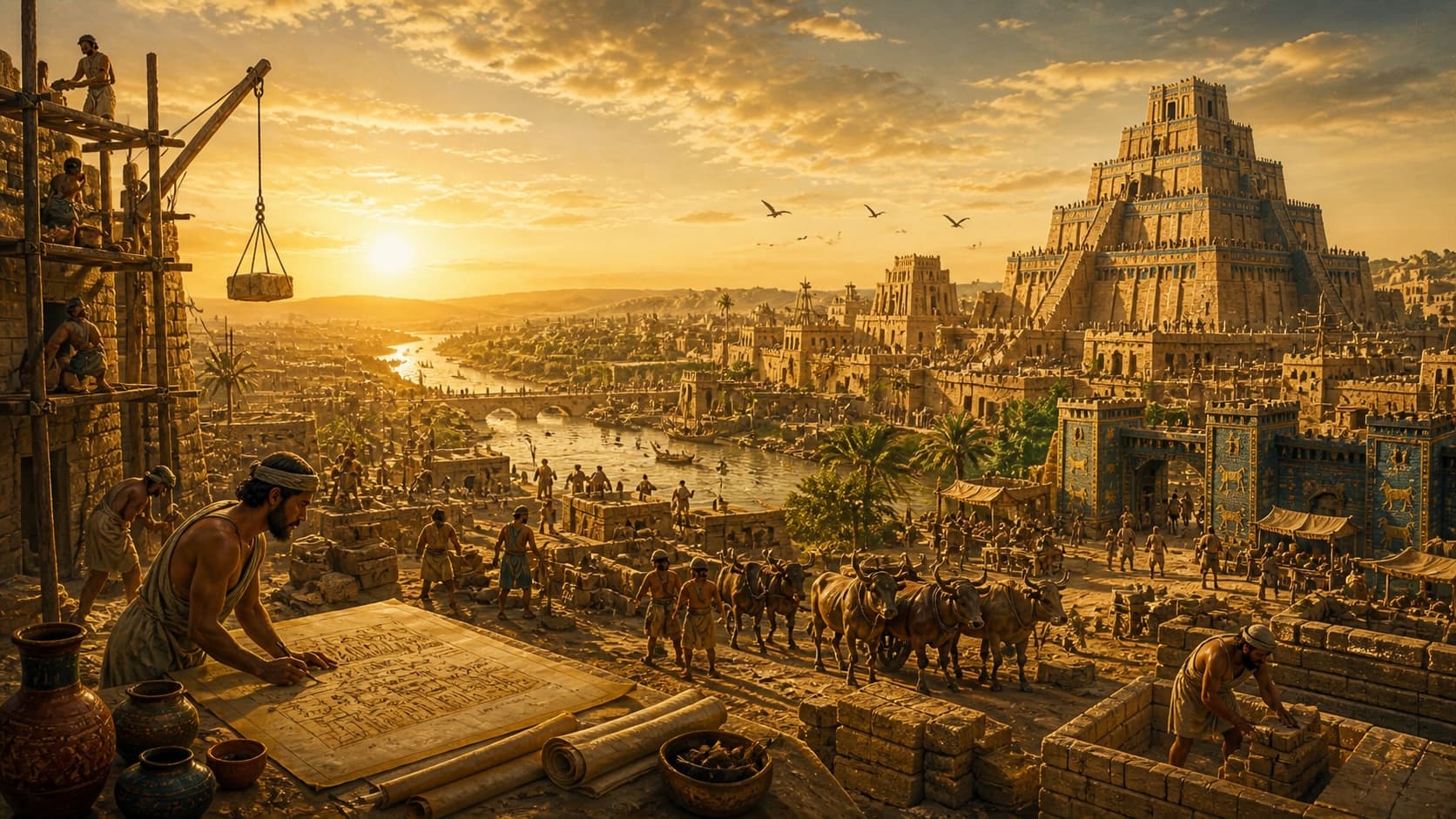
Somewhere in the south of what is now Iraq, about six thousand years ago — when no civilization worthy of the name yet existed in Europe — approximately fifty thousand people lived in the same place. It was called Uruk. It had temples, workshops, irrigation canals, and markets. It had neighborhoods. It had something resembling a government. And it had something no place on Earth had ever had before: writing.
But here's the detail I always find fascinating. The first written texts in human history are not poems or religious hymns. They are lists of goods. Receipts. Grain inventories. Writing was invented to keep track of who owed what to whom. Bureaucracy is older than literature.
> Writing was invented to keep track of who owed what to whom. Bureaucracy is older than literature.
Two Hundred Thousand Years on the Move
To understand why cities were born, you first have to understand how human beings lived before them. For most of our species' existence, we lived as hunter-gatherers. Groups of between twenty and a hundred and fifty people who moved around following animals and the cycles of plants. They had no fixed address. They had no home in the way we think of one today. Their home was movement itself.
It was a harder life than ours in some ways, but freer in others. And here's something that always catches people off guard: the average hunter-gatherer worked four to six hours a day. Not twelve, not ten. Four to six. The rest of the time was leisure, conversation, play, tending to social bonds. Modern studies of the few groups that still live this way — some peoples of the Kalahari or the Amazon — show that their diet was varied and, in many periods, more nutritious than that of a medieval peasant.
So why did they change? Why would someone working six hours a day decide to shift to working twelve hours tilling the soil? That question doesn't have a single answer. It was probably a combination of climate changes that pushed populations toward water sources, gradual population growth that made it harder to feed more people through hunting and gathering, and a slow process of experimenting with plants that eventually became irreversible. Nobody made the decision to stop being nomadic. It's just that at some point, it was too late to go back.
Around twelve thousand years ago, in the region historians call the Fertile Crescent — a crescent-shaped zone covering what is now southern Turkey, Syria, Iraq, and Israel — human beings began systematically cultivating plants and domesticating animals. And they started staying in one place. This process is called the Neolithic Revolution. The term "neolithic" comes from the Greek for "new stone," because more sophisticated polished-stone tools were in use at the time. But the real change wasn't technological — it was conceptual. The idea that human beings could intervene in natural cycles — plant in spring, harvest in fall — was a mental revolution before it was a material one.
Agriculture brought wonderful things. It brought the possibility of producing more food than was immediately needed. That surplus — that leftover — was the seed of everything else. If you can store food, you can feed people who don't directly produce food: craftspeople, priests, soldiers, administrators. And when you have that, you have specialization. And when you have specialization, you have social complexity. And when you have social complexity, you need to coordinate. And when you need to coordinate a lot of people in the same place, you have something that starts to look like a city.
But agriculture also brought terrible things. It brought exhausting, repetitive labor. It brought disease: when you live in one place with many people and domesticated animals, epidemics thrive. Smallpox, measles, the flu — nearly all the infectious diseases that devastated humanity for millennia — came from domesticated animals. And it brought inequality: if there's a surplus, someone is going to control it. And whoever controls the surplus has power over everyone else.
The First Cities: Open-Air Experimentation
The first cities didn't appear at the same moment or in the same place. They emerged independently in several parts of the globe at different times. The pattern repeated itself in Mesopotamia, the Indus Valley, northern China, and Mesoamerica. Where there is water, fertile land, and sufficient population density, something resembling a city eventually appears. It almost feels inevitable.
The oldest site we know of with urban characteristics is Jericho — not the Jericho of the Bible whose walls came tumbling down at the sound of trumpets, but the Neolithic Jericho, which is around eleven thousand years old. It was a cluster of a few hundred people grouped around a spring in the Jordanian desert. It had a stone wall and a tower nearly ten meters tall — the oldest monumental structure we know of. Archaeologists still debate what the tower was for. Defense? Ritual? A symbol of power? Probably all three at once, which tends to be the case in antiquity.
Then there's Çatalhöyük, in what is now central Turkey. It existed between nine and seven thousand years ago and reached a population of around eight thousand — an enormous number for the time. It was a city without streets. The houses were built directly against each other like a honeycomb, and people entered their homes through the roof, climbing down a wooden ladder. When you went out for a walk, you literally walked across your neighbors' rooftops. There were no central plazas, no obvious public buildings, no monumental temples. Life appeared to be organized in autonomous, similar cells, without a clear hierarchy.
And here's the detail I find both unsettling and fascinating: at Çatalhöyük, people buried their dead beneath the floors of their own homes — in the same room where they slept, ate, and raised their children. Archaeologists found, beneath the floors, the skeletons of entire generations of the same family. Coexistence with ancestors was literal and daily. On top of that, analysis of those skeletons shows that men and women had similar skeletal wear, suggesting they performed similar kinds of work. There are none of the gender-differentiated labor patterns that appear in later civilizations. Çatalhöyük seems to have been, in several respects, a more egalitarian society than many that came after it.
Uruk: The First Metropolis
The first truly large city — the first metropolis in history — was Uruk, in Mesopotamia, the region between the Tigris and Euphrates rivers in what is now Iraq. The word "Mesopotamia" in Greek means precisely "the land between the rivers." Those two rivers made the region extraordinarily fertile and supported population densities that would have been impossible elsewhere.
Around 3500 BC — when Europe still consisted mainly of scattered farming villages — Uruk became the largest city on Earth, with tens of thousands of inhabitants. Its center was the temple complex of Anu, a ziggurat — a stepped pyramid — about fifteen meters tall, painted white so it could be seen for miles across the alluvial plain. That building was not purely religious. It was the seat of political power, the center for food redistribution, the storehouse for surpluses, the office of the scribes — all at once.
The priests of Uruk managed the communal granaries, distributed rations to workers, and organized the crews that maintained the irrigation canals on which all of the region's agriculture depended. In Uruk, religion and public management were the same thing. The god wanted the canals clean. And if the canals weren't clean, the god — through the priest — was going to let you know about it.
It was in this context of complex management that writing appeared, around 3200 BC. The first texts we know of are clay tablets with wedge-shaped marks — cuneiform writing — recording quantities of barley, heads of cattle, beer rations. No metaphysics. No poetry. Pure accounting. The first writer in history was a grain counter who almost certainly didn't think of himself as a writer at all.
And that says something very deep about what a city actually is. A city is not simply a lot of people in one place. A city is a system for coordinating resources and labor at scale. For it to function, you need to know who has what, who owes what to whom, who worked how many hours, how much grain is in storage, when the next harvest is coming. Writing was the management technology that made large cities possible. Without writing, you can't administer a city of fifty thousand people. Your memory just isn't enough.
> Writing was the management technology that made large cities possible. Without writing, you can't administer a city of fifty thousand people. Your memory just isn't enough.
City-States: When Water Is Worth More Than Gold
After Uruk, the urban phenomenon spread throughout Mesopotamia. Ur, Lagash, Nippur, Eridu, Umma. Each city was an independent state with its own patron god, its own priest-king, its own walls, and its own army. And when water or farmland ran short, city-states went to war with each other.
The first recorded war in history is a good example of how that dynamic worked. It was between the cities of Lagash and Umma, about four thousand five hundred years ago. The cause: control of an irrigation canal that ran along the border between the two cities. They weren't fighting over gold, not over slaves, not over honor. They were fighting over water. The first documented armed conflict in history was a dispute over water resources. If that sounds familiar, it's because it is.
The documents that survived from that period — inscribed on clay tablets that endured for millennia — tell us the conflict lasted generations, with truces and restarts. Lagash eventually won. But the victory wasn't permanent: a few decades later, the cycle repeated with new players and new cities. The pattern of conflict over scarce resources, negotiation, temporary agreement, and new conflict is as old as cities themselves.
The Indus Valley: The Civilization That Left No Trace of Kings
In the Indus Valley — what is now Pakistan and northwestern India — another urban world flourished completely independently between 2600 and 1900 BC. The cities of this civilization, such as Mohenjo-daro and Harappa, had something that makes them unique among all ancient civilizations: a sophisticated sewage system, with drains running beneath the streets that evacuated waste away from residential neighborhoods. To put that in perspective: many European medieval cities, two thousand years later, had nothing comparable.
They also had urban planning with right-angle streets, buildings constructed with standardized-size bricks — suggesting a central authority that standardized construction — and a trade network reaching as far as the Persian Gulf. But what archaeologists didn't find is equally striking. There are no enormous palaces with burial chambers proclaiming a king's power. No artistic depictions of conquerors trampling enemies. No monumental rulers' tombs. Indus Valley society appears to have been notably more egalitarian than Mesopotamia or Egypt. And their writing — which survives on thousands of stone seals — has never been deciphered. Its secrets have been kept for four thousand years.
Around 1900 BC, these cities were abandoned. Why is still a matter of debate: a climate change that dried up the rivers, population movements from the north, or some combination of both. The Indus civilization left no political descendants and no readable texts. Only well-made bricks and drainage systems you can still see today.
Rome: A Million People and the Problem of Logistics
In the ancient world, the most extraordinary case of urbanism is Rome. At its peak, in the second century AD — when the Empire had already been expanding and consolidating for several centuries — Rome had between one million and one and a half million inhabitants. It was, by far, the largest city in the Western world. Nothing in Europe or the Mediterranean came close.
Sustaining that size required logistics with no parallel in antiquity. The city imported grain from Egypt and North Africa via the Mediterranean. It distributed it to the population at subsidized prices or even for free, in a system called the annona. Feeding a million people required thousands of tons of grain per year, arriving by ship to the port of Ostia and coming up the Tiber River. A constant flow, year-round, that if interrupted would trigger riots within days.
Rome had eleven aqueducts bringing fresh water from sources dozens of miles away, delivering approximately one million cubic meters of water to the city per day. It had sewage — the famous Cloaca Maxima, built in the sixth century BC and still functioning today — fire brigades (the first firefighting service in history), and a postal system connecting the far ends of the Empire.
When the Roman Empire collapsed in the West in the fifth century, cities contracted dramatically. Rome itself, which had held more than a million people, was reduced to around twenty or thirty thousand by the sixth century. The aqueducts broke and no one repaired them. Streets filled with rubble. In the Early Middle Ages, if you wanted stone for building, you went to the Roman ruins and pulled it out. The idea that the past was simply a quarry to be mined.
Medieval Cities and the Air That Sets You Free
The revival of cities in Western Europe took many centuries. The Church maintained some as episcopal centers — seats of bishoprics — and as pilgrimage destinations. But the great medieval urban impulse came from trade. Starting in the eleventh and twelfth centuries, as feudalism began to loosen and trade routes reopened, cities grew across all of Europe.
Medieval cities were peculiar places. Noisy, dirty, foul-smelling, and extraordinarily vibrant all at once. Most had no more than five or ten thousand inhabitants. But they had something that radically distinguished them from rural villages: freedom. "City air makes a man free" was a German saying of the era, and it wasn't just a metaphor. Under the feudal system, if a serf — a peasant legally bound to his lord's land — managed to live in a city for a year and a day without being reclaimed, he was legally free. Cities were escape valves from the feudal order.
Medieval cities also developed the institutions that would prove fundamental to the modern world. Craftsmen's guilds regulated trades and maintained quality standards. Universities — the first at Bologna in 1088, then Paris, Oxford, Salamanca — were born in cities. And banks were born in Italian cities — Florence and Venice — when merchants needed ways to move money across long distances without the risk of transporting physical gold along bandit-filled roads.
The Industrial Revolution and the Urban Hell of the Nineteenth Century
The greatest urban transformation of the modern era was the Industrial Revolution of the nineteenth century. In 1800, only London and Beijing had more than a million inhabitants. By 1900, there were eleven million-person cities. Industry concentrated work and production in cities at a speed that completely outpaced any government's ability to plan.
Industrial cities of the nineteenth century were, in many respects, sanitary hellholes. Factories spewing black smoke day and night. Rivers turned into sewers because there was nowhere else to put the waste. Working-class neighborhoods without ventilation or light, with families of six or seven crammed into a single room. Cholera, tuberculosis, and typhoid fever — diseases spread by contaminated water and overcrowding — were the norm. Life expectancy in Manchester or Liverpool in 1840, among industrial workers, was twenty-eight years. Twenty-eight. That's not a typo.
Out of that horror, modern public health was born. Cities learned the hard way that without clean water and sewer systems, they couldn't function. In London, the breaking point came in 1858, when the summer was so hot and the Thames so contaminated that the British Parliament had to evacuate because of the smell. They called it the Great Stink. The scandal was such that funds were immediately approved. Engineer Joseph Bazalgette built, in less than five years, a system of 132 kilometers of main sewers that transformed the city. Deaths from cholera dropped dramatically. Investments in sanitary infrastructure saved more lives in the nineteenth century than all medical advances combined.
> Investments in sanitary infrastructure saved more lives in the nineteenth century than all medical advances combined.
The Present: More Than Half of Humanity Lives in Cities
Today more than half of humanity lives in cities. By 2050, it's expected to be two-thirds. The world's largest cities have reached sizes that would have been incomprehensible to any previous generation: Tokyo has thirty-seven million people in its metropolitan area — more than the entire population of many countries. Shanghai, Mumbai, Mexico City, Cairo. Urban giants that function as economies unto themselves.
There's something paradoxical in all of this. Human beings spent two hundred thousand years living in small, intimate, mobile groups where everyone knew everyone else. And in the last twelve thousand years — and with rapidly accelerating speed in the last two hundred — we chose to concentrate in increasingly dense points on the planet. Cities are uncomfortable, expensive, noisy, and polluted. And yet people keep moving toward them from the countryside, from the provinces, from other countries.
Why? Because cities offer what no other place can offer in the same concentration: work, opportunity, human contact, stimulation, anonymity when you want to be anonymous, and community when you need it. Economic studies show that when a city doubles in size, productivity per inhabitant increases by fifteen percent. Friction generates ideas. Density generates innovation. Cities are the most efficient machine for generating wealth and innovation that humanity ever invented.
And they amplify their own tragedies too. Spatial segregation, real-estate speculation, pollution, the collapse of transportation. Cities take everything that is in the human condition — the best and the worst of it — and concentrate it to the limit.
Jericho, the world's oldest city, is still a city. It has about twenty thousand inhabitants today, in the same spot of the Jordanian desert where, eleven thousand years ago, someone decided not to leave. There's something in that which says everything about our species. Once we find a place to stay, it's very hard for us to go.
Related episodes
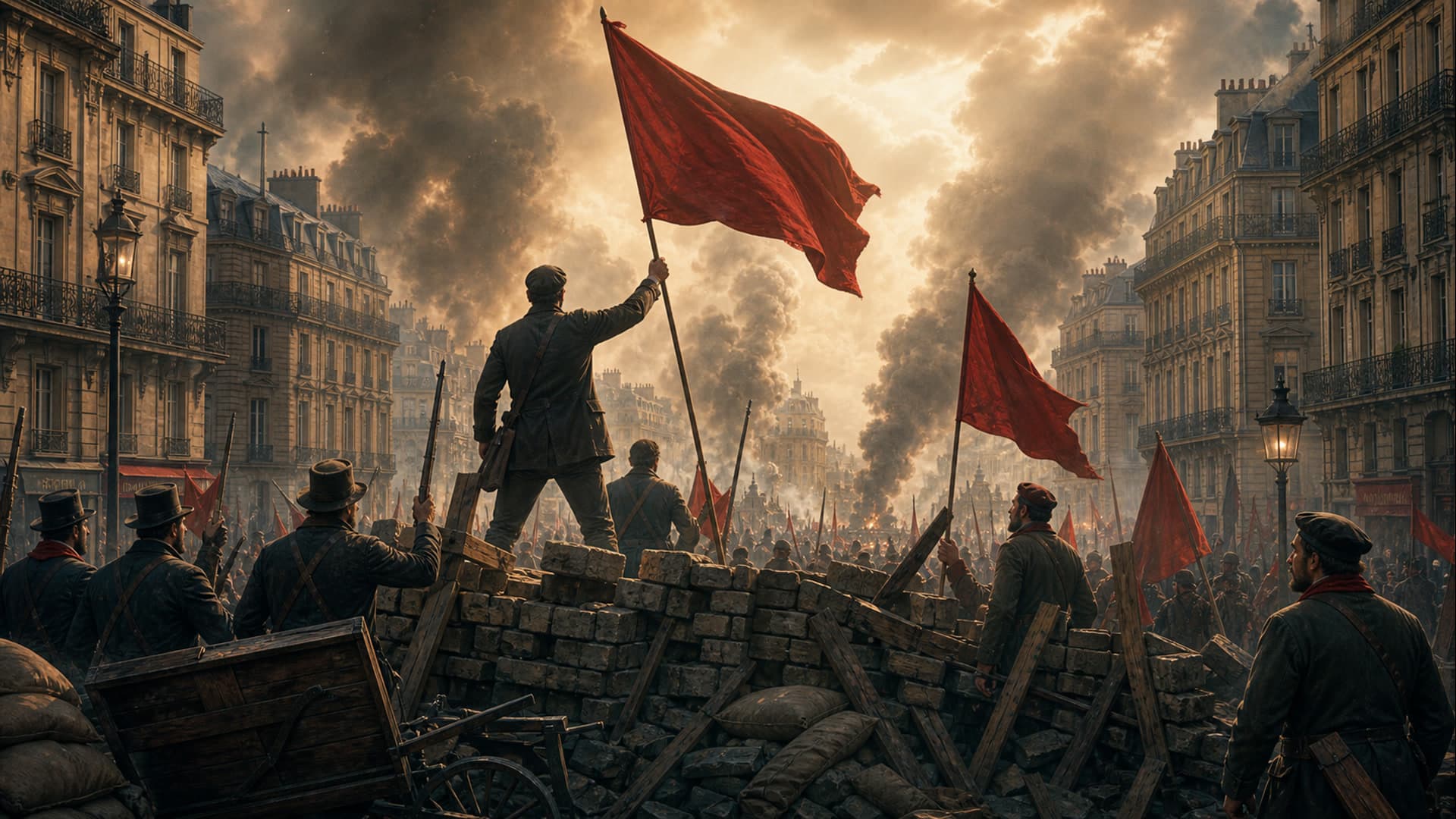
In 1871, Paris experienced 72 days of radical rule; Versailles crushed him in Bloody Week. Ideas and violence that marked the modern left.
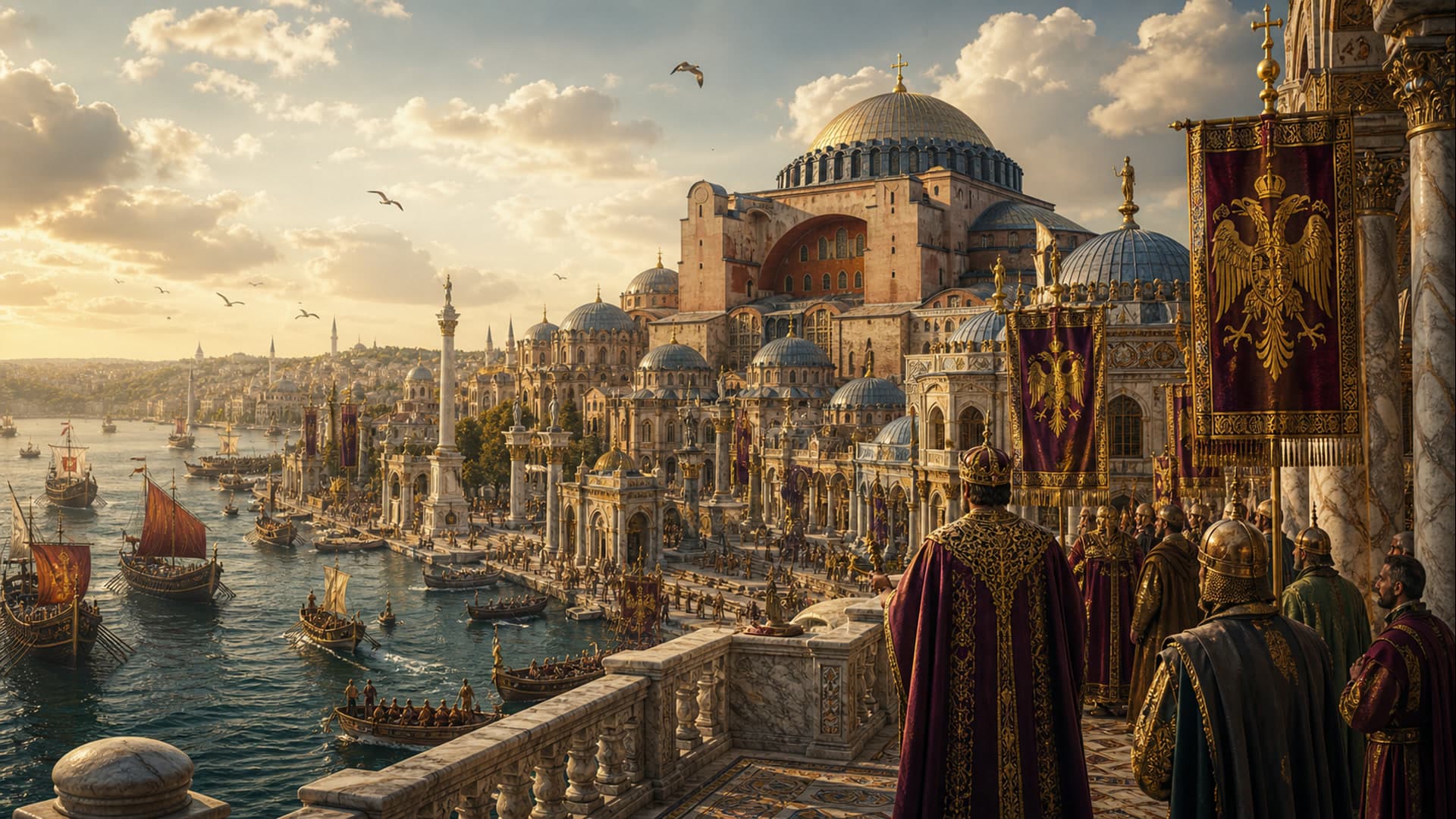
When Rome fell in 476, the Roman Empire kept on existing — for another thousand years, with its capital at Constantinople. That empire almost no one remembers was the bridge between the ancient and modern worlds, the guardian of the Greek texts that fu...
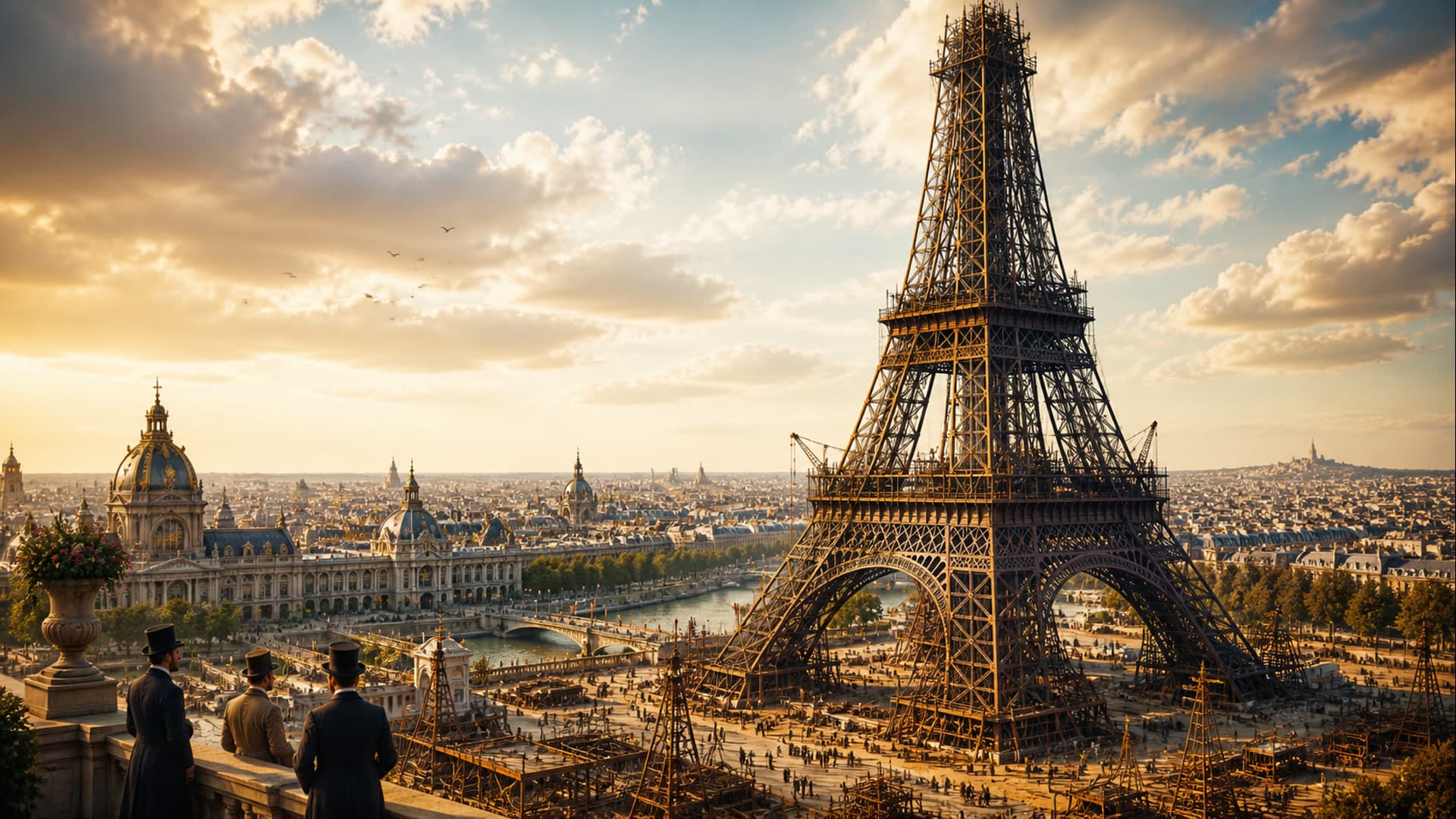
The Eiffel Tower wasn't Eiffel's idea, it was painted red, it was despised by France's greatest writers, and it came within years of being torn down. The man whose name it bears was facing fraud charges when it opened. This is the story of how the worl...