
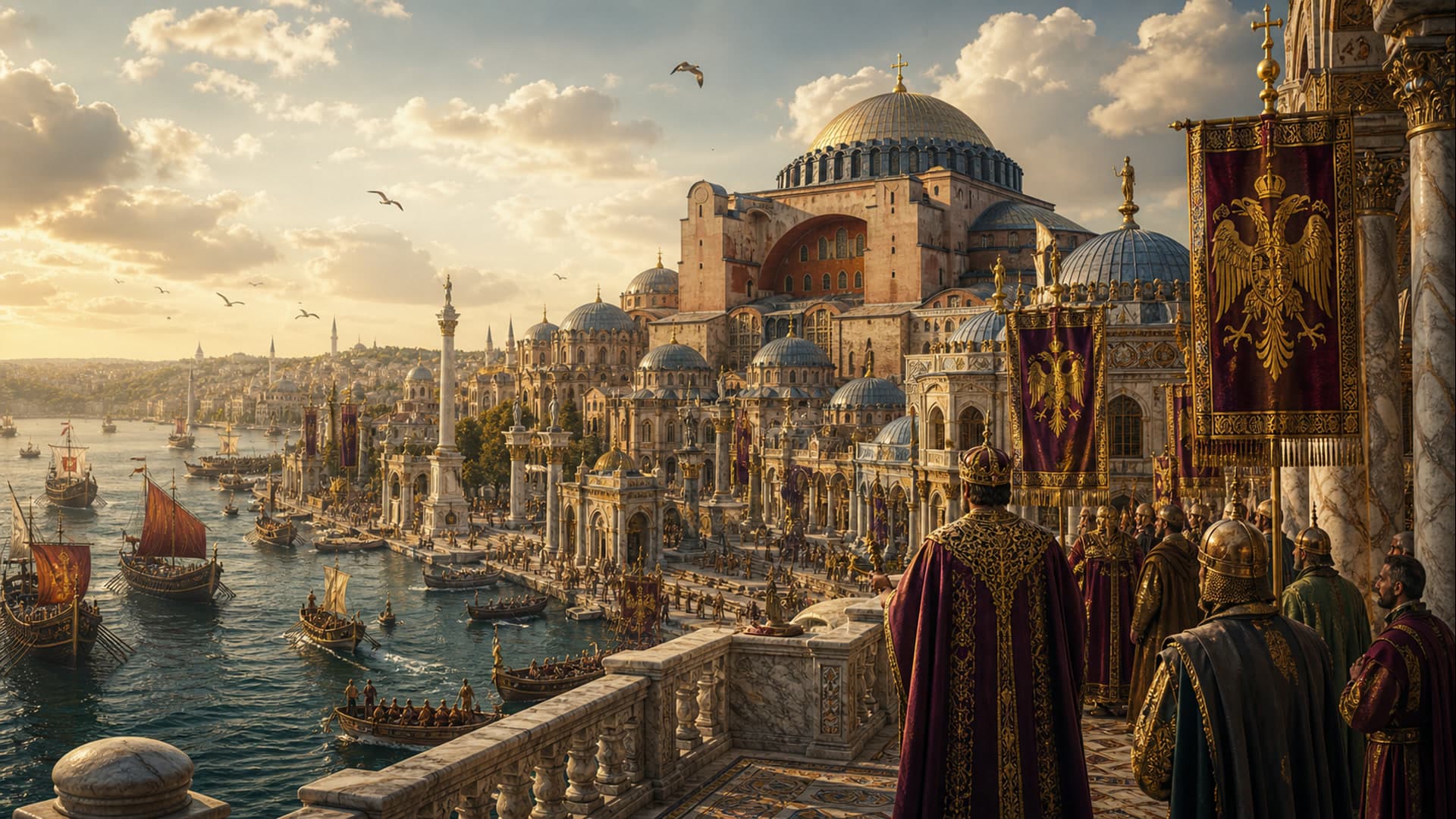
The Byzantine Empire
 Andres Aguilar
When Rome fell in 476, the Roman Empire kept on existing — for another thousand years, with its capital at Constantinople. That empire almost no one remembers was the bridge between the ancient and modern worlds, the guardian of the Greek texts that fu...
I would rather die as an empress than live as a fugitive — Theodora told Justinian during the Nika revolt.
The last Roman emperor dying as an anonymous soldier among the ruins of the city that Constantine had founded eleven centuries earlier.
In 476, the Roman Empire fell. That's what they teach you in school, right? Barbarians, decadence, the end of an era. The problem is that's only half the story. Because in 476, what fell was the western half of the Empire. The other half — the eastern one, with its capital at Constantinople — not only didn't fall, it kept on going for a thousand more years. A thousand years. Just think about that for a second. From the fall of Western Rome to the fall of Constantinople in 1453 is roughly the same span of time as from the fall of Constantinople to today. An empire that lasted so long it watched entire civilizations rise and fall while it was still there — reinventing itself, surviving, adapting. And yet almost nobody gives it the importance it deserves. Today we're going to talk about the Byzantine Empire — the power that kept the flame of Rome alive when Western Europe was mired in darkness, that served as the bridge between the ancient and the modern world, and whose history has more intrigue, betrayal, and dramatic twists than any TV series you've ever seen.
Rome Didn't Fall: It Moved
To understand Byzantium, you have to go back a little. In the third century, the Roman Empire was ungovernable. It was too large, with too many enemies on its borders and too many internal power struggles. In 285, Emperor Diocletian decided to split the administration of the empire in two: a western part centered on Rome and an eastern part centered on Nicomedia, in what is now Turkey. It wasn't a definitive split — more of an administrative arrangement — but it laid the groundwork for what would come.
The decisive move was made by Constantine. In 330, he founded a new capital on the site of the ancient Greek city of Byzantium, at a spectacularly strategic location: the Bosphorus Strait, where Europe meets Asia. He called it Constantinople — the city of Constantine. And this was no ordinary place. It was surrounded by water on three sides, making it nearly impossible to attack by land. It controlled the passage between the Mediterranean and the Black Sea — that is, the world's most important trade routes. From a military and economic standpoint, it was the best possible location for a capital.
When the Roman Empire in the West finally collapsed in 476, the eastern part was in a far stronger position. It had the richest provinces: Egypt, Syria, Anatolia. It had larger, more prosperous cities. It had a more efficient administration. And it had Constantinople, which for centuries was the largest, wealthiest, and most sophisticated city in the Western world. While London, Paris, and Rome were villages compared to what they had once been, Constantinople had half a million inhabitants, aqueducts, hippodromes, libraries, and imperial palaces covered in golden mosaics. It was in a different league entirely. Historians call it the Byzantine Empire, but the people who lived in it never called themselves that. They called themselves Romans — and they were right: they were the direct, legal, and institutional continuation of the Roman Empire. The name "Byzantine" is a later invention, coined by European historians who wanted to mark a distinction that didn't really exist.
> The name "Byzantine" is a later invention, coined by European historians who wanted to mark a distinction that didn't really exist.
Justinian and Theodora: Power, Ambition, and an Incredible Story
If there's one couple that defines the Byzantine Empire at the height of its glory, it's Justinian and Theodora. And their personal stories are so extraordinary that if you read them in a novel, you'd say they were made up.
Justinian came to power in 527. He was the nephew of a previous emperor, Justin I, who had been an illiterate peasant from the Balkans who joined the army and ended up on the throne. That alone gives you a sense of how different Byzantium was: a man of the humblest origins could become emperor. Justinian inherited his uncle's crown — and a colossal ambition: to restore the ancient Roman Empire, reconquer the lost territories in the West, and create a unified legal code.
But Theodora's story is even more striking. Theodora was the daughter of a bear keeper at the Constantinople hippodrome. The hippodrome was the city's entertainment center — something like a football stadium multiplied tenfold in social importance. When her father died, the family was left destitute. Theodora became an actress and dancer, which in that era was practically synonymous with prostitution. The sources of the time, especially the historian Procopius in his Secret History, describe her youth with scandalous details that should be taken with a grain of salt, since Procopius despised her. But the point is clear: Theodora came from the very lowest rung of Byzantine society.
And yet Justinian fell in love with her. So completely that he changed the laws to allow himself to marry an actress — something that was prohibited for someone of his rank. When he became emperor, she became empress. And she was no decorative empress. Theodora governed alongside Justinian as an equal. She made political decisions, received ambassadors, influenced appointments. In 532, when a massive revolt called the Nika Revolt nearly toppled them both, it was Theodora who stopped Justinian from fleeing. She said something that went down in history: that the imperial purple was the finest burial shroud. I would rather die as an empress than live as a fugitive. Justinian stayed, crushed the revolt, and consolidated his power.
> Justinian stayed, crushed the revolt, and consolidated his power.
Together, they accomplished great things. Justinian reconquered North Africa, Italy, and part of Spain. His generals — especially Belisarius — were brilliant strategists who achieved impressive victories with relatively small armies. Belisarius reconquered North Africa with just fifteen thousand men against the Vandals. He then took Sicily and advanced through Italy to retake Rome. He was one of the great military commanders in history, and his relationship with Justinian was complicated: the emperor needed him but also feared him, because an overly successful general is always a threat to the throne.
Justinian commissioned the Hagia Sophia, which for nearly a thousand years was the largest building in the world — a masterpiece of architecture that still leaves you speechless today. The central dome is 31 meters in diameter and appears to float above forty windows that let in light in a way that contemporaries described as supernatural. When it was completed in 537, Justinian reportedly walked in, looked up, and said: "Solomon, I have surpassed you." And he compiled the entirety of Roman law into a single legal body — the Corpus Juris Civilis — which is the foundation of civil law in half the countries in the world, including Argentina.
But it wasn't all glory. In 541, the bubonic plague arrived in Constantinople. It was devastating. Thousands were dying every day. The economy ground to a halt, the reconquests became unsustainable, and many of the recovered territories were lost in the following decades. Justinian himself fell ill but survived. The plague returned in waves for two centuries and profoundly weakened the empire.
Theodora, for her part, promoted laws protecting women: she banned forced prostitution, gave property rights to wives, and created shelters for homeless women. A former actress from the lowest rung of society transforming the laws of the most powerful empire in the world. It's a story you couldn't make up.
The City That Dazzled the World
Constantinople was not just a political capital. It was the center of the world. Travelers arriving from Western Europe — accustomed to small, dark cities — were left speechless. A twelfth-century crusader wrote that upon arriving he stood paralyzed, staring at the golden domes, the endless markets, the streets full of people from every background. There were Arab merchants, Russian pilgrims, Viking mercenaries, Persian diplomats. Everyone in the known world passed through Constantinople. And speaking of Vikings: Byzantine emperors hired Scandinavian warriors as elite guards. They were called the Varangian Guard, and they were the toughest men in the empire — men who had traveled down the rivers of Eastern Europe from Sweden and Norway and ended up protecting the emperor in a gold-covered palace at the other end of the world. Harald Hardrada himself, who later became King of Norway, served in the Varangian Guard before returning to Scandinavia. The medieval world was far more connected than we tend to think.
The Hippodrome was the social center of the city. Chariot races were the most popular spectacle, and the factions that supported each team — the Blues and the Greens — functioned almost like political parties. Rivalries between these factions could escalate into serious urban riots, like the aforementioned Nika Revolt. Politics, sports, and religion blurred together in ways we would find hard to understand today.
The city was also a leading intellectual center. While Western Europe was losing access to classical Greek and Roman texts, Constantinople preserved them in its libraries. Plato, Aristotle, Hippocrates, Galen — all of that intellectual tradition stayed alive and was studied and debated in Greek in Byzantine schools. When Western Europe rediscovered those texts centuries later, many arrived through Byzantium. Without the Byzantine Empire, a large portion of ancient philosophy and science would have been lost forever. That's not an exaggeration — it's a historical fact that is often overlooked.
> Without the Byzantine Empire, a large portion of ancient philosophy and science would have been lost forever.
Greek Fire and Invincible Walls
The Byzantine Empire didn't survive for a thousand years on wealth and culture alone. It was also a formidable military power, with innovations that kept it a step ahead of its enemies for centuries.
The most famous of these is Greek fire — an incendiary weapon used in naval combat. It was a kind of ancient flamethrower: an inflammable liquid projected under pressure against enemy ships, which kept burning even in contact with water. You couldn't put it out with water. Just think about how terrifying that is in a sea battle. The exact composition of Greek fire was such a closely guarded state secret that to this day no one knows with certainty how it was made. It was first used in 678 against an Arab fleet besieging Constantinople, and it was decisive in repelling the attack. For centuries, Greek fire was the ace up the Byzantines' sleeve that they played whenever the situation turned critical.
But the most impressive defense of all was the walls of Constantinople. The Theodosian Walls, built in the fifth century, were a triple-wall system with moats that was considered impregnable. And for a thousand years, they basically were. Arabs, Bulgarians, Russians, Persians — all tried and all failed. The walls withstood more than twenty major sieges throughout the empire's history. It is one of the most successful defensive systems in all of military history.
The Byzantines were also masters of diplomacy. While in Western Europe conflicts were almost always resolved by the sword, the Byzantines preferred negotiation, bribery, and intrigue. They had a network of spies and diplomats throughout the known world. They paid tributes to dangerous peoples to keep them at bay, set enemies against each other, and married Byzantine princesses to foreign kings to secure alliances. It was an extraordinarily sophisticated foreign policy that allowed them to survive surrounded by enemies for centuries. It wasn't always heroic — but it was effective.
God, Icons, and the Great Rupture
Religion was central to Byzantine life, but it was also a source of tremendous conflict. The most notable was the Iconoclast Controversy, which shook the empire for more than a century. The question seemed simple: is it right to venerate religious images, or is that idolatry? In 726, Emperor Leo III decided that icons were idolatry and ordered them destroyed. A civil war erupted between the Iconoclasts, who wanted to destroy the images, and the Iconodules, who defended them. Monks were persecuted, works of art destroyed, families divided. The conflict lasted until 843, when the veneration of icons was finally restored. This might sound like a minor theological dispute, but in Byzantium theology was politics and politics was theology. Everything mixed together. Emperors rose and fell depending on which side they took on icons. Generals were dismissed, patriarchs deposed, monasteries destroyed. The Iconoclast crisis left a deep mark on Byzantine art and culture.
The other major religious event was the Great Schism of 1054. The differences between the Church of Rome, led by the Pope, and the Church of Constantinople, led by the Patriarch, had been accumulating for centuries. Theological differences over the nature of the Holy Spirit, differences in ritual, differences over papal authority versus other religious leaders. In 1054, the papal legates and the Patriarch of Constantinople mutually excommunicated each other. Christendom split in two: Roman Catholicism in the West and Eastern Orthodoxy in the East. That division is still in place today, nearly a thousand years later. And it was no minor event: it defined the religious and cultural identity of half a continent.
The Slow Fall and the Dramatic End
From the eleventh century onward, the Byzantine Empire entered a slow but sustained decline. The defeat at the Battle of Manzikert in 1071 — where the Seljuk Turks destroyed the imperial army — was a blow from which it never fully recovered. It lost Anatolia, which was the territorial and military heart of the empire. It called for help from the West, and that help arrived in the form of the Crusades, which turned out to be as much of a problem as the Turks — and sometimes worse. If you listened to episode 21 on the Crusades, you'll remember how that story ended.
The mortal blow came from fellow Christians. In 1204, the crusaders of the Fourth Crusade — manipulated by Venice — sacked Constantinople. A Christian city destroyed by a Christian army. It was a catastrophe from which the empire never recovered. Although the Byzantines recaptured Constantinople in 1261, the empire they rebuilt was a shadow of what it had been: smaller, poorer, weaker.
During the fourteenth and fifteenth centuries, the empire shrank until it was limited practically to Constantinople and its surroundings. The Ottoman Turks — who had started as a small emirate in Anatolia — kept growing until they had completely surrounded what was left of Byzantium.
The end came on May 29, 1453. Ottoman Sultan Mehmed II, just 21 years old and burning with ambition, besieged Constantinople with an army of between eighty and a hundred thousand men. He also had a piece of artillery that changed history: a massive cannon built by a Hungarian engineer named Urban, capable of hurling stone projectiles weighing more than half a ton. Interesting detail: Urban had first offered his services to the Byzantine emperor, but Constantinople didn't have the money to pay him. So he went to Mehmed, who gave him everything he asked for. The legendary walls that had held for a thousand years were not designed to withstand that.
The siege lasted nearly two months. Mehmed did something that seemed impossible: since the Byzantines had blocked the entrance to the Golden Horn — the natural bay protecting the city — with a massive iron chain, Mehmed had his ships transported overland, on greased rollers, over a hill, and slipped them into the bay from behind. Seventy ships dragged across dry land. It was a brilliant military maneuver that left the defenders stunned.
Emperor Constantine XI, the last Roman emperor in history, had just around seven thousand defenders. He knew he was lost, but he refused to surrender. When the Ottomans finally broke through the walls and entered the city, Constantine XI threw off his imperial insignia, threw himself into the battle, and died fighting. His body was never found. Legends arose that he had turned to marble and would one day wake up and reclaim the city. It was the final act of an empire that had lasted more than a thousand years. There is something deeply moving in that image: the last Roman emperor dying as an anonymous soldier among the ruins of the city his predecessor Constantine had founded eleven centuries before.
Mehmed II entered the city and went straight to the Hagia Sophia. They say that when he saw the magnitude of the building, he stood in silence for a long moment. Then he ordered it converted into a mosque. Constantinople was renamed Istanbul and became the capital of the Ottoman Empire. One era had ended and another had begun.
The Legacy That Never Dies
Byzantium's impact on the modern world is far greater than most people realize. When Constantinople fell, many Byzantine intellectuals fled to Italy, taking with them ancient Greek manuscripts. Those texts fueled the European Renaissance — which we discuss in episode 7. Plato, Aristotle, the Greek playwrights, the scientists of antiquity — all of that reached Western Europe in part because of Byzantine refugees. Without that intellectual migration, the Renaissance would have looked very different.
Russia became the political and spiritual heir of Byzantium. When Constantinople fell, Moscow proclaimed itself the "Third Rome" — the successor to the Roman and Orthodox imperial legacy. Ivan III married Sophia Palaiologina, niece of the last Byzantine emperor, and adopted the Byzantine double-headed eagle as Russia's symbol. The Russian tsars — whose title comes from "Caesar" — saw themselves as continuators of that imperial tradition that had passed from Rome to Constantinople, and from Constantinople to Moscow. The Russian Orthodox Church, with its golden domes, its icons, and its solemn liturgy, is a direct child of Byzantium.
The Roman law that Justinian codified remains the legal foundation of dozens of countries. Byzantine architecture — with its domes and mosaics — influenced Islamic art and religious architecture across Eastern Europe. Even the idea of a state that combines religious and political authority, so present in Russian history, comes directly from the Byzantine tradition. And the Ottomans themselves, who destroyed Byzantium, absorbed much of its culture. Mehmed II considered himself an heir of Rome as much as an Islamic conqueror. Ottoman administration borrowed elements from the Byzantine bureaucratic system. It's one of those great ironies of history: the conqueror ends up being transformed by what he conquered.
The Byzantine Empire was many things: a military power, a cultural center, a sophisticated bureaucratic state, a guardian of the classical heritage. It was the bridge between the ancient and modern worlds, between East and West. It survived invasions, civil wars, epidemics, betrayals, and crises that would have destroyed any other state. And when it finally fell, its legacy didn't die with it. It scattered, transformed itself, infiltrated the culture, law, art, and religion of half the world. A thousand years of history that continue to shape the present — even if we almost never notice.
Related episodes
In 1871, Paris experienced 72 days of radical rule; Versailles crushed him in Bloody Week. Ideas and violence that marked the modern left.
The Eiffel Tower wasn't Eiffel's idea, it was painted red, it was despised by France's greatest writers, and it came within years of being torn down. The man whose name it bears was facing fraud charges when it opened. This is the story of how the worl...
The first texts humanity ever wrote were not poems or prayers — they were grain inventory lists. Writing was born to keep accounts, and cities were born because someone needed to keep them at scale. From Jericho to Tokyo, this is the story of how we we...