
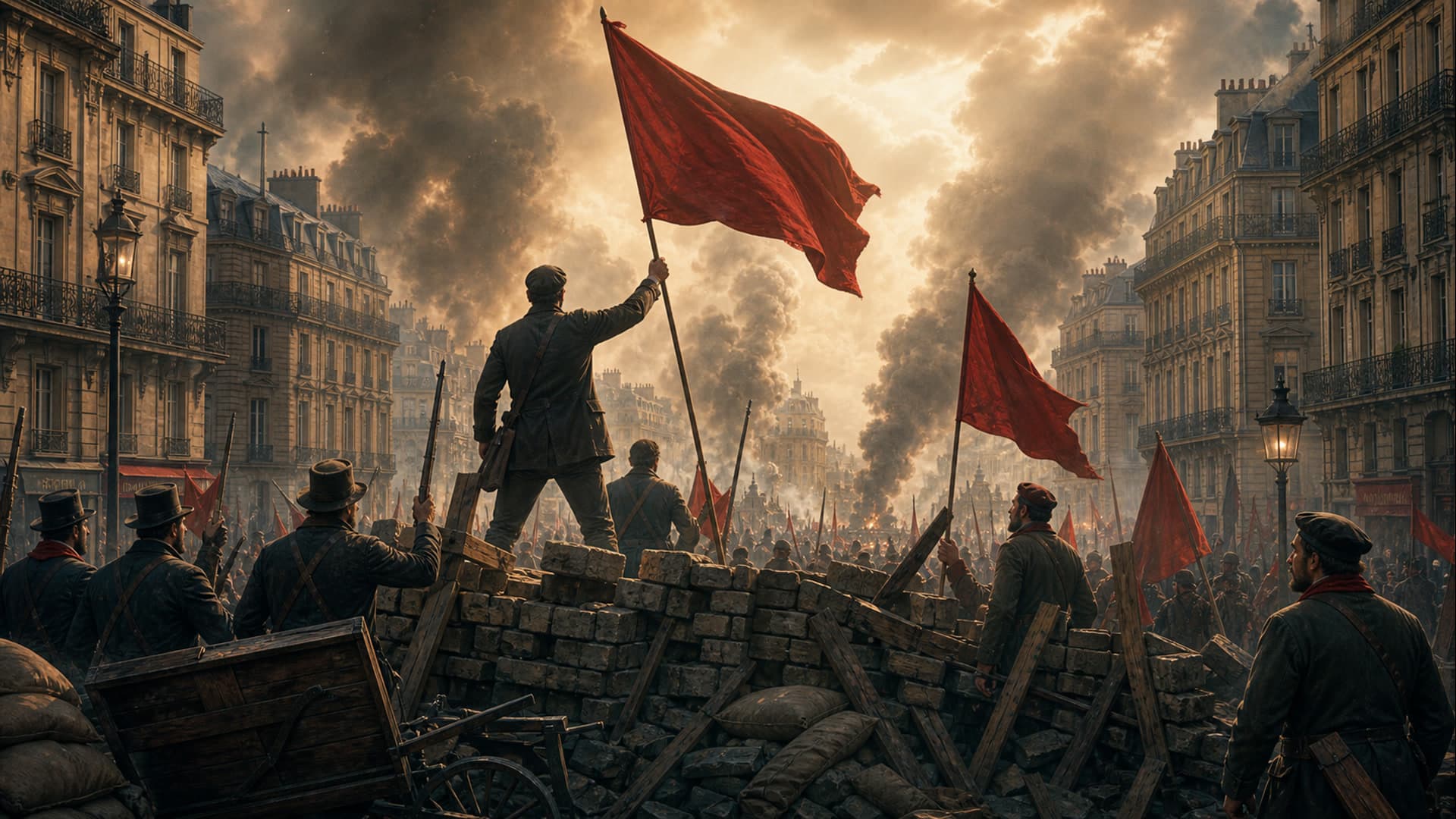
The Paris Commune: seventy-two days that scared the world
 Andres Aguilar
In 1871, Paris experienced 72 days of radical rule; Versailles crushed him in Bloody Week. Ideas and violence that marked the modern left.
If I'm not a coward, you shouldn't be either. Kill me —Louise Michel in court.
There were more deaths in one week than during the entire Terror of the French Revolution, which had lasted more than a year.
On May 28, 1871, in the Père-Lachaise cemetery in Paris, a group of 147 men and women were lined up against a wall and shot. There was no trial, there was no defense, there was no mercy. The French government soldiers killed them and left the bodies piled up right there, among the graves. That corner of the cemetery is known today as the Mur des Fédérés, the Wall of the Federated. Every year, thousands of people go to put flowers in front of that wall. Because what happened in Paris during 72 days in the spring of 1871 was so powerful, so radical and so brief that it never stopped resonating. It was the Paris Commune: the first workers' government in modern history. And the story of how he was crushed is one of the bloodiest and most revealing you will ever hear.
A humiliated France
To understand the Commune you have to first understand the disaster that preceded it. It's 1870, and France is ruled by Napoleon III, the famous Napoleon's nephew. This guy had proclaimed himself emperor in 1852, after a coup d'état, and had been in power for almost twenty years. He had a certain charisma, he had modernized Paris with the grand boulevards that we know today, but in foreign policy he was a disaster. And in July 1870 he made the worst mistake of his life: he declared war on Prussia.
Otto von Bismarck, the Prussian chancellor, was a strategic genius who had been deliberately provoking him. Bismarck needed a war against France to unify all the German states under the leadership of Prussia. And Napoleon III fell into the trap like a rookie. The excuse was an issue of succession to the Spanish throne that no one cared much about, but Bismarck manipulated a diplomatic telegram to make it appear that the French had been insulted. Hurt pride did the rest. France declared war on July 19, 1870, convinced that it was going to win easily.
The war was an absolute disaster for France. The French army, believed to be invincible, turned out to be poorly organized, poorly equipped and poorly led. The generals could not agree, the supply lines were in chaos and the Prussian troops were better trained, better armed and had a military organization that was the envy of Europe. In just six weeks, the Prussians devastated everything. On September 2, 1870, in the Battle of Sedan, Napoleon III himself was captured. The French emperor surrendered along with more than 80,000 soldiers. It was a humiliation of historical dimensions, the kind that marks a country for generations.
When the news reached Paris, people couldn't believe it. Two days later, on September 4, the crowd took to the streets and proclaimed the Republic. A National Defense Government was formed that vowed to continue fighting the Prussians. But the military reality was terminal. And what was coming was even worse: the siege of Paris.
Paris under siege
The Prussians surrounded Paris in September 1870 and began a siege that lasted four and a half months. Four and a half months locked up, without food coming in, without enough heat to withstand the winter, with no real hope that someone would come to rescue them. It was agony.
People began to eat what they could. First the horses. Then the dogs and cats. Then the rats. In the luxury restaurants of Paris, to give you an idea of the level of desperation, they served elephant and camel meat that had been slaughtered from the Jardin des Plantes zoo. There are menus from the time that record it: "elephant consommé", "roasted rat with Robert sauce". It wasn't a joke. It was the reality of a city of two million people that was dying of hunger.
The winter cold was brutal. There was no coal to heat the houses. People cut down the trees on the boulevards to make fires. The hospitals were overwhelmed, the doctors could not cope. The children and the old died first. A fact that gives chills: infant mortality tripled during the siege. It is estimated that in total between 47,000 and 65,000 Parisian civilians died, most of them from hunger and disease. And while people were dying, hot air balloons were the only way to communicate with the outside world. Parisians literally sent letters by balloon to let their families know they were still alive.
Meanwhile, the provisional government led by Adolphe Thiers negotiated surrender. Thiers was a conservative politician, astute, pragmatic to the point of coldness. He was not interested in heroic resistance. He wanted to end the war no matter what and preserve social order.
In January 1871 the armistice was signed. The conditions that Bismarck imposed were devastating: France lost Alsace and a large part of Lorraine, two industrial and symbolically important regions. He had to pay a war compensation of five billion francs, an insane figure for the time. And as a gesture of ultimate humiliation, Prussian troops paraded along the Champs-Élysées on March 1, 1871. Parisians closed the windows and hung black cloths from the balconies. It was a collective pain that was not forgotten.
The spark
Now, this is where everything gets complicated. Paris had endured the siege in a spirit of fierce resistance. During those months, National Guard units composed of workers, artisans, and small merchants had been formed. Ordinary people who armed themselves to defend their city. There were about 300,000 men organized into battalions. And they had cannons. About 400 cannons that had been bought with money from the Parisians themselves during the siege. Those cannons were his. Not from the government, not from the regular army. From the people of Paris.
The Thiers government, which had settled in Versailles because it did not trust the capital, looked at this armed National Guard with growing fear. He knew the city was furious: furious with the surrender, furious with the humiliation, furious with a government that had capitulated without consulting anyone.
And then Thiers made the mistake that triggered everything. On March 18, 1871, at dawn, he sent regular troops to Montmartre to take the cannons of the National Guard. The idea was to disarm Paris before it could rebel.
The soldiers arrived at Montmartre in the dark, but had not brought enough horses to transport the cannons. While they waited for reinforcements, dawn broke. And the people of the neighborhood woke up, saw what was happening and took to the streets. Women, children, workers, everyone surrounded the soldiers. They yelled at them not to take the cannons. They rebuked them. They looked into their eyes.
And here something extraordinary happened: the soldiers refused to shoot at the crowd. They disobeyed orders. Some turned their rifles. Others fraternized directly with civilians. Two generals who tried to restore order were captured by the crowd and shot. It was violent, it was chaotic, but it marked the exact moment when power changed hands.
Thiers, when he learned what had happened in Montmartre, made a drastic and immediate decision: he ordered the complete evacuation of all regular troops, all officials and the entire state apparatus of Paris. He retired to Versailles with his ministers, his generals, his bureaucracy. He left Paris empty of official authority. The most important city in France was, from one day to the next, in the hands of its own inhabitants.
The Commune
On March 26, elections were held in Paris. Some 230,000 Parisians voted and elected a Communal Council of 92 members. Two days later, on March 28, 1871, the Paris Commune was officially proclaimed. It was a huge popular festival. There was music, speeches, red flags everywhere. People were crying with emotion in the streets. They felt that for the first time in history, the people truly governed.
And what they did in those 72 days was astonishing, especially when you think about the context: they were surrounded by a hostile army that was preparing to crush them, they had no real experience of government, and they knew that time was against them.
They separated the Church from the State. This in 1871, when in most European countries the Church still had enormous political power. They declared public, secular and free education for all. They established that public officials could not earn more than a qualified worker. This measure was extraordinary: the idea that governing was not a privilege of the rich but a service to the community, with a salary equal to that of any worker.
They promoted worker cooperatives. Workshops and factories abandoned by their owners, who had fled Paris, were handed over to the workers to manage collectively. They established equal pay between men and women in public education, something that has not yet been fully achieved in many countries around the world. They recognized free unions and the rights of children born out of wedlock, who until then were considered "illegitimate" and had practically no rights. They suspended evictions and waived rent arrears accumulated during the siege.
They banned night work in bakeries, which was a terrible form of labor exploitation: bakers worked at night, in unsanitary conditions, without adequate rest. They established that objects pawned in pawn shops for less than 20 francs, which were basically the belongings of the poor, were returned free of charge. They demolished the Vendôme Column, that monument that Napoleon I had erected with the bronze of cannons captured from the enemy, because they saw it as a symbol of militarism and the war of conquest. It was a provocative gesture that cost them dearly later.
Each of these measures, separately, was radical for the time. All together, implemented in 72 days, they constituted a complete social revolution.
Louise Michel and the women of the Commune
And here we must talk about women, because the Commune was an extraordinary moment for them. At a time when women could not vote, could not have property in their name, could not access university, the women of Paris organized, fought and actively participated in the government.
The most famous is Louise Michel. She was a schoolteacher, an anarchist, a poet, and had a bravery that left everyone speechless. During the Prussian siege she had already been an ambulance driver and volunteer combatant. When the Commune began, it became one of its most powerful voices. He organized popular meetings, gave speeches that raised crowds, and walked around the barricades armed with a rifle. They called her "the Red Virgin" and she hated that nickname because she was not interested in being turned into a romantic symbol. I wanted action, not mystique.
But she wasn't alone. Nathalie Lemel, a Breton bookbinder, co-founded the Women's Union for the Defense of Paris and the Care of the Wounded. This organization not only treated the injured but also promoted women's cooperative workshops and demanded concrete equal pay. Élisabeth Dmitrieff, a young Russian woman of barely 20 years old sent by Marx from London, organized women's work cooperatives and fought on the barricades during the last fighting. There were women managing hospitals, women teaching in the reorganized schools, women debating in neighborhood assemblies.
The conservative press called them "les pétroleuses", the oil companies, accusing them of setting buildings on fire with oil bottles during Bloody Week. It was largely propaganda designed to dehumanize them and justify repression. But the image of the incendiary woman was etched in the French imagination for decades. The fear of women who rebel is old, and the Commune awakened it with a force that the French ruling class did not forget for a long time.
Bloody Week
The Commune lasted from March 18 to May 28, 1871. Exactly seventy-two days. Because from Versailles, Thiers meticulously prepared the reconquest. With the tacit approval of Bismarck, who released French prisoners of war so that they could be used against the Communards, the army of Versailles grew to more than 130,000 well-armed and disciplined soldiers.
On May 21, Versailles troops entered Paris through a poorly defended gate in the southwest of the city. What history remembers as the Semaine sanglante, the Bloody Week, began. And what happened during those seven days was one of the worst massacres in the history of any European city.
The soldiers of Versailles advanced neighborhood by neighborhood, street by street. The community members set up barricades and fought desperately. There was house-to-house fighting, as in a total urban war. But the disproportion of forces was enormous. The commoners were brave but poorly coordinated among themselves, worse armed than a regular army, and had no unified chain of command.
The most terrible thing was not the fighting itself but the summary executions. The Versailles soldiers had brutal instructions. They shot anyone whose hands were stained with gunpowder, who was wearing a National Guard uniform, or who simply seemed suspicious to them. Women with blackened hands, or who supposedly smelled of kerosene, were executed on the spot under the accusation of being petroleuses. There was no process, there was no appeal. An officer pointed and a platoon fired.
During those days of combat, several emblematic buildings in Paris burned. The Tuileries Palace, the Hôtel de Ville, parts of the Palace of Justice. Some fires were set by retreating community members, others were a direct consequence of the bombings. The city was devastated. Columns of black smoke could be seen for kilometers.
The last fighting was fought in the east of Paris, in the working-class neighborhoods of Belleville and Ménilmontant, which had always been the heart of the Commune. The last barricade fell on May 28 on Ramponeau Street. Only one community member defended her, according to some sources. He fired his last cartridge and disappeared. And that same day, in the Père-Lachaise cemetery, the final massacre took place: the 147 prisoners shot against the wall that today is a place of pilgrimage for the left around the world.
The figures are chilling. It is estimated that between 10,000 and 20,000 community members were executed during Bloody Week and in the weeks that followed. Some historians raise the figure to 30,000. To sum it up: there were more deaths in one week than during the entire Terror of the French Revolution, which had lasted more than a year. Nearly 43,000 people were arrested afterwards. Thousands were deported to New Caledonia, a lost French colony in the South Pacific, months away by sea.
Louise Michel was one of those deported. At his trial, he challenged the military court with a phrase that became famous: "If I'm not a coward, you shouldn't be either. Kill me." They didn't kill her. She was sent to New Caledonia, where she spent seven years. There, a notable fact, he established a relationship with the Kanak, the native people of the island, and expressed solidarity with their fight against French colonialism. When he returned to France after a general amnesty, he continued to campaign with the same intensity until the day he died, at the age of 74. He never gave up.
The legacy that did not go out
Seventy-two days. It seems like nothing. But the Paris Commune had an impact that infinitely exceeded its brief existence.
Karl Marx, who followed events from London practically in real time through correspondents, wrote "The Civil War in France" just weeks after the fall of the Commune. For Marx, the Commune was the practical demonstration that the working class could take power and organize society in a different way. He was living proof that the bourgeois state could be replaced by something different, something built from below. The Commune became a central reference for Marxist thought.
Lenin studied her obsessively. Before the Russian Revolution of 1917, he methodically analyzed the errors of the Commune: they did not take over the Bank of France, which continued to function and quietly finance the Versailles government; they did not march on Versailles when Thiers was weak and vulnerable; They were, according to Lenin, too democratic, too deliberative when they needed speed and military decision. When the Bolsheviks took power in October 1917, Lenin counted the days. They say that when they surpassed the 72nd day, the Commune's record, he danced in the snow.
But the influence of the Commune goes far beyond Marxism. The anarchists claim it as an example of popular self-management without a leading party, without a centralized bureaucracy. Feminist movements point to it as a foundational moment in the fight for women's rights. The separation of church and state that the Commune implemented in 1871 became law in France only in 1905, thirty-four years later. Free, secular, public education: another direct legacy that France formally adopted with the Jules Ferry laws in the 1880s. Labor rights, worker cooperatives, the idea that a civil servant should not become rich from his position: all of this has roots in those 72 days of Parisian spring. Even the red flag as a symbol of the international labor movement was consolidated with the Commune.
Why does it matter today?
There is something in the Paris Commune that continues to challenge, that does not age. Every time a social movement occupies a square, every time workers recover a factory as happened so many times in Argentina after 2001, every time people organize from below and say "enough, we can do it differently", the spirit of the Commune is there, like an echo that never goes out. It is no coincidence that March 18 is commemorated in many countries as a day of workers' memory.
The Commune was not perfect. The community members made serious mistakes. They were militarily naïve, strategically disorganized, and failed to extend the revolution beyond the limits of Paris. The repression they suffered was so disproportionate, so savage, that for decades it functioned as a brutal warning: this is what happens when the people dare to govern.
But it also showed something that no massacre could erase. That it is possible, even for 72 days, to organize a company in another way. That ordinary people, workers, teachers, artisans, book binders, can make decisions about their own lives without anyone telling them how to do it from above. That equality is not just an abstract concept but something that can be built, measure by measure, decree by decree, barricade by barricade.
The Père-Lachaise wall is still there. The flowers continue to appear every year. And the story of the Paris Commune remains, after more than 150 years, one of the most powerful and moving that modern history can tell. Seventy-two days that proved another world was possible, and a week of blood that tried to make sure no one would forget. We don't forget it.
Related episodes
When Rome fell in 476, the Roman Empire kept on existing — for another thousand years, with its capital at Constantinople. That empire almost no one remembers was the bridge between the ancient and modern worlds, the guardian of the Greek texts that fu...
The Eiffel Tower wasn't Eiffel's idea, it was painted red, it was despised by France's greatest writers, and it came within years of being torn down. The man whose name it bears was facing fraud charges when it opened. This is the story of how the worl...
The first texts humanity ever wrote were not poems or prayers — they were grain inventory lists. Writing was born to keep accounts, and cities were born because someone needed to keep them at scale. From Jericho to Tokyo, this is the story of how we we...