
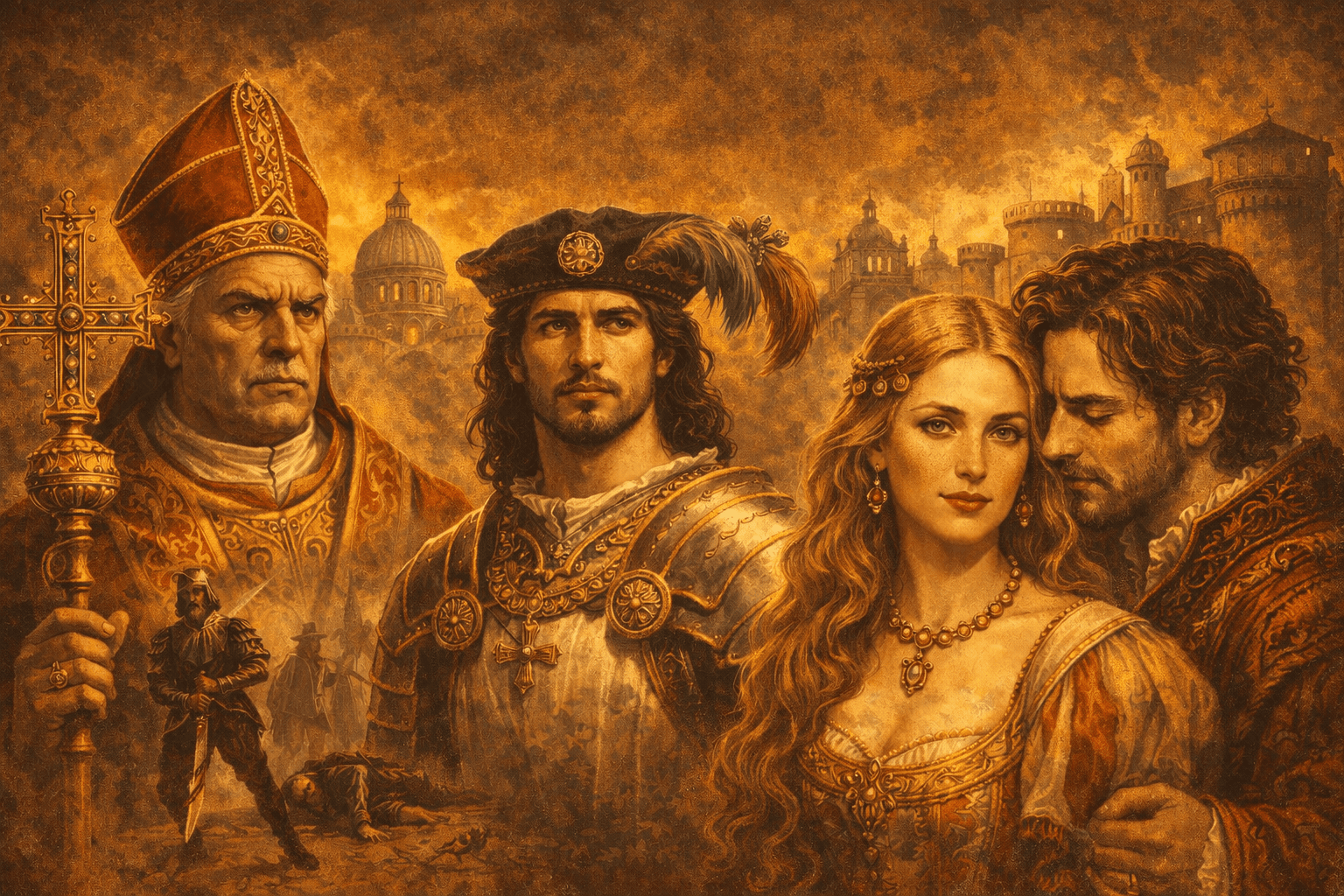
The Borgias
 Andres Aguilar
A Spanish cardinal bribed his way to the papacy, turned the Vatican into a family enterprise, and raised two children who became legends of ambition and scandal. Rodrigo Borgia — Pope Alexander VI — and his son Cesare gave Machiavelli the material for ...
In 1492 — the same year Columbus reached the Americas — something equally historic but considerably darker was unfolding in Rome: a Spaniard named Rodrigo Borgia had just bought his way into the papacy.
He didn't win a fair election. He wasn't chosen for his spiritual merits or the reverence of his peers. He flat-out bribed the cardinals — bags of gold, castles, land, and promises of advantageous marriages for their relatives. And so the most corrupt man of the Renaissance became Alexander VI, spiritual leader of all of Christendom. What followed was a saga of betrayal, murder, and scandal that even the most ambitious fiction would struggle to top.
But the Borgias didn't start in Rome. They started in Valencia.
From Minor Spanish Nobility to the Heart of Vatican Power
Originally they were the Borjas: a family of minor Valencian nobility with no particular prospects, modest landowners in a peripheral kingdom. Everything changed when one of them, Alfonso de Borja, proved to be extraordinarily gifted in canon law and diplomacy. He served as an advisor to the King of Aragon, then became a bishop, and his defining moment came when he successfully brokered a conflict between the Aragonese Crown and the papacy. As a reward, he was made a cardinal and relocated to Rome.
Alfonso arrived in the Eternal City already old, well into his seventies. Nobody gave him any political weight. When Pope Nicholas V died in 1455, the conclave was so deadlocked among the most powerful cardinals that no one could gain the upper hand. The compromise pick was the old Spaniard: they elected him figuring he'd be dead soon and that no one would lose ground in the meantime. The miscalculation was considerable. Alfonso de Borja became Calixtus III and — like virtually every pope of that era — his first order of business was to practice nepotism with a dedication that left no room for ambiguity. He made cardinals of several Spanish nephews and relatives. Among them, his favorite: Rodrigo Borgia, twenty-five years old.
Rodrigo was the perfect opposite of his austere and pious uncle. He was tall, attractive, charismatic, and had an appetite for pleasure, power, and luxury that nothing and nobody was going to moderate. But he was also genuinely brilliant and possessed of a manipulative skill few of his contemporaries could match. His uncle had given him the starting point; he would do the rest. Over the next thirty-seven years, serving as Vice-Chancellor of the Vatican — one of the most influential administrative posts in the Church — Rodrigo steadily accumulated wealth, power, and enemies in roughly equal measure. He sold ecclesiastical positions, took cuts from appointments, and conducted his business with the nonchalance of someone who knows exactly what he's doing and has absolutely no intention of stopping.
And while doing all of that, he had a family.
As a cardinal of the Catholic Church, Rodrigo maintained a stable and publicly known relationship with Vannozza dei Cattanei, a middle-class Roman woman who was intelligent and beautiful, with whom he had four children he acknowledged without the slightest pretense: Juan, Cesare, Lucrezia, and Jofré. In Renaissance Italy, clerical celibacy was more a written rule than a lived reality, especially among the ecclesiastical elite. What set Rodrigo apart wasn't that he had children, but the brazenness with which he wove them into his political strategy: he married them off, appointed them, used them as pieces on a chessboard he controlled from the center.
When Pope Innocent VIII died in 1492, Rodrigo Borgia was sixty-one years old, in possession of a considerable fortune, and with his ambitions fully intact. The obstacle was that other equally powerful cardinals wanted the same position. The solution was characteristically Borgia: he sent mules loaded with silver to the residences of the undecided cardinals. To Cardinal Sforza he offered four mules loaded with silver and the castle of Nepi. To others he promised abbeys, ecclesiastical benefits, and positions for their relatives. The deal was direct and efficient. On August 11, 1492, Rodrigo Borgia was elected Pope and took the name Alexander VI.
Rome received the news with a mixture of outrage and resignation. No one was ignorant of how he'd gotten there. No one was ignorant of his track record. But there he was — the Vicar of Christ on earth, the successor of Saint Peter — was the man who had bought the highest office in Christendom.
The Children: The Washout, the Dark Genius, and the Pawn
The first thing Alexander VI did as Pope was exactly what Calixtus III had done forty years before: consolidate his family's power. And his three principal children were characters so different from one another that history itself could hardly have invented them.
Juan, the eldest son, was his father's favorite. Alexander adored him with that particular blindness parents sometimes develop toward the children who disappoint them the most. He married him to a Spanish noblewoman, made him Duke of Gandía, and appointed him commander of the papal armies. The problem was that Juan was, by the near-unanimous consensus of his contemporaries, incompetent. His military campaigns were disasters. His soldiers held him in contempt. In Rome he was seen as a spoiled kid playing dress-up as a condottiere. But Alexander kept giving him chances, incapable of seeing what everyone else saw clearly.
Cesare was the exact opposite. If Juan was the favorite, Cesare was the family's dark genius. Intelligent with a coldness that unsettled even those who admired him, calculating, completely stripped of the scruples that held others back. His father had destined him for the Church: at seventeen he was a bishop, at eighteen a cardinal. But Cesare loathed ecclesiastical life with an intensity his contemporaries described as visceral. He didn't want to be a clergyman. He wanted to be a prince, a soldier, a conqueror. He wanted real power, not the ceremonial power of the pulpit. He wore the cardinal's robes like a cage, and everyone knew it.
And then there was Lucrezia, the most misunderstood of the three. Posterity turned her into one of history's most persistent archetypes: the seductive poisoner, the Renaissance femme fatale who killed her lovers with a hollow ring filled with arsenic. It's an extraordinarily vivid image — and one almost entirely unsupported by historical evidence. The real Lucrezia was an educated woman, raised with the care the Borgias reserved for instruments they needed to be presentable, and fundamentally a chess piece in the hands of her father and brother. She was married off at thirteen to Giovanni Sforza to seal a political alliance. When that alliance stopped being useful, they annulled the marriage by forcing her to publicly declare it had never been consummated — humiliating her before all of Rome so that Giovanni could not object. They then married her to Alfonso of Aragon, a young man she apparently fell genuinely in love with. When that second marriage stopped fitting the family's plans, Alfonso turned up dead. All fingers pointed to Cesare. Lucrezia had no say in any of these decisions.
The Murder That Changed Everything
During the first years of Alexander's papacy, the scandals were mostly financial and sexual in nature. The corruption was systematic, the Vatican's parties were legendary for their excess, church offices were sold with the openness of a street market, and foreign ambassadors sent letters home to their monarchs describing what they witnessed with a tone that wavered between moral indignation and ethnographic fascination. But the bloodshed had not yet arrived.
It arrived in June of 1497\.
One night, Juan Borgia left a dinner at the Vatican in the company of his brother Cesare and several friends. At some point he separated from the group, saying he had something to take care of. It was the last time anyone saw him alive. His body appeared days later floating in the Tiber, bearing nine stab wounds.
The murder shattered Alexander in a way no one in Rome had anticipated. The Pope wept in public — something highly unusual for a sovereign of his era and temperament — and promised to reform the Church, change his ways, and pursue the investigation to its final conclusion. For a moment it seemed that the grief might actually produce something real. But the grief passed, the promises evaporated, and the investigation was quietly closed without results.
Who killed Juan Borgia? Rome had theories. The Orsinis, traditional enemies of the family. The Sforzas, resentful over the humiliation of Lucrezia's divorce. But the theory that circulated with the most persistence — whispered in drawing rooms and public squares, because saying it out loud was dangerous — pointed to Cesare.
Cesare hated his brother with the precision of a man who knows exactly what he's being denied. Juan had the armies, the titles, the unconditional love of their father. Cesare had a cardinal's robes and an ambition that couldn't fit within any diocese.
Records from that night showed that Cesare and Juan had argued violently before parting ways. Cesare had motive, opportunity, and — by all accounts from those who knew him — the temperament to act without hesitation. Nothing was ever proven. But what happened next is telling: a few months after the murder, Cesare resigned from the cardinalate. This was virtually unprecedented in ecclesiastical history. Alexander permitted it. Cesare put on armor and became what he had always wanted to be.
Cesare Borgia: Machiavelli's Blueprint
From that point on, Cesare Borgia was the real power behind the papal throne. His father appointed him captain-general of the Church's armies and assigned him a mission that suited his temperament perfectly: conquer the Romagna, a region of northern Italy that nominally belonged to the papacy but was in practice a patchwork of small independent lordships governed by families who had spent generations ignoring Rome.
Cesare accomplished it with an efficiency that left his contemporaries at a loss for words. He struck fast, before the enemy could organize. He negotiated when negotiation was more useful than war. He betrayed without remorse when betrayal was more effective than any other option. He used Vatican gold to hire the best mercenaries and the best military engineers. Leonardo da Vinci worked for him as a military engineer. Niccolò Machiavelli met him in person during a Florentine diplomatic mission and was so impressed that years later he would make Cesare the central model of The Prince, his treatise on political power. Not because Machiavelli approved of his methods, but because Cesare was the most perfect embodiment he had ever encountered of what he called virtù: the ability to use whatever tool is available to achieve the objective, without letting external moral considerations interfere with the analysis of what works and what doesn't.
There is one episode Machiavelli describes in The Prince as a perfect example of that logic. When Cesare conquered Cesena, he left the city under the command of a subordinate named Remirro de Orco — an efficient man, but so brutal that he soon made the inhabitants unbearably resentful. When Cesare returned and assessed the situation, he understood the problem: Remirro had been useful for the conquest, but his brutality was generating resistance that could turn dangerous. The solution was as direct as it was calculated: he had Remirro arrested, executed, and left with his body cut in half in the town's main square. In a single move, he eliminated the source of popular discontent, demonstrated who was really in charge, and terrified any potential opposition. The citizens of Cesena, according to the chronicles, were simultaneously satisfied and terrified. Exactly what Cesare was going for.
While Cesare was conquering territory in the north, Alexander VI continued being pope — and continued being scandalous. Chroniclers of the era recorded parties that are difficult to describe without sounding like you're exaggerating. Ambassadors wrote letters to their sovereigns describing what happened at the Vatican with a tone that swung between moral outrage and the clinical detachment of an anthropologist in the field. Alexander made no effort to hide it. He held absolute power and exercised it without any concern for appearances.
Alexander VI held absolute power and exercised it openly. Foreign ambassadors sent their monarchs letters describing the papal parties with a tone that swung between moral outrage and ethnographic fascination.
He also continued using Lucrezia as a diplomatic instrument. After the death of her second husband, he married her off a third time to Alfonso d'Este, heir to the Duchy of Ferrara. This marriage turned out to be, paradoxically, the one that would give Lucrezia something resembling freedom. In Ferrara, removed from Rome and her family, she was able to build a life of her own. She became a patron of the arts, governed the duchy effectively during her husband's absences, and cultivated correspondence with poets, philosophers, and humanists. The woman legend described as a poisoner and seductress was in reality a competent ruler and a respected cultural figure. When she died in 1519, she was genuinely mourned. The gap between the historical Lucrezia and the legendary one is a fairly precise measure of how badly posterity can distort a story when the fictional version is just too good to fact-check.
The Cardinal's Dinner and the Fall of the Borgias
In August of 1503, at what appeared to be their peak of power, the Borgias suffered the blow from which they would never recover.
Alexander and Cesare were invited to dine at the villa of Cardinal Adriano da Corneto. It was Roman summer, with the heat and humidity that made it the most dangerous season of the year in a city built on swampy ground. Days after the dinner, both fell gravely ill. Alexander VI, who was seventy-two years old, died on August 18\. Cesare survived, but was so physically devastated that for weeks he could barely stand.
The theory that immediately swept through Rome was perfectly poetic in its symmetry: the Borgias had attempted to poison Cardinal Corneto to seize his fortune, but by mistake had themselves drunk the contaminated wine. The masters of poison, killed by their own weapon. It was a story so narratively satisfying that it lodged itself in historical memory as established fact. The problem is that it almost certainly isn't. The symptoms the period's physicians described are consistent with malaria, which was endemic in Rome during the summers and that year was causing an unusually high number of deaths. But the poison legend was simply too perfect to lose out to the facts.
Alexander's death changed everything within a matter of weeks. Without his father as Pope, Cesare lost the very foundation on which he had built all his power. The cardinals who elected the next pontiff were, many of them, bitter enemies of the family. The lordships of the Romagna that Cesare had conquered began revolting one by one. The mercenaries who had served him left as soon as the paychecks stopped. Allies found urgent reasons to revisit their commitments.
Cesare tried to recover. He was arrested, escaped, fled to Spain, and joined the army of his brother-in-law, the King of Navarre. On March 12, 1507, during the siege of a completely obscure Navarrese town called Viana, he died in combat. He was thirty-one years old. The man who had dominated Italy, who had served as Machiavelli's model for his theory of power, who had hired Leonardo da Vinci as a military engineer, died in a nameless skirmish in a forgotten corner of Spain. The speed of the fall was almost as staggering as the speed of the rise.
The Legacy: The Reformation the Borgias Triggered Without Meaning To
What remained after the Borgias?
The immediate answer is: a legend that grew over time until it became almost independent of the events that generated it. Every story about them got amplified. Every rumor solidified into certainty. The incestuous relationship between Cesare and Lucrezia — which no contemporary source documents in any credible way — became a fixed element of the narrative. The poisons they supposedly deployed multiplied in the telling until they became the family's go-to solution for any domestic inconvenience. Lucrezia, who was more victim than perpetrator of nearly everything that happened during her father's papacy, became fixed in the popular imagination as the Renaissance femme fatale.
But it would not be entirely honest to fully exonerate the Borgias of the legend that surrounds them. Alexander VI was objectively one of the most corrupt popes in an institution that, during that period, was not exactly known for its integrity. He bought his election. He sold ecclesiastical offices systematically. He used Church resources to enrich his family. He had children first as a cardinal and then as pope, and actively wove them into Vatican politics. Cesare was a conqueror who used deception, betrayal, and violence without any apparent inner conflict. They were products of their time, yes — but even by the standards of Renaissance Italy, they represented an extreme that their contemporaries recognized as such.
What makes the Borgias genuinely fascinating isn't the crimes they committed, but what they represent about the contradictions of their era. The Renaissance was simultaneously the period of greatest artistic and cultural flourishing in European history and one of the most violent in terms of internal politics. The same civilization that produced Leonardo, Michelangelo, and Raphael also produced the Borgias. The same cities where Neoplatonism was debated and Madonnas were painted with unprecedented delicacy were also cities where lords murdered one another with a regularity that no chronicler found particularly surprising. The Church that preached apostolic poverty and the imitation of Christ had, at its very top, a man who used the faithful's money to fund his illegitimate son's military campaigns.
The Renaissance was simultaneously Europe's period of greatest artistic flourishing and one of its most violent in terms of internal politics. The Borgias were the most perfect embodiment of that contradiction.
The Borgias embodied those contradictions without any attempt to hide them. The Borgia Apartment in the Vatican, decorated by Pinturicchio with frescoes still considered masterpieces of the Renaissance, was the private home of the man who had bought the papacy. Artistic patronage and institutional corruption weren't separate phenomena: they were two sides of the same exercise of power.
There is one historical consequence of the Borgias that rarely surfaces in popular narratives about them, but which may be the most significant of all. The scandal of Alexander VI's papacy was one of the factors that made the Protestant Reformation possible. When Martin Luther nailed his ninety-five theses to the door in Wittenberg in 1517 — fourteen years after Alexander's death — one of his central grievances was precisely the corruption that the Borgias had taken to its logical extreme: the sale of indulgences and ecclesiastical offices, the unchecked luxury of the popes, the yawning gap between what the Church preached and what its leaders practiced. Alexander had been dead for over a decade, but his legacy remained the most effective argument for those who wanted to prove that Rome needed radical reform. Without intending to or even realizing it, the Borgias helped split Western Christianity in two.
The Catholic Church eventually responded with the Council of Trent and the Counter-Reformation, establishing stricter controls over the very practices the Borgias had taken to their extreme. It was a painful and long overdue reform, but a real one. Without the scandal of the Borgia papacy, it's possible that the reforming impulse within the Church would have taken much longer to materialize.
Why the Borgias Still Fascinate Us
Centuries after their extinction as a politically relevant family — the descendants of Juan kept the Duchy of Gandía in Spain but never reclaimed their Italian influence — the Borgias continue to appear in novels, TV series, films, and plays with a regularity no other Renaissance family can match.
The reason isn't just the scandal. It's that the Borgia story illustrates something about power that remains true in any era. Rodrigo Borgia had genuine intelligence, charisma, and political ability. He could have used those qualities in very different ways. He used them to accumulate personal wealth and family power, unchecked by any institutional constraint. Cesare had extraordinary military and political talent, demonstrated by his campaigns in the Romagna. In other circumstances, he might have been a capable statesman. What turned him into the subject of the most influential political work of the Renaissance was precisely his willingness to act without any regard for the rules others imposed on themselves.
Lucrezia is the most revealing case of the three. She was educated, capable, intelligent. The years she spent in Ferrara, with genuine autonomy, proved it clearly. But she spent most of her life being used as an instrument by men who made every decision that affected her. It's a reminder that the Borgia story wasn't only about the corruption of power, but also about the constraints that power imposed on those who weren't its main players.
The Borgias' power also illustrates something that modern institutions try to resolve without ever quite managing it: what happens when the concentration of power is total and accountability is nonexistent. Alexander VI was simultaneously the head of state of the papal territories, the spiritual leader of Western Christendom, and the final arbiter of any ecclesiastical dispute. There was no mechanism that could question him, no institution that could demand answers, no free press that could expose what was happening. The satirical pamphlets that circulated through Rome describing his scandals were the Renaissance equivalent of social media: effective at generating outrage, powerless to produce consequences.
And yet, they fell. Not through legal process or popular revolution. They fell because Alexander died of a disease endemic to the city he had governed, and because without him the scaffolding of power they had spent fifteen years building collapsed in a matter of weeks. All that power, all those conquests, all that network of alliances and fear evaporated with a speed that left even those who had watched it constructed absolutely slack-jawed. It is the oldest lesson about power built on fear: it lasts exactly as long as the person exercising it.
When you visit Rome today, traces of the Borgias are scattered across the city. The Pinturicchio frescoes in the Borgia Apartment at the Vatican — still visitable, and of unmistakable beauty. The Borgia Tower in the Vatican walls. The churches and palaces they funded. And in Santa Sofia, in Ferrara, the tomb of Lucrezia — the most misunderstood of them all — who rests far from Rome and the legends that outlived her.
The Borgias were a mirror in which the Renaissance saw itself and did not like what it found. But the image didn't disappear. It stayed there, reflecting something about human power and its limits that five hundred years have not finished resolving.
Related episodes
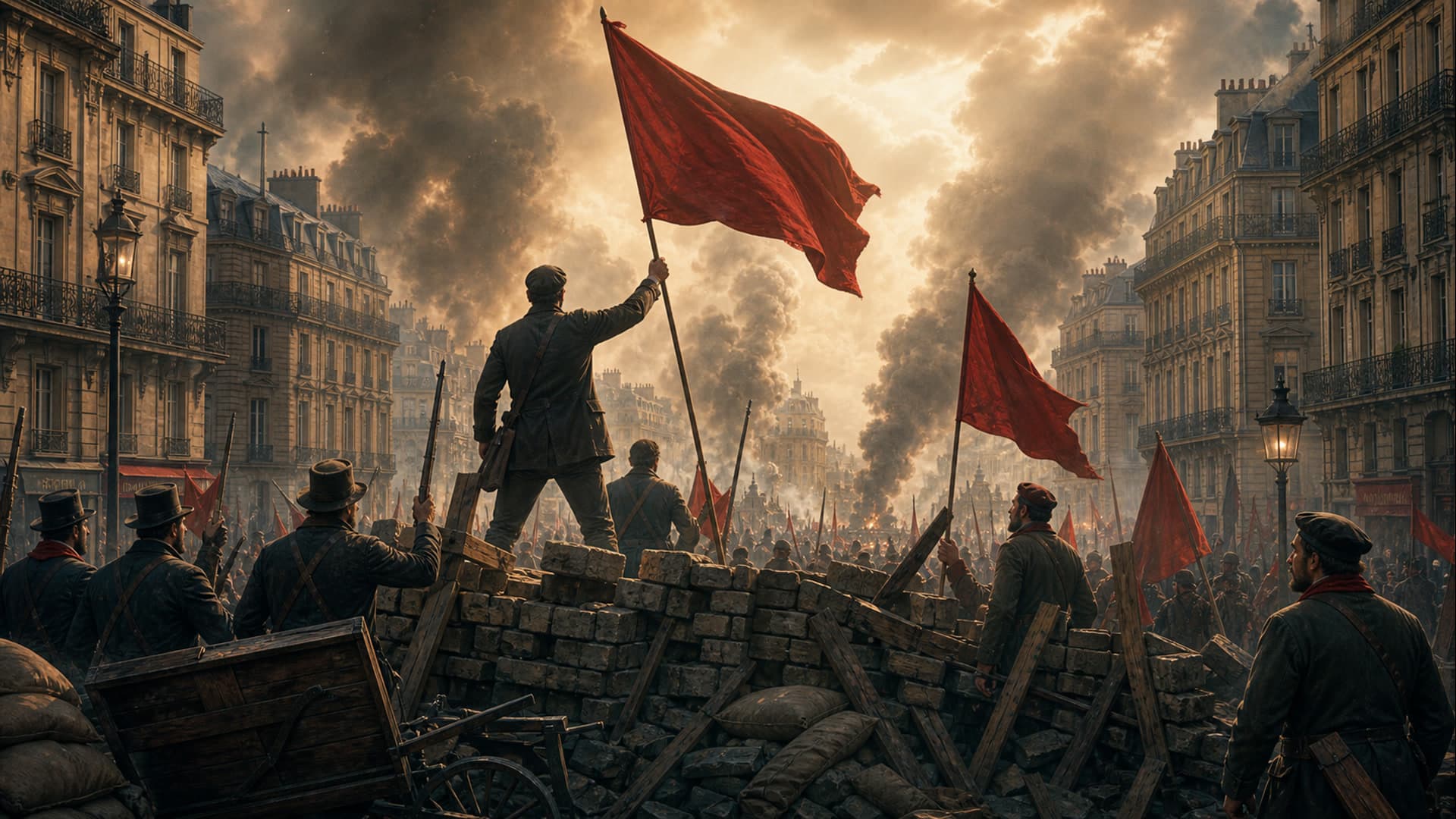
In 1871, Paris experienced 72 days of radical rule; Versailles crushed him in Bloody Week. Ideas and violence that marked the modern left.
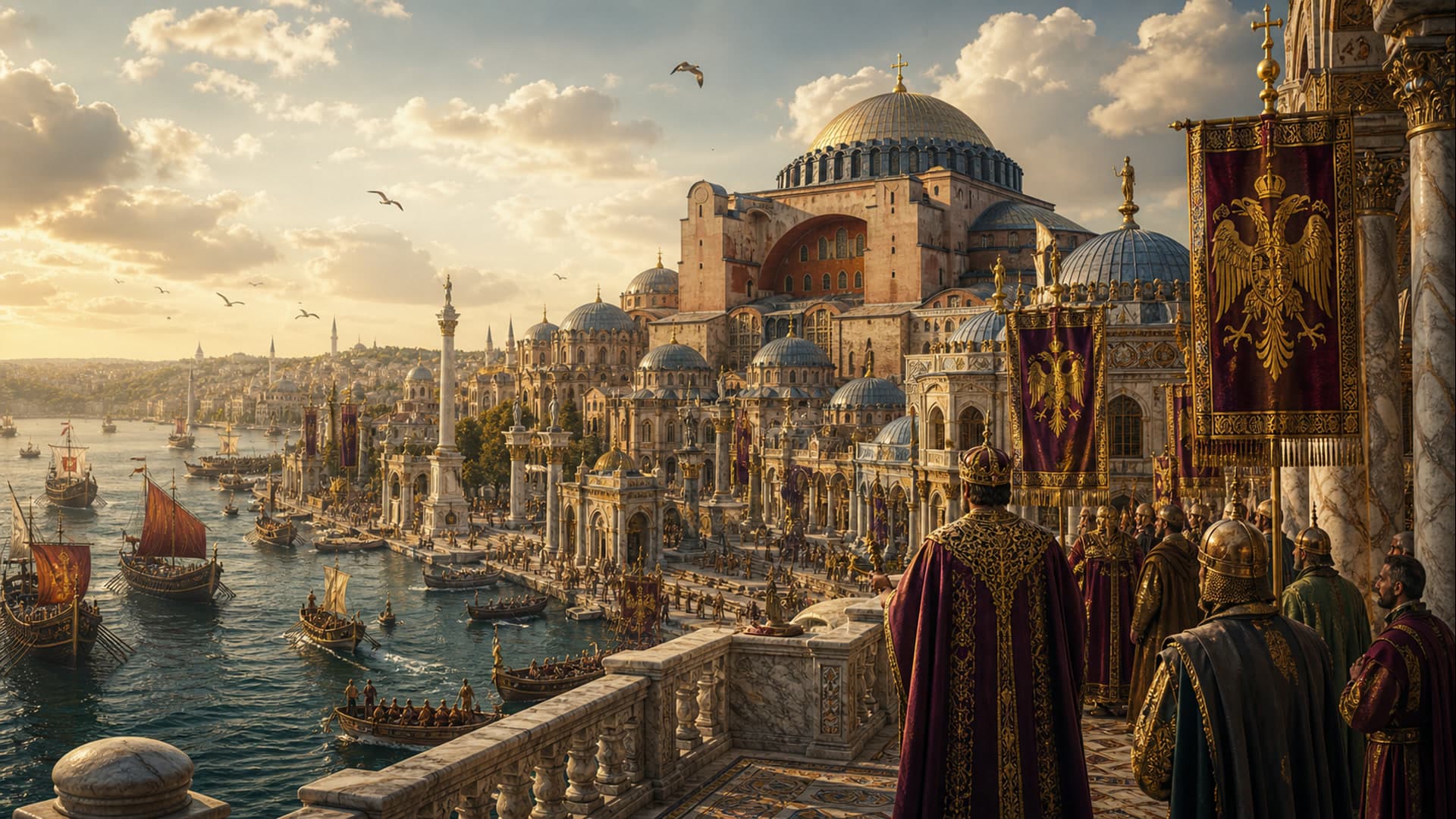
When Rome fell in 476, the Roman Empire kept on existing — for another thousand years, with its capital at Constantinople. That empire almost no one remembers was the bridge between the ancient and modern worlds, the guardian of the Greek texts that fu...
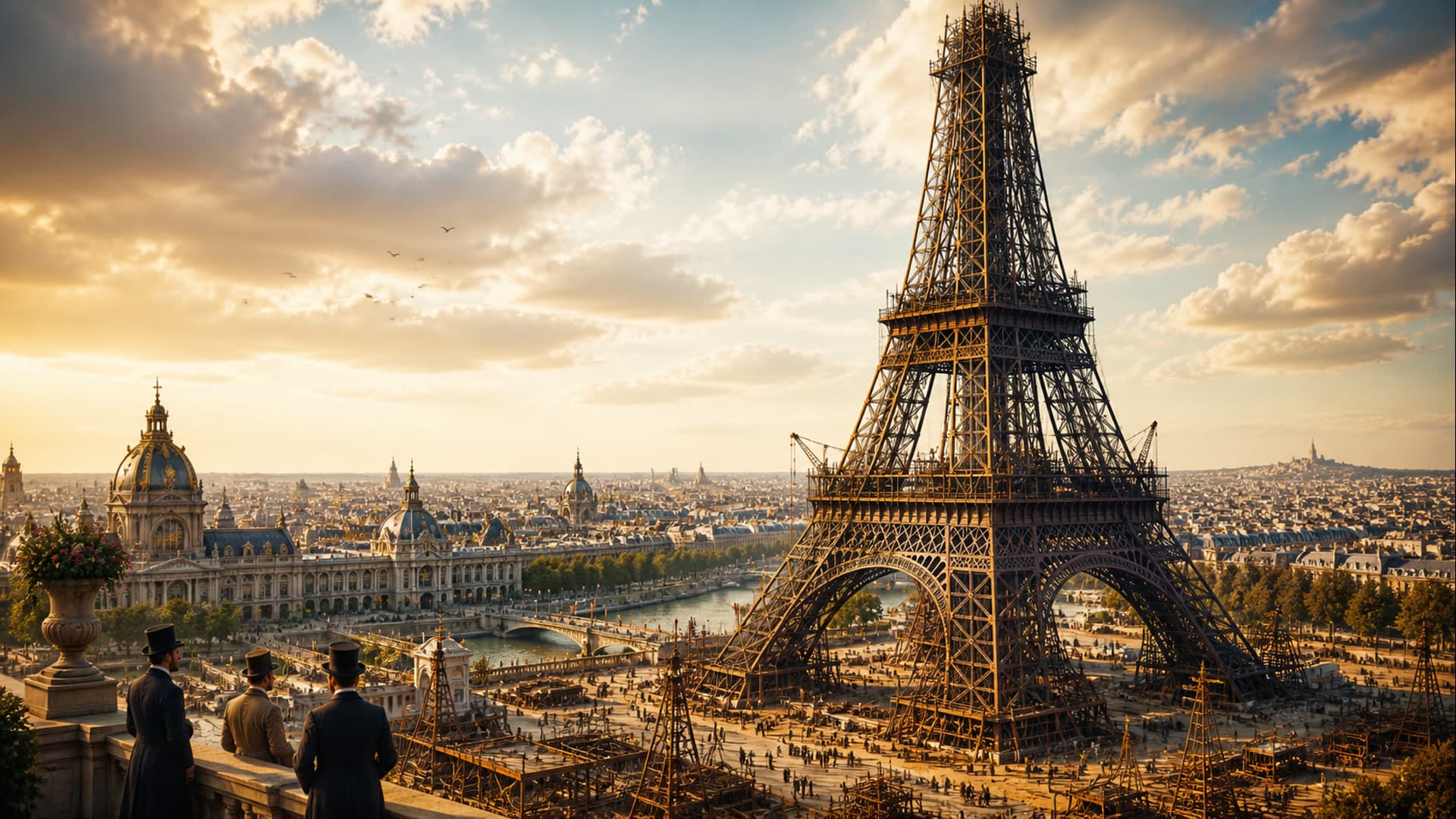
The Eiffel Tower wasn't Eiffel's idea, it was painted red, it was despised by France's greatest writers, and it came within years of being torn down. The man whose name it bears was facing fraud charges when it opened. This is the story of how the worl...