
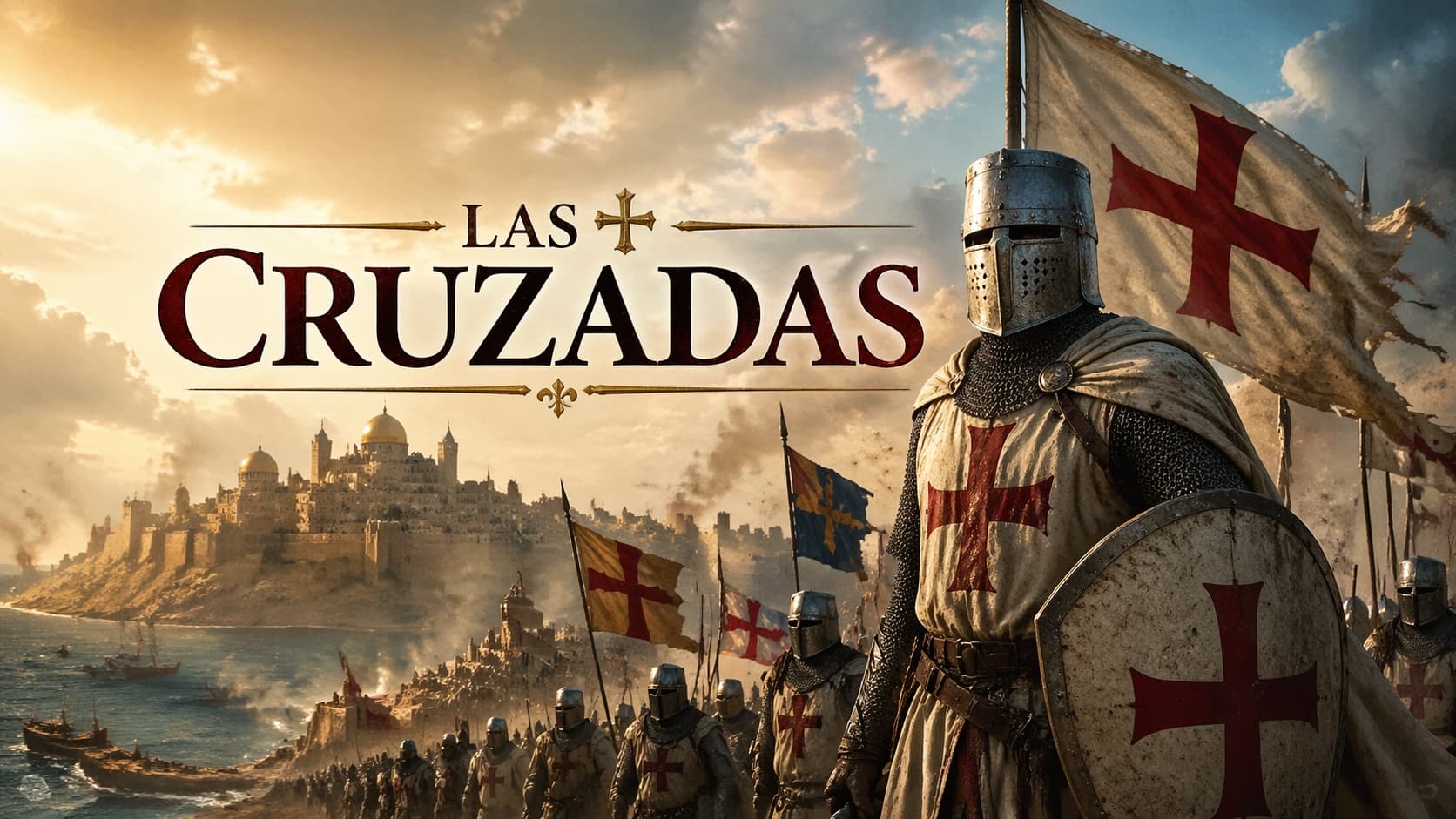
The Crusades
 Andres Aguilar
In 1095, the Pope gave a speech and all of Europe took up arms. For two centuries, crusaders and Muslims fought over Jerusalem with faith, greed, and a violence that still echoes today. But behind the battles lies a more complex story: how that confron...
Deus vult — God wills it — was the battle cry that launched Europe toward the Holy Land.
Faith, ambition, and money. That was the underlying cocktail of the entire crusading enterprise.
The year was 1099. For three years, an enormous army had been marching across Europe and the Middle East. They had crossed the Bosphorus, conquered cities in what is now Turkey, and survived months of starvation and disease during brutal sieges. And now they stood before the walls of Jerusalem. When they finally entered the city, the massacre was so savage that contemporary chroniclers described streets with blood up to the ankles. That wasn't poetic exaggeration. It was what crusaders did when they took a city. And they did it convinced that God wanted it that way.
Background: Europe, Islam, and Byzantium's Plea for Help
To understand why the Crusades began, you first have to understand the world around the year 1000. Europe at that time was a fragmented, violent continent where kings held relatively little power and local nobles did whatever they pleased. If you listened to episode 13 on Feudalism, you'll remember that system well. The Catholic Church was the only institution with real authority across the entire continent. The Pope was, in practical terms, the most powerful figure in Europe.
But it wasn't just about Europe. Beginning in the seventh century, when Islam emerged from the Arabian Peninsula, it expanded at a speed that left the world of the time stunned. In less than a hundred years, Muslim armies had conquered North Africa, Persia, and Spain, and had reached southern France before being stopped at the Battle of Poitiers. Jerusalem — a city sacred to Jews, Christians, and Muslims alike — fell to Arab forces in 637, just five years after the death of Muhammad.
For more than four centuries, that arrangement worked reasonably well. The Arab caliphs — the rulers of the Islamic world — allowed Christian pilgrims to visit the holy sites of Palestine. There was tension, but there was coexistence. The trouble came when the Seljuks, a Turkish people who had converted to Islam, conquered Baghdad in 1055 and began expanding aggressively. Unlike the Arab caliphs, the Seljuks were far more hostile toward Christian pilgrims. They robbed them, attacked them, killed them. The pilgrimage to the Holy Land became extremely dangerous.
Then came the blow that unleashed everything. In 1071 — about fifteen years before the founding of the first European university, at Bologna — a Seljuk army destroyed the Byzantine Empire's army at the Battle of Manzikert. The Byzantine Empire was the direct heir of the Eastern Roman Empire, with its capital at Constantinople, the wealthiest city in Christendom. In that battle, it lost nearly all of its territory in Asia Minor — essentially what is modern-day Turkey. Overnight, the Turks were a few days' march from Constantinople. The desperate Byzantine emperor sent a letter to the Pope asking for help. If you want more on that story, we tell it in episode 25 on the Byzantine Empire.
The Pope at that moment was Urban II. He was a shrewd, politically-minded man with a remarkable instinct for power. When he received the plea for help, he saw a tremendous opportunity — not only to aid the Christians of the East, but to unify the European nobles who wouldn't stop fighting each other, to strengthen the authority of the Papacy, and to redirect all that bottled-up feudal violence outward from the continent.
In November 1095 — more than three and a half centuries before Columbus reached America — Urban II convened a council at Clermont, in southern France. He stood before thousands of people: bishops, nobles, and common folk alike, and delivered one of the most influential speeches of the medieval era.
We don't have the exact text of that speech, but we know its core: Urban II called on the nobility to set aside their internal wars and march to liberate Jerusalem.
The response was immediate. The crowd began shouting "Deus vult," which in Latin means "God wills it." That phrase became the battle cry of the Crusades.
The motivations weren't purely religious. There was genuine faith, yes — but also political calculation, personal ambition, and business opportunities for commercial cities like Venice and Genoa.
Faith, ambition, and money. That was the underlying cocktail of the entire crusading enterprise.
> Faith, ambition, and money. That was the underlying cocktail of the entire crusading enterprise.
The People's Crusade: Peter the Hermit and the First Disaster
Before the official army set out, something unexpected happened. A wandering preacher named Peter the Hermit began touring Europe announcing the Crusade with almost delirious fervor. He was a thin, poorly dressed man who traveled by donkey and drew crowds wherever he went. Around him, a spontaneous army began forming — peasants, beggars, landless people, and some enthusiastic but ill-equipped knights. There was no organization. No supply lines. No strategy.
In 1096, this mob of somewhere between thirty thousand and a hundred thousand people began marching east. Before they even reached the Holy Land, they had already massacred Jewish communities along the Rhine and Danube. Those were the first large-scale medieval pogroms in Western Europe. The logic was terrifying in its simplicity: if they were going to fight the infidels in the East, why not start with the infidels right next door? It was brutality without justification — but it had its own internal logic within that mental framework.
The same mob looted Hungarian and Byzantine cities along the way. The Byzantine emperor Alexios I got them across the Bosphorus as quickly as possible just to be rid of them. And when they reached Seljuk territory, the Turks slaughtered them in a matter of hours. Of the thousands who set out, very few survived. Peter the Hermit saved himself by sheer luck — he was in Constantinople negotiating resources with the emperor when the massacre happened.
That was the first chapter of the Crusades. A total disaster.
The First Crusade: Nicaea, Antioch, and the Fall of Jerusalem
The real army came later, and it was a different story — better armed, better led, and made up of powerful feudal lords.
The journey was an ordeal from the start. They crossed into Anatolia in 1097 and spent months besieging Nicaea, the Seljuk capital. They took it with Byzantine help, though Emperor Alexios quietly negotiated the city's surrender on his own terms to ensure he kept control of it — which infuriated the crusaders who had been counting on plundering the place. Relations with Byzantium were strained before they'd even properly begun.
They marched south and defeated a massive Turkish army at Dorylaeum, a victory that opened the road east. But the real drama came with the siege of Antioch, a huge and heavily fortified city in what is now southern Turkey. The crusaders laid siege to it starting in October 1097. For months, as they tried to take the city, they were also being hit from behind by Turkish relief armies. People died of hunger, disease, and cold. Horses became so scarce that knights were forced to fight on foot. Many deserted — including some high-ranking nobles who went back to Europe claiming to seek reinforcements and simply never came back. The situation was so desperate that some crusaders cooked and ate the bodies of dead enemies just to survive. The chronicles mention this without drama, as though it were an understandable response to the circumstances.
The city finally fell in June 1098, partly thanks to a betrayal from within that opened one of the gates during the night.
> The city finally fell in June 1098, partly thanks to a betrayal from within that opened one of the gates during the night.
Then the crusaders found themselves besieged inside Antioch and on the verge of collapse. In that context, a story spread about the discovery of a sacred relic in the city, and it lifted the troops' morale. Whatever its authenticity, the psychological effect was decisive: the crusaders held out and survived the crisis.
From Antioch they pushed south. In June 1099, nearly three years after leaving Europe, they reached Jerusalem. They besieged it for five weeks. On July 15, 1099, the crusaders entered the city. What followed was a massacre. Muslims and Jews were killed alike. The Al-Aqsa Mosque — the third holiest site in Islam — was filled with corpses. Chronicles speak of blood up to the knees, a literary exaggeration, but one that captures the magnitude of the horror.
Godfrey of Bouillon was chosen as ruler of Jerusalem, and shortly afterward his brother Baldwin succeeded him, with the formal title of king.
That was how the Kingdom of Jerusalem was born — a crusader state in the heart of the Middle East that would last nearly two hundred years.
Outremer: Crusader Kingdoms and Life in the Holy Land
Throughout the twelfth century, the crusaders built several states in the region: the County of Edessa in the north, the Principality of Antioch, the County of Tripoli, and the Kingdom of Jerusalem itself. These are known as the Crusader States, or Outremer — an Old French term meaning "overseas," or "beyond the sea."
Life in Outremer was strange and contradictory. The first-generation crusaders were Europeans in a foreign land. But their children were born in Palestine, spoke Arabic, wore local clothing in the heat, ate local food. Over time, the inhabitants of the crusader kingdoms became something hard to categorize: neither fully European nor fully local. They traded with their Muslim neighbors, maintained diplomatic relations with Arab sultanates, and sometimes made alliances with Muslim kingdoms against newly arrived crusaders from Europe who wanted to fight everyone without understanding the local politics.
The crusaders also built extraordinary castles. The most famous is the Krak des Chevaliers, in what is now Syria — still standing today and considered one of the finest examples of medieval military architecture in the world. Those castles were the backbone of crusader defense: they controlled the roads, protected the territory, and served as permanent homes for the knights of the religious military orders, such as the Templars and the Hospitallers.
The military orders — the Templars and Hospitallers — were crucial. They defended routes, managed castles, and eventually became economic as well as military powerhouses.
But the territory was small and the neighbors were many. And when the Islamic world began to unify politically, the crusaders were going to be in serious trouble.
Saladin: Hattin and the Loss of Jerusalem
The man who changed the history of the Crusades was named Saladin — though his full name in Arabic was Salah ad-Din Yusuf ibn Ayyub, meaning something like "Righteousness of the Faith." He was Kurdish, born in what is now Iraq, and he eventually became Sultan of Egypt and Syria. He was a formidable warrior, but also known for his chivalry and political intelligence. Even his crusader enemies admired him and wrote about him with respect.
In 1187 — the same year the King of Castile, Alfonso VIII, founded the first university in Spain at Palencia — Saladin assembled a massive army and confronted the forces of the Kingdom of Jerusalem at the Battle of Hattin, in what is now northern Israel. The battle was a total disaster for the crusaders. The King of Jerusalem, Guy of Lusignan, was captured. The Grand Master of the Templars was summarily executed. The True Cross — the relic supposedly containing a fragment of the wood of Christ's crucifixion, which the crusaders carried into battle as a sacred talisman — was captured. The crusader army was almost completely destroyed.
Three months later, Saladin entered Jerusalem. Unlike what happened in 1099, he avoided a general massacre and negotiated the departure of much of the population through ransoms.
The news hit Europe like a slap in the face. Pope Gregory VIII declared that the loss of Jerusalem was divine punishment for the sins of Christians — and called for a new Crusade.
The Third Crusade: Kings, Honor, and a Treaty With No Clear Winner
The Third Crusade, which began in 1189, was the first in which Europe's most powerful kings participated directly on the battlefield. That made it more dramatic — but also more complicated, because the egos of kings generated constant friction.
The three central figures were Frederick Barbarossa, the elderly but fearsome Holy Roman Emperor; Philip II of France; and Richard I of England, known to history as Richard the Lionheart.
Frederick Barbarossa was the oldest and the most respected. He led the largest army. But he drowned crossing the Salef River in Anatolia under still-unclear circumstances. He was around seventy years old. His death shattered the German army — most of his soldiers, without their leader, simply went home.
That left Philip and Richard, who tolerated each other but weren't friends. Together they besieged and took Acre, the main port of the eastern Mediterranean, in 1191. It was an important victory, but costly in time and lives. And then Philip — sick and tired of sharing the spotlight with Richard — went back to France, leaving his troops behind.
Richard pressed on alone. And here's where the legend begins. He was an exceptional military commander: tall, red-haired, physically imposing, and more comfortable speaking French than English due to his Norman heritage. He won several battles against Saladin, including the Battle of Arsuf, where the crusader knights charged before Richard gave the order and he somehow turned the chaos into a victory. A first-rate commander, no question.
But there's a gesture between him and Saladin that appears in all the chronicles. During one campaign, Richard's horse was killed in the middle of battle. Saladin — his enemy — heard about it and sent him two replacement horses. Total enemies on the battlefield, yet both recognized and respected a shared code of honor.
> Total enemies on the battlefield, yet both recognized and respected a shared code of honor.
Richard reached within sight of Jerusalem twice. Both times, he refused to attack — not out of lack of courage, but because he calculated that even if he took the city, he couldn't hold it: he didn't have enough men to defend it and couldn't stay in the Holy Land indefinitely. It was a militarily rational decision but politically devastating. In 1192, he signed a treaty with Saladin: the crusaders kept the coastal strip along the Mediterranean, and Christian pilgrims could visit Jerusalem freely. No clear victory, no clear defeat. Richard boarded a ship back to Europe, was captured by the Duke of Austria along the way, and only released after England paid a ransom of a hundred thousand marks of silver — a nearly incomprehensible fortune.
Saladin died just months after the treaty, in 1193.
The Fourth Crusade and Decline: From Constantinople to Acre
If the First Crusade was the one that militarily "worked," the Fourth Crusade was the most shameful example of a mission completely derailed from its original purpose.
It all began in 1198 when Pope Innocent III — a man of extraordinary political energy — called for a new Crusade. The plan was to attack Egypt first, to weaken the material base of the Islamic world, and from there advance toward the Holy Land. To do that, they needed ships — lots of ships. And the only ones who could supply them in that quantity were the Venetians.
Venice, the great commercial power, offered its fleet at an extremely high price. Since the crusaders couldn't pay, they ended up bound to Venetian interests.
The crusaders, broke and out of options, accepted. And so in 1202, the army of the Fourth Crusade attacked a Christian city. The Pope excommunicated them — the most severe punishment the Church could impose, casting them out of the Christian community. They went ahead anyway.
Then came something even more extraordinary. An exiled Byzantine prince named Alexios approached the crusaders with a proposal: help me reclaim the throne of Constantinople — which was taken from me — and in return I'll give you money, troops, and the reunification of the churches of Rome and Constantinople, which had been separated for over a century. The crusaders, still short on funds and without a clear path forward, accepted.
In 1204, the Fourth Crusade sacked Constantinople — a Christian city that was supposed to be an ally. It was a human and cultural catastrophe that permanently fractured the relationship between Eastern and Western Christendom.
On those ruins they founded a Latin Empire that didn't last long, but the damage to the Byzantine world was irreversible.
The Fourth Crusade never reached the Holy Land.
In 1212, what's known as the Children's Crusade took place — a popular movement as massive as it was disorganized, ending in failure and suffering. Though certain aspects of the episode are debated by historians, it shows just how deeply the idea of crusading had penetrated society.
Later crusades produced diminishing returns. Some failed militarily; others secured temporary agreements through diplomacy — but without establishing a lasting presence.
In 1291, the Mamluks, an Egyptian sultanate, captured Acre, the last major crusader stronghold in the Holy Land. Its defenders died or fled to the sea. The fall of Acre ended the Crusader States after nearly two hundred years of existence.
Consequences: Hatred, Commerce, and a Living Memory
The Crusades left consequences that still reverberate today. On the costs side: they deepened mistrust between Christians and Muslims, worsened the persecution of Jewish communities, and dealt a decisive blow to the Byzantine Empire.
On the side of world-transforming consequences: the Crusades enormously intensified trade between Europe and the East. The Italian commercial cities — Genoa, Venice, Pisa — grew extraordinarily wealthy. Spices, silk, new agricultural techniques, and Arab medical and philosophical knowledge flowed into Europe. Many texts of Aristotle and other Greek philosophers that had been lost in the West were recovered through the Arab world, feeding the medieval intellectual revival and later the Renaissance itself — which we discuss in episode 7.
They also accelerated Europe's transformation. To finance expeditions, many nobles sold land or negotiated urban privileges, weakening the classic feudal order.
What becomes clear after studying this period is that the Crusades can't be reduced to any single thing. They were simultaneously a project of genuine faith, an enterprise of territorial conquest, a looting operation, a commercial business venture, and a diplomatic disaster of enormous proportions. People who truly believed in what they were doing, mixed with people who simply wanted to get rich, led by men who saw political opportunity — all of it driven by an institution that needed to demonstrate its power.
And the city of Jerusalem — which was at the center of it all from beginning to end — remains today the focal point of one of the world's most intractable conflicts. Some wounds from history take a very long time to heal.
Related episodes
In 1871, Paris experienced 72 days of radical rule; Versailles crushed him in Bloody Week. Ideas and violence that marked the modern left.
When Rome fell in 476, the Roman Empire kept on existing — for another thousand years, with its capital at Constantinople. That empire almost no one remembers was the bridge between the ancient and modern worlds, the guardian of the Greek texts that fu...
The Eiffel Tower wasn't Eiffel's idea, it was painted red, it was despised by France's greatest writers, and it came within years of being torn down. The man whose name it bears was facing fraud charges when it opened. This is the story of how the worl...