
The Unification of Italy
 Andres Aguilar
In 1861, Italy officially became a nation. The problem was that almost nobody in it felt Italian. They spoke different dialects, answered to different rulers, and had spent centuries as a patchwork of competing kingdoms. The man who stitched them toget...
In 1861, when the Kingdom of Italy was officially proclaimed, the statesman Massimo d'Azeglio uttered a phrase that became legendary: "We have made Italy; now we must make Italians." It was a brutal admission. The country existed on paper — it had a king, a parliament, and a flag. But most of its inhabitants did not speak Italian — they spoke regional dialects that in many cases differed from each other more than Spanish differs from Portuguese — had never thought of themselves as "Italians," and in many cases clearly preferred the previous order.
Building a nation is one of the most difficult political undertakings that exists. Unifying the Italian peninsula in the nineteenth century was particularly complicated because it meant dismantling a mosaic of states with centuries of their own history, defying Austria — the dominant power in central Europe — negotiating with France, and convincing, or forcing, very diverse populations to accept a shared identity. That all of this was accomplished in just over a decade, between 1848 and 1861, is almost a political miracle. That it was done in such a chaotic, unpredictable, and twist-filled way makes it also a great story.
The unification of Italy is also a story that speaks to something universal: the distance between the ideal and reality, between the map we dream of and the territory we inherit, between the enthusiastic proclamation and the morning after when you have to start governing what you promised. Italy resolves that problem in its own particular way — with a unique mixture of genuine greatness and inevitable compromise — and that combination makes it still fascinating to the political world today.
The Italian Mosaic Before Unification
To understand what unification was, you first have to understand what came before it. At the start of the nineteenth century, the Italian peninsula was a collection of states with their own histories, institutions, and traditions. There was the Kingdom of Sardinia — also called the Kingdom of Piedmont-Sardinia — governed by the House of Savoy, in the northwest. There was the Duchy of Milan and most of the north, under Austrian control. There was Tuscany, with its extraordinary cultural tradition and moderate government. There were the Papal States, a vast territory governed directly by the Pope that crossed the peninsula from east to west. And there was the Kingdom of the Two Sicilies — encompassing Sicily and the entire southern part of the peninsula — governed by the Neapolitan Bourbons.
This fragmentation was nothing new. Italy had been a political mosaic since the fall of the Roman Empire. The Renaissance had flourished precisely because there were independent city-states competing with one another — as we saw in the episode on the Renaissance in Florence. Venice was a commercial republic, Florence was governed by the Medici, Milan by the Sforzas. That diversity produced extraordinary culture, but also political and military weakness. When the French under Napoleon arrived in the late eighteenth century, and then the Austrians after 1815, they imposed themselves on states that could not resist them separately.
Napoleon, paradoxically, was the first to plant the seeds of Italian unification. During his domination of the peninsula, he reorganized the states, introduced the French Civil Code, abolished feudal privileges, and above all gave a generation of Italians the experience of living within larger, more modern political structures. When the Bourbons and the Austrians returned after 1815 to restore the old order, they found an Italy that was no longer the same. The genius of the Congress of Vienna was to restore the thrones; its failure was to think it could restore the mentalities.
The years following the Congress of Vienna saw the rise of the Risorgimento, meaning "resurgence" or "resurrection." It was not a single political party but a collection of currents sharing the goal of Italian unification, though deeply disagreeing on how to achieve it and what kind of Italy to create.
The Nation as a Cultural Project: Leopardi, Verdi, and Those Who Dreamed in Italian
Before Italian unification was a political project, it was a cultural one. And that is fundamental to understanding how it became possible. States can be unified with armies and treaties. Nations are built with poets, composers, and storytellers who create the image of a shared past and a common destiny.
The poet Giacomo Leopardi, who lived between 1798 and 1837, wrote his greatest works in a literary Italian that was far more sophisticated and unified than any of the regional dialects spoken across the peninsula. He wasn't doing it out of political militancy: he was using the highest cultural instrument available to him. But in doing so, he contributed to the construction of a common language that existed in literature long before it existed in the street. The same was true of Manzoni, whose novel The Betrothed of 1827 was deliberately written in a Tuscan Italian — the most prestigious of the literary dialects — with the explicit intention of contributing to the creation of a national language.
Music did the same thing with greater emotional power. Giuseppe Verdi became the composer of the Risorgimento not because he planned to, but because his operas resonated in ways the Italian public inevitably read as political statements. The chorus of Hebrew slaves in Nabucco, singing in captivity of their longing for freedom, was heard by Milanese audiences living under Austrian rule as a direct message. When audiences burst into applause and demanded that the "Va pensiero" be repeated, they were not just applauding the music: they were declaring something about themselves. And the acronym VIVA VERDI — Vittorio Emanuele Re D'Italia — that appeared written on walls across the Italian peninsula was proof that culture can be more subversive than any political pamphlet.
Secret Societies and Conspiracy as Political Method
Before getting to the wars and the generals, you have to understand one peculiarity of the Risorgimento: in its early decades, it was largely a clandestine movement. Secret societies were the engine of resistance before resistance could be open.
The most famous was the Carboneria — the charcoal burners — a network of secret cells spread across the peninsula. No one knows for certain how many members it had or exactly what its origins were, but its influence on the uprisings of the 1820s and 1830s was enormous. Its rituals were elaborate and deliberately obscure, with references to charcoal production as a metaphor for political purification. When Austrian or Bourbon authorities captured a Carbonaro, it was very hard to unravel the whole network because the cell system meant each member knew only a limited number of others.
The young Mazzini was a Carbonaro before he founded Young Italy. He was arrested in 1830 and imprisoned in the fortress of Savona, in Liguria. It was during those months of confinement that he developed his own political project: an organization more transparent in its objectives, more oriented toward youth, with a clearer philosophical and moral foundation than the hermetic rituals of the Carboneria. Young Italy was born from that reflection in prison.
This tradition of conspiracy and secret society left a deep mark on Italian political culture. The idea that the real powers operate in the shadows, that behind the visible institutions there are hidden networks making the real decisions, has very concrete historical roots in that period. It is not just paranoia: for decades, the only way to do politics was to do it in secret.
The Three Men of the Risorgimento
Three figures embody the great currents of the unification movement, and each is fascinating in completely different ways.
Giuseppe Mazzini was the ideologist. A Genoese from a middle-class family who from a very young age became convinced that Italian unification was an almost religious mission, a moral obligation of Italians before God and history. He founded Young Italy, a secret organization dedicated to organizing the revolution. He was exiled from Italy several times, lived in London for decades, and from there wrote, published, and conspired without rest. Mazzini was a committed republican: he wanted a unified Italy as a democratic republic, without a king. His ideas inspired an entire generation of young Italians — and, incidentally, Simón Bolívar and national movements across half of Europe.
The problem with Mazzini is that his ideas were beautiful and his plans were disasters. He organized dozens of uprisings that failed spectacularly, often because they were poorly planned, relied on insufficient participants, or simply because the political reality wasn't ready. Each failure left him untouched in his conviction — he remained the prophet of Italian unity — but left a trail of dead or imprisoned young men in its wake. He was the kind of leader who inspires from a distance but is very hard to follow up close.
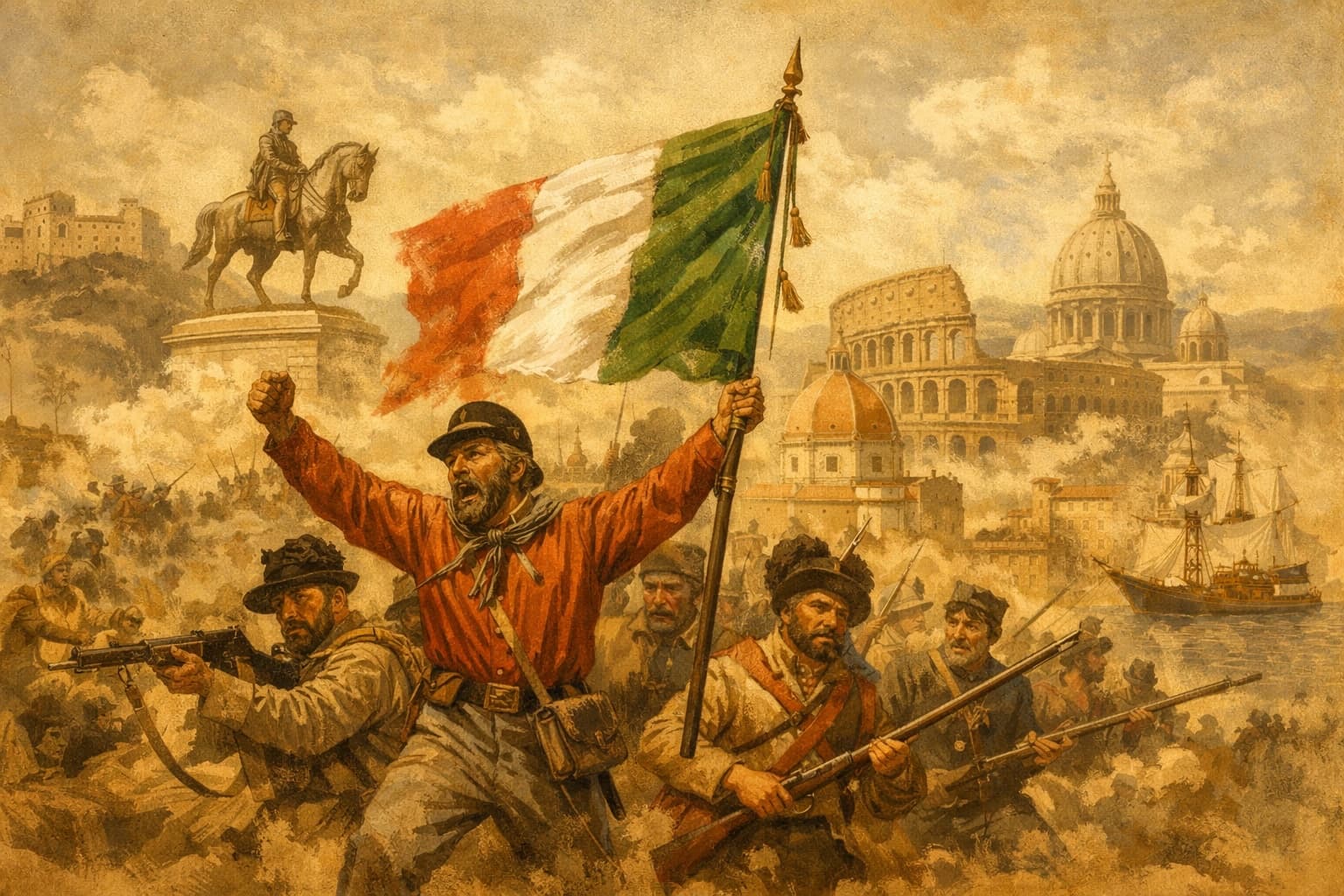
Giuseppe Garibaldi was the warrior. Born in Nice — which at the time was part of the Kingdom of Sardinia — he was a sailor, revolutionary, mercenary in South America, and finally the most legendary general of the Risorgimento. What made Garibaldi extraordinary was not only his personal courage — though it was considerable — but his ability to inspire others. Men without military training followed Garibaldi because he transmitted absolute conviction. He fought in Uruguay and Brazil before returning to Italy. He wore his famous red shirt, which became the symbol of his volunteers.
Garibaldi was a man of action with little patience for politics. He despised diplomatic compromises, chancellery maneuvers, drawing-room negotiations. He wanted Mazzini's republican Italy, but he was pragmatic enough to eventually put himself at the service of the King of Sardinia when he became convinced it was the only way to achieve unification.
Camillo di Cavour was the politician. Prime Minister of the Kingdom of Sardinia from 1852, he was the architect of the actual unification, the man who converted the romantic ideas of the Risorgimento into concrete policy. He was liberal, pragmatic, an admirer of the English constitution, and an exceptional negotiator. He understood that Italy could not unify without the support of some foreign power to counterbalance Austria, and he spent years cultivating the alliance with France and Napoleon III.
Cavour and Garibaldi detested each other. One was the man of the desk, the encrypted telegrams, the secret agreements. The other was the man of the battlefield and the dramatic proclamation. But the Italian unification needed both: without the popular legitimacy that Garibaldi's people's army provided, Cavour would not have had the social base to build the state. Without Cavour's diplomatic architecture, Garibaldi's victories would not have survived the reaction of the European powers.
Italian unification required simultaneously an ideologist who would never yield, a warrior who acted without asking permission, and a politician who knew when to sell that warrior's birthplace in exchange for the allies needed to win. All three together were unstoppable.
1848: The Year That Almost Changed Everything and Changed Nothing
The year 1848 was the year of revolutions across Europe. In Italy, the revolutionary wave was especially strong. In Milan, citizens rose against the Austrians in the Five Days of Milan — five days of urban combat in March 1848 that forced the Austrian army to withdraw from the city. In Venice, a republic was proclaimed. In Rome, the Pope fled and Mazzini and Garibaldi established a Roman Republic that lasted several months.
King Charles Albert of Sardinia declared war on Austria. For a moment, it seemed possible. But the Austrian army regrouped, found a competent general in Marshal Radetzky — who was over eighty years old at the time but was still a formidable military mind — and crushed the Piedmontese army at the battles of Custoza and Novara. Charles Albert abdicated in favor of his son, Victor Emmanuel II.
The Italian 1848 ended in total defeat. But it planted something important: it showed that Italians were capable of rising up, that the idea of unity had a real popular base, and that Austria was vulnerable. It also made clear that without foreign support, unification was impossible. That lesson was the one Cavour absorbed better than anyone.
Cavour Weaves the Alliance: The Road to the War of 1859
During the 1850s, Cavour worked methodically to prepare the Kingdom of Sardinia for the next attempt. He modernized the Piedmontese economy, built railways, reformed the army, partially secularized the state. He sent Piedmontese troops to Crimea — where Britain and France were fighting Russia — with no direct strategic interest, purely to earn a seat at the peace conference and raise the "Italian question" before the European powers. It was an investment of lives and money in diplomatic visibility. The cold logic of Realpolitik in its purest expression.
And above all, he cultivated his relationship with Napoleon III. In July 1858, Cavour and the French emperor met secretly at the spa town of Plombières, in the Vosges. What they agreed was a clear plan: France would provide military assistance to Sardinia in a war against Austria, in exchange for Sardinia ceding Nice and Savoy to France. If they won, the north of Italy would come into Sardinia's orbit.
The Plombières agreement was a landmark of Realpolitik. Cavour essentially sold Garibaldi's birthplace — Nice — to France to finance the unification war. When Garibaldi found out, he was furious. But Cavour's logic was relentless: without France, there was no war. Without war, there was no unification.
The war started in 1859. Napoleon III personally came to Italy at the head of his army. The battles of Magenta and Solferino were enormous Franco-Piedmontese victories. At Solferino, casualties in a single day exceeded 40,000 killed and wounded on both sides. A Swiss businessman who happened to be in the area, Henri Dunant, was so horrified by the suffering of the wounded left on the battlefield that some years later he founded the International Red Cross. The chaos of a war contributed, indirectly, to creating one of the most important humanitarian organizations in history.
Napoleon III then signed a surprise peace with Austria, without consulting Cavour. He ceded Lombardy to Sardinia, but not Venetia. Cavour resigned in fury. But the process he had set in motion could no longer be stopped.
Garibaldi and the Thousand: The Adventure No One Ordered
The most dramatic episode of the unification came in May 1860, and it was essentially a military adventure that no one in the government had officially authorized. Garibaldi, at the head of just over a thousand volunteers — the famous Mille, in their red shirts — landed in Sicily to overthrow the Bourbon Kingdom of the Two Sicilies.
What followed was one of the most extraordinary episodes of the nineteenth century. Garibaldi swept across Sicily as if the gods were on his side. The Bourbon troops, vastly outnumbering him in men and equipment, collapsed one after another. The Sicilian population, which had its own grievances against the Bourbons, massively supported the invaders. Within weeks, Palermo fell. Then he crossed to the mainland and pushed north. Naples fell. The most powerful kingdom on the Italian peninsula crumbled before a force of volunteers with old rifles and boundless enthusiasm.
At the historic meeting at Teano, Garibaldi greeted Victor Emmanuel by calling him "King of Italy" and handed over the conquered territories — without ceremony, without negotiation, with the same directness that defined him. Then he left for his island of Caprera, where he farmed and lived simply. He turned down honors, titles, money. He had done what he had to do and left. That gesture of personal detachment was what turned Garibaldi into an almost mythic figure, not just in Italy but across Europe.
Was the unification exactly what Garibaldi had wanted? No. He wanted a republic, not a monarchy. He wanted to liberate Rome. He wanted a democratic and socially just Italy. What he got was a constitutional kingdom dominated by Piedmontese elites. But what he got was also far more than had existed before.
Italy and Germany: Two Unifications, Two Models
It is no coincidence that Italian and German unification happened in practically the same historical period. Both are responses to the same question the nineteenth century posed to Europe: how to build modern nation-states on the fragmented legacy of the post-Napoleonic order? But the answers were very different and so were the results.
Bismarck unified Germany in 1866-1871 with brutal discipline and a political efficiency that the Risorgimento lacked in almost everything. Three quick, well-planned wars, the defeat of Austria and then France, the proclamation of the German Empire in the Hall of Mirrors at Versailles. Bismarck was a genius of Realpolitik — a term he himself popularized — who instrumentalized nationalism without letting it govern him. The result was a powerful, centralized, disciplined state that would become the dominant power of continental Europe within decades.
Italy was the opposite. The process was chaotic, improvised, full of contradictions. Garibaldi acted without orders. Diplomats ran behind events. Agreements were constantly renegotiated. The result was an institutionally weaker state with enormous structural problems — the southern question, the tension with the Church, the lack of real national identity — that would drag on for decades.
Both models arrived at the twentieth century with their characteristics amplified. Germany, with its strong state and militarism, produced Nazism. Italy, with its weak state and fragmented identities, produced Fascism as a desperate attempt to create the national cohesion that liberal unification had failed to achieve. The European twentieth century cannot be understood without understanding the unifications of the nineteenth century. The seeds of disaster were embedded in the earlier triumphs.
The Legacy: A Half-Built Nation
On March 17, 1861, parliament proclaimed Victor Emmanuel II King of Italy. Rome was still missing — it would not be incorporated until 1870 — and so was Venetia, annexed in 1866. But the basic structure was in place.
What remained was a profoundly unequal country. The south — the Mezzogiorno — never truly integrated with the developed north. Piedmontese elites governed a country they barely knew, applying laws and institutions designed for Piedmont to regions with completely different realities. The Sicily that Garibaldi had liberated soon discovered it had traded the Bourbons for the Piedmontese, and that the trade was not as beneficial as expected. Discontent in the south ran so deep that for years there was an informal civil war — what was called post-unification "banditry" — that was really popular resistance to the new order.
The Catholic Church was another enormous problem. Pope Pius IX, who had lost the Papal States, refused to recognize the new Italian state and forbade Catholics from participating in Italian politics — a prohibition that lasted until 1919. That tension between the Italian state and the Church defined Italian politics for decades, and was not formally resolved until the Lateran Pacts of 1929, signed between Mussolini and the Vatican. Italian Fascism, among its other wrongs, did manage to close that wound that liberal unification had not been able to heal.
The economic problem was equally deep. At the time of unification, the north of Italy — especially Piedmont and Lombardy — already had a respectable industrial and commercial base. The south was fundamentally agrarian, with a highly concentrated land tenure structure and levels of poverty that looked more like the Third World of the twentieth century than the Europe of the nineteenth. Unification did not narrow that gap: in many ways it deepened it, because the economic policies of the new state favored the industrialized north. The "Southern Question" — what to do about the impoverished south — became one of the central themes of Italian social thought. The socialist Antonio Gramsci, born in Sardinia in the late nineteenth century, built much of his political analysis on that reality of a country that was, in practice, two different countries under the same flag.
Garibaldi became an international symbol of the struggle for freedom: when he arrived in London in 1864, the crowd that came to receive him was so vast that the government had to ask him to leave ahead of schedule to prevent chaos. In Latin America, several cities bear his name. Abraham Lincoln offered him command of an army during the American Civil War — Garibaldi declined because Lincoln was not willing to commit to immediately abolishing slavery.
Italian opera, already a massive cultural force across Europe, became a vehicle for national feeling: Verdi, whose surname was used by patriots as an acronym for "Vittorio Emanuele Re D'Italia," composed works that moved audiences to tears across the continent. The Nabucco of 1842, with the chorus "Va pensiero," was interpreted as a lament of the Italian nation under foreign occupation. Popular culture carried the message where politics could not reach.
Mazzini died in 1872 without ever having been able to vote in the country he had spent his entire life trying to create. There is something of poetic justice and something of historical cruelty in that: the man who had dreamed most passionately of a unified Italy could not participate in it as a full citizen. The electoral laws of the new state excluded those who didn't pay certain taxes, and Mazzini — who had spent decades in exile without building a personal fortune — fell on the wrong side of that threshold. The prophet of the nation died outside the nation he built.
Cavour died in 1861, at fifty years old, just three months after the proclamation of the kingdom, without seeing Rome become Italy's capital. And D'Azeglio's phrase from the beginning — "we have made Italy; now we must make Italians" — remains one of the most honest descriptions of what it means to build a state. It is not enough to draw the borders. It is not enough to proclaim a nation. The hardest part is always what comes next: convincing people that the nation is worth it.
That task, which seemed titanic in 1861, never fully finished. Italy entered the twentieth century with its internal fractures visible, went through Fascism and World War II, rebuilt its democracy after 1945, and remains today a country where regional differences, distrust of central government, and the difficulty of building durable consensus are permanent features of the political landscape. The Risorgimento created Italy. Making Italians turned out to be the work of centuries.
Related episodes
In 1871, Paris experienced 72 days of radical rule; Versailles crushed him in Bloody Week. Ideas and violence that marked the modern left.
When Rome fell in 476, the Roman Empire kept on existing — for another thousand years, with its capital at Constantinople. That empire almost no one remembers was the bridge between the ancient and modern worlds, the guardian of the Greek texts that fu...
The Eiffel Tower wasn't Eiffel's idea, it was painted red, it was despised by France's greatest writers, and it came within years of being torn down. The man whose name it bears was facing fraud charges when it opened. This is the story of how the worl...