
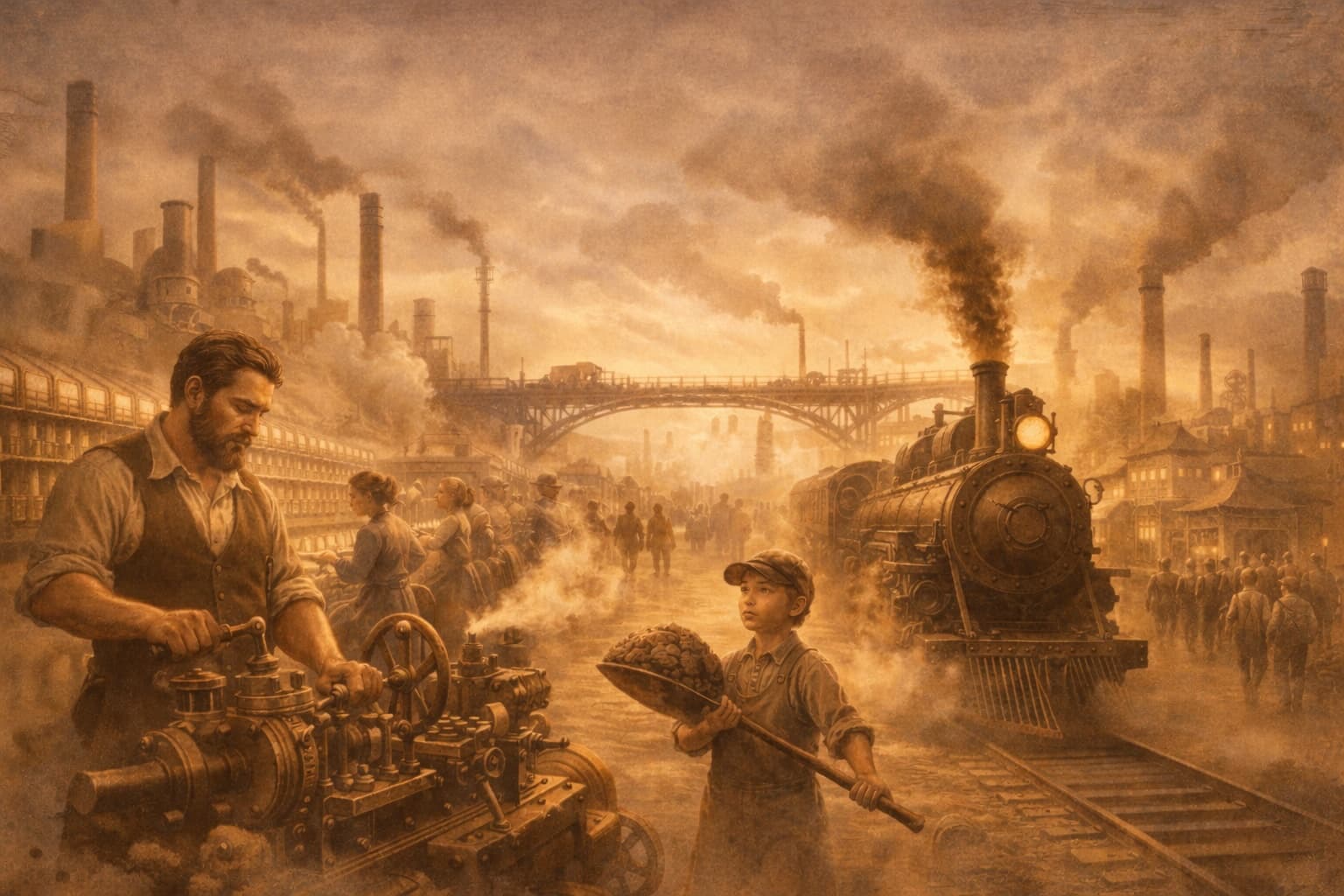
The Industrial Revolution
 Andres Aguilar
In a single century, humanity went from plowing fields by hand to powering factories with steam engines. It was the fastest transformation in the history of human labor — and it came at a brutal cost. Child workers in mines, cities drowning in smog, an...
In 1811, a group of English workers entered a textile factory in Nottingham under cover of night and destroyed everything in sight: looms, machines, tools. They weren't vandals. They acted with deep conviction: those machines were stealing their work, their dignity, and their future. They called themselves the Luddites, and claimed to follow the orders of a certain General Ned Ludd — a figure who in all likelihood never existed, a mythical name someone invented to give shape to a desperate resistance. The British government responded by sending more soldiers to protect the factories of Nottingham than it had deployed fighting Napoleon on the Iberian Peninsula. That tells you everything about what was happening.
To understand what the Industrial Revolution meant, you first have to understand the magnitude of what changed. We're not talking about gradual progress, about incremental improvement on what already existed. We're talking about a rupture. The difference between a world where available energy came from the muscles of people and animals, the wind, and flowing water, and a world where suddenly there were machines that could do in hours what used to take weeks. That leap has no equivalent in prior human history. Perhaps the only comparable moment is happening now, with artificial intelligence — and it's no coincidence that the debate today about whether machines will replace us is exactly the same one the Luddites were having in 1811.
The World Before Machines
To understand what the Industrial Revolution was, you first have to understand the world that existed before it. And that world was, in many respects, recognizable across centuries. It had barely changed.
The vast majority of people lived in the countryside. They worked the land, raised animals, made by hand what they needed. If you wanted a shirt, someone wove it on a hand loom. If you needed a horseshoe, the village blacksmith forged it piece by piece. The energy available was that of the human body, the horse, the wind filling a ship's sails or turning a windmill's blades. It was a slow, localized world where most people were born, lived, and died within a few miles of home.
The economy was what historians call preindustrial: small artisan workshops, hand production, local markets. There was long-distance trade, of course, but it was limited and expensive. Clothing was a luxury item for many. A pair of shoes might last decades because replacing them was a major expense. Cities existed, but they were the exception. London, the largest city in Western Europe, had around 600,000 inhabitants in 1700. By modern standards, a modest number.
What is most striking is the stability of the pace of life. The daily existence of an English peasant in the seventeenth century was not radically different from that of a peasant in the twelfth. The cycles of agriculture, the rhythms of manual work, the limits imposed by available energy: all of it had been more or less the same for centuries. There were small technical advances here and there — improvements to plows, new crops brought from the Americas, more efficient navigation techniques — but the fundamental model remained unchanged. The human being was the engine of the world, and human engines have very concrete limits.
That centuries-long stability is what makes the Industrial Revolution seem so abrupt. It wasn't, really: it took decades to fully unfold. But compared to the thousand years before it, it was a blink.
Why England, and Why Then
Here is a question historians have been debating for centuries: why did the Industrial Revolution begin in England, in the second half of the eighteenth century, and not in China — which already knew about coal and had great manufacturing traditions — or in the Italian city-states with their merchant wealth, or in the Netherlands with its advanced financial system?
The answer doesn't come down to a single factor. It was a combination of elements that aligned in a way that was unique and difficult to reproduce.
England had coal. Enormous quantities of it, near the surface and easy to transport because the deposits sat close to the sea or navigable rivers. That wasn't the case in other European countries, where moving coal overland made much of early industrialization economically unviable. Coal was the fuel of the first Industrial Revolution, and easy access to it was an enormous advantage.
England also had a particular political structure. Since the Glorious Revolution of 1688, the king's power had been limited by Parliament, dominated by an aristocracy and a merchant class that understood the value of protecting private property and contracts. Inventors could patent their ideas with reasonable confidence that no one would capriciously expropriate them. That legal guarantee was no minor detail: it incentivized investment in innovation in a way that didn't exist in the same form under French absolutism or in the fragmented German states.
There's a less obvious but fascinating factor that economist Robert Allen developed in detail: England had the highest wages in Western Europe. Paradoxically, the high cost of labor was one of the drivers of mechanization. If paying a worker is expensive, you have a powerful incentive to invent a machine that does the same job. English entrepreneurs felt that pressure more acutely than their continental competitors. It's a classic example of how concrete economic problems push technical innovation: it wasn't abstract brilliance, it was the practical need to cut costs.
Finally, there was a culture of practical curiosity deeply embedded in certain English circles. The Royal Society brought together scientists and craftsmen who mixed in ways unusual for the time. Theoretical knowledge and hands-on know-how were beginning to find each other, and from that combination came the inventions that changed the world. This wasn't an academy turned inward on itself: it was science looking directly at the workshop.
The Machine That Changed Everything
In 1769, a Scotsman named James Watt patented a fundamental improvement to the steam engine. The steam engine itself wasn't new: the Englishman Thomas Newcomen had built a working version in 1712 to pump water from coal mines. But it was extraordinarily inefficient — it consumed enormous amounts of coal to produce relatively little useful work.
Watt understood the problem. In Newcomen's design, the main cylinder was cooled and reheated on every cycle to condense the steam, a phenomenal waste of energy. His solution was brilliant in its simplicity: separate the space where steam was generated from a cooler cylinder where it condensed. That way the main cylinder stayed hot throughout, eliminating the cycle of cooling and reheating. The result was a machine that consumed four to five times less coal to do the same work. An extraordinary leap in efficiency.
But Watt didn't do it alone. He needed capital to develop his invention and found it in Matthew Boulton, a Birmingham entrepreneur with vision and money. The firm of Boulton and Watt became the first company in history to manufacture steam engines as a standard product: not one custom-built machine per client, but series production with interchangeable parts. That idea was itself revolutionary. The concept of interchangeable parts — manufacturing identical components that can replace each other — seems obvious today, but it was a tremendous conceptual transformation: the product no longer depended on the craftsman who made it, but on the standard design.
In 1781, Watt added the crank-and-flywheel mechanism that converted the back-and-forth motion of the piston into continuous rotation. Suddenly, the steam engine could drive any machinery that required rotation: looms, lathes, mills. It was no longer just a giant pump for the mines. It was the mechanical heart of a new way of producing. Energy was no longer scarce. For the first time in history, the amount of work that could be done in a day no longer depended on how many arms and legs were available.
The steam engine was not simply an invention: it was the first time human beings had access to an almost limitless, scalable source of energy. That leap, which seems technical, was really philosophical: it changed the fundamental relationship between human beings and work, and between human beings and nature.
The Textile Industry: Where It All First Exploded
The sector that first adopted the new technology on a massive scale was textiles, and here we encounter a figure who is pure novel material.
Richard Arkwright was a barber who became an entrepreneur. In 1769, the same year as Watt, he patented the water frame, a machine for spinning cotton that could be powered by water or steam. But his genius lay less in invention — there is evidence that he borrowed ideas from others without acknowledgment — than in organization. He was among the first to understand that a factory was not simply a large workshop: it was a system. A system with rules, schedules, hierarchies, and rhythms dictated by the machines.
Arkwright imposed factory discipline with a severity that would be illegal today: fines for arriving late, for talking during work, for opening windows at the wrong time. His workers, many of them women and children, started at five in the morning and finished well past eight at night. There was no concept of paid leave or accident compensation. If the machine caught your finger, that was your problem. Work no longer followed the rhythms of the sun or the seasons: it followed the rhythm of the machine, indifferent and constant.
His first factory in Cromford, Derbyshire, built in 1771, was the first modern textile factory in the world. By 1790 it employed nearly 5,000 people, and he was one of the richest men in England. A former barber with no university degree and no noble blood who had built an industrial empire from almost nothing. The Industrial Revolution was creating a type of wealth and a type of power that didn't depend on family lineage. That social change was as profound as the technological one.
Cotton production grew exponentially: between 1760 and 1800, British exports of cotton fabrics multiplied twentyfold. Twenty times over in forty years. And it was precisely that overwhelming success that drove traditional craftsmen to despair. A skilled hand-weaver who had spent years mastering his trade suddenly found himself competing with a machine operated by an untrained child. That loss of status and economic security was devastating. The Luddites were not mere vandals: they were desperate artisans watching their world disappear. And the government that crushed them with more soldiers than it had against Napoleon was the same government that had created the legal conditions for that world to be swept away.
The Iron That Gave the Revolution Its Skeleton
While cotton set the pace in textiles, a quieter revolution was underway in metallurgy. Abraham Darby was a Quaker ironmaster who in 1709 succeeded in smelting iron using processed mineral coal called coke, instead of traditional charcoal. It sounds like a minor technical detail, but it was enormous. English forests were being deforested at an alarming rate to produce charcoal. Coke was abundant, cheap, and allowed higher temperatures to be reached, improving the quality of the iron produced.
Cheap, abundant iron was the skeleton on which the rest of the Industrial Revolution was built. Machines were made of iron. Railway tracks were iron. Factory building beams were iron. Abraham Darby's grandson built in 1779 the world's first cast-iron bridge over the River Severn, in a place that is today called Ironbridge precisely for that reason. It was a technical marvel proving that this material could replace stone and wood in large-scale construction. That bridge still stands today and can be visited. It is a UNESCO World Heritage Site.
Decades later, iron would give way to steel — a far stronger and more versatile material — thanks to the Bessemer process developed in 1855. With steel came the second phase of industrialization: skyscrapers, longer-span bridges, ocean-crossing ships with metal hulls. Without that metallurgical revolution, the machine revolution would not have been possible. Steam needed iron to materialize into something useful.
The Railroad: When Time and Space Shrank
If there is one symbol of the Industrial Revolution that captures the imagination absolutely, it is the railroad. And the story of its birth has everything: a self-taught inventor, an epic competition, and a speed that left the world speechless.
George Stephenson was an engineer from northern England who had learned to read as an adult and developed an obsession with using steam engines to move vehicles on rails. In 1814 he built his first locomotive. He kept improving the design over the years, convinced that the future of transportation lay on rails and steam.
The defining moment came in 1829 with what became known as the Rainhill Trials. A passenger railway line was to be built between Liverpool and Manchester, and the organizers held a competition to choose the best locomotive. Stephenson entered the Rocket, built together with his son Robert: an elegant machine with a multi-tube boiler that generated steam far more efficiently than previous designs. In the trials, the Rocket reached 46 kilometers per hour. For perspective: the fastest racehorse could run at 60 or 70 kilometers per hour, but not over miles and not pulling heavy loads. The locomotive could.
The Liverpool-Manchester line opened in 1830 and was a resounding success that triggered the railway mania of the following decades: within twenty years, England had built thousands of kilometers of track that connected the country in unprecedented ways. Railways made it possible to move goods in volumes and at speeds that had been unthinkable, to open markets previously limited by logistics, and to allow people to travel in ways that transformed society entirely.
But the railroad changed something beyond transportation. It changed the very perception of time. Before, every city had its own local time zone calibrated to the sun. A difference of a few minutes between towns didn't matter because no one traveled fast enough for it to be an issue. With railway timetables that had to be coordinated on a national scale, that diversity of local times became an operational nightmare. Thus was born, literally, the need for a standard national time.
The concept of the standard time zone was a direct consequence of the railroad. Technology didn't just change how we moved: it changed how we understood space and time.
The Human Cost: The Revolution's Shadows
It would be dishonest to tell the story of the Industrial Revolution only as a tale of progress and technical wonder. It carried a brutal human cost, especially in its first decades.
Industrial cities grew at a speed that infrastructure could not absorb. Manchester, which had around 20,000 inhabitants in 1750, reached 300,000 by 1850. That breakneck growth produced appalling living conditions. Working-class neighborhoods were cramped rows of flimsy houses with no ventilation, no clean water, no systems for waste disposal. Cholera and typhus epidemics decimated the population regularly. In 1832, a cholera epidemic killed more than 50,000 people in Britain alone. Doctors didn't understand that it was a waterborne disease until 1854, when John Snow mapped cholera cases in London and traced them to a water pump on Broad Street. That finding was the starting point of modern epidemiology.
Work in the factories was exhausting and dangerous. Twelve-, fourteen-, and even sixteen-hour days were common. There were no guaranteed days off beyond Sunday. There was no accident compensation. There was no minimum working age: children of six and seven worked in factories and mines. In coal mines, the smallest children operated ventilation trap doors, sitting alone in the dark for hours, opening and closing them to allow air to circulate. They worked up to twelve hours a day in total darkness.
Friedrich Engels went to Manchester in 1842 as a representative of the family textile firm. What he saw marked him permanently. In 1845 he published The Condition of the Working Class in England, a book that documented in meticulous detail the living conditions in working-class neighborhoods. The average life expectancy of a manual laborer in Manchester at the time was less than thirty years. For the upper classes of the same city, more than double. Inequality was not just a matter of income: it was a matter of decades of life.
The political response was slow and painful. The dominant ideology was laissez-faire, the idea that the state should not interfere in the economy and that the free market would solve all problems. Any attempt to regulate working conditions was resisted as an attack on freedom. But gradually, in the face of the evidence of misery and the pressure of growing labor movements, protective legislation began to emerge. The Factory Act of 1833 prohibited the employment of children under nine in textile factories. It was little, but it was a start. The trade union movement kept growing despite being illegal for many years. Strikes were violently suppressed. Organizers were deported to the colonies. And still, the labor movement did not yield.
The Ideas That Were Born with the Smokestacks
The Industrial Revolution did not only change the economy and technology. It changed thought. It generated ideas that are still being fought over today.
Adam Smith published The Wealth of Nations in 1776, just as the Industrial Revolution was getting underway, and laid the foundations of liberal economic thought: free markets, the division of labor, the invisible hand that coordinates economic activity. His description of a pin factory, where the division of labor multiplies productivity in extraordinary ways, was prophetic of what was to come. Smith was not a blind defender of capitalism: his book also warns about the dangers of monopoly, the corruption of the system by merchants and industrialists, and the brutalizing effects of repetitive work on workers' intelligence. Those parts of Smith get cited far less than the ones about the invisible hand.
On the other side of the spectrum, Karl Marx spent decades in the British Museum in London studying the capitalist economy that industrialization had created. Capital, published in 1867, was a monumental attempt to understand the system's contradictions: the generation of colossal wealth on one side and the misery of workers on the other, labor turned into a commodity, the alienation of the producer from what they produce. Marx's ideas are the direct children of the Industrial Revolution: without the factories of Manchester and Birmingham, without the working-class neighborhoods Engels described, Capital would not have existed.
Trade unionism, social democracy, modern liberalism, socialism, anarchism, the welfare state: all these political currents are responses to the problems raised by industrialization. The debate over how to distribute the fruits of technological progress, over who should control the means of production, over the rights of workers, is a debate that was born in the English factories of the late eighteenth century and has not ended yet.
The Revolution Spreads: From England to the World
The Industrial Revolution did not stay in England. In the second half of the nineteenth century, Belgium, France, Germany, and the United States developed their own industrializations, each with its particular characteristics. Germany, which unified as a nation in 1871, leveraged a combination of state investment, a sophisticated technical education system, and access to the coal of the Ruhr to become the most dynamic industrial power in Europe by the end of the nineteenth century. By 1900, Germany had surpassed Britain in steel production. The United States, with its vast territory, natural resources, and massive immigration providing labor, became the world's largest industrial power at the start of the twentieth century.
The Second Industrial Revolution — the one driven by electricity, oil, chemistry, and the internal combustion engine — transformed the landscape from 1870 onward. Thomas Edison, Nikola Tesla, Werner von Siemens: the second generation of industrial inventors created the electric world we take for granted today. The light bulb, the telephone, the automobile, the airplane: all emerged from that second cycle of innovation. And by then, industrial logic had expanded on a global scale, with industrialized Europe and the United States consuming raw materials from colonial territories in Africa, Asia, and Latin America. The economic map of the world we know today was drawn to a large extent during that period.
The Legacy We Inhabit
Today, more than two centuries later, we still live in the world the Industrial Revolution created. The geographic distribution of wealth across the planet still reflects, to a significant degree, who industrialized first and who arrived late or not at all. The countries that led the first industrialization are still developed economies. The countries that remained as raw material suppliers for those industries still struggle to escape that structural position.
Argentina is a textbook case. At the end of the nineteenth century and the start of the twentieth, the country entered the global industrial economy as a supplier of meat and grain. It was a successful insertion by the standards of its time, but it left an economic structure of dependency that is still a central part of the Argentine political debate. The question of how to industrialize, how to add value to natural resources rather than exporting them raw, is a question that countries across Latin America have been trying to answer for more than a century.
Climate change, one of the great problems of the twenty-first century, has its direct origins in the Industrial Revolution. The mass burning of coal to power steam engines was the starting point for the accumulation of greenhouse gases in the atmosphere. We have been emitting carbon dioxide for 250 years as a consequence of that historical decision. The current climate crisis is not a twenty-first century problem: it is the accumulated bill of two and a half centuries of industrialization.
And the debate we are having today about artificial intelligence and automation, about whether algorithms will take the jobs of millions of people, is essentially the same debate the Luddites were having in 1811. Technology that destroys jobs and creates others, that generates wealth and inequality at the same time, that promises progress for all while leaving many behind: that tension is as old as the first steam engine. What history tells us is not that the Luddites were right or that they were wrong. It tells us that this tension is inherent to the process, that the costs of technological transformation are distributed very unevenly, and that deciding who absorbs them and who avoids them is a political decision, not only an economic one.
The most remarkable thing about this story is that it was nobody's plan. There was no lone genius who woke up one morning and decided to change the world. It was the accumulation of thousands of small decisions: inventions that solved concrete problems, entrepreneurs looking to make money, workers who resisted or adapted, politicians who took decades to understand what they were looking at. And from that disorderly mix came the modern world.
That should tell us something about how great historical changes work: they don't always arrive with fanfare. Sometimes they come in through the service entrance, in work clothes and smelling of coal. And by the time we see them coming, they've already changed everything.
Related episodes
In 1871, Paris experienced 72 days of radical rule; Versailles crushed him in Bloody Week. Ideas and violence that marked the modern left.
When Rome fell in 476, the Roman Empire kept on existing — for another thousand years, with its capital at Constantinople. That empire almost no one remembers was the bridge between the ancient and modern worlds, the guardian of the Greek texts that fu...

The Eiffel Tower wasn't Eiffel's idea, it was painted red, it was despised by France's greatest writers, and it came within years of being torn down. The man whose name it bears was facing fraud charges when it opened. This is the story of how the worl...