
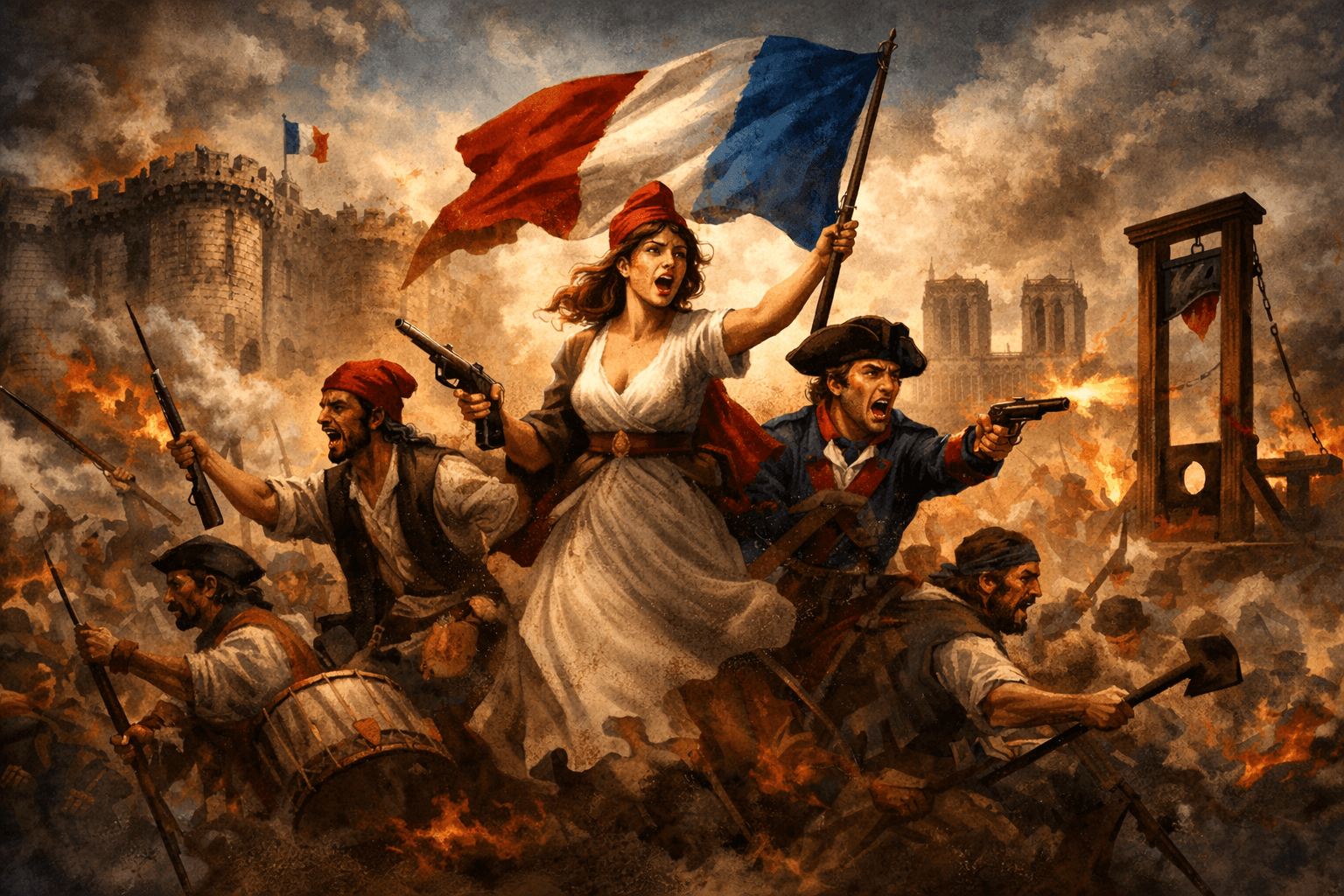
The French Revolution
 Andres Aguilar
It dismantled a thousand-year-old monarchy, gave the world its first modern constitution, and introduced the guillotine as a tool of equality. The French Revolution didn't just change France — it rewrote the political vocabulary of civilization. In thi...
If you had to choose a single event to understand how we got to the world we live in today, this would be it. Everything we take for granted about democracy, human rights, and equality before the law was born here, between fire and the guillotine.
France Before the Storm: A System Built to Collapse
To understand the French Revolution, you first have to understand the world that made it inevitable. It was not a sudden eruption or a historical accident. It was the logical consequence of decades — centuries, really — of a profoundly unjust political and social system, held together by a foundation that was crumbling beneath the weight of its own contradictions.
We are in France, in the late eighteenth century. The country was a mismanaged and deeply unequal state. Picture the scene: on one side, King Louis XVI living at Versailles, an enormous palace built to awe the world, where feasts and celebrations were a permanent fixture, while most French citizens had no bread. The king, it must be said, was not a wicked man in the traditional sense. He was simply a poor fit for the historical moment he had been handed. He was far more interested in locksmithing than in politics. He was not the leader a nation in crisis needed.
Meanwhile, his wife, Marie Antoinette — an Austrian princess sent to France as a symbol of political alliance — had become the perfect target for popular fury. She was accused of spending fortunes on gowns, jewels, and towering wigs. Her reputation was in ruins. The people called her "Madame Deficit." And there was that phrase she almost certainly never said: "Let them eat cake," supposedly her response upon learning that the people had no bread. The fact that the story was so widely believed, regardless of its truth, says everything about how the public perceived its monarchy.
On the other side were the people. And when we say the people, we mean 98% of France. Peasants who worked from dawn to dusk and could barely feed their families. Workers in the cities crammed into miserable conditions. Merchants and middle-class professionals were exhausted from bearing a crushing tax burden, while the nobility and the clergy paid absolutely nothing. Because that was how the system worked: the privileged were exempt. The entire fiscal weight fell on those who had the least.
And on top of this structural fracture, an economic crisis of enormous proportions had been building. France had funded the independence of the American colonies against England, and that venture had cost a fortune. The state treasury was depleted. Harvests had failed for several years running. Bread prices surged. People were literally dying of hunger in the streets. Imagine going to the market and finding that bread now costs twice what it did the week before, while your wages remain exactly the same. That was France in 1789\.
The Ideas That Set History in Motion
But hunger alone does not make a revolution. Ideas are also required. And the eighteenth century had produced them in abundance.
The Enlightenment, the intellectual movement that had swept across Europe for decades, had put radical concepts into circulation: that human beings are fundamentally equal in dignity, that political power must derive from the consent of the governed, and that institutions should be judged by their usefulness rather than their age. Philosophers like Voltaire, Rousseau, and Montesquieu wrote works that circulated widely, with people reading them in coffee houses and debating them in public squares.
Rousseau, in particular, had articulated the idea of the "social contract": the notion that government exists to serve the people, and that when it fails in that duty, the people have the right to change it. In another context, that idea might have remained confined to books. But in the France of 1789, with hunger in the streets and injustice in plain sight, those words became fuel.
The American independence of 1776 had also demonstrated that ideas could be made real. That people could overthrow a system of government and build another in its place. Many French soldiers and officers had fought in that war. They came back with more than military victories: they came back with the certainty that change was possible.
The Trigger: The Estates-General
Louis XVI tried to resolve the fiscal crisis by turning to his ministers, who told him it was impossible to continue without reforming the tax system. And to reform something of that magnitude, tradition dictated that the Estates-General had to be convened — a kind of representative assembly that had not met since 1614\. More than 170 years of institutional silence.
The Estates-General had three chambers: the First Estate represented the clergy, the Second Estate the nobility, and the Third Estate everyone else — that is, 98% of the population. But the voting system was a trap: votes were cast by Estate, not by head count. So even though the Third Estate represented the vast majority of French people, the other two Estates could always ally against them and block their proposals. It was an institutional design tailored to protect the privileged.
They convened in May 1789 at Versailles, and conflict broke out immediately. The Third Estate demanded that votes be counted by person, not by Estate. The nobility and clergy refused. Weeks of sterile debate followed. Then the Third Estate made a historic decision: in June 1789, they declared themselves the National Assembly, the legitimate representatives of the French people, and announced their intention to draft a constitution with or without the king's consent. It was an unprecedented challenge to the established order.
Louis XVI attempted to stop them by force: he locked the doors to their meeting hall. The response was immediate. The deputies marched to a nearby tennis court and there swore the Tennis Court Oath: they would not disperse until France had a constitution. It was the first moment in which the people formally stood their ground, in institutional terms, against the absolute power of the monarch.
July 14th: The Fall of the Bastille
The king wavered. At times, he seemed willing to negotiate; at others, he concentrated troops around Paris. Rumors of violent repression were multiplying. The tension in the capital had become unbearable.
And then came July 14, 1789\.
An enormous crowd marched on the Bastille, a fortress-prison that rose at the heart of Paris as a physical symbol of royal power. At the time, there were barely seven prisoners in its cells — that was beside the point. The Bastille was an emblem. And the crowd knew that gunpowder and ammunition were stored inside, weapons they needed against the threat of the king's troops.
They demanded the arms be handed over. The governor refused. Negotiations dragged on for hours amid mounting tension, until armed confrontation became inevitable. Dozens of people died. The crowd, furious and resolute, stormed the fortress. When they finally took it, the scene was brutal: the governor was captured and killed, and his head was paraded through the streets of Paris on a pike.
Is this a revolt?" Louis XVI asked when he was told what had happened. "No, sire," replied one of his nobles. "It is a revolution.
Only then did the king begin to grasp the magnitude of what was unfolding. But it was already too late. Power had begun to change hands.
July 14th is now France's national holiday. Not because that day was an orderly triumph or a clean act of justice, but because it was the moment the people proved they could act, that they could confront power and win. For all its violence, it marked a turning point that history would not reverse.
The Great Fear and the Abolition of Feudalism
The fall of the Bastille unleashed a wave of uprisings across the entire country. In the countryside, people experienced what historians call the Great Fear: a widespread panic fueled by rumors that gangs of brigands, hired by the nobility, were going to attack peasant communities. Whether or not the threat was real, its effect on the feudal order was devastating.
Peasants took up arms, stormed castles, and above all burned the records and documents that detailed the obligations they owed their lords. Centuries of servitude were reduced to ashes in a matter of weeks. It was violent, chaotic, and brutal — but it was also deeply real liberation.
The National Assembly responded with a historic gesture: during the night of August 4, 1789, in a session that lasted until dawn, the deputies abolished the feudal system. Overnight, birth privileges were eliminated. All citizens were equal before the law.
Days later, in August 1789, the Assembly passed the Declaration of the Rights of Man and of the Citizen. This document — which to this day forms part of the French legal order — proclaimed that all human beings are born free and equal in dignity and rights, that sovereignty resides in the nation, and that the purpose of all government is to preserve liberty, property, security, and resistance to oppression.
Reading those words today might seem obvious. In 1789, it was a conceptual revolution as significant as the political one.
The Women of Paris and the King's Return
Louis XVI resisted signing the decrees passed by the Assembly. He left them on his desk, unsigned, acting as though he could simply ignore them. The tension between the palace and the people continued to escalate.
In October 1789, something remarkable occurred — an event that often gets overshadowed by the grand moments of revolutionary history. Thousands of women marched from Paris to Versailles. Market sellers, housewives, working women — they walked more than twenty kilometers in the rain, armed with sticks, knives, and the fury of those who cannot feed their children. Their demand was concrete: bread, and that the king return to Paris, where the people could keep watch over him.
They arrived at the Palace of Versailles en masse, surrounded the building, and demanded to be heard. The situation grew critical: at one point, the crowd nearly broke into Marie Antoinette's chambers. The queen escaped by seconds.
In the end, Louis XVI yielded. The royal family was relocated to the Tuileries Palace in the center of the city. Technically, they were still the royal family. In practice, they were prisoners of the people.
The Flight, the Betrayal, and the End of Trust
Over the months that followed, the Assembly worked on drafting a constitution. The debates were intense. Political factions began to crystallize around increasingly defined positions: those who wanted a constitutional monarchy with a limited king, and those who wanted far deeper change — a republic. They sat on opposite sides of the assembly hall: moderates to the right, radicals to the left. Those two words, and everything they imply, come directly from that physical arrangement.
Among the radicals, one group stood out: the Jacobins. Their most prominent figure was Maximilien Robespierre, a provincial lawyer of absolute rigidity. He was incorruptible, austere, constitutionally incapable of accepting bribes. He spoke constantly of virtue and the republic. But that inflexibility, which initially appeared to be a strength, would later become something far darker.
In June 1791, Louis XVI committed the error that destroyed any remaining chance of political survival for the monarchy: he tried to flee. The royal family disguised themselves and set out toward Austria, where Marie Antoinette's relatives could offer them shelter and resources to restore royal power. But they were recognized in a small town called Varennes. They were stopped and escorted back to Paris.
The popular reaction was one of total outrage. The king had been exposed as precisely what many had always suspected: a traitor conspiring with foreign powers against his own country. From that point on, the constitutional monarchy that some had still been defending became politically indefensible.
War and Radicalization
In 1792, the conflict went international. Austria and Prussia were watching the Revolution with a mixture of horror and strategic calculation. The kings of Europe understood perfectly well that if the French people could remove their monarch, the example might spread. In April 1792, France declared war on Austria.
At first, things went badly for the French. The army was disorganized; many noble officers had emigrated when the Revolution began, taking with them years of experience and training. Austro-Prussian forces were advancing toward Paris.
It all began with the noblest of ideals: liberty, equality, fraternity. It ended with the guillotine working without pause, anonymous denunciations, and paranoia as a method of governance.
In July 1792, the commander of the Prussian army published a manifesto threatening Paris with total destruction if the royal family was harmed. It was the worst possible political miscalculation. Rather than terrifying Parisians into submission, it drove them to a point of no return.
On August 10, 1792, a massive crowd attacked the Tuileries Palace. The Swiss Guards who defended the building fought to the last: hundreds of them were killed. Louis XVI and his family barely escaped and sought refuge in the Assembly. The Assembly arrested them and sent them to prison. The monarchy had ceased to exist in any practical sense.
The Republic and the King's Trial
In September 1792, the National Convention convened, elected by universal male suffrage. It was the first time in history that all men — regardless of wealth or social status — could vote. Its first act was to abolish the monarchy and proclaim the Republic. The official calendar was reset to zero: Year I of the French Republic had begun.
The Convention then faced an uncomfortable and urgent question: what to do with Louis XVI?
The debate was intense and anguished. Some wanted him exiled; others wanted to keep him alive as a diplomatic guarantee. But investigators had found documents proving that the king had been passing information to France's enemies while publicly swearing loyalty to the constitution. It was treason in the strictest sense of the word.
He was tried before the Convention itself. The verdict was unanimous: guilty. The vote on sentencing was more dramatic — the death penalty won by a single vote.
On January 21, 1793, Louis XVI was executed by guillotine in the Place de la Révolution, before a crowd of thousands. According to contemporary accounts, he attempted to speak, but drums drowned out his voice. The blade fell. For the first time in more than a thousand years, France had no king. The rest of Europe stood in stunned silence.
The Terror: When the Revolution Devours Its Own
The consequences were immediate. England, Spain, Holland, and nearly all of Europe formed a coalition against France. It was the revolutionary nation against the continent. And inside the country, the situation was equally explosive: in the Vendée region, a royalist and Catholic uprising erupted into a brutal civil war.
The Convention responded with emergency measures. It created the Committee of Public Safety to coordinate national defense. It implemented mass conscription — all young men were required to serve. France transformed itself into a military machine without precedent in Western history.
But the price of that cohesion was the Terror.
To guarantee internal unity and eliminate "enemies of the Republic," Robespierre and the Jacobins began using the guillotine in a systematic and methodical way. The Law of Suspects of September 1793 established that anyone denounced as counterrevolutionary could be arrested and summarily tried. The presumption of innocence disappeared. A single accusation was enough to condemn a person.
Thousands were executed. Nobles and clergy, but also merchants, officials, and revolutionaries from the very first days of the uprising. The Girondins — the moderate wing of the Convention — were arrested and guillotined. Paranoia took over politics. Robespierre spoke of building a "Republic of Virtue," a new moral order for humanity. But he was building it with the executioner's axe.
Marie Antoinette was executed in October 1793\. Her trial was an exercise in public humiliation; the charges included accusations that history would later judge as deliberate fabrications. She was brought to the scaffold in a common cart, stripped of any marks of rank. By all accounts, she died with dignity — though that dignity brought her captors little comfort.
The Terror reached its height in the spring and summer of 1794\. The guillotine worked without pause. Even Georges Danton — one of the Revolution's most charismatic and celebrated leaders — fell victim to the very system he had helped create. His crime was calling for moderation, arguing that enough blood had been shed. He was arrested in April 1794 and executed weeks later.
The Fall of Robespierre and the End of the Terror
The final irony of Robespierre's story is that by systematically eliminating every rival and adversary, he left himself politically alone. And that solitude was his undoing.
The members of the Convention who had survived began to ask themselves: if he could destroy Danton, who could guarantee they would not be next? Fear — the very instrument the Terror had used to govern — changed direction. It no longer terrified the regime's enemies. It terrified the regime's own supporters.
On 9 Thermidor, Year II (July 27, 1794, by the traditional calendar), Robespierre arrived at the Convention expecting to deliver another of his speeches on republican virtue. Instead, he was accused, shouted down, and prevented from speaking. He was arrested along with his principal allies.
That night, he attempted to take his own life with a gunshot, but succeeded only in shattering his jaw. The following day, he was guillotined alongside twenty-one of his closest associates. The very mechanism he had used to eliminate his enemies destroyed him in the end. The Terror was over.
The reaction that followed — known as the Thermidorian Reaction — brought a collective exhale. Political prisoners were released, Jacobin clubs were shut down, and the official discourse was moderated. But the country was in ruins: the economy shattered, inflation out of control, the social fabric frayed by years of violence and mutual suspicion.
The Directory, Napoleon, and the End of a Cycle
In 1795, a new constitution created the Directory, a collective government of five directors designed to prevent power from concentrating in any single person. It was a compromise solution that never quite worked. The Directory was weak, deeply corrupt, and ineffective. It survived four years of permanent crisis.
Yet during those years, something remarkable was happening on the battlefields. The wars continued, but France had begun to win them. Mass conscription had created the largest army Europe had ever seen, and merit — not family name — determined who rose through the ranks. Young officers who demonstrated talent advanced with a speed that had been unthinkable under the old order.
One of those officers surpassed them all: Napoleon Bonaparte, a Corsican who was already a general at twenty-five, winning battles his superiors considered impossible. In Italy, in Egypt, wherever he was sent, he prevailed. He became the military hero France needed, and the name all of Europe feared.
In November 1799, Napoleon staged a coup. With his soldiers surrounding the building where the Directory was in session, he dissolved the government and established the Consulate, with himself as First Consul. The republican phase of the Revolution had ended.
But Napoleon did not simply erase what had been built. What he did was something more complex and more enduring: he consolidated the Revolution's achievements under his own personal authority. In 1804, he crowned himself Emperor — with the Pope present, though it was Napoleon himself who placed the crown on his own head, in a gesture laden with symbolism. But his power did not rest on divine right or lineage. It rested on merit, military victory, and popular support.
A Legacy That Reached Across the World
Napoleon's most enduring contribution to the world's legal history was the Civil Code of 1804, known as the Napoleonic Code. It was not an entirely original creation; it was a systematic organization of the most important ideas produced by the Revolution. But that systematization proved decisive.
The Code established that all citizens were equal before the law, that no privileges of birth existed, that private property was inviolable, and that contracts must be honored. It regulated marriage, inheritance, and civil liability. It was, in essence, the operating manual for a modern state.
And that Code was exported. The Napoleonic Wars carried French troops across the entire European continent, and in every territory they occupied, the new legal order was implemented. Countries that had never had a coherent modern legal system suddenly had one. What is remarkable is that when Napoleon was defeated and his Empire collapsed, many of those countries retained the Code or used it as the foundation for their own legislation.
France's reach extended far beyond Europe. Argentina, Chile, Colombia, and much of Latin America ended up building their legal systems on Napoleonic foundations. If you study law in those countries today, you are studying something whose roots reach directly back to the French Revolution.
Napoleon also consolidated other revolutionary reforms. He created the public education system. He founded universities and technical schools. He professionalized the state administration on the basis of merit — anyone with ability could advance, regardless of their family background.
He betrayed other ideals, of course. Freedom of the press disappeared. Democracy did too. The man who had benefited most from the openings created by the Revolution governed with an iron hand. But the structural transformations he produced — in law, in education, in administration — outlasted his fall and have remained with us ever since.
What Did It All Leave Behind?
The French Revolution changed the world in ways we have still not fully processed.
It destroyed feudalism as an economic and social system. It established the principle that all human beings possess rights that no government can take from them. It created the modern concept of citizenship — not the subject who obeys, but the citizen who participates. It demonstrated that people can change a political system, that power is neither eternal nor inevitable. It produced the political categories of left and right that structure democratic debate to this day. It directly influenced the independence movements of Latin America, the revolutions of the nineteenth century, and the liberal democracy of the contemporary world.
But it also demonstrated, with terrifying clarity, the dangers of revolutionary violence. The Terror killed tens of thousands. The wars it unleashed killed hundreds of thousands more. The Revolution began with the highest ideals humanity had ever articulated: liberté, égalité, fraternité. It produced the guillotine working without pause, anonymous denunciations, and paranoia as a method of governance.
Robespierre wanted to build a Republic of Virtue. He built a regime of terror. Danton died calling for an end to the violence. The moderate Girondins were executed for their moderation. Heroes became executioners, and executioners became victims of their own methods.
The French Revolution was all of that at once. It is not possible to take only one of its faces and leave the rest behind. The grandeur and the horror coexisted inseparably.
Why We Are Still Thinking About This More Than Two Hundred Years Later
Every time we debate the role of the state, the limits of power, or when it is legitimate to resist an unjust government, we are having conversations that began in the streets of Paris in 1789\. The terms of the debate — left and right, reform and revolution, liberty and equality, order and justice — were defined, in large part, during those turbulent years.
Reading about the French Revolution is not an exercise in historical nostalgia. It is understanding where the ideas that organize our political life, our rights, and our institutions actually come from. It is understood that nothing we take for granted was always so. That democracy, equality before the law, and the separation of powers are relatively recent achievements, built with enormous effort and, in many cases, with blood.
Ordinary people did extraordinary things. Heroes became villains. The noblest ideals coexisted with the most brutal cruelty. It was human, in all its complexity.
The French Revolution was chaotic, bloody, inspiring, and terrifying all at once. It was a demonstration of the best and the worst we are capable of when we decide the world can be different and choose to act on that belief.
That is why, more than two hundred years later, it still fascinates us. It still challenges us. It still has something to teach.
Related episodes
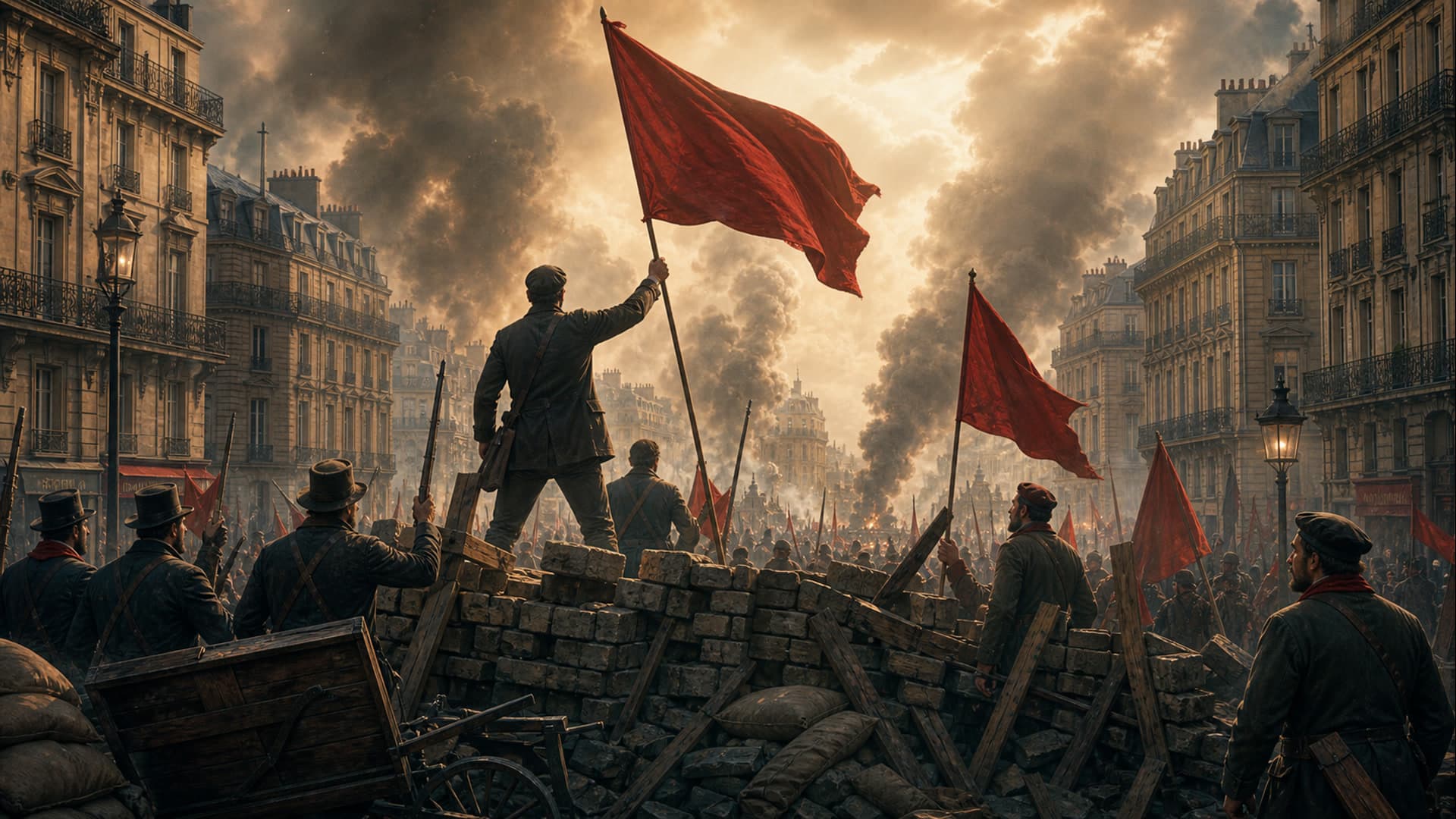
In 1871, Paris experienced 72 days of radical rule; Versailles crushed him in Bloody Week. Ideas and violence that marked the modern left.
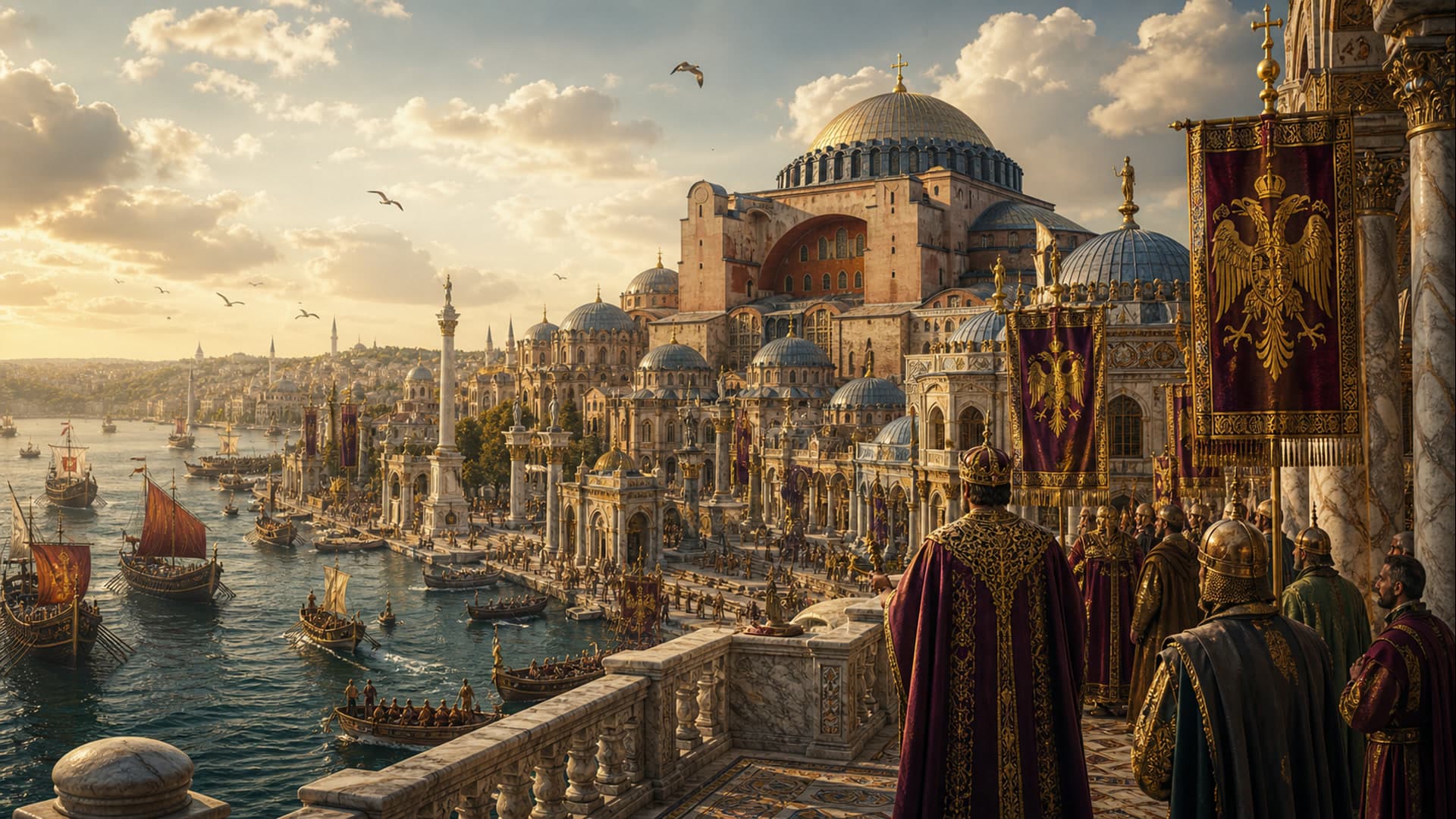
When Rome fell in 476, the Roman Empire kept on existing — for another thousand years, with its capital at Constantinople. That empire almost no one remembers was the bridge between the ancient and modern worlds, the guardian of the Greek texts that fu...
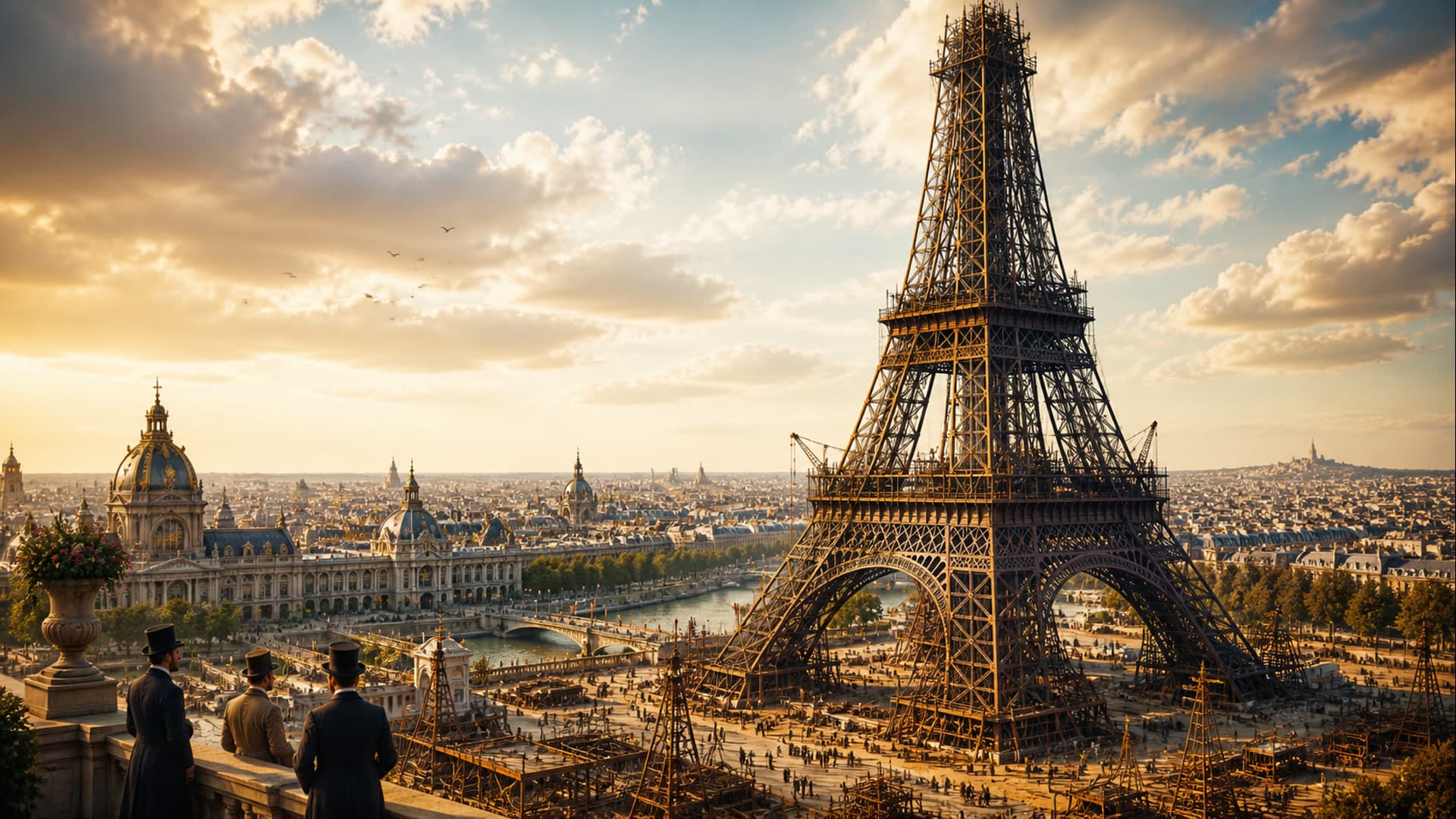
The Eiffel Tower wasn't Eiffel's idea, it was painted red, it was despised by France's greatest writers, and it came within years of being torn down. The man whose name it bears was facing fraud charges when it opened. This is the story of how the worl...