
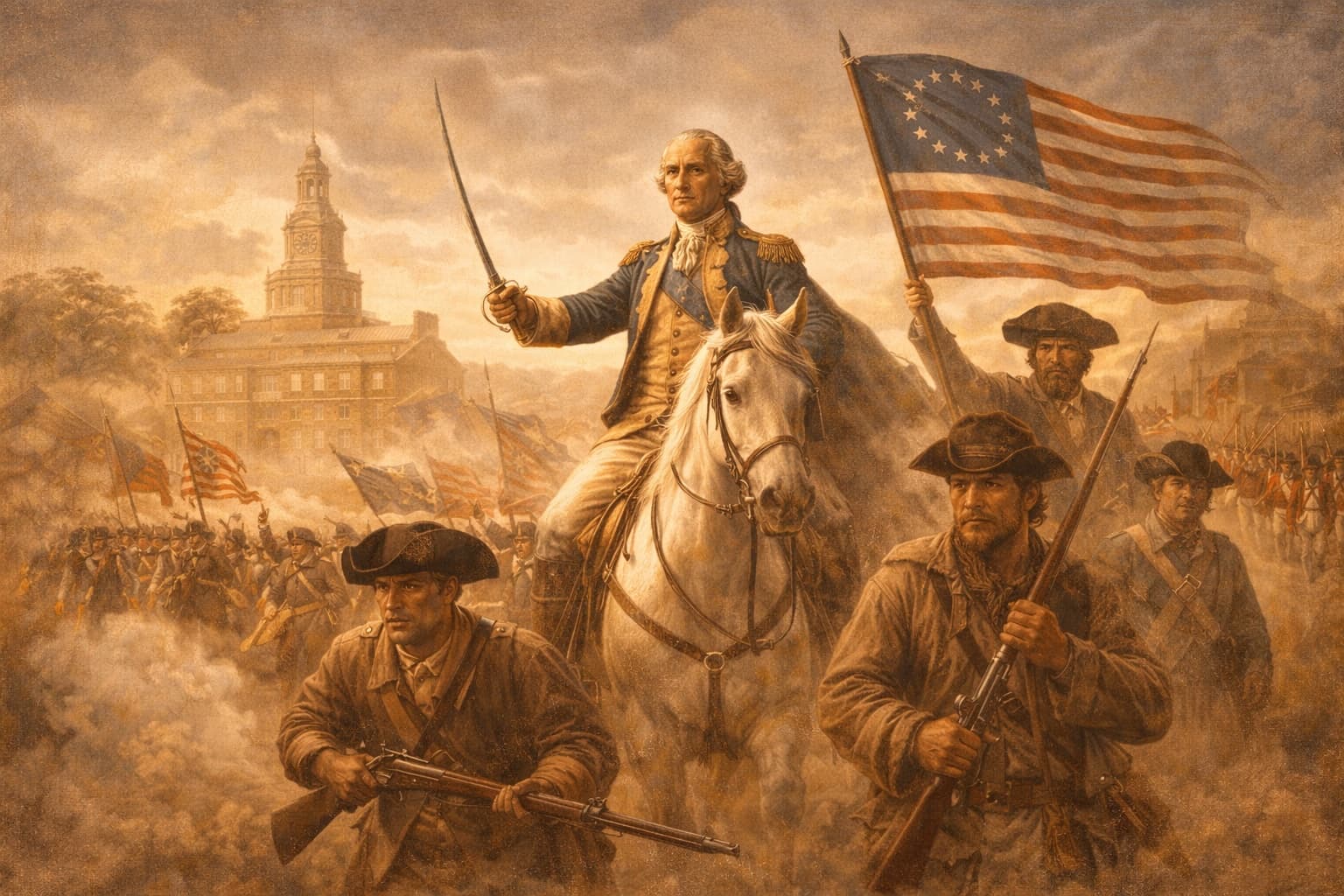
American Independence
 Andres Aguilar
When thirteen colonies declared independence from Britain in 1776, King George III wrote in his diary: 'Nothing of importance happened today.' That underestimation was possibly the most expensive mistake in the history of the British Empire. This episo...
On July 4, 1776, while delegates to the Continental Congress were signing the Declaration of Independence in Philadelphia, King George III of Great Britain wrote in his personal diary: "Nothing of importance happened today." He wasn't being ironic. He genuinely didn't think what was happening in his American colonies mattered. That underestimation was, perhaps, the most costly mistake in the history of the British Empire.
Today the Fourth of July is celebrated as one of the most important days in modern history. And rightly so: what happened in those colonies between 1763 and 1783 was not just another independence war. It was the first time a European colony broke away from its metropolis arguing philosophical principles about human rights and the social contract. It was the laboratory where ideas that would later shake the world were first tested: that governments derive their authority from the consent of the governed, that all men are created equal, that there are rights no government can take from anyone. Beautiful ideas, dangerous ideas — ideas that came packaged with an enormous hypocrisy that is also worth examining.
The Intellectual Soil: The Ideas That Made the Revolution Possible
Before talking about taxes and battles, you have to understand the intellectual soil in which the American Revolution grew. Because what the colonists did was not simply rebel against a tax they found unjust: they articulated that grievance in a philosophical language that had been developing for decades and transformed what could have been a revolt into a revolution.
The English philosopher John Locke, who wrote his Two Treatises of Government in 1689, was probably the most influential thinker in the formation of American colonial political thought. Locke argued that human beings have natural rights — to life, liberty, and property — that pre-exist any government and that no government can legitimately take away. The government exists to protect those rights, and if it fails in that mission, the people have the right to overthrow it. These ideas sat on the shelf of practically every educated man in the American colonies. Jefferson would distill them into the Declaration of Independence with an almost poetic precision.
The Baron de Montesquieu, the French jurist whose book The Spirit of the Laws appeared in 1748, contributed another key piece: the theory of the separation of powers. The idea that the executive, legislative, and judicial powers must be held in separate hands so that none of the three can become a tyranny was the architectural principle of the American Constitution of 1787. The Founding Fathers did not invent these ideas: they applied them. And in applying them, they created the first large-scale experiment in a modern liberal state.
Thomas Paine was the pamphleteer who brought those philosophical ideas to the people. His text Common Sense, published in January 1776, became the first bestseller in American history: more than 500,000 copies sold in a country of two and a half million inhabitants. Paine wrote in plain language, without the academic flourishes of Jefferson or Madison. He explained to the carpenter and the farmer why monarchy was an absurd system and why independence was not only possible but necessary. Without Paine, the intellectual process of the Enlightenment would have remained in the parlors of educated men. Paine took it to the street.
The World Before the Revolution: Prosperous Colonies, Accumulated Tensions
To understand American independence, you first have to understand what those thirteen colonies were. They were not poor, oppressed territories. By the mid-eighteenth century, they were prosperous communities with a solid rural and urban middle class, literacy rates higher than in many parts of Europe, and a tradition of local self-government that went back decades. Each colony had its own legislative assembly. The colonists were accustomed to running their own affairs.
And here is the key: that autonomy was not a gift from the British Crown. It was the result of decades of relative imperial neglect. Great Britain, during the first half of the eighteenth century, was too busy with its European wars to pay much attention to what was happening in America. The colonies grew, organized themselves, developed their own institutions, and when London finally wanted to exercise more control, it found a society that was no longer willing to accept it.
The turning point came with the Seven Years' War — known in America as the French and Indian War, 1754-1763. It was a global war, fought in Europe, in America, in India, in the Caribbean. Britain won it and took Canada and Florida, expelling the French from North America. But the war left the British treasury empty and gave London a new conviction: if the American colonies had benefited from that war — after all, the French and their Native American allies were no longer a threat — then the colonies should contribute to paying for it. That logic, which in the abstract doesn't sound unreasonable, was the spark that set everything ablaze.
Taxation Without Representation: The Cry That United a Continent
The British Parliament began passing a series of laws imposing taxes on the American colonies. The Stamp Act of 1765, which taxed all kinds of documents, newspapers, and printed materials. The Townshend Acts of 1767, which put tariffs on glass, paper, lead, and tea. For the colonists, these laws had a fundamental problem: they had no representatives in Parliament in London. They were being taxed by a body in which they had no voice.
"No taxation without representation" became the rallying cry. And here it's worth pausing, because this was not just an economic complaint. It was a first-rate philosophical claim. The idea that citizens could not be taxed without their consent came from Magna Carta in the thirteenth century — it was at the heart of the English legal tradition. The American colonists argued that by denying them representation, the Crown was violating its own founding principles. They weren't asking for something new: they were demanding that what the English tradition already recognized as their right be honored.
The resistance was organized and creative. American merchants agreed to boycott British goods. Colonial women wove their own cloth to avoid buying English fabric. Political action groups like the Sons of Liberty formed, combining intellectual debate with pressure in the streets.
The breaking point came on March 5, 1770, in what history knows as the Boston Massacre. A group of British soldiers, surrounded by a hostile crowd, opened fire and killed five colonists. The first to fall was Crispus Attucks, a man of African and Native American ancestry. Paul Revere engraved an illustration of the event that deliberately exaggerated the brutality of the soldiers and was circulated through all the colonies. It was, in modern terms, a social media campaign. And it worked.
Three years later came the Boston Tea Party. In December 1773, a group of colonists disguised as Mohawk Indians boarded three ships of the East India Company and threw 342 chests of tea into the water. The message was unmistakable. London's response was harsh: the Coercive Acts of 1774 closed the port of Boston, suspended the autonomous government of Massachusetts, and forced colonists to quarter British soldiers in their homes. These measures were designed to break the resistance. What they accomplished instead was to unify the colonies.
The Founding Fathers: Brilliant, Contradictory, Human
We need to talk about the people who led this process, because they are fascinating. They were not saints or textbook revolutionaries. They were men of their time, with their greatness and their flaws, and understanding them in their complexity makes the history far more interesting.
George Washington was a Virginia planter, owner of one of the largest plantations in the colony. He was also a slaveholder — he owned more than three hundred at one point. He was respected, serious, with a commanding physical presence. He was not the most brilliant orator nor the most original thinker, but he had something few leaders possess: the ability to hold an army together under desperate circumstances. What Washington did during the winters at Valley Forge was extraordinary. He kept the army alive through sheer will and political skill.
Thomas Jefferson was the principal author of the Declaration of Independence. The man who wrote that "all men are created equal and endowed with inalienable rights" was also the owner of more than six hundred enslaved people over his lifetime. With one of them, Sally Hemings, he fathered several children. Jefferson never freed them during his lifetime. This contradiction is not a minor detail: it is the heart of a founding hypocrisy that the United States is still reckoning with. The question of how a man so intelligent could write those words and at the same time own human beings has no simple answer. It has a historical answer: he lived in a society where that contradiction was so normalized that it could be invisible to those who benefited from it.
Benjamin Franklin was the oldest and perhaps the most brilliant of them all. At 70 years old he went to Paris as ambassador and convinced the French to enter the war on the American side. He was the shrewdest diplomat in the process. He was also an inventor, journalist, philosopher, and in his youth a character who could have filled several podcast episodes on his own.
Alexander Hamilton, the youngest among the major leaders, arrived from the West Indies without family or fortune. He became the architect of the American financial system, the first Secretary of the Treasury, and the man who most clearly understood what kind of state needed to be built. He was killed in a duel in 1804 by Aaron Burr, the sitting Vice President. Yes: the Vice President of the United States killed the former Secretary of the Treasury in a duel. American history has episodes that seem like fiction.
John Adams was the least likeable of the group and also the most honest with himself in his writings. He legally defended the British soldiers accused after the Boston Massacre, because he believed every accused person deserves legal representation, even though it cost him enormous popularity. He was the second President of the United States and spent much of his life in the shadow of Washington and Jefferson, which generated a frustration he made no effort to conceal in his letters. That brutal honesty, that lack of pose, arguably makes him the most interesting of the Founding Fathers for the modern reader.
What unites all these men, for all their differences and contradictions, is that they lived at an extraordinary moment and proved equal to that moment — at least on the political and intellectual plane. Their private lives, their moral compromises over slavery, their personal ambitions, tell another story. But the institutional architecture they designed turned out to be robust enough to survive civil wars, economic depressions, world wars, and constitutional crises for more than two centuries. That is no small achievement.
The War: David vs. Goliath, With a Lot of Help
The First Continental Congress met in 1774. The Second, in 1775, was already managing a war that had begun in April of that year with the clashes at Lexington and Concord. By the time the Declaration of Independence was signed in July 1776, the armed conflict had been going on for more than a year.
On paper, it was a war the Americans couldn't win. The British army was the most professional force in the world. The Royal Navy controlled the seas. The Continental Army was an amalgamation of state militias and untrained volunteers, chronically short of supplies, weapons, and above all money.
But the war was not won in pitched battles. It was won through strategy, time, and international alliances. Washington understood that he didn't need to defeat the British militarily; he needed to hold out long enough for the war to become too costly for London. He avoided the big engagements where he could lose everything, harassed, retreated, waited. It was a war of attrition that required enormous discipline from an army that constantly wanted to fight and constantly suffered defeats when it did.
The American victory at the Battle of Saratoga in 1777 was the decisive moment on the diplomatic front. General Horatio Gates, with the crucial support of the newly arrived Benedict Arnold — still a hero before his later betrayal — surrounded and forced the surrender of a British army of more than 6,000 men. It was the first major defeat of the British army in open battle, and it convinced France that the Americans could win. France recognized American independence and entered the war. Spain and the Netherlands followed. Suddenly Britain was not fighting only in America; it was fighting in the Atlantic, in the Mediterranean, in the Caribbean, in India. The final blow came at Yorktown, Virginia, in October 1781. Cornwallis surrendered. The war was effectively over.
Washington lost more battles than he won. What he never lost was the army. And keeping the army alive, in fighting condition, through years of defeats and hardship, was his real genius.
The War in the South and the Loyalists
There is an aspect of the American Revolution that epic narratives tend to leave out: not all the colonists wanted independence. It's estimated that roughly a third of the colonial population were "Loyalists," meaning they remained loyal to the British Crown. Another third were patriots. And the last third tried to stay neutral for as long as circumstances allowed. The revolution was not a unanimous movement: it was also, in many ways, a civil war.
In the South, this dimension was especially violent. North and South Carolina were the scene of a war within the war, where Loyalist and Patriot colonists clashed in small battles, ambushes, and reprisals that had very little of the heroism found in the grand historical portraits. The Loyalists who survived the war had to emigrate — many to Canada, where they founded communities that preserved their "loyal to the Crown" identity for generations.
After the war, the United States expelled or marginalized more than 60,000 Loyalists who emigrated to Canada, the Bahamas, and other British colonies. Their properties were confiscated. Their names were erased from patriotic narratives. The American Revolution was also that: the construction of a national story that decided who were the heroes and who were the traitors, who belonged to the new nation and who did not.
The Winter at Valley Forge: When Everything Almost Ended
There is an episode that rarely gets the attention it deserves and that captures better than any other what the American Revolution really was. In the winter of 1777-1778, the Continental Army camped at Valley Forge, Pennsylvania.
Washington had approximately twelve thousand soldiers when he arrived at Valley Forge. The winter was brutal. There weren't enough tents. Soldiers slept in wooden barracks they had built themselves. Food was scarce. Clothing was insufficient: there are records of soldiers standing guard in the snow without shoes, leaving tracks of blood on the frozen ground. Disease killed more than two thousand men over those months. Desertions were constant.
Washington wrote desperate letters to Congress asking for supplies. Congress had no money. Local merchants preferred to sell to the British army, which paid in sterling rather than in Continental dollars that were already depreciating. Meanwhile, the British army spent the winter comfortably in Philadelphia, barely thirty kilometers away.
Why didn't everything fall apart? Partly it was Washington, who through a combination of discipline, moral authority, and constant presence kept the soldiers at their posts. Partly it was Friedrich von Steuben, a Prussian officer who arrived at Valley Forge in February 1778 and within weeks transformed a group of undisciplined volunteers into something resembling a professional army. Von Steuben didn't speak English, but he had an interpreter, and his methods worked. When spring came, the Continental Army was a completely different fighting force from the one that had entered that camp in December.
The Constitution: Inventing a Country from Scratch
Winning the war was the easy part. The real challenge was building a functional state. The Articles of Confederation, the first governing document of the united states, proved too weak: each state was nearly sovereign, the central government could not collect taxes on its own, could not regulate commerce between states, and the system was such a mess that it left the new nation vulnerable to creditors and neighbors alike. Shays' Rebellion of 1786-1787, an uprising of indebted farmers in Massachusetts that the central government had no resources to put down, was the alarm bell that made the political elite understand the system needed urgent overhaul.
The Constitutional Convention of 1787 in Philadelphia was one of the most extraordinary exercises in political engineering in history. For four months, with the windows closed so that debates wouldn't leak to the street, delegates from the states debated the principles of the new government. The result was the Constitution of the United States, which with few amendments remains the fundamental law of the country more than two hundred and thirty years later.
The negotiations were hard. Large states wanted representation proportional to population. Small states wanted equal weight for all. The solution was a bicameral Congress: the House of Representatives based on population, the Senate with two senators per state regardless of size. The "Great Compromise."
There was another compromise with a less noble name and far longer-lasting consequences. The southern states insisted that enslaved people count as part of the population for calculating representation in the House. The solution was the three-fifths clause: an enslaved person counted as three-fifths of a person for census purposes. It was a way of giving more political power to slaveholding states without acknowledging the humanity of the enslaved. That structural compromise, which made the Constitution possible to sign, also meant that the problem of slavery was buried in the foundations of the new state. When that problem finally exploded, it did so in the form of civil war, eighty years later.
The Legacy: The Ideas That Changed the World, With Their Shadows
American independence had a global impact that is difficult to overstate. The French Revolution of 1789 is impossible to understand without the American example: the same philosophical principles, the same rhetoric of natural rights, the same idea that citizens can overthrow an illegitimate government. Lafayette, the French general who had fought alongside Washington, was one of the leaders of the French Revolution. Ideas traveled with people.
In Latin America, the impact arrived a few decades later. Simón Bolívar, José de San Martín, the leaders of the Latin American independence movements read the same philosophical texts that had inspired the North Americans. The Declaration of Independence, the writings of Jefferson and Madison, the American Constitution: they were reference texts for a generation of Spanish-speaking revolutionaries.
But the legacy has its shadows. The phrase "all men are created equal" explicitly excluded women, who would not have full political rights until 1920. It excluded African Americans, who would not be legally equal until the civil rights movement of the twentieth century. It excluded Native peoples, who would be displaced, massacred, and stripped of their lands in the decades and centuries that followed.
American independence was simultaneously one of the boldest and most promising political experiments in modern history, and one of the most hypocritical in its concrete applications. Both things are true at the same time, and the tension between them defines much of the political history of the United States to this day.
There is one detail that has always struck people about the story of the Founding Fathers. Thomas Jefferson and John Adams — who had been fierce political rivals for decades — died on the same day: July 4, 1826. Exactly fifty years after the signing of the Declaration of Independence. Adams's last words, according to tradition, were: "Thomas Jefferson still survives." He did not know that Jefferson had died hours earlier, in Virginia. That coincidence was interpreted in the time as a divine sign. Today we see it as one of those twists of history that seem too perfect to be real, and yet are. Two men who had devoted their entire lives to building something together, who had then spent decades fighting and drifting apart, who had written to each other again in their final years with a disarming frankness, dying on the same day that was the anniversary of the declaration they had both signed. History is rarely that elegant. And when it is, it's worth stopping for a moment to take it in.
There is also another dimension of the American legacy worth noting: the influence of that constitutional model on Latin American independence movements was enormous but selective. Creole leaders took the philosophical principles and the republican structure, but also inherited some of the contradictions. The Latin American republics of the nineteenth century proclaimed formal equality while maintaining structures of racial and social exclusion inherited from the colonial period. The gap between constitutional principles and social reality was — and in many cases remains — one of the great challenges of the region.
The American Revolution was not just the birth of a nation. It was the first large-scale practical test of whether the philosophical principles of the Enlightenment could be turned into government. It was the demonstration that it was possible to create a rational state, based on principles explicitly set out in writing, where power derived not from God or blood but from the consent of citizens. Before 1776, that was political theory. After 1787, it was a Constitution. That the social contract was not just an idea — it could be a founding document. That natural rights were not just words — they could be law. That all of this was done imperfectly, with enormous contradictions and costs distributed in deeply unjust ways, doesn't diminish the experiment. It adds the dimension that every true story has: that of human beings who are sometimes equal to their own ideals, and sometimes not.
Related episodes
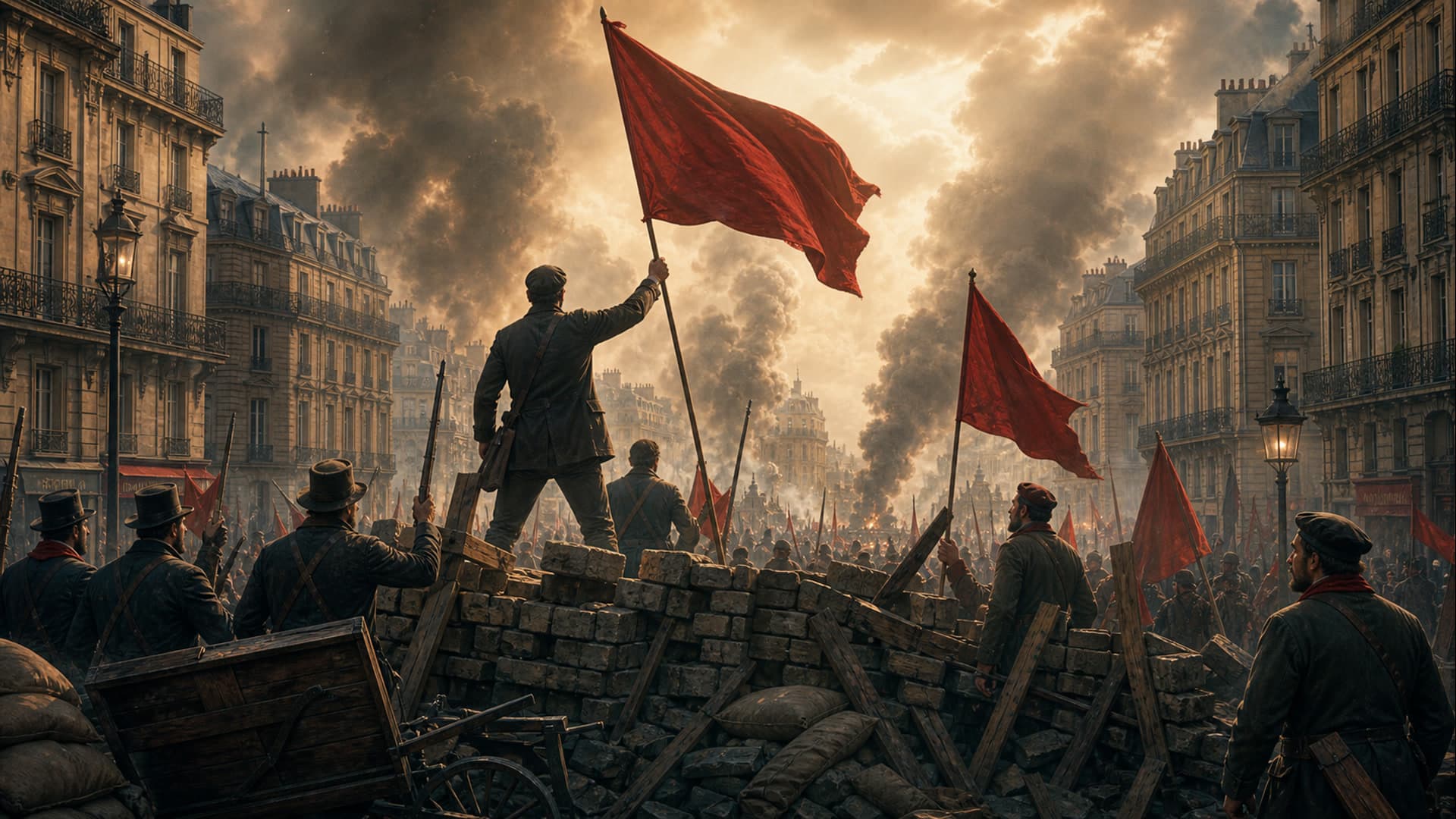
In 1871, Paris experienced 72 days of radical rule; Versailles crushed him in Bloody Week. Ideas and violence that marked the modern left.
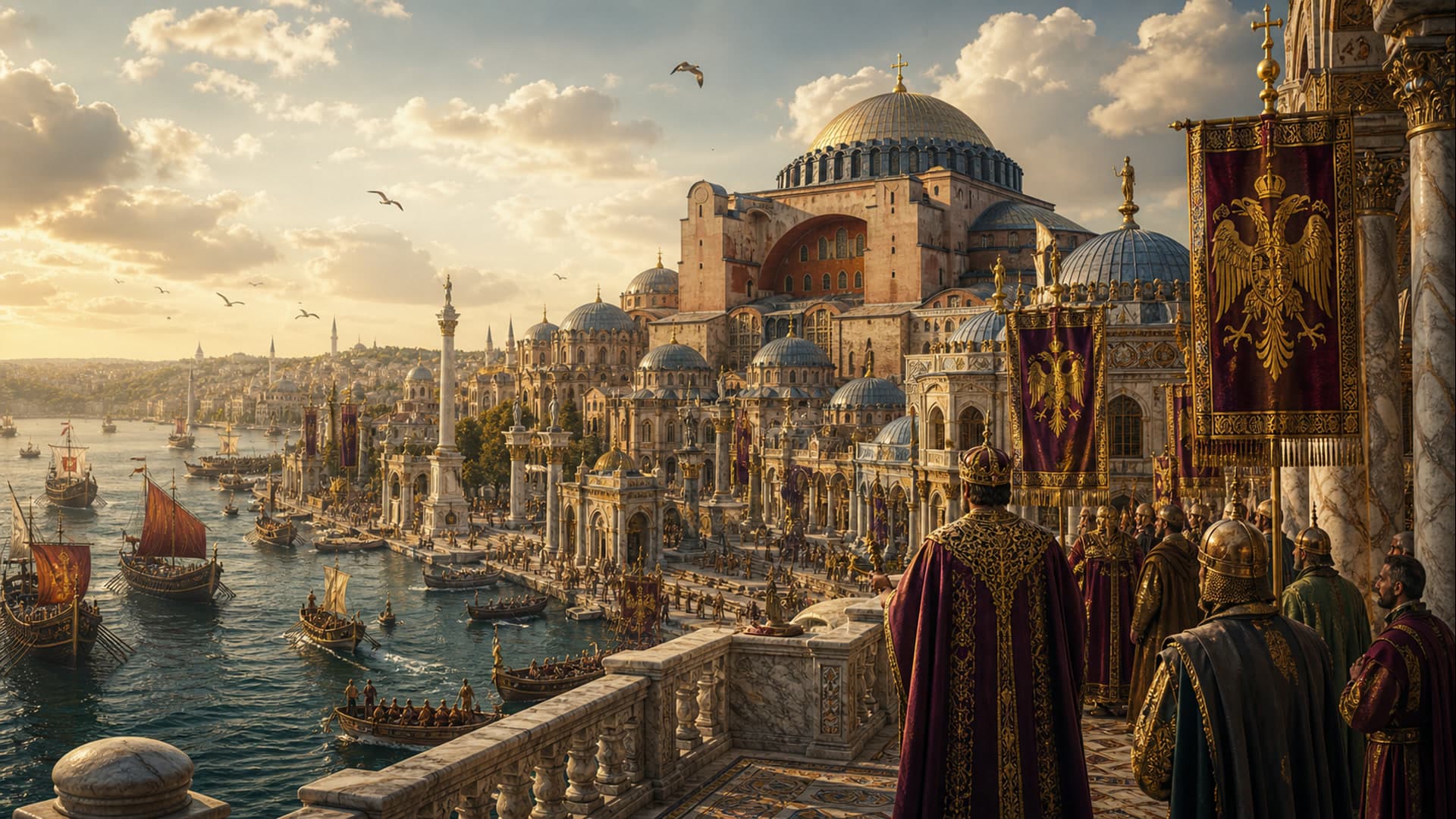
When Rome fell in 476, the Roman Empire kept on existing — for another thousand years, with its capital at Constantinople. That empire almost no one remembers was the bridge between the ancient and modern worlds, the guardian of the Greek texts that fu...

The Eiffel Tower wasn't Eiffel's idea, it was painted red, it was despised by France's greatest writers, and it came within years of being torn down. The man whose name it bears was facing fraud charges when it opened. This is the story of how the worl...