
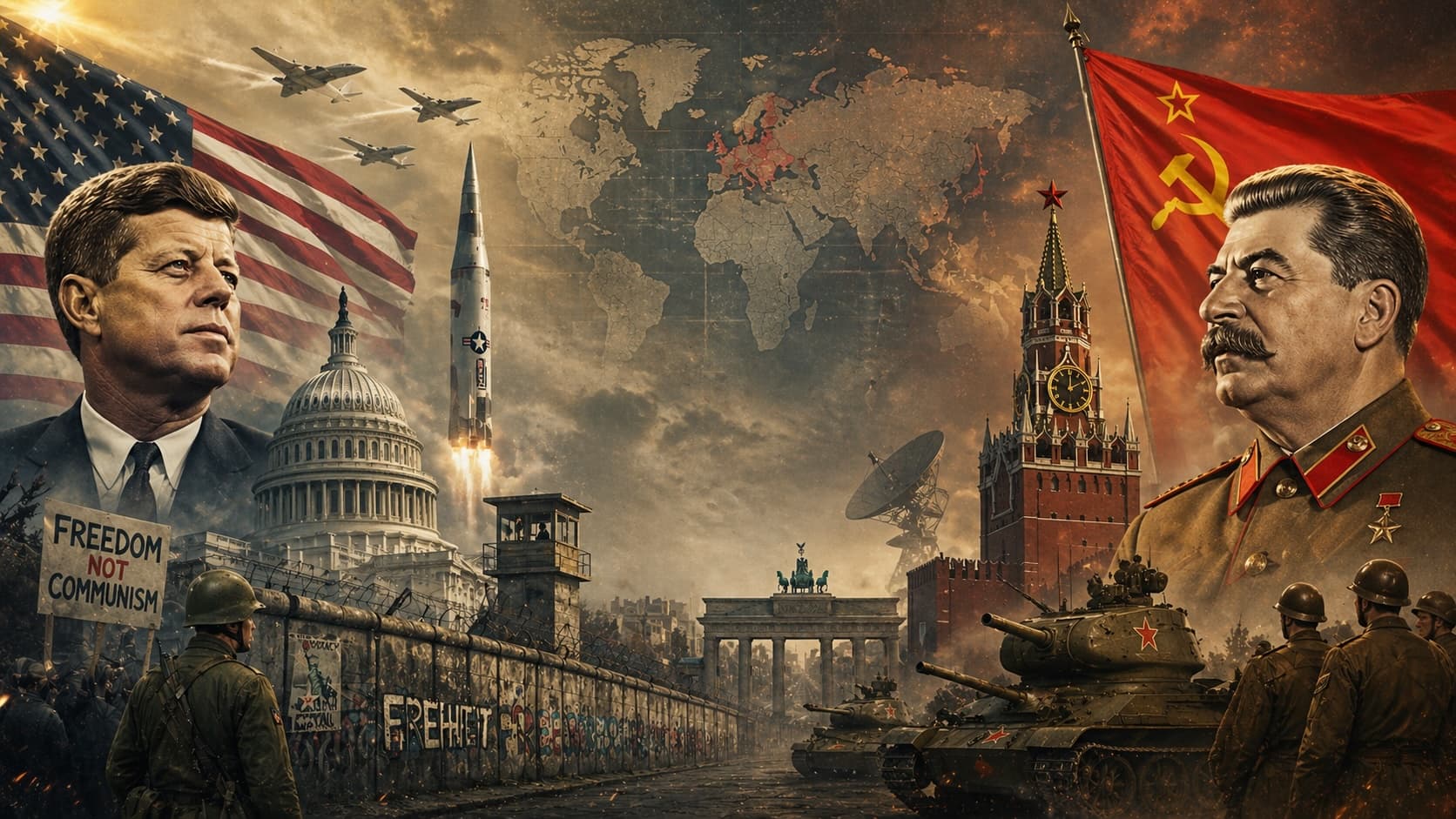
The Cold War
 Andres Aguilar
One night in 1983, a Soviet lieutenant colonel received an alert that five American nuclear missiles were incoming. He had minutes to decide. His choice changed history — and almost no one knew about it for fifteen years. That night captures everything...
He calculated that if the United States were really attacking, they'd send hundreds of missiles, not five. He bet it was a system malfunction. He was right.
The Iron Curtain was the perfect metaphor: a curtain that divided Europe into two blocs.
On September 26, 1983, in an underground bunker on the outskirts of Moscow, a Soviet lieutenant colonel named Stanislav Petrov was pulling his guard shift at the nuclear early-warning center. It was midnight. Tensions between the United States and the Soviet Union were at one of their highest points in decades — just three weeks earlier, the Soviets had shot down a South Korean civilian airliner that had strayed into their airspace, killing 269 people. The world was on edge.
And then Petrov's monitors lit up. The Soviet satellite system had detected the launch of five intercontinental ballistic missiles from American soil. Five nuclear missiles heading toward the Soviet Union. The protocol was clear: report the attack immediately so the Soviet retaliatory system could be activated before the missiles arrived. Petrov had minutes to decide.
And he decided not to report it. He calculated that if the United States really wanted to attack, they'd send hundreds of missiles — not five. He bet it was a system malfunction. He was right. It was a technical glitch caused by sunlight reflecting off clouds. If Petrov had followed protocol, the Soviet system would have launched automatic reprisals, and the world might have ended that night.
1945: Two Victors, One Deep Mutual Suspicion
To understand the Cold War, you have to start at the end of World War II, in 1945. If you listened to episode 34, you know that conflict destroyed Europe, killed tens of millions of people, and reshaped the map of the world. When it ended, two superpowers remained standing: the United States and the Soviet Union. Two giants. Two opposing systems. And a planet to divide between them.
The United States emerged from the war as the most powerful economy in the world. Its territory had never been attacked. Its industry was intact — even strengthened by the war effort. They had the atomic bomb. And they had an ideology: liberal capitalism, representative democracy, the free market. The idea that the individual had rights no state could take away.
The Soviet Union was the opposite in almost every way. It had suffered brutal destruction during the war: twenty million dead, cities razed, an economy in ruins. But the Red Army was the largest in the world. And it had its own ideology: communism — the idea that private property was the root of all social ills, that the state must control the means of production to guarantee equality. Under Stalin, that had become a dictatorship of monumental terror, but the idea still held appeal in many parts of the world, especially among the poor and those who had suffered under colonialism.
The problem was that these two powers — which had been allies against Hitler — now profoundly distrusted each other. The Soviets believed the capitalists had wanted to destroy them from the very beginning. Americans saw communism as a global threat spreading like a disease. The suspicion was mutual and deep.
And Europe was caught in the middle — destroyed, starving, and ready to be influenced by whoever put money on the table first.
The division began almost immediately. At the Yalta Conference in February 1945, Franklin Roosevelt, Winston Churchill, and Stalin had met to plan postwar Europe. Stalin promised free elections in the Eastern European countries that the Red Army had liberated from the Nazis. Those elections never happened. Instead, Stalin installed puppet communist governments in Poland, Czechoslovakia, Hungary, Romania, Bulgaria, and the zone of Germany he was assigned to administer. Churchill, during that conference, had scrawled an informal equation on a piece of paper: give me 90 percent of Romania and Bulgaria, 50 percent of Yugoslavia. Realpolitik — politics based on raw power rather than principles — worked the same way for everyone.
In 1946, Churchill delivered a speech in Fulton, Missouri. He was already out of power in Britain, but he was still the most respected voice in the West. And he said something that became one of the most quoted phrases of the twentieth century: from Stettin in the Baltic to Trieste in the Adriatic, an iron curtain has descended across the continent. The Iron Curtain was the perfect metaphor: a curtain dividing Europe into two blocs. To the west, the capitalist democracies. To the east, the communist regimes under Soviet orbit.
President Harry Truman responded with what became known as the Truman Doctrine, in 1947. The premise was simple: wherever a government was threatened by communism, the United States would help it. It didn't matter whether that government was democratic or not. The priority was containing communism. And that word — containment — became the backbone of American foreign policy for decades.
At the same time, Truman launched the Marshall Plan — a brilliant idea: the United States would invest billions of dollars to rebuild the shattered economies of Western Europe. West Germany, France, Britain, Italy, the Netherlands — all received massive aid. The logic had two layers. For one thing, a prosperous Europe was less vulnerable to communism: people who have jobs and a future don't vote for revolutions. For another, a prosperous Europe bought American products. Altruism and economic self-interest went hand in hand, as they so often do in history.
The Soviet Union rejected the Marshall Plan and pressured its satellite states to reject it too. Stalin distrusted American generosity and saw it as a form of ideological infiltration.
The first major concrete conflict came in 1948 with the Berlin Blockade. The city of Berlin had been divided into four sectors — American, French, British, and Soviet — even though it sat physically inside Soviet-controlled Germany. Stalin decided to block all land access to the western sectors of Berlin. The plan was to strangle the city until the Western powers gave up and ceded it.
The United States responded with the Berlin Airlift. For eleven months, Allied planes landed in West Berlin on average every ninety seconds, carrying food, fuel, medicine, and even coal. It was an extraordinary logistical operation — at its peak, they were delivering eight thousand tons of supplies per day. West Berliners experienced it as a symbol of resistance. Stalin lifted the blockade in May 1949, conceding failure. Berlin would remain an open wound at the heart of Europe.
In September 1949, the world changed in a way that terrified the West: the Soviet Union detonated its first atomic bomb. The American nuclear monopoly had lasted less than four years. Now both superpowers had weapons capable of destroying entire cities. The arms race entered a new phase that might be called the logic of mutual horror: if one attacks, the other destroys the attacker. Nobody wins. The threat of total annihilation becomes the deterrent against total annihilation.
A few months later, in October 1949, came another shock: Mao Zedong proclaimed the People's Republic of China. The most populous country in the world had gone communist. From Washington's perspective, the world seemed to be falling like dominoes.
The Cold War took its first hot form on the Korean Peninsula in 1950. At the end of World War II, Korea had been divided at the 38th parallel: the north under Soviet influence, the south under American protection. In June 1950, the North Korean army, backed by the Soviets and the Chinese, crossed the parallel and attacked the south. The United States, under the UN umbrella, responded with force. General Douglas MacArthur commanded the Allied troops, and for months the front line moved up and down the entire peninsula. When MacArthur wanted to take the war into Chinese territory and suggested using nuclear weapons, Truman fired him — it was an escalation that could have triggered World War III.
The Korean War ended in 1953 with an armistice that basically left things as they were: the 38th parallel as the border, two Koreas. A conflict that cost more than three million lives and ended right where it had started. North and South Korea remain divided to this day.
MAD: The Rational "Madness" of Nuclear Balance
Here's a good moment to explain one of the key concepts of the Cold War: Mutually Assured Destruction. The American strategists gave it the acronym MAD — which, of course, also means "crazy" in English, and they were aware of the irony. The logic was that if either superpower launched a nuclear attack, the other retained enough capability to deliver a devastating second strike. Both would be destroyed. Therefore, neither would attack. Security rested on the mutual threat of extinction. It was a perfectly rational kind of madness.
> Security rested on the mutual threat of extinction. It was a perfectly rational kind of madness.
Sputnik, the Space Race, and Missiles in Cuba
In 1957, the space race began — which we cover in detail in episode 27. When the Soviet Union launched Sputnik, the first artificial satellite in history, Americans panicked. A rocket that could put a satellite in orbit could also deliver a nuclear bomb to any point on the planet.
Cuba 1962: Thirteen Days on the Brink
But the most intense moment of the entire Cold War came in October 1962, with the Cuban Missile Crisis. If you listened to episode 36 on the Cuban Revolution, you'll remember that Fidel Castro had overthrown dictator Batista in 1959. The Kennedy administration tried to topple Castro in the Bay of Pigs invasion in 1961 — a humiliating failure for the United States. In response and for protection, Castro drew closer to the Soviets. And Soviet Premier Nikita Khrushchev decided to install nuclear missiles in Cuba, just ninety miles from the coast of Florida.
American spy planes photographed the installations under construction. Kennedy found out on October 16, 1962. He had thirteen days to resolve the crisis before the missiles became operational.
Those thirteen days are perhaps the most dangerous period in all of modern history. Kennedy wanted to avoid war but couldn't allow Soviet nuclear missiles ninety miles from his country. He declared a "quarantine" — a euphemism for a naval blockade — of Cuba and demanded the missiles be withdrawn. Khrushchev responded with public toughness but was quietly looking for a way out.
What followed is one of the greatest case studies in crisis management in history. Kennedy and Khrushchev negotiated in secret through intermediaries. The deal was double-sided: the Soviets would remove their missiles from Cuba, and the United States would promise not to invade Cuba and — secretly — remove its own missiles from Turkey, which were pointed at the Soviet Union. Both leaders gave something up. Both were able to present it at home as a victory.
Soviet submarine B-59 deserves special mention. During the most tense days of the crisis, this nuclear submarine was trapped beneath the American naval blockade, out of contact with Moscow, being pounded by depth charges from American destroyers trying to force it to surface. The submarine's commander and political officer believed the war had already started and wanted to fire the nuclear torpedo they had on board. Only one man stopped them: flotilla commander Vasili Arkhipov, who refused to authorize the launch. All three senior officers had to agree. Arkhipov said no. And he quite possibly saved the world.
> Arkhipov said no. And he quite possibly saved the world.
Vietnam and the Domino Theory
Through the 1960s, the hot war was fought mainly in Vietnam. We cover that extensively in episode 9, but the Cold War context is central: the United States intervened in Vietnam to prevent it from falling to communism, applying the so-called Domino Theory — the idea that if one country went communist, its neighbors would follow like a row of falling dominoes. The Vietnam War proved that the world's most powerful superpower could lose a guerrilla war in the jungle against an enemy with far less technology but far more determination.
Détente, Afghanistan, and Reagan's Escalation
The 1970s brought what became known as Détente — a period of reduced tension between the two superpowers. Nixon, the most anti-communist president imaginable, traveled to China in 1972 and opened diplomatic relations with Mao's government — a brilliant move to drive a wedge between China and the Soviet Union. He also signed the first nuclear arms control agreements with Brezhnev, the Soviet leader: the SALT treaties, which placed limits on the number of ballistic missiles each side could have. It was an implicit admission that neither side could win the arms race and that some rules had to be established.
But détente came to an end in 1979. That year, two fundamental things happened. First, the Iranian Revolution overthrew the Shah of Iran — an American ally — and installed an anti-American Islamic theocracy. Second, and far more destabilizing for the world, the Soviet Union invaded Afghanistan to prop up a communist government that was being attacked by Islamic guerrilla groups. The United States responded by arming and funding the Afghan fighters resisting the Soviet invasion. Those fighters were called the Mujahideen, and among their ranks was a young Saudi man from a wealthy family named Osama bin Laden. The consequences of that sponsorship would become painfully clear twenty years later, on September 11, 2001.
The Second Escalation: "Evil Empire," Petrov Again, and Gorbachev
The 1980s brought the second most dangerous escalation of the Cold War, with Ronald Reagan in the White House. Reagan was ideologically anti-communist in a way that had gone out of fashion among diplomats. He called the Soviet Union the "Evil Empire." He massively increased the defense budget. He launched the Strategic Defense Initiative — dubbed "Star Wars" by the press — a project to create a missile shield in space. The Soviets didn't know whether it was technically feasible, but they couldn't afford not to respond to it. Military spending began to choke their economy.
It was in that context of maximum tension that the Stanislav Petrov incident we mentioned at the start took place. On September 26, 1983, war came closer to breaking out than most of the world knew for decades. Petrov received no medal. In fact, he received an official reprimand for not having properly filled out the alarm's paperwork. That, too, is history.
> Petrov received no medal. In fact, he received an official reprimand for not having properly filled out the alarm's paperwork. That, too, is history.
The Wall Falls and the USSR Dissolves
In 1985, Mikhail Gorbachev came to power in the Soviet Union. He was different from his predecessors: young, dynamic, aware that the Soviet system was in deep crisis. He launched two reforms that became famous even outside Russia. Glasnost — meaning "transparency" in Russian — sought to open the political system and allow criticism. Perestroika — meaning "restructuring" — sought to reform the Soviet economy. Together, those two reforms proved too much for a system that tolerated neither freedom nor economic efficiency. They started uncovering problems without being able to solve them.
The countries of the Eastern Bloc began to stir. In Poland, the Solidarity trade union, led by Lech Walesa — an electrician from the Gdansk shipyard — had been challenging the communist government for years. With Gorbachev's implicit backing, making clear he would not send in tanks as his predecessors had done, the communist regimes of Eastern Europe began falling one after another in 1989.
The most symbolic moment was the fall of the Berlin Wall. The Wall had been built in 1961 to stop East Germans from fleeing to the West. By the time it fell, it had divided Berlin for twenty-eight years. It was the most powerful physical symbol of the Cold War.
On November 9, 1989, the spokesman for East Germany's Communist Party announced at a press conference that citizens could cross the border freely. When asked when, the spokesman — not entirely sure what he was saying — replied: immediately, right now. Within hours, thousands of East Berliners gathered at the checkpoints. The guards, with no clear orders, let people through. And the crowd, in total euphoria, began tearing down the Wall with pickaxes and hammers.
One image that captures an entire era: twenty-eight years of division torn down in a night of spontaneous celebration.
The Soviet Union held on for two more years. In August 1991, a group of conservative conspirators attempted a coup to remove Gorbachev and halt the disintegration process. The coup failed because the military refused to support it, and because Boris Yeltsin — the leader of Russia — climbed on top of a tank in Moscow and called for civil resistance. It was one of the most cinematic moments in recent history.
On December 25, 1991, Gorbachev resigned as President of the Soviet Union. The red flag with the hammer and sickle was lowered from the Kremlin for the last time. The Soviet Union ceased to exist, and in its place fifteen new independent nations appeared. The largest and most significant was Russia.
The Cold War was over. Or so it seemed.
Legacies: Costs, Technology, and Tensions That Linger
The legacy of the Cold War is enormous and contradictory. On the costs side: the two blocs spent astronomical sums on nuclear weapons — funds that could have ended world hunger several times over. Dozens of wars in Asia, Africa, and Latin America were fueled by one bloc or the other in pursuit of their geopolitical interests. The coups in Guatemala, Chile, Brazil, Argentina, Indonesia, and the Congo had direct or indirect CIA support, all in the name of fighting communism. The price was paid by millions of people who had nothing to do with the dispute between Washington and Moscow.
On the side of positive legacies — and there are some: the competition between the two blocs drove extraordinary technological advances. The space race gave us satellites, GPS, the materials and electronics that are in every cell phone. The internet was born as an American military project to maintain communications in the event of a nuclear attack. The polio vaccine was developed in large part thanks to the massive public funding of the postwar era. The ideological competition also pushed capitalist countries to build stronger welfare states, because they needed to show that capitalism could give their people something better than what communism promised.
And the world after? The fall of the Soviet Union didn't bring the universal peace that some had imagined. Francis Fukuyama, an American political scientist, published a famous 1989 essay titled "The End of History," arguing that the triumph of liberal democracy was irreversible. Three decades later, that thesis looks pretty optimistic. Russia remains a power that challenges the Western order. China is communist politically and capitalist economically, and became the world's second-largest economy. The tensions of the Cold War mutated — but they didn't disappear.
Epilogue: Stanislav Petrov
The story of Stanislav Petrov, the man who didn't push the button in 1983, wasn't made public until 1998. He died in 2017 in relative anonymity. He never received any official recognition from the Russian government. But several Western countries gave him awards and honors. In 2014, he received the Dresden Peace Prize in Germany. A man who quite possibly saved civilization — living in a small apartment on the outskirts of Moscow.
That's what history looks like sometimes. The ones who truly change the world are the ones who decided to do nothing.
Related episodes
In 1871, Paris experienced 72 days of radical rule; Versailles crushed him in Bloody Week. Ideas and violence that marked the modern left.
When Rome fell in 476, the Roman Empire kept on existing — for another thousand years, with its capital at Constantinople. That empire almost no one remembers was the bridge between the ancient and modern worlds, the guardian of the Greek texts that fu...
The Eiffel Tower wasn't Eiffel's idea, it was painted red, it was despised by France's greatest writers, and it came within years of being torn down. The man whose name it bears was facing fraud charges when it opened. This is the story of how the worl...