
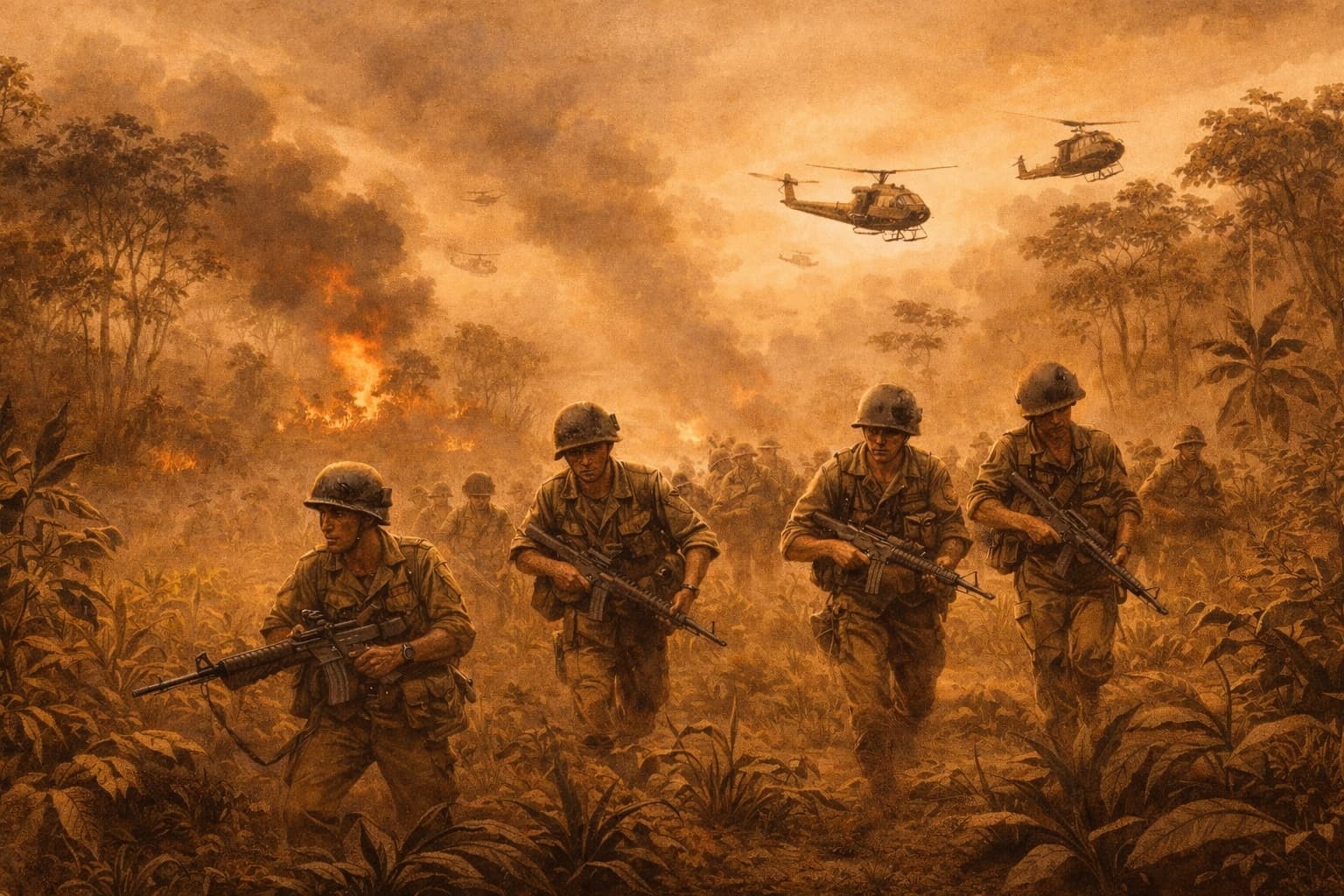
The Vietnam War
 Andres Aguilar
It lasted twenty years, killed up to three million Vietnamese and nearly 60,000 Americans, and was the first war to be broadcast live on television into the living rooms of the nation that started it. The Vietnam War began with a fabricated naval incid...
One of the longest, most documented, and most questioned wars in modern history began with a lie, was sustained by more lies, and ended with a chaotic evacuation that the entire world watched on television.
The Fire That Shook the World
On June 11, 1963, on a major avenue in Saigon, a 66-year-old Buddhist monk sat down in lotus position at an intersection. His companions doused him with fuel. He struck the match himself.
The flames engulfed him completely while he remained absolutely still, without making a single sound. AP photographer Malcolm Browne captured the image. Within hours, that photograph circled the globe and became one of the most powerful symbols of protest of the twentieth century.
That monk, Thích Quảng Đức, was not protesting against the United States. He was protesting against the puppet government the United States was propping up in South Vietnam: a corrupt, repressive regime led by a Catholic ruler who persecuted the Buddhist majority of his own country.
That image — brutal and devastating — was just the beginning of what would become the longest, most filmed, and most questioned war in American history. A conflict that left nearly sixty thousand Americans dead, between two and three million Vietnamese killed, and a national wound that took decades to even begin to heal.
To understand how it came to that, you have to go back quite a bit further.
Colonial Roots: Vietnam Before America
Vietnam was a French colony from the mid-nineteenth century. The French called it French Indochina and exploited it systematically for decades: rubber plantations, mining operations, rice monoculture for export. The same old colonial story.
During World War II, when the Japanese invaded Southeast Asia, they occupied Vietnam and displaced the French administration. It was in that power vacuum that the figure who would change the entire history of the country emerged: Ho Chi Minh.
Ho Chi Minh wasn't his real name. It was one of the many pseudonyms he used throughout his life. Born as Nguyen Sinh Cung in 1890, he had worked on ships, lived in Paris and in London, and spent time in Moscow. He converted to Marxism-Leninism, convinced that this ideology offered the most direct path to liberating colonized peoples. In 1941, during the Japanese occupation, he founded the Viet Minh — a resistance movement that fought against both the Japanese and any foreign power that aspired to dominate Vietnam.
When World War II ended in 1945, Ho Chi Minh seized the power vacuum and declared the country's independence. His speech was remarkable: he directly quoted the American Declaration of Independence, convinced that the United States — which had just fought against Japanese colonialism in Asia — would support Vietnamese self-determination.
It was a serious miscalculation. The French wanted their colony back, and the United States, deep in the Cold War, had no intention of supporting any communist leader, no matter how many times he quoted Thomas Jefferson.
The First Defeat: France and the Precedent of Dien Bien Phu
And so began the First Indochina War, which lasted from 1946 to 1954. The French tried to retake control by force, but the Viet Minh put up a formidable resistance: guerrilla combat, constant ambushes, deep knowledge of the terrain. The European colonial power never managed to impose itself.
The decisive battle was Dien Bien Phu in 1954. The Viet Minh surrounded and completely destroyed the French forces in a maneuver that was simultaneously a military victory and an unprecedented political humiliation. France had no choice but to sit down and negotiate.
At the Geneva Conference of 1954, the major powers agreed to temporarily divide Vietnam at the seventeenth parallel: North Vietnam under Ho Chi Minh's communist government; South Vietnam, under a non-communist administration. The plan called for national elections in 1956 to reunify the country.
Those elections were never held. The reason was simple: everyone knew Ho Chi Minh would win by a wide margin. He was the hero of independence, with massive popular support. The United States could not allow a communist victory through democratic means. Instead of elections, Washington backed a government in the south led by Ngo Dinh Diem.
The 1956 elections never happened. Everyone knew Ho Chi Minh would win them. Instead of honoring the agreement, the United States chose to prop up a dictator. That decision had devastating consequences.
The Diem Government: Corruption, Repression, and the Birth of the Viet Cong
Diem was Catholic in a majority-Buddhist country, authoritarian, and deeply unpopular. His government was a disaster from the start: he openly persecuted the Buddhist community, suppressed all opposition, and distributed power among members of his own family.
His brother controlled the secret police. His sister-in-law, Madame Nhu, was a figure of religious fanaticism who banned divorce, prostitution, and even dancing. The international press started calling her "the Dragon Lady." The regime was so unpopular that a new insurgency didn't take long to emerge in the south: the Viet Cong — communist guerrillas fighting for the reunification of the country under Ho Chi Minh.
The United States began sending military advisors to South Vietnam in the late 1950s. At first there were only a few hundred of them, with the mission of training the South Vietnamese army to defend itself. The fundamental problem was that army had no real motivation: it was fighting to defend a government nobody respected, while the Viet Cong fought for what they believed was a just cause — national reunification and the expulsion of the foreign invader.
The scales were completely unbalanced, and American advisors knew it.
In June of 1963, when Diem intensified his crackdown on Buddhists, the self-immolation of Thích Quảng Đức shocked the entire world. Washington concluded that Diem was politically unsustainable. The CIA gave the green light to a coup, and in November 1963, South Vietnamese military officers overthrew and assassinated the president. Three weeks later, John F. Kennedy was assassinated in Dallas. Lyndon Johnson assumed the presidency with an unfolding conflict that was about to become a catastrophe.
The Gulf of Tonkin: The Perfect Excuse
Johnson did not want a war in Vietnam. He had ambitious plans for social reform in the United States — the Great Society program — and he aspired to be remembered as the president who fought poverty and racial segregation. But he was also terrified of becoming the president who "lost" Vietnam to communism.
Deep in the Cold War, with the domino theory circulating in every strategic debate, losing Vietnam meant — by that logic — that all of Southeast Asia would fall in succession. So Johnson made the decision that would define him historically.
In August of 1964, two American destroyers were reportedly attacked by North Vietnamese torpedo boats in the Gulf of Tonkin. The word "reportedly" is significant: the second attack — the one that triggered the escalation — probably never happened. It was the product of confusion, tension, and a radar that misread the movement of waves. Documents declassified decades later confirmed these suspicions.
But Johnson used the incident to ask Congress for open authorization to use military force in Vietnam. Congress passed the Gulf of Tonkin Resolution almost unanimously. With it, Johnson had a blank check to do whatever he deemed necessary.
The Unstoppable Escalation: From Advisors to Half a Million Troops
In March of 1965, the first American Marines landed at Da Nang: thirty-five hundred soldiers who were officially there only to protect the airbase. From that point on, the escalation was constant and irreversible.
By the end of 1965, there were two hundred thousand American troops in Vietnam. By 1968, there were more than five hundred thousand. The war that nobody wanted to admit was a war had become the largest armed conflict since Korea.
The strategy adopted by the American high command was called "the war of attrition." The logic was simple in theory: kill enough enemy combatants until North Vietnam ran out of men willing to keep fighting. The measure of success was enemy casualties — the famous body count — which military officials dutifully reported. The problem was that North Vietnam had millions of people willing to fight, and every time American forces caused civilian casualties in airstrikes or ground operations, they created new recruits for the Viet Cong.
The body count became the metric of success. But every dead civilian generated a new fighter. The strategy was, in essence, self-defeating.
The War in the Jungle: Hell with No Front Lines
American soldiers faced an adversary who fought by no conventional playbook. There were no recognizable front lines, no large set-piece battles. The Viet Cong used guerrilla tactics: an extensive network of underground tunnels, booby traps of every variety, ambushes in unexpected places, permanently blended in with the civilian population.
A farmer could be a guerrilla fighter at night. A well-traveled road could have buried mines. American soldiers lived in a state of permanent alertness, unable to distinguish who was a civilian and who was a combatant. Paranoia was inevitable.
On top of all that were the physical conditions of the terrain: oppressive heat, torrential tropical rains, dense vegetation, insects, snakes, diseases like malaria and dysentery.
The average age of the American soldier in Vietnam was nineteen. Most came from low-income families; many enlisted because they had no other economic options. They arrived in the country without truly understanding why they were there. They'd been told about the communist threat, the domino theory — but in the middle of the jungle, sweating and scared, all that rhetoric sounded abstract and distant. The only concrete thing was surviving the day.
There was also a structural injustice in the composition of the forces: middle-class college students could obtain draft deferments. The ones who actually fought were, in the vast majority, working-class young men, with a disproportionate share of Black and Latino soldiers. Muhammad Ali, then the heavyweight boxing champion of the world, refused to be drafted, arguing that no Vietnamese person had ever discriminated against him. His title was stripped and he was criminally convicted. He became a symbol of the antiwar movement.
Napalm, Agent Orange, and the Consequences That Linger
The United States launched a massive bombing campaign against North Vietnam called Operation Rolling Thunder. Between 1965 and 1968, more bombs were dropped on Vietnam than were dropped in all of World War II. Factories, bridges, roads, infrastructure of every kind. The goal was to destroy the North's logistical capacity to supply the Viet Cong in the south.
It didn't work. The North Vietnamese rebuilt damaged infrastructure overnight, received continuous assistance from the Soviet Union and China, and maintained the flow of troops and supplies to the south through what was called the Ho Chi Minh Trail — an extensive network of roads and paths that wound through Laos and Cambodia.
The conflict grew progressively more brutal. The American military used napalm — an incendiary compound that stuck to skin and burned down to the bone — and Agent Orange, an herbicide designed to defoliate the jungle and strip the Viet Cong of vegetative cover. Decades later, it was confirmed that Agent Orange — contaminated with dioxins — caused cancer and birth defects that continue to affect Vietnamese populations to this day.
The atrocities were not limited to one side. The Viet Cong executed South Vietnamese government officials, planted mines that killed civilians indiscriminately, and used entire villages as human shields. It was, in every sense, a dirty war.
My Lai: The Crime That Couldn't Be Hidden
The darkest moment of America's involvement in Vietnam came in March of 1968, in a village called My Lai. A company of soldiers entered the hamlet searching for Viet Cong fighters. What followed was a massacre: more than five hundred unarmed civilians — elderly men and women, children — were executed. There were rapes. Houses were burned. Livestock was killed.
The cover-up came close to succeeding. But helicopter pilot Hugh Thompson, who witnessed the massacre from the air, made an extraordinary decision: he landed, positioned himself between the surviving civilians and his own fellow soldiers, and threatened to open fire if the killing continued. Back at the base, he filed a report describing what had happened.
It took more than a year for the story to reach the press. When it did, the scandal was enormous. My Lai demonstrated what the official rhetoric was working hard to conceal: the war was profoundly corrupting the very forces that were supposedly fighting in the name of democratic values.
The Tet Offensive: Tactical Defeat, Political Victory
The true turning point of the entire war came in January of 1968, during the celebrations of Tet — the Vietnamese lunar New Year, the most important holiday in the country's cultural calendar. A ceasefire had been agreed upon for the occasion.
The Viet Cong and the North Vietnamese Army violated it with an unprecedented surprise offensive: simultaneous coordinated attacks on more than a hundred cities and military bases across South Vietnam. North Vietnamese forces even breached the perimeter of the American embassy in Saigon.
The impact on American public opinion was immediate and devastating. For months, the Johnson administration had been assuring the country that the war was being won, that the adversary was weakened, that there was "light at the end of the tunnel." Suddenly, that same adversary launched the most sweeping attack of the entire conflict.
Militarily, the Tet Offensive was a failure for Hanoi: American and South Vietnamese forces repelled the attacks with heavy losses for the Viet Cong. But in terms of political communication, it was a total victory for North Vietnam.
Journalist Walter Cronkite — the most trusted news anchor in America at the time — traveled to Vietnam after the offensive and returned to declare on camera that, in his view, the war was a stalemate from which there was no victorious exit. When Johnson saw that broadcast, according to those present in the room, he reportedly said: "If I've lost Cronkite, I've lost Middle America."
The Tet Offensive was a military failure for North Vietnam. But it showed millions of American television viewers that their government had been lying to them. That changed everything.
The Home Front: The War in the Streets of America
The antiwar movement had been building since the mid-1960s, initially among college students and pacifist activists. After Tet, it became a mass phenomenon.
Young people publicly burned their draft cards. Protests multiplied at universities and in cities. Families split apart: World War II veterans who had served with pride couldn't understand their children's refusal to serve in Vietnam. Soldiers returning from the front weren't welcomed home as heroes — as their fathers had been in 1945 — but were in many cases met with rejection and hostility. American society was deeply divided.
Johnson announced in March of 1968 that he would not seek reelection. The war had politically exhausted him. Richard Nixon won the election by promising a "secret plan" to end the conflict.
The plan turned out to be Vietnamization: better training of the South Vietnamese army so it could progressively take on the combat burden as American troops gradually withdrew. The problem was that army remained deeply dysfunctional: morally broken, riddled with corruption, lacking the conviction that drove their adversaries.
Nixon also made a decision that widened the conflict: he ordered bombing campaigns over Cambodia and Laos to cut off supplies flowing through the Ho Chi Minh Trail. Those bombings were secret — Congress had not authorized them. When the information leaked in 1970, protests erupted again. At Kent State University in Ohio, the National Guard opened fire on student protesters, killing four of them. The image of a young woman kneeling beside the body of one of the dead, her face contorted in horror, became one of the defining photographs of that era.
The Pentagon Papers: When the Lies Were Documented
In 1971, a military analyst named Daniel Ellsberg leaked to the New York Times an extensive classified Department of Defense report that would become known as the Pentagon Papers. The document was devastating: it demonstrated with the government's own internal evidence that the United States government had systematically lied to the American people and to Congress about the progress of the war from the very beginning. The government's own analysts knew they could not win the war. And yet they continued sending young men to die.
The scandal was enormous. Trust in government institutions, already eroding, collapsed even further. The Pentagon Papers are considered one of the foundational milestones of the deep institutional distrust that would come to define American society in the decades that followed.
Peace negotiations had been underway in Paris since 1968 but were deadlocked. North Vietnam would accept nothing short of reunification of the country under its control. The United States refused to abandon South Vietnam. In December of 1972, desperate to force an agreement, Nixon ordered the most intense bombing of the entire war over Hanoi, the North Vietnamese capital. Hospitals and residential areas were struck. International condemnation was sweeping.
Finally, in January of 1973, the Paris Peace Accords were signed. The United States would withdraw; there would be a ceasefire; the question of reunification would be left for later resolution. It was, in practice, a capitulation wrapped in diplomatic language. Nixon presented it to the country as "peace with honor." Almost nobody bought that description.
The Fall of Saigon: The Ending Everyone Watched
The last American troops left Vietnam in March of 1973. But the war between the two Vietnamese states continued. Without direct backing from Washington, the South Vietnamese army disintegrated with surprising speed.
In April of 1975, North Vietnamese forces advanced on Saigon. The American ambassador ordered an emergency evacuation. The scenes were chaotic and burned themselves permanently into collective memory: helicopters lifting off from the roof of the embassy, South Vietnamese civilians who had worked with the United States clinging to the landing skids trying to escape, a city that knew its fate was sealed.
On April 30, 1975, a North Vietnamese tank crashed through the gates of the presidential palace in Saigon. Vietnam was reunified under communist rule. The city was renamed Ho Chi Minh City, though the name Saigon persists in everyday use to this day.
The Scale of the Disaster
The numbers are, in themselves, one way of grasping the magnitude of what happened.
Nearly sixty thousand American soldiers died. Another three hundred thousand came home wounded. But the Vietnamese figures are of an entirely different order: it is estimated that between two and three million people lost their lives — combatants and civilians, on both sides. Millions more were wounded, maimed, or affected by Agent Orange, whose consequences continue to manifest in birth defects decades later.
American veterans returned to a country that didn't know how to receive them. Many suffered from what we now call PTSD — there was no official name for the condition then — and ended up fighting their demons alone, without recognition or adequate support from the government that had sent them into combat.
In Vietnam, unexploded bombs still buried in the earth continue to claim victims to this day.
The Historical Irony
All that fear, all those decisions, all that destruction — they were driven by the domino theory: if Vietnam fell to communism, the entire region would fall in succession.
History disproved that hypothesis. Cambodia and Laos did become communist regimes, but Thailand, Malaysia, Indonesia, the Philippines, and the rest of Southeast Asia went on to develop with capitalist systems, many of them closely aligned with the West.
And the greatest irony of all: Vietnam today has a market economy. It actively attracts foreign investment. It is one of the United States' major trading partners. American companies have manufacturing operations there. American tourists visit the beaches of Da Nang — where the first Marines landed in 1965 — and tour the Viet Cong tunnels as a historical attraction.
Ho Chi Minh died in 1969, six years before the victory he had dedicated his life to achieving. His body is embalmed in a mausoleum in Hanoi, where people line up to pay their respects. To the Vietnamese, he is the father of the nation, the liberator. To global history, he is a more complex figure: the communist leader who defeated the greatest military power in the world.
Lessons That Should Not Be Forgotten
The Vietnam War was a chain of miscalculations, each one compounding the last. It began with a profound underestimation of the Vietnamese people's determination to be free. It continued with the decision to support corrupt regimes for the sole merit of being anticommunist. It was sustained through the systematic deception of the American public about the true state of the conflict. And it reached its inevitable conclusion through the arrogance of believing that technological and military superiority always overcomes political determination and popular support.
It was also the first war to arrive in living rooms through the television set. Journalists had nearly unrestricted access to the battlefield. Every night, Americans watched footage of the conflict: bodies, wounded soldiers, burning villages. That coverage changed public perception in ways without precedent. Since then, in every subsequent conflict — Iraq, Afghanistan — press access has been controlled with far greater strictness.
The music of the era is another irreplaceable historical document. Songs like Creedence Clearwater Revival's Fortunate Son, the Rolling Stones' Gimme Shelter, and Buffalo Springfield's For What It's Worth capture the anguish and rage of a generation watching its peers die in a war it didn't understand and didn't support.
Ever since Vietnam, whenever the United States considers a military intervention somewhere in the world, someone in the debate inevitably asks: is this going to be another Vietnam? It's a question that hasn't lost its relevance. And as long as we don't truly understand why that war went the way it did, it will remain necessary to ask.
The war ended nearly fifty years ago. Its consequences, however, have not finished unfolding.
Related episodes
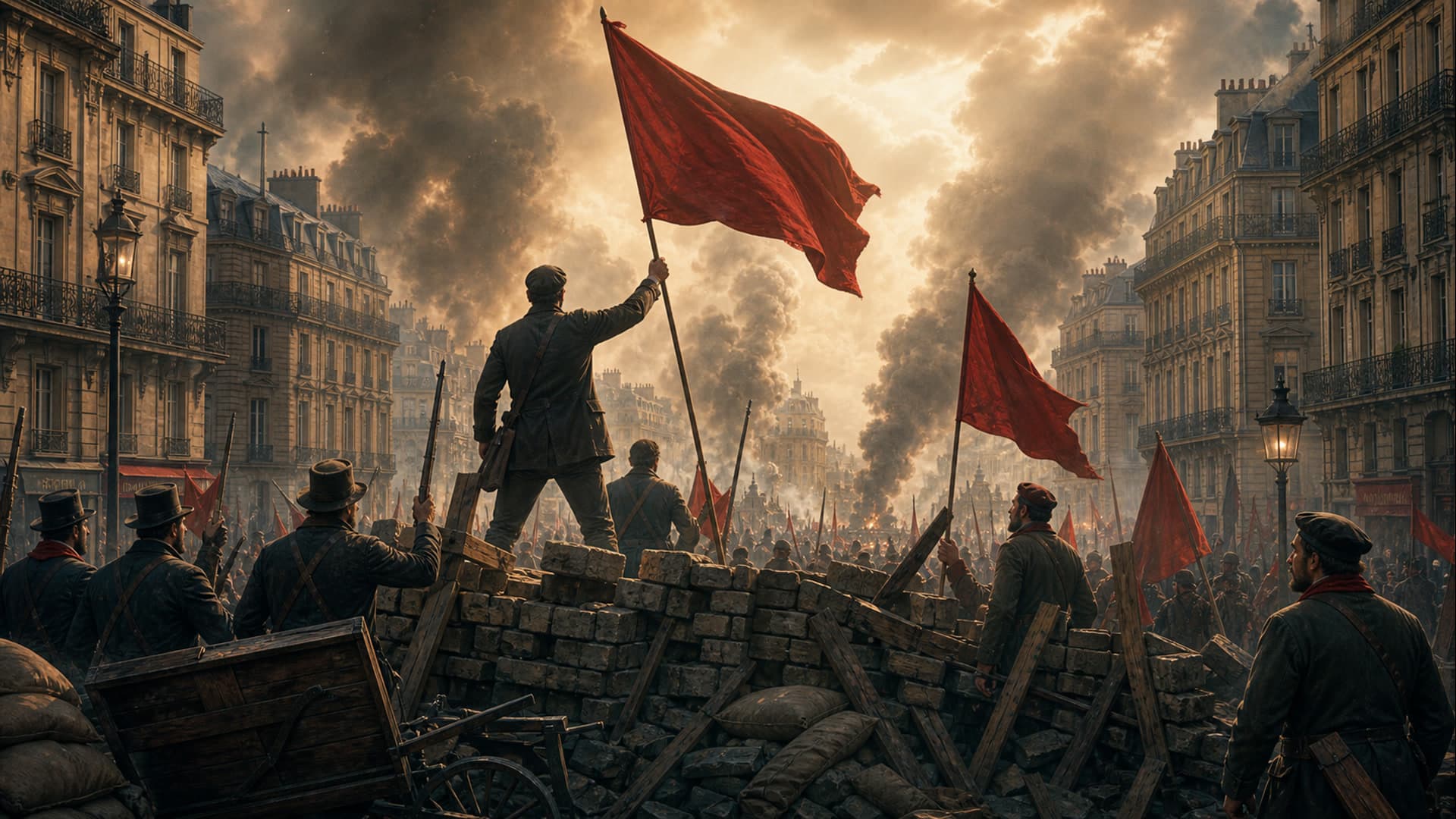
In 1871, Paris experienced 72 days of radical rule; Versailles crushed him in Bloody Week. Ideas and violence that marked the modern left.
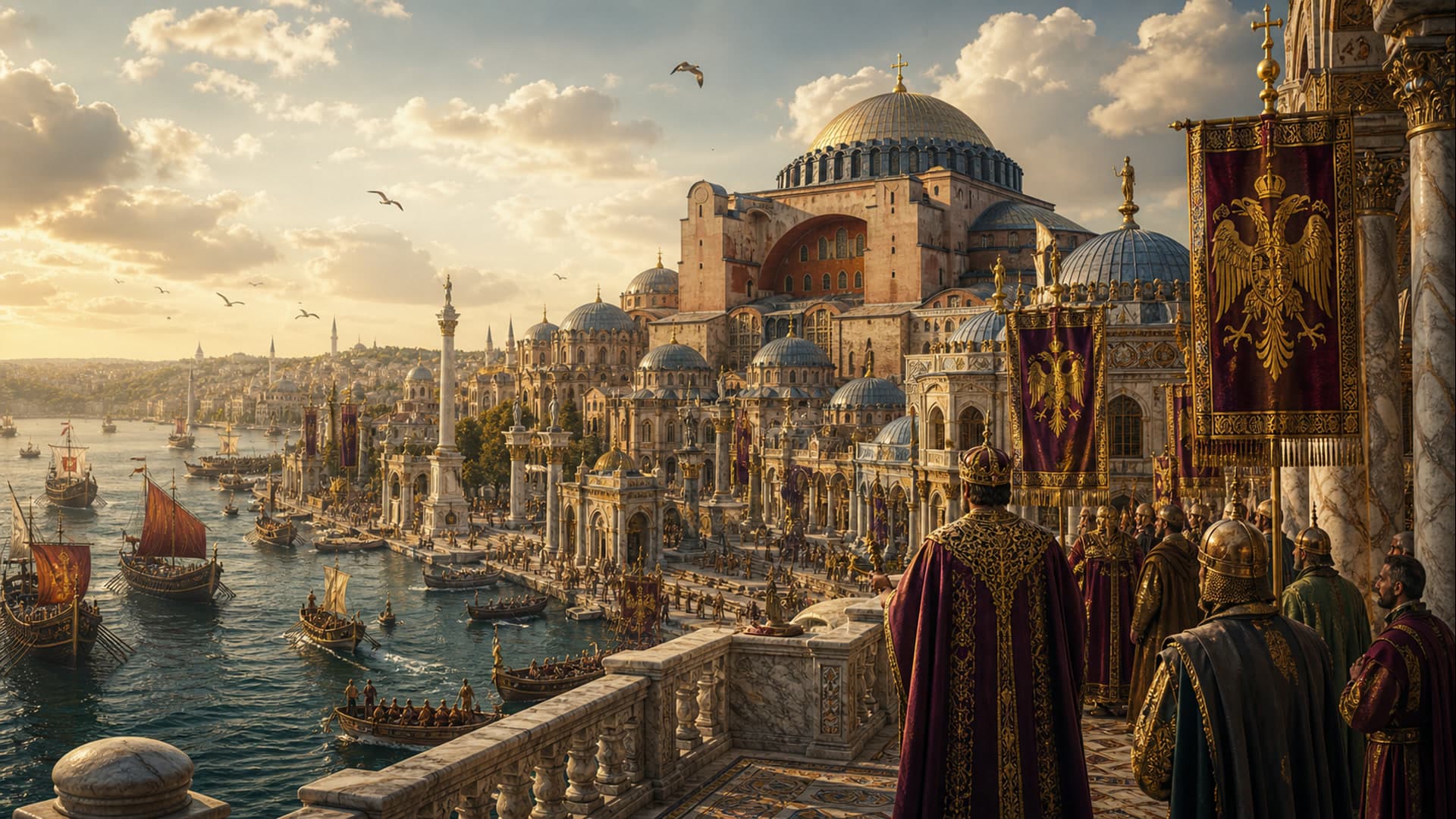
When Rome fell in 476, the Roman Empire kept on existing — for another thousand years, with its capital at Constantinople. That empire almost no one remembers was the bridge between the ancient and modern worlds, the guardian of the Greek texts that fu...
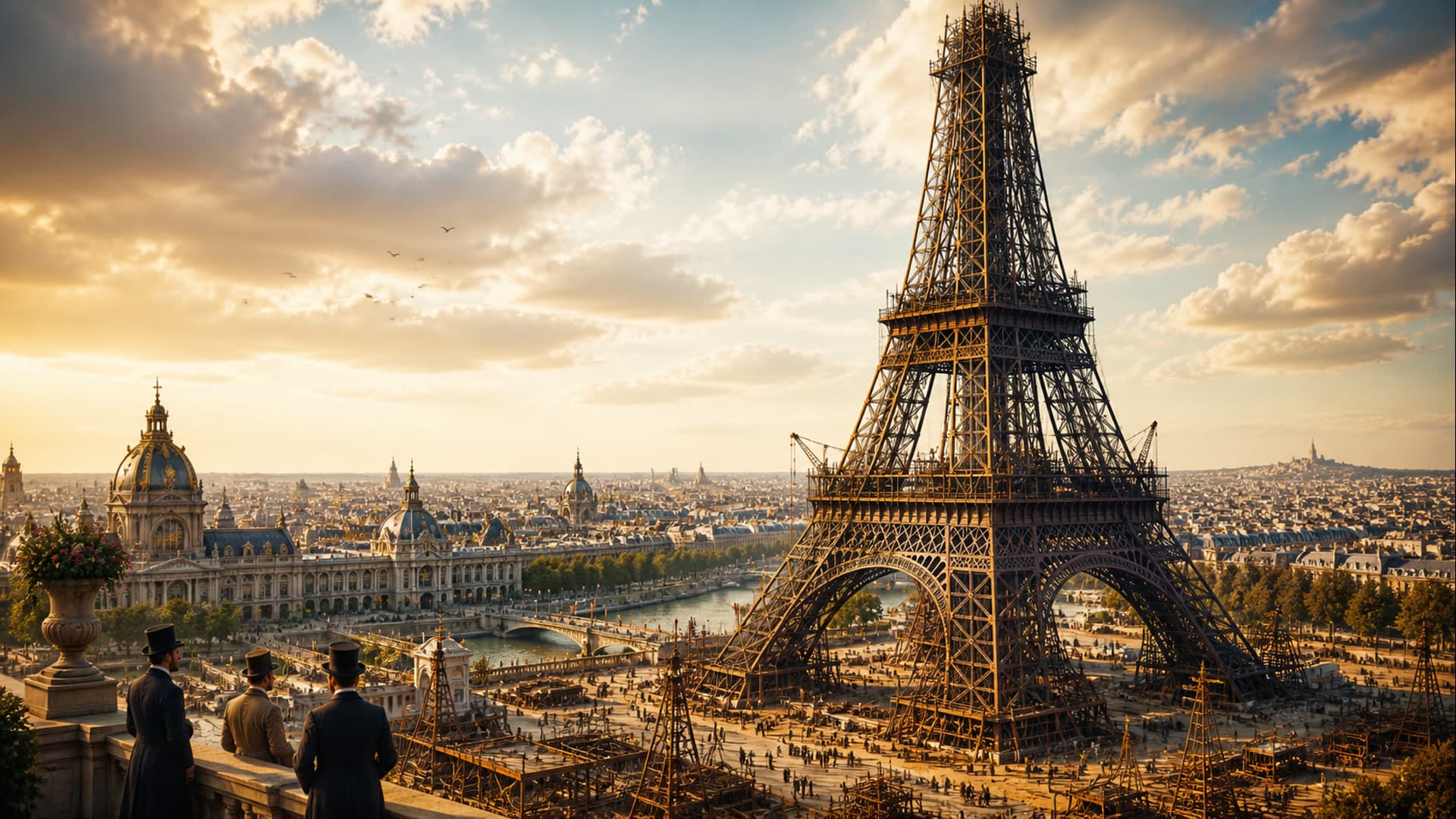
The Eiffel Tower wasn't Eiffel's idea, it was painted red, it was despised by France's greatest writers, and it came within years of being torn down. The man whose name it bears was facing fraud charges when it opened. This is the story of how the worl...