
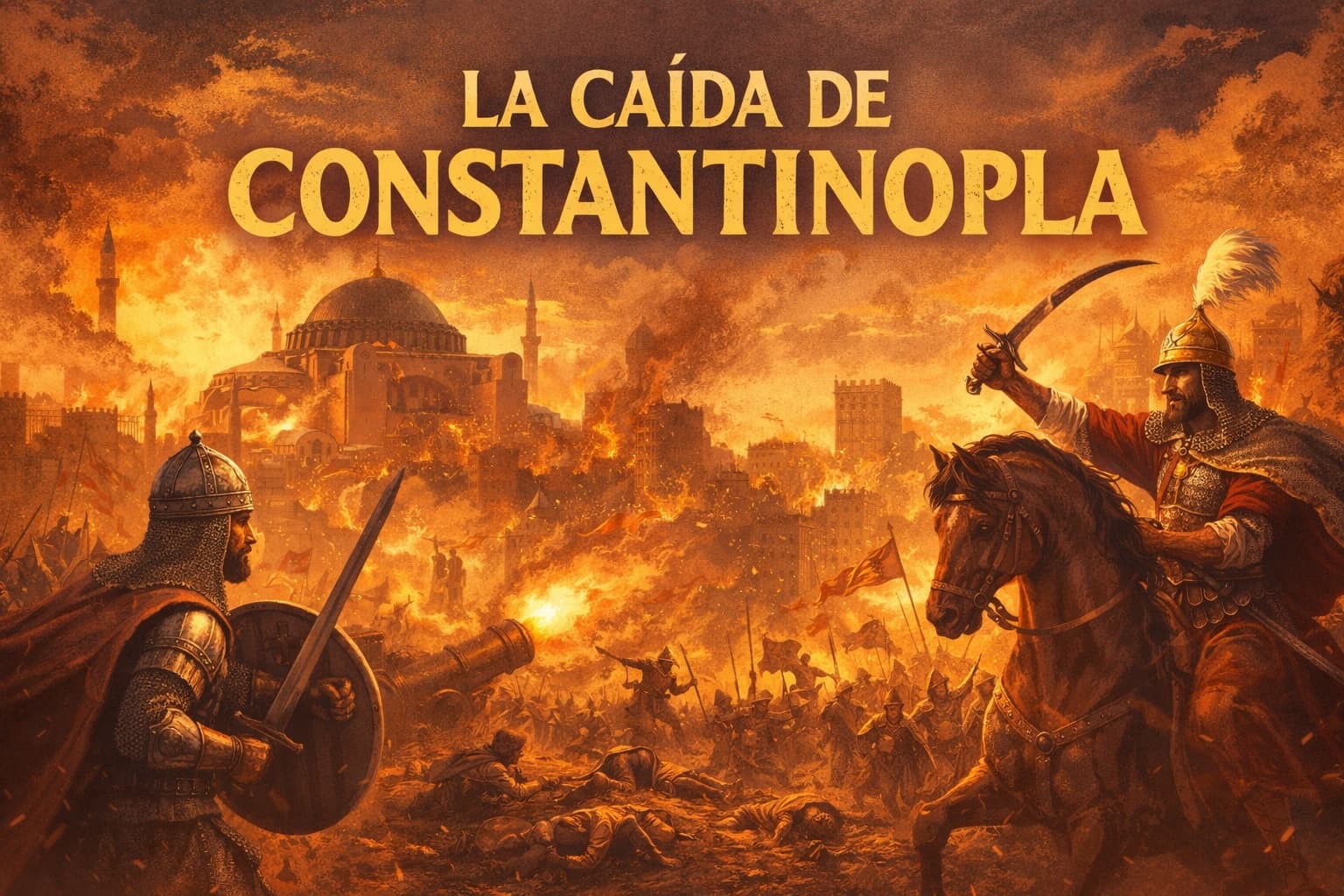
The Fall of Constantinople
 Andres Aguilar
The walls had never fallen. For a thousand years, Arabs, Persians, Bulgarians, and Crusaders all broke against them. Then a nineteen-year-old sultan hired a Hungarian engineer who had first offered his services to the other side — and everything change...
It's four in the morning on May 29, 1453\. The most formidable walls in the world have just been breached by a cannon the size of a tree. Tens of thousands of warriors are pouring through the gap. A thousand years of history are about to end.
Constantinople was no ordinary city. For more than a millennium, it was the city — the largest, the wealthiest, the most heavily defended in the Western world. The capital of the Byzantine Empire, the direct heir to Rome, the gatekeeper of trade between Europe and Asia. Its walls had held off Arabs, Persians, Bulgarians, and Crusaders. In a thousand years, no one had ever taken it.
What happened in the spring of 1453 was simultaneously the close of one era and the opening of another. The date — May 29, 1453 — is one of the few that historians use without debate to mark the end of the Middle Ages and the beginning of the modern world. Not because a historical period ends in a single day, but because that day crystallized into one event everything that was already shifting: military technology, the balance of power between civilizations, the world's trade routes, and — indirectly — the exploration of a continent that no one in Europe even knew existed.
The City and Its Walls
To understand what was lost that day, you have to understand what Constantinople actually was. Founded by the Roman Emperor Constantine in 330 AD on a peninsula commanding the Bosporus Strait, it was designed from the start to be an imperial capital. The geography was extraordinary: control that strait, and you controlled all maritime traffic between the Black Sea and the Mediterranean, between Europe and Asia. Trade flowed through Constantinople, and the emperors collected taxes on every ship, every cargo, every transaction. The city was swimming in gold.
And it had the walls. The Theodosian Walls, built in the 5th century, were the most impressive feat of defensive engineering in the ancient and medieval world. A triple line of defense combining an outer moat, a thirty-foot inner wall, and a main wall nearly seventy feet high and sixteen feet thick. In a thousand years, no army had ever scaled them or brought them down. The Arabs tried in the 7th century and again in the 8th. The Bulgarians, the Russians, the Crusaders themselves — all failed. The walls were not merely a physical defense. They were a legend, and legends carry a power that goes beyond marble and stone.
By 1453, however, the Byzantine Empire was a shadow of what it had been. Centuries of warfare, religious schisms, the devastation of the Fourth Crusade — when European Crusaders, in one of the most shameful episodes of medieval history, sacked Constantinople in 1204 rather than fighting the Muslims they had been sent to fight — and the sustained advance of the Ottoman Turks had reduced the "empire" to something that in practice was just the city and its immediate surroundings. A city-state with imperial aspirations, governing a territory that a century earlier would barely have qualified as a provincial district.
The Ottomans had been advancing for more than a century. They controlled all of Anatolia and had crossed into Europe, conquering the Balkans piece by piece. Constantinople was literally surrounded by Ottoman territory. It was a Byzantine island in a Turkish sea, sustained only by the legend of its walls and the increasingly faint hope that Western Europe would send help.
Mehmed and Urban's Cannon
In 1451, a nineteen-year-old named Mehmed II ascended to the Ottoman throne. And Mehmed had an obsession that went back to childhood: taking Constantinople. His grandfather had tried. His father too. Both had broken themselves against the walls. Most observers in Europe assumed the new sultan was an ambitious young man who would run into the same wall — literally. They made the classic mistake of underestimating someone who didn't fit their expectations.
By any measure you choose, Mehmed was an extraordinary man. He spoke Turkish, Arabic, Greek, Latin, Persian, and Serbian. He had studied mathematics, astronomy, and philosophy. He was obsessed with ancient history, deeply admired Alexander the Great, and saw himself in that tradition of conquerors who reshape the world. And he had understood something his predecessors had been unwilling to accept: that taking Constantinople would require technology that didn't yet exist. It would have to be invented.
The technology in question was heavy artillery, and the man who could build it arrived in circumstances that read like something from a novel. Urban was a Hungarian engineer specializing in cannon founding who showed up first in Constantinople, offering his services to Emperor Constantine XI. He told the emperor — with the quiet confidence of a craftsman who knows his trade — that he could build a cannon capable of knocking down the walls of Babylon. The problem was that Constantine had no money. The imperial treasury was exhausted, taxes barely covered basic needs, and hiring a first-rate cannon founder was simply out of reach.
Urban was a practical man. He crossed the Bosporus and offered his services to Mehmed. The sultan, who had unlimited resources, told him to build the largest cannon that was technically possible. Money was no object.
What Urban built defied the imagination. A twenty-seven-foot cannon that fired six-hundred-pound stone projectiles. Moving it required sixty oxen and two hundred men. When they test-fired it, the shot was heard thirteen miles away and the ball drove a crater nearly six feet deep into soft ground. The limitation was heat: after each shot, the metal needed hours to cool enough to reload. Seven shots a day was the maximum. It was also inherently dangerous — cannons could explode, and in fact Urban was killed when one of his own projectiles detonated prematurely during the siege.
The engineer who could have saved Constantinople ended up building the weapon that destroyed it. It was the first large-scale example of what would later be called dual-use technology: the same tool that defends can also destroy.
But Mehmed didn't stop at the giant cannon. He had dozens of artillery pieces of various sizes built — sixty to seventy in total, a concentration of firepower the ancient world had never seen assembled in a single army. He prepared a land force of between eighty thousand and two hundred thousand men — the sources disagree considerably — along with a fleet of more than a hundred ships to blockade the city from the sea.
On the other side of those walls, Constantine XI had seven thousand soldiers.
The Siege
The siege began officially on April 6, 1453\. Mehmed encircled the city by land while his fleet blockaded the sea approaches. From the first day, cannons began pounding the land walls with relentless regularity. The noise was so sustained, so deafening, that the chronicles of the time record a detail that is difficult to read without a sense of dread: the constant stress and terror caused miscarriages among pregnant women in the city. It was a siege designed to destroy stone and human will in equal measure.
Urban's giant cannon blew car-sized holes in the main wall with each shot. The most heavily damaged sections began crumbling within days. It looked as though the city would fall within weeks.
But the Byzantines did something Mehmed hadn't fully calculated. Every night, when the bombardment stopped, they came out of the city with tools, timber, stones, and whatever materials they could find, and repaired the damage. Monks, women, children, merchants — the entire population joined in the nightly repairs. It was an act of desperation bordering on the heroic. Every morning, when the Ottomans prepared to assault, they found walls rebuilt overnight. Not perfect, not as solid as the originals — but standing.
Mehmed launched direct assaults that were repelled with considerable losses. The commander of the land defense, a Genoese mercenary captain named Giovanni Giustiniani — who had arrived with seven hundred professional soldiers, almost the only meaningful reinforcement Europe had sent — turned out to be an exceptional military organizer. He was everywhere at once, plugging breaches, reorganizing exhausted troops, holding together a garrison that knew it was fighting without any real hope of victory.
Mehmed tried alternatives. He had mobile siege towers built, which the defenders burned with Greek fire — an incendiary compound the Byzantines produced from a formula they guarded as a state secret. He ordered tunnels dug beneath the walls to collapse them from below. The defenders hired a Scottish-born engineer named Grant who detected the digging through the most primitive and effective method imaginable: bowls of water placed on the ground, whose vibrations revealed where excavation was underway. The counter-tunnels they opened turned the earth beneath the city into a labyrinth of combat in total darkness, with sappers from both sides fighting blind in galleries that could collapse at any moment.
The boldest operation of the entire siege was also its most improbable. The entrance to the Golden Horn — the natural harbor of Constantinople — was blocked by a massive chain that prevented Ottoman ships from entering. Mehmed ordered a road of greased wooden rails built skirting the harbor by land. In a single night, using oxen and pulley systems, they dragged seventy ships over five miles of dry land and floated them inside the Golden Horn. When the defenders woke up and looked toward the harbor they had considered safe, enemy ships were sailing in it. It was a devastating psychological blow that didn't solve the military problem of the walls, but it deeply eroded the morale of a garrison that had been running on no sleep for weeks.
Constantine XI and the Decision to Stay
In that context of exhaustion and despair, the conduct of the last emperor earned the place it holds in historical memory. Constantine XI was nearly fifty years old — advanced for the era — and knew with a clarity he didn't allow himself to show that he would probably not leave this city alive.
He had sent emissaries to all of Christian Europe asking for help. To Rome, to Venice, to Genoa, to Hungary, to the Iberian kingdoms. The response was, with few exceptions, silence or empty promises. France and England had just concluded the Hundred Years' War and were rebuilding their strength. Spain was fighting in Granada. The Italian city-states were tangled in their own rivalries. The Pope made reunification of the Eastern and Western churches a condition of assistance — something Orthodox Greeks rejected almost unanimously as doctrinal betrayal. Europe had its own problems, and Constantinople was left alone.
Constantine walked the walls every day. He spoke with the soldiers, knew the commanders by name, appeared at the most pressured points when the situation deteriorated. There was an ancient prophecy circulating among the defenders: Constantinople would fall when ruled by an emperor named Constantine, son of Helena — just like the first Constantine who had founded the city. The last emperor's mother was named Helena. He knew the prophecy. He never referred to it in public.
On May 26, with the siege in its seventh week, Mehmed sent an ultimatum. The terms were reasonable by medieval standards: if the city surrendered, everyone could leave with their possessions, civilians would be respected, there would be no reprisals. If they held out until taken by force, Ottoman soldiers would have the traditional right to sack the city for three days. It was a genuine offer from a commander who preferred to win without destroying what he planned to govern.
Constantine convened his council. The offer was tempting to many — the city had been starving for weeks, the defenders were at their physical limit — but the emperor rejected it. The chronicles attribute to him a speech that was probably embellished or outright invented by later chroniclers, but whose substance reflects exactly what his actions demonstrated: that he would not surrender the city, that all those with him had chosen to die rather than yield, and that so it would be.
Constantine knew he was going to lose. Europe had abandoned him, the prophecy pointed to his name, and the numbers didn't add up by any measure. He kept fighting anyway. That's why the Greeks still remember him eight hundred years later.
The Final Assault
Mehmed scheduled the decisive attack for May 29\. His own generals had suggested lifting the siege — they had been bombarding for nearly two months with considerable losses and had not yet breached the city. The sultan refused. He ordered forty-eight hours of continuous bombardment. The walls, already weakened by weeks of impacts and emergency repairs, gave way in several places. Ramps of rubble formed that attackers could use to climb.
At one in the morning on May 29, the assault began.
The tactic was three waves. First the Bashi-bazouks — poorly armed but numerous irregular troops whose function was to exhaust the defenders more than defeat them. The Byzantines repelled them at a cost, but fatigue was building. Then the Anatolian troops, more capable professional soldiers. The fighting was harder and lasted for hours. The defenders were still holding — but there were no reserves left.
And then something happened that changed everything. Giustiniani was hit by a shot from a hand cannon in the chest. The wound was not necessarily fatal, but it was severe and the pain disabled him. He asked to be taken down from the walls. Constantine begged him to stay — he knew that his best commander's withdrawal at that moment would be read by the soldiers as a signal that everything was lost. Giustiniani insisted. He was evacuated to a ship. He would die days later. But the immediate damage was exactly what Constantine had feared: the Genoese soldiers who had followed their commander for nearly two months, seeing him withdraw, began falling back.
At that precise moment, Mehmed unleashed the Janissaries.
The Janissaries were the absolute elite of the Ottoman army. Their history was macabre in its singularity: Christian children captured in conquered territories, converted to Islam in infancy, trained from the time they could reason to be perfect soldiers. They had no family, no homeland, no loyalty except to the sultan. They had rested during the first two waves of the assault. They arrived fresh, disciplined, and fanatical — facing defenders who had been fighting for hours without sleep.
The Janissaries found two simultaneous entry points. One was a side gate called the Kerkoporta that had been left open — whether through carelessness or betrayal is something historical debate has never definitively resolved. Through it entered a group that climbed to the top of the walls from the inside. Simultaneously, another contingent scaled one of the breaches blown open by the cannons. Suddenly the defenders were being attacked from inside and outside the walls at the same time.
The collapse spread within minutes. What remained of the defending force began to fall back. Some tried to reach the ships in the harbor. Others kept fighting in the streets, with no way to coordinate or grasp the full magnitude of what was happening. Constantine XI, according to the chronicles, removed his imperial regalia so as not to be recognized, drew his sword, and threw himself into hand-to-hand combat. No one saw him again. His body was never identified with certainty.
The different versions of his death reflect what each era needed to believe. The heroic version — which is also the most historically plausible — is that he died fighting on the walls and was buried beneath the bodies with no way to distinguish him from any other fallen soldier. There is a Greek legend that says an angel transformed him into marble and hid him in a cave beneath the walls, and that one day he will awaken and reconquer the city. Legends about rulers who did not truly die but are waiting for the moment to return are ancient and universal. What they always say is the same: that this person and what they represented deserved something better than a definitive ending.
By eight in the morning, the Ottoman banner flew over the walls. The city had fallen.
The Sack and Mehmed's Gesture
What followed was what the laws of war at the time dictated: three days of looting. Ottoman soldiers moved through the city taking what they found, killing those who resisted, and capturing the rest for sale as slaves. Thousands of people died in those hours. Thousands more were sold in the slave markets of Anatolia and the Balkans.
On the third day, Mehmed stopped the sack and entered the city. What he did next says something about the kind of conqueror he was. He entered the Hagia Sophia — the most important cathedral in the Orthodox Christian world, built in the 6th century and considered for nine hundred years one of the wonders of the world. He converted it into a mosque — a symbolic act of the highest order for his Muslim subjects — but ordered that the mosaics and works of art be preserved. He prohibited the destruction of buildings and monuments. He invited the Greeks who had fled to return and guaranteed their rights as subjects of the new empire.
Mehmed declared himself Kayser-i Rum — Caesar of Rome. It was not an empty title: he genuinely saw himself as the heir to the Roman imperial tradition, the continuation of the same line that Constantine the Great had initiated a thousand years earlier. And in certain respects he was right. The Ottoman Empire adopted Byzantine institutions, administrative structures, and cultural traditions with a fluency suggesting that the conquest was, in part, an absorption. Constantinople remained the capital of a great empire, remained the control point of the Bosporus, remained a city of foremost global importance. Only now it was called Istanbul, and the call to prayer rang from minarets rather than church bells.
The Consequences That Changed the World
The fall of Constantinople had effects that extended far beyond the Balkans and Anatolia — and some of them are visible even today.
The first was cultural. When the city fell, thousands of Greek intellectuals, clergy, and scholars fled westward carrying manuscripts that in many cases were the only surviving copies of classical Greek texts. Plato, Aristotle, Thucydides, Sophocles — much of that body of work had been preserved in the libraries of Constantinople while Western Europe had lost it during the Middle Ages. Those refugees and their manuscripts arrived in Venice, Florence, and Rome. Italian Renaissance historians consistently point to the arrival of these Greek scholars as one of the factors that accelerated the rediscovery of ancient philosophy and literature. Without the fall of Constantinople, the Renaissance would have looked different — and likely moved more slowly.
The second effect was geopolitical, and its consequences reached literally to the other side of the planet. The Ottomans now controlled the most strategically important chokepoint in trade between Europe and Asia. Access to Chinese and Indian goods — spices, silks, porcelain — that arrived via eastern land and sea routes became considerably harder and more expensive for Europeans. This didn't completely shut down trade, as is sometimes oversimplified, but it created a new urgency to find alternative routes.
The Portuguese had already begun exploring the African coast before 1453, but the context of that exploration changed after the city's fall. Within four decades, Vasco da Gama reached India by rounding the Cape of Good Hope. And in 1492 — just thirty-nine years after the fall of Constantinople — Christopher Columbus crossed the Atlantic sailing west in search of an alternative route to Asia, and found something nobody was expecting. The chain of causation is long and has several links, but the connection between the fall of Constantinople and the European discovery of America is real. If the Ottomans hadn't disrupted the eastern trade routes, the pressure to find alternatives would have been less acute, and the timing of exploration would have been different.
The fall of Constantinople was not just the end of an empire. It was the trigger that pushed Europeans to search for new routes to Asia. Without that push, Columbus might have sailed west decades later — if ever.
The third effect was symbolic, but carried enormous historical weight. The year 1453 is the date historians use to mark the end of the Middle Ages. Not because medieval historians woke up on May 30th and decided they were living in a different era — but because that event concentrated and crystallized the shift in a whole set of conditions that were already in motion: the decline of the Pope's universal authority, the rise of nation-states, the beginning of the Age of Exploration, and the growing importance of military technology over traditional architectural defenses.
That last point deserves particular attention. The Theodosian Walls had held for a thousand years because they represented the state of the art in defensive architecture. They were built at a time when the only way to take a city was to scale it or starve it — and for that purpose, they were perfectly designed. Urban's cannons made them obsolete in a matter of weeks. Not because the walls were poorly built, but because offensive technology had made a discontinuous leap forward. It's the same logic military history would repeat in centuries to come: armor against artillery shells, trench lines against tanks, aircraft carriers against anti-ship missiles. Every new technology makes obsolete the defenses built to withstand the previous one.
What Remained
Mehmed II reigned for thirty more years and kept expanding the empire with an energy that seemed to find no natural limits. He conquered Serbia, Bosnia, and much of Greece. He dreamed of taking Rome and becoming the universal heir to the imperial tradition — but died in 1481 at forty-nine, probably poisoned by his own son in one of those dynastic transitions the Ottoman world never quite managed with grace.
Giustiniani, the Genoese captain who had organized the most brilliant possible defense with pitiful resources, died a few days after being evacuated from the walls. He never learned that the city had fallen, and never knew that his withdrawal had been the turning point. There is something unresolvable about that fate: he had come because he believed in what he was doing, he had fought extraordinarily for nearly two months, and a single shot from a hand cannon at the most critical moment turned his reasonable retreat into the trigger of catastrophe. History distributes tragedy with no sense of proportion.
If you visit Istanbul today, the Theodosian Walls still stand — partially restored, walkable in several stretches. They have gaps in the same places where the Ottoman cannons blew their openings in 1453\. The Hagia Sophia, after nearly five centuries as a mosque and decades as a museum, was returned to active use as a mosque in 2020 by decision of the Turkish government. It remains one of the most extraordinary buildings human civilization has ever produced, and it continues to generate debate about whose history it belongs to: the Greeks who built it, the Ottomans who preserved it, the Turks who administer it, or all of humanity that visits it.
That question — to whom does the history of a place belong when it has changed hands so many times — is, in a certain sense, the open question that the fall of Constantinople left behind more than five hundred years ago. There is no simple answer. But asking it clearly is already a start.
Related episodes
In 1871, Paris experienced 72 days of radical rule; Versailles crushed him in Bloody Week. Ideas and violence that marked the modern left.
When Rome fell in 476, the Roman Empire kept on existing — for another thousand years, with its capital at Constantinople. That empire almost no one remembers was the bridge between the ancient and modern worlds, the guardian of the Greek texts that fu...
The Eiffel Tower wasn't Eiffel's idea, it was painted red, it was despised by France's greatest writers, and it came within years of being torn down. The man whose name it bears was facing fraud charges when it opened. This is the story of how the worl...