
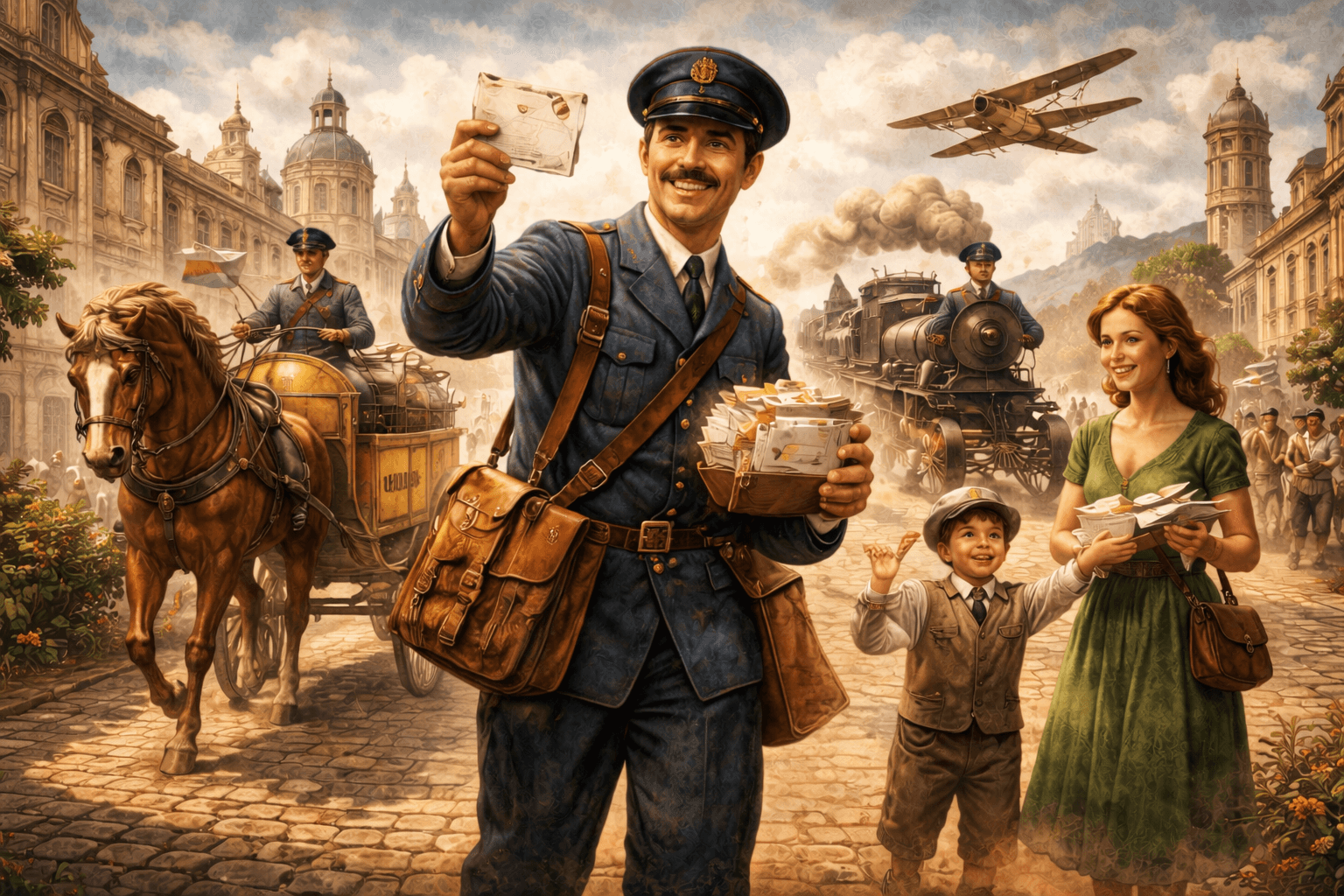
The Postal Service
 Andres Aguilar
For most of human history, sending a message across a country was a privilege reserved for the powerful. Then one British schoolteacher published a pamphlet proposing a radical idea: a flat fee, paid upfront, for anyone. Governments thought it would ba...
In 1916, a man in Wyoming wrapped up his baby daughter, stuck fifty cents worth of stamps on her, and mailed her to her grandparents' house. It was completely legal. And that absurd little fact tells you more about the mail than any textbook definition ever could.
The baby weighed less than the package limit, so she technically qualified. The mail carrier picked her up, transported her a few miles, and delivered her without incident. They obviously banned mailing people after that, but the fact that it was ever possible reveals something extraordinary: at that moment, the postal service was so reliable, so universal, and so woven into everyday life that people used it for absolutely everything. You could trust the government to deliver whatever you needed — including your daughter — safely and cheaply.
The mail is one of those things we completely take for granted. You put a letter in the mailbox, slap a stamp on it, and somehow it magically shows up across the country or on the other side of the world. But for most of human history, sending messages over long distances was expensive, slow, and reserved for people with power. The idea that anyone can communicate with anyone else for a flat, affordable fee is relatively recent. And it changed everything.
The First Systems: Mail for Kings, Not for People
The earliest organized mail systems appeared in ancient civilizations, and even then they were impressive feats of logistical engineering. The Persians maintained a relay network of horse-mounted messengers that operated with remarkable precision. Herodotus described the system with a phrase that would later become legendary: that neither snow, nor rain, nor heat, nor gloom of night could stay these couriers from the swift completion of their appointed rounds. The United States Postal Service later adopted that line as its unofficial motto — centuries later. The concept was simple but brilliant: relay stations distributed along established routes, where one messenger would hand off to a fresh rider on a fresh horse, and so on down the line. Information could travel at speeds that seemed almost impossible for the era.
The Romans refined the system across their network of paved roads, with well-organized waystation infrastructure that still draws admiration today. But here's the fundamental problem with all of these systems: they were built for the state. For official, military, administrative messages. Not for a merchant writing to a supplier, or a mother letting her son know how the family was doing. The mail was a tool of power, not a public service.
The big shift began with an Italian family — the Tassis, or Thurn und Taxis in German — who in the 15th century started organizing mail services under contract for the Holy Roman Empire and the Spanish Crown. Worth clarifying: they have nothing to do with the taxicabs you hail on the street. The surname comes from the Italian tasso, meaning badger. Modern taxis get their name from the taximeter, the device that measures the fare. Two completely separate etymologies that happened to converge on the same sound. The Habsburgs, who ruled territories scattered across half of Europe, needed reliable communication between their domains. The Tassis built a network of relay stations with messengers, horses, and established routes — and then had an idea that changed everything: they offered the service to private individuals, for a fee. It was one of the first "public" mail systems in the sense that anyone with money could use it.
But that was the catch: you had to have money. Sending a letter cost a small fortune, and the rate varied by distance. And the system had a quirk that seems completely backwards today: the person who paid wasn't the sender — it was the recipient. If someone sent you a letter and you didn't feel like paying, you simply turned it away at the door. The mail was still, in essence, a privilege. It worked, but it wasn't for everyone.
Rowland Hill and the Stamp That Democratized the World
That state of affairs held for centuries, until 1837, when a British schoolteacher and social reformer named Rowland Hill published a pamphlet that would change the history of communication. It was titled Post Office Reform: Its Importance and Practicability, and in it Hill argued that the postal system was inefficient, expensive, and unjust. His proposal was so simple it almost seemed naive: a flat prepaid rate.
The idea was this: regardless of distance, every letter within the United Kingdom would cost the same. One penny. And the sender would pay upfront, not the recipient. To prove postage had been paid, a small adhesive paper with a printed value would be affixed to the envelope: the postage stamp.
Just about everyone thought he was wrong. Government officials argued the postal service would go bankrupt, that slashing rates would generate unsustainable losses. But Hill was making a brilliant economic argument: if you dropped the price dramatically, far more people would use the mail. The volume of letters would grow so much that it would more than offset the lower rate. This wasn't philanthropy — it was economies of scale applied to a public service.
He was right. In 1840, the United Kingdom implemented the uniform rate system and launched the world's first postage stamp: the Penny Black, bearing the profile of Queen Victoria on a black background. The results were immediate and decisive. Before the reform, the British postal service processed around 75 million letters a year. A decade later, it was 350 million. People who had never been able to afford to send a letter started doing it regularly. Families separated by distance, workers who had migrated to industrial cities, merchants in small towns — suddenly everyone had access to the same communication tool that had previously been the exclusive domain of the well-off.
The stamp itself was a notable technical innovation. It was small, easy to produce, and adhesive; it displayed its value clearly and was difficult to counterfeit thanks to its fine detail and watermarks. Every country that adopted the system afterward designed its own, and stamps quickly became national symbols. Philately — the technical name for stamp collecting — became one of the most popular hobbies in the world, and over time generated a market for valuable objects that still moves serious money today.
Other countries saw Britain's success and moved quickly to replicate it. Brazil was the second to adopt stamps, in 1843\. The United States followed in 1847\. France in 1849\. By the middle of the 19th century, most developed countries had modern postal systems, affordable rates, and a service that, for the first time in history, was genuinely accessible to ordinary people.
The Mail and the Building of Modern Nations
In the United States, the mail was a central instrument in westward expansion. The government understood early on that connecting the country by mail was as important as building roads. In 1860, when California was already a state but the transcontinental railroad didn't yet exist, they created the Pony Express: a relay service of horse-mounted riders covering more than 1,900 miles between St. Joseph, Missouri, and San Francisco. The riders rode day and night, switching horses at stations spaced every ten to fifteen miles. They could deliver a letter in ten days — an extraordinary speed for the time. The service became legendary almost immediately, and the image of those riders — tough, daring, racing across open plains — became one of the enduring symbols of the American frontier.
It lasted barely eighteen months. The transcontinental telegraph was completed in October 1861, and the Pony Express was obsolete overnight. The speed of lightning beat the fastest horse.
It was the railroad, however, that truly transformed the mail at scale. Trains could carry enormous volumes of correspondence at speeds unimaginable for any previous service. The U.S. developed a particularly ingenious solution: Railway Post Office cars, which were mobile post offices built right into the trains. Specialized clerks rode along sorting mail throughout the journey, so that by the time the train reached its destination, letters were already organized and ready for final delivery. It was a processing operation in constant motion — continuous, efficient, and remarkably effective.
The mail was also the invisible engine of modern commerce. Businesses could send catalogs, invoices, orders, and confirmations. Sears built one of the largest commercial empires of the 20th century on the back of the mail: customers in remote towns received catalogs hundreds of pages thick, picked out what they wanted, sent in their order by mail, and received their merchandise weeks later. It was, in every meaningful sense, the e-commerce of 120 years ago — the same promise of buying things without leaving home, the same dependence on a reliable logistics network.
During wartime, the mail took on a human dimension that went far beyond logistics. Letters were the only real connection between soldiers at the front and their families back home. In World War I, millions of letters flowed constantly between the trenches and households across the country. The military mail had its own distribution systems, its own protocols. Letters passed through censors who blacked out any information that might be useful to the enemy: locations, troop movements, plans. Sometimes they arrived so heavily redacted that barely anything legible remained. But families kept them anyway — because a letter was proof that someone was still alive on the other side.
The Universal Postal Union and the First Globalization
One of the most practical problems with modern mail was international correspondence. If you're sending a letter from the U.S. to Japan, that piece of mail has to pass through multiple countries, each with its own system, its own rates, and its own rules. Coordinating all of that was, until the middle of the 19th century, a mess of bilateral treaties, conflicting tariffs, and incompatible procedures.
In 1874, representatives from twenty-one countries gathered in Bern, Switzerland, and founded the Universal Postal Union — one of the first truly functional international organizations in history. The agreement was elegant in its simplicity: every member country would accept and distribute mail from all the others, with compensation mechanisms for transit costs. Common rules were established for packaging, addressing, and rates. Suddenly, a letter could travel anywhere in the world on a single stamp, without the sender needing to understand the postal systems of every country it passed through.
In many ways, it was an early example of institutional globalization. Long before the United Nations, the World Trade Organization, or any other major supranational body existed, the Universal Postal Union was demonstrating that countries with vastly different political systems and economic interests could cooperate around a shared infrastructure. Today it has 192 member countries — more than the United Nations itself.
Airmail was the next technological leap. The first postal flights began in the 1910s, with pilots flying primitive aircraft by visually following roads and railroad tracks because there wasn't enough instrumentation to navigate any other way. Many died in crashes. It was extraordinarily dangerous work — and yet airmail volume grew rapidly, because the time advantage was enormous. Airmail stamps, more expensive and often featuring special designs, became particularly prized by collectors. Scarcity has value, and in its early decades, airmail was uncommon enough that its stamps were genuinely coveted.
Philately, Printing Errors, and the Most Expensive Scrap of Paper in the World
There's something fascinating about the fact that small printed rectangles of paper — designed to be used up and discarded — can become objects worth millions. The most valuable stamp in the world is the British Guiana One-Cent Magenta of 1856, of which only one example exists. It sold in 2014 for $9.5 million.
The story behind that stamp is remarkable. A ship was supposed to bring stamps from England to the colony of British Guiana, but was delayed. The colony ran out of stamps. The local postmaster decided to print emergency ones at the local newspaper office — octagonal in shape, magenta in color, with his own initials stamped on them to make forgery harder. They were functional, but ugly. When the ship finally arrived with the proper stamps, the emergency ones were discarded. Or so everyone thought. In 1873, a twelve-year-old boy found one among his uncle's letters and sold it to a local collector for six shillings. Over the next 150 years, that stamp passed through the hands of some of the world's wealthiest collectors, each time at a higher price. A one-cent scrap of paper that became the most valuable postal object in history.
Printing errors have their own cult following within philately. The most famous in the United States is the Inverted Jenny of 1918 — an airmail stamp depicting a Curtiss JN-4 biplane, nicknamed the Jenny, that was accidentally printed upside down on a single sheet of one hundred stamps. Only that one sheet got out before the mistake was caught. A man named William Robey bought them at the post office window, immediately recognized the error, and quickly sold them for a significant profit. Today each of those hundred stamps is worth hundreds of thousands of dollars. Collectors pursue them with obsession because they are singular and irreproducible: an industrial imperfection transformed into absolute rarity.
ZIP codes, meanwhile, were an innovation that transformed the system's operational efficiency without most people ever noticing much. Germany introduced postal codes in 1941\. After World War II, other countries gradually followed. The United States implemented its five-digit system in 1963\. That sequence of numbers at the end of every address allows sorting machines to process thousands of pieces per hour with a precision that previously required dozens of workers. Automation quietly transformed the mail over the following decades: optical address readers, automated sorters, tracking systems. By the 1980s, mail processing in the most developed countries was highly mechanized — even though the final stretch, the carrier at your front door, remained as human as ever.
Pigeons, Spies, and Letters That Never Arrived
To talk about the mail in wartime is to talk about an institution under extraordinary pressure — one that revealed both its resilience and its limits. Postal censorship was systematic practice in nearly every major conflict of the 20th century. In the Soviet Union, entire offices were dedicated to opening correspondence, reading its contents, and flagging expressions of dissent. If a letter contained something deemed subversive, it never reached its destination, and the sender could face severe consequences. People responded by developing private codes, veiled references, and indirect ways of saying what couldn't be said openly. It was a permanent game of wit against surveillance.
In World War I, British intelligence services created fake mail systems for their spy networks — complete with perfectly forged stamps and postmarks from neutral countries, allowing agents to send reports that appeared to originate in Switzerland or Spain when they were actually coming from enemy territory. The Germans had similar operations. The war was being fought in the envelopes, too.
And then there were carrier pigeons — representing, in some ways, the oldest and most surprising form of long-distance communication under extreme conditions. Hundreds of thousands were used in both World Wars. In certain tactical situations they were more reliable than radio, because the enemy couldn't intercept the message without physically capturing the bird. Some pigeons received formal military decorations for messages that saved lives. One of the most celebrated in World War I delivered a message that rescued 200 trapped American soldiers — after being shot, losing an eye and a leg. She kept flying forty kilometers and completed the mission. After her death, she was preserved through taxidermy and her remains are kept in a military museum in Washington.
In Alaska, before an adequate road network existed, mail carriers covered routes spanning hundreds of miles by dogsled through the Arctic winter. The most famous episode from that tradition was the 1925 Serum Run to Nome. Technically it wasn't mail — but it used exactly the same infrastructure and the same routes that mail carriers had spent decades learning. A diphtheria outbreak threatened to devastate the isolated community of Nome on Alaska's western coast, and antitoxin serum needed to arrive urgently. It was transported by train to Nenana, and from there, twenty dog teams and their mushers relayed it across the final 674 miles in the dead of winter, at temperatures hitting fifty below zero. They made it in five and a half days. The lead dog on the final team, Balto, became world famous — celebrated with a statue in Central Park and later an animated film. And all of it was possible because a human-and-canine network already knew those routes intimately, built by the people who had been carrying the mail out there for decades.
The Mail in the Digital Age: Between Nostalgia and the E-Commerce Box on Your Porch
The digital era hit the mail in ways nobody fully anticipated. Email essentially eliminated the personal letter. Almost nobody handwrites to a friend or family member anymore. Traditional mail volume has fallen steadily in every developed country over the past two decades, and postal services have had to reinvent themselves or contract.
But here's the paradox nobody saw coming clearly: e-commerce saved the mail. Amazon, eBay, Etsy, and the rest of the online shopping ecosystem need to deliver physical packages — and postal services turned out to be perfectly positioned to do it. They have universal coverage, infrastructure already installed across the entire country, and trained personnel for the last mile — that final stretch to your front door, which remains the hardest and most expensive part of the logistics chain to solve. While letter volume collapsed, package volume exploded. The mail didn't die. It mutated.
Postal services now compete with private companies like FedEx, UPS, and DHL, which offer faster speeds, real-time tracking, and a more polished customer experience. But they also charge more. The public mail retains advantages no private company can match: it's universal by legal mandate, it must deliver to remote areas even when it's not profitable, and it's generally cheaper for basic shipments. They're different operating logics competing in the same market.
There's a political dimension to public mail that often gets underestimated. In a democracy, access to information and free communication are fundamental. Historically, the mail allowed newspapers to reach every corner of the country, allowed people to communicate without middlemen, allowed ideas to circulate. In the United States, periodicals could be mailed at subsidized rates as part of a deliberate policy of promoting the free flow of information. It was democratic infrastructure in the most literal sense.
The privacy of postal correspondence is constitutionally protected in most countries: opening someone's mail without a warrant is a federal crime. It's a protection that took centuries to establish and that, compared to email — where private companies read your content to serve you ads and governments can access your data under far looser legal standards — looks almost quaintly robust.
What the Mail Did for Humanity
There's something about a physical letter that email simply cannot replicate. A handwritten letter takes time and effort: you choose the paper, the handwriting is personal and unrepeatable, it can be reread years later. On the other end, someone holds it, tucks it in a drawer, rediscovers it decades on. The great historical love letters between famous people are extraordinary documents. Franz Kafka's letters to Milena Jesenská. Simone de Beauvoir's to Jean-Paul Sartre. Soldiers' letters to their wives during wartime. They are windows into other lives, other ways of loving and thinking, that would not have survived without the mail.
Archives of correspondence are also treasures for historians. Preserved letters reveal what everyday life was actually like in other eras: how people spoke, what worried them, what family and friendship and work relationships looked like. Without modern mail and the culture of letter writing it encouraged, our knowledge of the inner lives of ordinary people in the 19th and 20th centuries would be considerably poorer.
Some cases seem lifted straight from fiction. In 2015, in the U.S., a letter sent in 1943 was finally delivered — it had been lost for seventy-two years. The family of the original recipient, long since passed away, found in their mailbox a letter from a wartime friend written decades before. A portal to the past, suddenly materializing in the everyday mail.
And then there were dead letter offices — a name that sounds like something out of a short story, but was a genuine bureaucratic reality: the final destination for mail that couldn't be delivered because the address was wrong, the recipient unknown, or the return address missing. Postal workers would open those letters trying to find clues to redirect them. They found everything: love confessions, family photos, cash, important documents. There were enormous collections of these undeliverable pieces — messages that never arrived, human connections severed by a wrong street number. It's hard not to find a metaphor in that.
The mail, when you get right down to it, seems simple — even mundane. An envelope, a stamp, a mailbox on the corner. But when you really think about it, it's one of the most profound innovations of the last two centuries. It democratized communication at a time when communication was power. It connected the world before the telephone, the telegraph, or the internet existed. It made modern commerce possible, along with mass journalism, scientific correspondence, and long-distance romance. And it proved that a well-designed public service can transform the lives of millions of people who will never know the name of the person who made it possible.
The next time a package arrives at your door or you walk past a mailbox on the street, remember that behind it lie centuries of history, ingenuity, and thousands of people keeping a system running that, in its time, seemed as impossible as it was revolutionary. There was an era when sending a letter was a privilege reserved for kings and emperors. That anyone today can do it — for less than the cost of a cup of coffee — remains, if you stop to think about it, a silent revolution that changed what it means to be human.
Related episodes
In 1871, Paris experienced 72 days of radical rule; Versailles crushed him in Bloody Week. Ideas and violence that marked the modern left.
When Rome fell in 476, the Roman Empire kept on existing — for another thousand years, with its capital at Constantinople. That empire almost no one remembers was the bridge between the ancient and modern worlds, the guardian of the Greek texts that fu...
The Eiffel Tower wasn't Eiffel's idea, it was painted red, it was despised by France's greatest writers, and it came within years of being torn down. The man whose name it bears was facing fraud charges when it opened. This is the story of how the worl...