
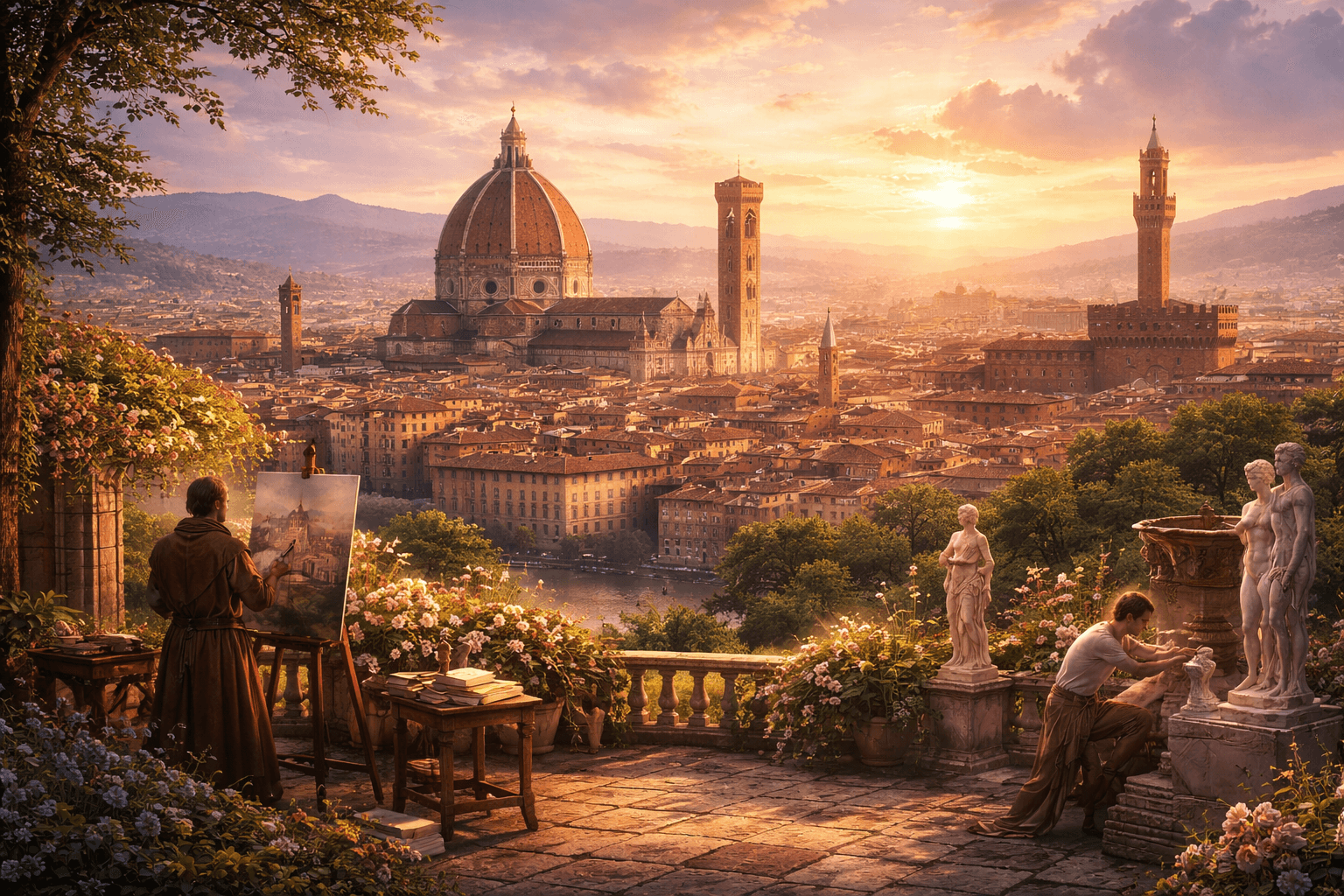
The Renaissance in Florence
 Andres Aguilar
A city of 50,000 people permanently transformed art, science, and the way human beings think about themselves. The Medici supplied the money. Leonardo, Botticelli, and Michelangelo supplied the genius. Between the 14th and 16th centuries, Florence beca...
Bankers, geniuses, and corrupt popes. How a city of 50,000 people changed art, science, and human thought forever. The Medici, Leonardo, Botticelli, and the birth of the modern world.
Picture this: you're in Florence, the year is 1504. You turn a corner and find a crowd of people staring upward, mouths hanging open. You follow their gaze and see a marble statue more than sixteen feet tall. It's a naked man, powerfully built, with a defiant look that cuts right through you. This is Michelangelo's David. The artist was just twenty-nine years old when he finished this masterpiece that the whole world knows today. But here's the truly mind-blowing part: the block of marble Michelangelo used had been sitting abandoned in a storage yard for forty years because other sculptors — experienced, prestigious artists — had deemed it worthless. Too many imperfections, cracks, flaws that made it impossible to work with. Michelangelo saw what others couldn't. He saw the perfect David trapped inside that imperfect stone. And that ability to see potential where others see only ruin is, essentially, what the Renaissance was all about.
A City-State That Changed History
The Florentine Renaissance was one of the most fascinating periods in human history — a moment when an Italian city not much bigger than a mid-sized American town permanently transformed art, science, politics, and even the way we think about ourselves. An extraordinary era spanning the fourteenth through sixteenth centuries, where the perfect conditions came together for human genius to bloom like never before.
To understand what the Renaissance actually was in Florence, we first need to situate ourselves in time and place. We're talking about Italy, but unified Italy as a nation didn't exist yet. It was a patchwork of independent city-states constantly competing with each other: Venice, Milan, Rome, Naples, and of course Florence. Each had its own government, its own currency, its own armies. Imagine something like if New York, Chicago, and Los Angeles were separate countries — with their own borders, customs checkpoints, and ongoing trade disputes.
Florence around 1300 was a very wealthy city. Wealthy for two reasons mainly: wool and banking. The Florentines had figured out how to process wool more efficiently than anyone else, and how to make money with money. They invented the bill of exchange — basically a medieval check — and built banks that operated across all of Europe, lending to kings, popes, and merchants. The most powerful family in this business were the Medici, and understanding them is the key to understanding everything that followed.
What Does "Renaissance" Actually Mean?
Literally, it means "rebirth." But what was being reborn? Classical Greco-Roman culture. During the Middle Ages — which had lasted nearly a thousand years — much of the knowledge from ancient Greece and Rome had been lost or sat buried in monasteries where almost no one read it. The manuscripts were there, covered in dust, written in Latin and Greek that few people knew how to read or interpret correctly. The Renaissance thinkers said: "Hold on, there's a buried treasure here that we've been wasting," and they set about digging it up with obsessive dedication. They rediscovered Plato and Aristotle, Greek plays, Roman architecture, Greek sculpture, ancient scientific treatises. But they didn't copy it blindly like a recipe. They studied it deeply and mixed it with new ideas, creating something entirely original.
The fundamental shift in thinking went like this: during the European Middle Ages, everything revolved around God and the afterlife. This earthly life was supposedly a temporary place of suffering before eternity. The human being was seen as something fundamentally fallen, sinful, in constant need of redemption through the Church. Medieval artists painted figures that were flat, rigid, almost devoid of real human expression. Everything was symbolic, everything pointed exclusively to the divine.
The Renaissance didn't abandon God — that's important to clarify, because a lot of people misread this — but it put the human being at the center of attention as well. Humanism emerged, a school of thought that said: "Hey, humans are capable of incredible things in our own right. We can reason, create beauty, discover truths about the world. We are worthy of being studied and celebrated as marvelous creations."
The Revolution in Art
This new way of thinking shows up in absolutely everything Florence produced. In painting, figures start to look real, three-dimensional, with recognizable human emotions.
Painters discover and systematize linear perspective — the mathematical technique that makes a flat canvas appear to have real depth, as if you could step right into it. Filippo Brunelleschi, a brilliant Florentine architect, was one of the first to mathematize perspective with precision. He ran experiments with mirrors in Florence's central plaza to demonstrate exactly how vanishing lines and viewpoints worked. Artists studied human anatomy with an almost scientific obsession; some even dissected cadavers in secret to understand precisely how muscles, bones, and tendons worked beneath the skin. Leonardo da Vinci, for example, made literally hundreds of anatomical drawings so precise and detailed that they're still referenced in medical schools. He would sneak into morgues and hospitals at night to study bodies — something that was technically illegal and that the Church deeply disapproved of.
The Medici: The Bankers Who Funded the Renaissance
Without the Medici family — without their fortune and their vision — much of the Florentine Renaissance simply would not have existed. The Medici were bankers who rose to enormous power during the fifteenth century. The true founder of the dynasty was Giovanni di Bicci de' Medici, who established the Medici Bank in 1397 and turned it into the most important bank in Europe. But the real architect of the family's power was his son, Cosimo de' Medici — also known as Cosimo the Elder.
Cosimo was the first to bring the family to the absolute summit of power in Florence, around the mid-fifteenth century. Officially, Florence was a republic where citizens elected representatives through a complex system of lotteries and votes. In practice, the Medici controlled everything from the shadows, manipulating elections and buying loyalty. Cosimo never declared himself king or dictator or anything of the sort. He was far too smart and cunning for that. He understood perfectly that Florentines had a fierce republican pride inherited from Rome, and that any obvious attempt at monarchy would end in bloody revolt. Instead, he used his enormous fortune to make himself absolutely indispensable to the city. He funded public works that benefited everyone, offered generous loans to promising artists, built beautiful churches and impressive palaces, and sponsored libraries open to the educated public. He earned the genuine affection of the people through strategically calculated generosity. When Cosimo died in 1464, all of Florence mourned him sincerely as a father. His tombstone reads "Pater Patriae" — Father of the Fatherland. Think about that: a banker with that honorary title.
Lorenzo the Magnificent: The Renaissance's Rock Star
Cosimo's grandson would prove even more important to the cultural flowering. Lorenzo de' Medici, universally known as Lorenzo the Magnificent. This man was literally the rock star of the Renaissance. He was a recognized poet, a talented musician, a skilled statesman, an amateur philosopher who held his own in serious debates. His court was permanently filled with the greatest artists and intellectuals in Europe. Michelangelo lived in the Medici palace during his adolescence, under Lorenzo's personal protection, learning from the family's collection of ancient art. Botticelli painted almost exclusively for him and his inner circle. The leading Neo-Platonic thinkers of the era gathered regularly at his villa in Careggi to discuss Platonic philosophy under the garden trees. Lorenzo organized spectacular sporting tournaments, legendary parties that went on for days, poetry competitions in which he himself competed. Florence under Lorenzo's rule was unquestionably the cultural capital of all of Europe.
The Pazzi Conspiracy
But Lorenzo was no saint, and Florentine politics was brutal. There were constant conspiracies against Medici power. In 1478, something terrible happened: the rival Pazzi family, secretly backed by Pope Sixtus IV — who despised the Medici — attempted to assassinate Lorenzo and his younger brother Giuliano during a solemn High Mass at the Florence Cathedral. The moment chosen for the attack was the elevation of the host, when all the faithful were kneeling with their eyes on the altar. The conspirators struck with hidden daggers. Giuliano was stabbed to death — more than twenty wounds, according to the records. Lorenzo barely escaped with a wound, desperately taking refuge in the sacristy where his guards protected him. The revenge was brutal, swift, and merciless. The conspirators were captured within hours and hanged from the windows of the Palazzo Vecchio for all of Florence to see. Their bodies dangled for days as a warning. The Pazzi family was utterly destroyed: assets seized, members exiled or executed, their very surname officially banned in Florence. Lorenzo continued to rule after that with a much harder hand, but with the same cultural vision.
When Lorenzo died prematurely in 1492 at just forty-three years old, the delicate political balance he had maintained for decades collapsed quickly. France invaded northern Italy with an enormous army. Lorenzo's son Piero turned out to be a political disaster — he handed over strategic fortresses to the French without even attempting to fight. Outraged Florentines violently expelled him from the city and the entire Medici family was forced into exile.
Savonarola: The Fanatic Who Burned Masterpieces
That's when one of the most extreme and contradictory figures of the Renaissance stepped onto the stage: Girolamo Savonarola. This Dominican friar arrived in Florence preaching furiously against moral corruption, excessive luxury, and what he saw as absolute spiritual decadence. Savonarola was incredibly charismatic, apocalyptic in his vision, ferocious in his denunciations. He preached with passion that Florence would be brutally punished by God if it didn't repent immediately of its sins. That luxury, pagan art, and worldly pleasures were steering the entire city straight to eternal hell. Incredibly, he managed to turn thousands of Florentines into religious fanatics almost overnight.
Savonarola organized the infamous "Bonfire of the Vanities" in February of 1497, in the Piazza della Signoria. People burned en masse what they deemed immoral works of art, banned books, musical instruments, luxurious clothing, expensive jewelry, mirrors, imported perfumes. Even original paintings by Botticelli were reportedly thrown into the fire by fanatics. People hurled their most prized possessions into the flames in a state of hysterical religious fervor. Savonarola had basically declared all-out war on the Renaissance from within Florence itself.
But his reign of religious terror was relatively short-lived. In 1498, Pope Alexander VI — completely fed up with Savonarola's constant attacks on Rome and his open defiance — formally excommunicated him. The Florentines, exhausted by the fanaticism and restrictions that were ruining the economy, turned against him quickly. He was arrested, savagely tortured into confessing heresy, put through a rigged trial, and finally executed. First he was hanged, then his body was burned in the same plaza where he had burned so many works of art. Historical irony at its finest. His ashes were thrown into the Arno River so his followers would have no relics to venerate.
The Geniuses of the Renaissance
Let's return to art itself, where the Florentine Renaissance truly blazed with blinding light. Before the Renaissance, artists were considered essentially craftsmen — people who worked with their hands following the orders of more important patrons. They were organized into guilds, like shoemakers or blacksmiths. But during the Renaissance, the artist became something entirely different: an individual creator, a genius with a personal vision, a respected intellectual. Leonardo da Vinci, Michelangelo, Raphael — these men weren't seen merely as skilled painters. They were considered visual philosophers, deep thinkers who expressed complex ideas about the human condition through art.
Leonardo da Vinci: The Renaissance Man
Leonardo da Vinci is probably the most perfect example of the "Renaissance man" — the idea of someone who masters multiple completely different disciplines. He painted very few works over his entire lifetime, fewer than twenty completed paintings, but each one is a masterpiece that has been obsessively studied for centuries. The Last Supper, painted on the wall of a convent dining hall in Milan, uses mathematical perspective to create breathtaking dramatic depth. The Mona Lisa, with that enigmatic smile that hypnotizes viewers, remains the most famous painting in the world five hundred years later. But simultaneously, Leonardo was designing flying machines inspired by bats, revolutionary weapons of war, complex hydraulic systems, innovative bridges. He studied anatomy by dissecting cadavers, studied botany by drawing plants, geology by examining rocks, and optics by experimenting with light. His personal notebooks contain literally thousands of pages of meticulous observations, precise technical drawings, scientific theories ahead of his time — all written backwards in mirror script. He was an obsessive genius who almost never finished projects because he was always distracted by the next brilliant idea that came to him.
Michelangelo: The Sculptor Who Freed Forms from Marble
Michelangelo Buonarroti was temperamentally the opposite of Leonardo. More dramatic, more emotionally intense, more laser-focused on his vision. He considered himself a sculptor first, a painter second. Painting, he would say publicly, was for lesser artists without real talent. He worked marble directly, liberating the perfect forms that were, in his view, trapped inside the stone waiting to be discovered. When Pope Julius II — a man just as temperamental and stubborn as Michelangelo — forced him to paint the enormous ceiling of the Sistine Chapel, Michelangelo protested bitterly for months. But he did it anyway, and what a job he did. He spent four brutal years lying on his back on uncomfortable scaffolding, painting more than three hundred monumental figures on the ceiling. The work permanently damaged his eyesight and left him with chronic neck pain. But the final result is objectively one of the most awe-inspiring works of art humanity has ever created. The scene of the creation of Adam — where the fingers of God and Adam nearly touch, separated by a tiny charged space full of theological meaning — is probably one of the most iconic and reproduced images in the entire world.
Botticelli: Ethereal Beauty
Sandro Botticelli painted things that were aesthetically entirely different. His most famous works — The Birth of Venus and Primavera — are ethereal, delicate, filled with references to Greco-Roman pagan mythology and an idealized feminine beauty that seems almost unreal. Botticelli combined classical ancient themes with a supremely refined painting technique and a unique sense of color. His Venuses and nymphs seem to float in the air, light as feathers. But tragically, he fell under the hypnotic influence of Savonarola during his reign and reportedly threw several of his own "pagan" paintings into the bonfires of the vanities — a terrible cultural loss. After Savonarola's execution, Botticelli continued to paint but never fully recovered that luminous joy of his early work.
Brunelleschi: The Engineer Who Defied the Laws of Physics
Architecture also exploded creatively in Florence in revolutionary ways. Filippo Brunelleschi didn't only invent mathematical linear perspective — he also designed and built the monumental dome of the Duomo, the Cathedral of Santa Maria del Fiore. This dome was an enormous technical problem that had frustrated architects and engineers for decades. The Gothic cathedral had been deliberately built with a giant hole in the roof because literally no one knew how to construct a dome of that size without it collapsing under its own weight. The interior diameter was more than 140 feet across. Brunelleschi solved it through pure engineering, with no historical precedent to draw on. He designed an ingenious double dome — one shell inside another — with a complex herringbone system of reinforcements that distributed forces intelligently. He couldn't use traditional scaffolding from the ground because it would have been impossible at that height. So he invented special lifting machines, rotating cranes, compound pulleys. When he finally finished it in 1436 after sixteen years of work, it was by far the largest dome in the world. The Florentines simply call it "il Duomo" — the dome — as if no other dome existed.
Machiavelli: Politics Without the Mask
But the Florentine Renaissance wasn't just beautiful art and creative geniuses producing masterpieces. It also radically changed how we think about politics and power. Niccolò Machiavelli — another brilliant Florentine — wrote his most famous treatise, The Prince, in 1513, while he was exiled and politically marginalized after the Medici returned violently to power. This slim book is essentially a completely unvarnished manual of real political power, with zero romanticization or conventional moralizing. Machiavelli writes with brutal honesty: "Look, real politics isn't fundamentally about being good, moral, or just. It's about being effective and holding onto power against constant enemies. A smart prince has to know exactly when to be generous and when to be cruel, when to keep promises and when to break them without remorse, when to be loved and when to be feared. Ideally you'd be both, but if you have to choose, it's better to be feared — because fear is more reliable than love." It sounds deeply cynical, but Machiavelli was being brutally realistic based on direct experience. He had worked for years in the Florentine republican government. He had personally witnessed how power actually worked — with its constant betrayals, fragile alliances, and bloody conspiracies.
The book got him accused of total immorality for centuries. The name Machiavelli entered the language as a synonym for unscrupulous political manipulation. But today political scientists read it as the first truly modern treatise on empirical political science. Machiavelli radically separated politics from religion and traditional morality — something revolutionary in an era where absolutely everything was justified through divine mandates and biblical teachings. He proposed that rulers should be studied scientifically, the way nature is studied, by observing how they actually behave in concrete situations rather than how they should behave according to ideal moral theories. That coldly empirical approach to politics was tremendously innovative.
Why Florence?
Why did all of this happen in Florence and not in Paris or London? Several reasons converged almost miraculously:
Abundant wealth. Florence was rich from trade and banking, and that wealth was invested in art and knowledge. The Medici spent fortunes on artists and libraries because being a patron was how you demonstrated power.
Fierce competition between Italian city-states. If Florence hired Leonardo, Milan would try to poach him by offering more money. That competition drove quality to exponentially higher levels.
Relative freedom. Florence wasn't a democracy, but compared to the feudal kingdoms of northern Europe, there was greater social mobility. Michelangelo was the son of a minor government official. Leonardo was illegitimate. Their talent carried them to the top.
Gutenberg's printing press changed everything. Books stopped being prohibitively expensive and ideas could circulate widely for the first time in history.
The Legacy of the Renaissance
The cultural legacy of the Florentine Renaissance is absolutely enormous and remains completely alive today. It fundamentally changed how we see the world and our place in it. Before the Renaissance, knowledge was fragmented, confined to small religious elites, locked inside unquestionable dogmas.
The Florentine Renaissance demonstrated that a city, given the right conditions, could generate an explosion of creativity that changed history forever. That individual talent matters more than bloodline. That art can be as important as war or religion. And above all, that looking to the past doesn't mean staying there — it means using it as a launching pad to create something new. That spirit of reinvention, of believing we can be better than we are, is the true gift Florence left us.
Related episodes
In 1871, Paris experienced 72 days of radical rule; Versailles crushed him in Bloody Week. Ideas and violence that marked the modern left.
When Rome fell in 476, the Roman Empire kept on existing — for another thousand years, with its capital at Constantinople. That empire almost no one remembers was the bridge between the ancient and modern worlds, the guardian of the Greek texts that fu...
The Eiffel Tower wasn't Eiffel's idea, it was painted red, it was despised by France's greatest writers, and it came within years of being torn down. The man whose name it bears was facing fraud charges when it opened. This is the story of how the worl...