
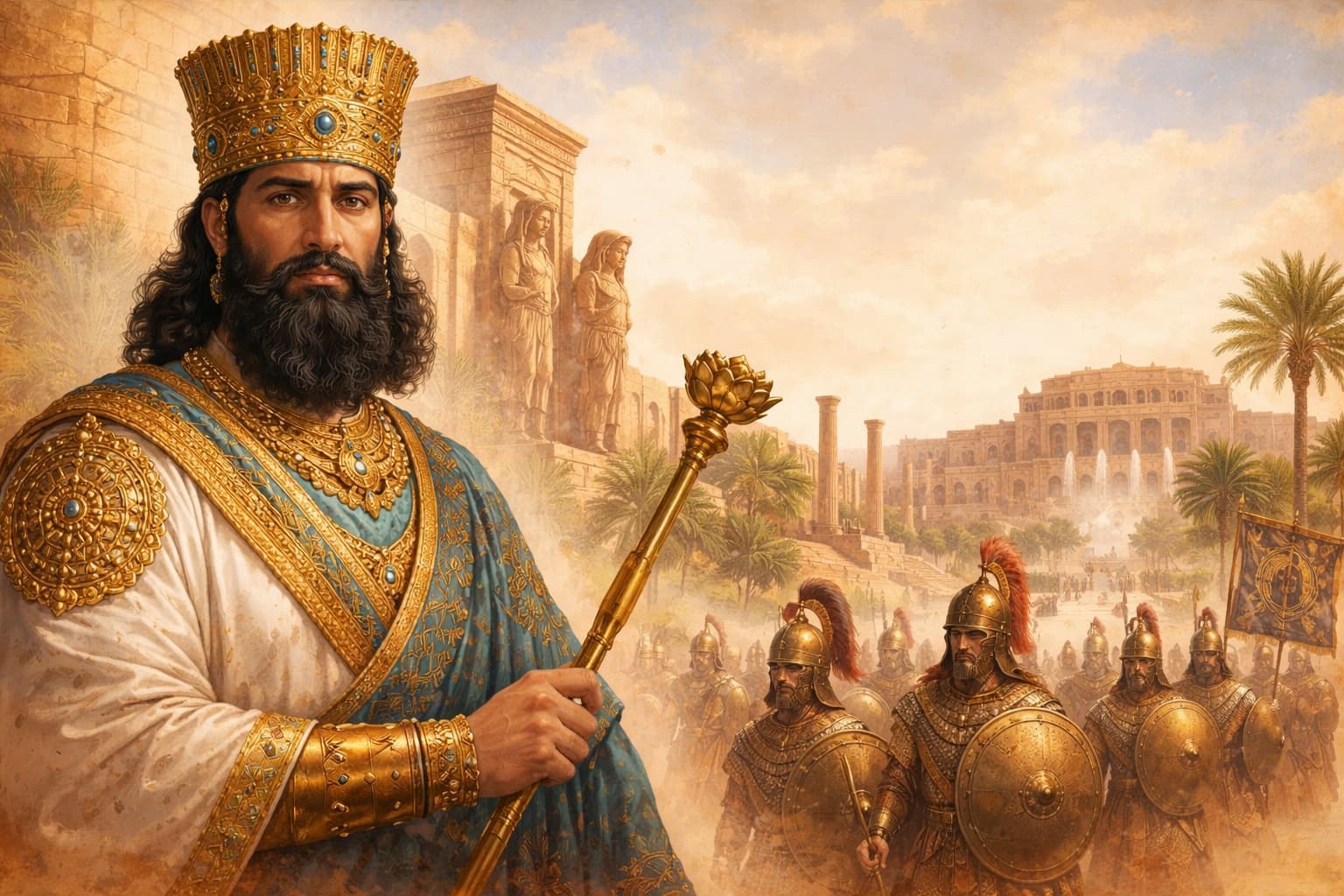
The Persian Empire
 Andres Aguilar
In 539 BCE, the greatest army in the world marched into Babylon and did something no conqueror had ever done before: it freed the enslaved, respected the temples, and declared religious tolerance for all peoples under its rule. Cyrus the Great didn't j...
In 539 BCE, the most powerful army in the world marched into Babylon — the largest and richest city on earth at the time. Its walls were so wide, the Greeks said, that chariots could run side by side along the top of them. It had hanging gardens, colossal temples, a population of hundreds of thousands. It was the center of the known world. And when the new conquering king entered the city, he did something absolutely nobody expected: he massacred no one, looted no temples, enslaved no inhabitants. On the contrary, he declared religious freedom, returned the idols that the Babylonians had plundered from other peoples, freed the enslaved — including the Jews who had spent decades in Babylonian captivity — and had all of this recorded on a cylinder of fired clay that today sits in the British Museum in London.
That object, known as the Cyrus Cylinder, is considered by many historians to be the first decree of human rights in the history of humankind. And the king who ordered it was named Cyrus II, though history remembers him as Cyrus the Great. His decision in Babylon was not merely a humanitarian gesture: it was a declaration of principles about how to govern an enormous and diverse territory. Rather than imposing a single identity on conquered peoples, Cyrus proposed to respect differences and govern through them. That idea — radical for its time — was the foundation on which the first great Empire in history was built.
Today the Persian Empire is almost always reduced to a supporting role in Western historical narratives: the villain of Greek history, the enemy that the 300 Spartans held back at Thermopylae. That is a great injustice. The Persians were, in many respects, the inventors of the first modern state in history. Provincial administration, a postal network, religious tolerance as state policy, diplomacy as an alternative to permanent war: all of those ideas find their first sustained experiment in the Achaemenid Empire.
The World Before Cyrus: Persians, Medes, and Neighborhood Politics
To understand the Persian Empire you first need to locate yourself on the map and in time. Persia was essentially what is today Iran: an arid, mountainous plateau in the heart of Asia. The Persians were an Indo-European people — meaning their languages and cultures shared common roots with the Greeks, the Latins, and many centuries later with us, the Spanish-speaking world — who had arrived in that region around 1000 BCE.
During their first centuries, they were a relatively minor people, politically dominated by their northern neighbors, the Medes. The Medes were the dominant power in the region. They had defeated the Assyrian Empire and were the reigning force across Central Asia. The Persians lived to the south, in a region called Anshan, and owed them loyalty. That remained the case for decades, until around 550 BCE when Cyrus II appeared.
What Cyrus accomplished in fewer than twenty years is one of the great narratives of ambition and conquest in all of ancient history. First he rebelled against the Medes, defeated them militarily, and unified Persians and Medes under his command. Then he marched west and defeated the famous Croesus, King of Lydia — from whom we get the expression "rich as Croesus," because Lydia was the land where gold coins were supposedly invented — in what is today Turkey. The legend has it that before attacking Cyrus, Croesus consulted the Oracle of Delphi, which replied: "If you cross the Halys River, you will destroy a great empire." Croesus crossed the river, convinced the oracle was promising him victory. And indeed he destroyed a great empire: his own. The oracle never said which empire it meant.
With Lydia under control, Cyrus had access to the entire western coast of Asia Minor, where the wealthiest Greek cities were. Many of them surrendered without fighting — the terms Cyrus offered were reasonable: keep your internal government, pay a fixed tribute, don't resist militarily. It was a model of absorption that minimized wars of attrition and maximized the speed of expansion. A conqueror who offered better terms than the alternatives was a conqueror who didn't need to conquer: surrender came by itself.
And then came Babylon, the great triumph described at the start. By 530 BCE, when Cyrus died in a campaign against the Massagetae — a nomadic people of the Central Asian steppes — he had built the largest empire the world had ever seen. It stretched from present-day Pakistan to North Africa, from Central Asia to the Aegean Sea. And he had done it in fewer than twenty years. The speed is so extraordinary that some historians compare Cyrus to Alexander. The difference is that Alexander destroyed Cyrus's Empire in ten years, while Cyrus's lasted two centuries. Empires built on consensus tend to last longer than those built only on the sword.
Darius the Great: The Administrator Who Gave Shape to the Giant
Cyrus died before his work was complete, but what came next was equally impressive. His son Cambyses II continued the expansion and in 525 BCE conquered Egypt, another of the great kingdoms of the ancient world. But Cambyses had a turbulent reign and died in obscure circumstances in 522.
It was then that the man who would give the Persian Empire its definitive form came to power: Darius I, also known as Darius the Great. Darius was not a direct son of Cyrus or Cambyses, but he was of Achaemenid blood and imposed himself in an internal struggle for power. And once consolidated, he set to work with an energy and a vision that make him one of the great administrators in history.
Darius took a vast territory — with peoples speaking dozens of different languages, radically different cultures, deserts, mountains, fertile valleys, coastlines — and organized it in a way that was completely innovative for its time. The system was called the satrapy. He divided the empire into provinces, each with a satrap in charge, something like a viceroy or regional governor appointed by the king. The satrap had autonomy to govern his region, but answered to the central king, paid fixed taxes, and was obligated to maintain order. Additionally, Darius appointed royal inspectors — called "the eyes and ears of the king" — who traveled the territory to ensure that satraps neither became corrupt nor accumulated too much power.
This may sound logical to us today, living in states with provinces or departments. But in the world of the fifth century BCE it was an organizational revolution. The usual alternative was to conquer territories and let them govern themselves until they rebelled. Darius, by contrast, created a coherent administrative structure with laws, taxes, and communications that actually worked.
To make the empire function, Darius built the most impressive road network in the ancient world. The most famous was the Royal Road, which connected the administrative capital Susa — in present-day Iran — with Sardis on the Mediterranean coast of what is now Turkey: more than 2,700 kilometers of paved road, with relay stations one day's ride apart, security guards, and royal messengers who changed horses at each station. The Greek historian Herodotus was so impressed that he wrote that "neither snow, nor rain, nor heat, nor darkness of night prevents these couriers from completing their designated stages." That phrase was later adopted as the unofficial motto of the United States Postal Service. The Persians, without knowing it, left their mark even on the words inscribed in American post offices.
Darius's tax system was another notable administrative achievement. He divided the satrapies into fiscal districts with fixed quotas of gold and silver to be paid to the central treasury. That treasury, accumulated in the royal capitals of Persepolis, Susa, and Ecbatana, became the largest the world had ever seen. When Alexander conquered Persepolis, he found there a trove of such magnitude — the sources say it took thousands of mules and camels to transport it — that modern historians have compared its value to tens of billions of current dollars. All that wealth was the result of centuries of methodical fiscal administration. The Persian Empire was not only militarily powerful: it was economically the richest state in the ancient world for more than two centuries.
Darius also introduced a standard currency — the gold daric, bearing the image of the king drawing a bow — that facilitated trade across the enormous distances of the territory. It was the first time in history that a state of that size adopted a truly unified currency with imperial reach. Before Darius, commerce between distant regions required negotiating the value of every exchange. With the daric, a merchant leaving India could pay in the same currency upon arriving at the shores of the Mediterranean.
Darius's satrapy system was the first lasting solution to the problem of governing diversity on a continental scale. Its architecture — a strong center, autonomous provinces, independent inspectors — was copied by Rome, by the Arabs, and by the Ottomans.
The Persian Wars: When Greece Resisted the World
The Persian Empire did not only look east. It also looked west, toward Greece, and there began one of the most narrated conflicts in ancient history: the Persian Wars. The Greeks called the Persians "Medes" because they originally confused the two peoples, and that's where the name comes from.
The opening spark was the revolt of the Greek cities of Asia Minor against Persian rule, a revolt supported by Athens, which Darius saw as an unforgivable affront. In 490 BCE, the Persian army landed on the plain of Marathon, about 40 kilometers from Athens. The Athenians, heavily outnumbered but employing a brilliant tactic, defeated Darius's army in a battle that history immediately mythologized. The legend has it that a soldier named Pheidippides ran from the battlefield to Athens to announce the victory and died of exhaustion upon arrival. That's where the marathon comes from.
Darius was furious and began planning a massive retaliatory expedition, but he died in 486 without being able to launch it. It fell to his son Xerxes to fulfill that ambition. And Xerxes did it on a grand scale. In 480 he organized the largest military expedition the ancient world had ever seen: an army of tens of thousands, perhaps over 200,000 by modern estimates.
To cross the Hellespont — the strait separating Asia from Europe — Persian engineers built two bridges of boats. A storm destroyed them before the army crossed. Xerxes' reaction to this setback became legendary in antiquity: he ordered the sea to be flogged. He literally sent his soldiers to put chains in the water and give the Hellespont three hundred lashes for daring to destroy his bridges. He also had the engineers responsible for the disaster beheaded. That episode speaks of a man accustomed to everything obeying his will — including the forces of nature.
The Persians finally crossed on a new bridge and pushed south. At Thermopylae, the Spartan king Leonidas, with 300 Spartans and several thousand allies, held out for three days before being surrounded and massacred. That sacrifice was deliberate: to buy time for the rest of Greece to organize. After Thermopylae, the Persians took and burned Athens. But at the naval battle of Salamis, the Athenian strategist Themistocles laid a trap for the Persian fleet: he lured it into narrow waters where numbers offered no advantage and where the more maneuverable Greek ships destroyed it. Xerxes watched the battle from a throne on the shore. He had to watch his fleet go under.
The crucial point here is what would have happened had Persia won. The Persian defeat in Greece allowed Athenian democracy to survive, allowed the theater, philosophy, and sculpture of Greece to flourish in the years that followed, and allowed that culture to reach Rome and through Rome to us. Without the Greek victory at Salamis, the Western world would be a radically different place. That doesn't mean the Persians were "the villains" of this story: it means that historical contingency matters. The civilizations we know are the ones that won certain battles, not the ones that were most right.
But there is something else worth noting about the Persian Wars: the narrative that came down to us is essentially Greek, written by the victors. Herodotus, the main source for this period, was Greek and wrote for a Greek audience. His descriptions of the Persian army as a disorganized horde of millions have been systematically challenged by modern archaeologists. The Persians were well-trained, well-equipped, and well-commanded soldiers. They lost the Persian Wars due to a combination of logistical, climatic, and tactical factors, not because they were disorganized barbarians. Reading the history of the Persian Wars only through Greek eyes is like reading the Battle of Las Navas de Tolosa only from Castilian sources: you get part of the truth, not all of it.
Persepolis and the Civilization That Deserves Admiration
Beyond the wars, the Persian Empire at the height of its splendor was an extraordinary civilization that deserves to be admired for its own achievements, not only in relation to its Greek enemies.
The ceremonial capital, Persepolis, was an architectural work without equal. Darius and his successors built there a complex of palaces and halls on a massive stone platform, with staircases covered in reliefs depicting delegations from all the nations of the empire — Ethiopians, Bactrians, Indians, Medes, Arabs, Greeks — bringing tribute to the king of kings. It was a visual representation of the world order: the entire world converging on the Persian center. The construction techniques combined Egyptian, Mesopotamian, and Greek influences, because the Empire was cosmopolitan enough for its craftsmen to come from everywhere. Today the ruins of Persepolis sit in southern Iran and are a UNESCO World Heritage Site.
Persepolis was not just a palace: it was a political statement in stone. The reliefs on the staircases don't show conquered peoples humiliated: they show delegations from every nation of the empire bringing their finest products as offerings to the king of kings. The Ethiopians bring a giraffe. The Indians bring vessels of spices. The Greeks bring cloth. The image is of organized diversity, not crushing domination. Compare that with Egyptian obelisks or Assyrian friezes, which invariably depicted the pharaoh or king crushing his enemies. The visual message of Persepolis was different from anything that had preceded it: the world converges here, and the king organizes that convergence. It was imperial propaganda unlike anything before it.
The Empire also had a sophisticated economy for its time. Trade in spices, metals, textiles, and crafts flowed along the royal roads from India to the Mediterranean. Persian cities were cosmopolitan centers where merchants and craftsmen from dozens of peoples coexisted. The multicultural model that Cyrus had inaugurated with his proclamation in Babylon was not only a moral principle: it was also intelligent economic policy. A Greek merchant who could travel safely along the king's highways and pay in a coin recognized throughout the empire was a merchant who generated wealth for that empire.
Zoroastrianism: The Religion That Changed the World Without Our Knowing It
The religion of the Empire was Zoroastrianism, founded by the prophet Zoroaster or Zarathustra centuries earlier. And here comes one of the most striking facts in this entire episode: Zoroastrianism introduced a series of concepts that are going to sound very, very familiar.
The cosmic struggle between good and evil represented by opposing divine forces. The human free will to choose between them. The final judgment of the soul after death. Paradise for the righteous and hell for the wicked. The resurrection of bodies at the end of time. The concept of a Savior who will come at the end of days to restore the divine order.
All of those concepts, which today we naturally associate with Judaism, Christianity, and Islam, were developed in Zoroastrianism centuries earlier. During the Babylonian captivity, the Jews lived alongside Zoroastrian ideas, and many historians believe that contact with that tradition profoundly influenced the subsequent development of Jewish religious thought. There is, in other words, a possible line connecting the ideas of the Persian prophet Zoroaster with the beliefs of more than two billion people in the world today. The Persian Empire was not only political and economic: it was also, through Zoroastrianism, one of the great transmitters of religious ideas in human history.
Zoroastrianism also introduced the idea that time has a direction: that history advances toward an end, toward a final resolution of the conflict between good and evil. The circular religions of Mesopotamia and Egypt — where time repeated itself in eternal cycles, like the Nile or the Sun — were gradually replaced by a linear conception of history that today dominates secular thought as much as religious thought. The idea of progress, that humanity is moving toward some better destination, is a secularization of that Zoroastrian intuition. The Persian Empire, without knowing it, helped give shape to one of the most fundamental categories of modern Western thought.
Alexander and the End of the Empire
The end of the Persian Empire came at the hands of Alexander the Great, to whom we dedicated a full episode in this podcast. In just ten years, Alexander defeated the Persian king Darius III in three decisive battles: the Granicus in 334, Issus in 333, and Gaugamela in 331. Darius III fled from the last two battles, which was devastating for his authority: a Persian king who fled the battlefield lost all legitimacy. He was finally assassinated by his own generals in 330.
Alexander took Persepolis and, after a banquet, burned the royal palaces. The legend says it was at the urging of an Athenian woman named Thais, who wanted to avenge the burning of Athens by Xerxes. There is something of poetic justice in that, though also something of brutal irony: the act that closed the Persian Empire was essentially an act of deferred revenge, two hundred and fifty years after the fact.
But Alexander did something no simple conqueror would have done: instead of destroying Persian culture, he embraced it. He adopted Persian royal dress, incorporated Persian nobles into his court, took Persian wives, required his Macedonian generals to marry Persian women. He tried to create a new fused civilization that we call Hellenistic. That generated enormous resistance among his own men, who saw in him someone who had betrayed his Greek roots. But it was also an implicit acknowledgment that the Persian world was too valuable to simply discard.
The Legacy That Shapes the Present
The legacy of the Persian Empire is immense, though often invisible in the historical narratives we learn in school. The idea of the multicultural state — a government that respects and administers the differences of its subjects rather than crushing them — comes in large part from the Persians. The satrapy system directly influenced the provincial organization of Rome, the Arab caliphates, and the Ottomans.
The royal road network with its efficient messaging system is the direct predecessor of the postal systems we discussed in episode three. And the religious influence of Zoroastrianism on the Abrahamic traditions is one of those underground connections in history that are rarely taught but that shaped everything that came afterward.
The Persian language, Farsi, is still spoken today by more than a hundred million people in Iran, Afghanistan, and Tajikistan. Medieval Persian poetry — Omar Khayyam, Rumi, Hafiz — is considered among the most beautiful and profound in all world literature. Rumi in particular has become the most-read poet in the United States in the twenty-first century. The words of a Persian Sufi from the thirteenth century resonating in the contemporary world: that is what culture does when it is truly deep.
And the territory that was the heart of the Achaemenid Empire remains, 2,500 years later, the cultural and political heart of a region that never stops generating headlines. Iran and its conflicts with the Western world cannot be understood without the memory of that imperial past, of that consciousness of having once been the center of the known world, and the perception of a decline imposed from outside. The roots of Persia did not disappear with Alexander or with the Arabs or with any of the later conquerors. They survived, adapted, and remain.
What endures most from all of this is the figure of Cyrus the Great: a conqueror who understood, two thousand five hundred years ago, that real power is not built on terror but on respect. And that intuition changed how the empires that followed thought about the relationship between ruler and ruled.
The Cyrus Cylinder is today in the British Museum in London. From time to time, the Iranian government asks for its return. From time to time, the British Museum refuses. In that modest dispute there is something worth noting: a 2,500-year-old fired clay object still relevant enough for two modern governments to fight over it. That, in itself, is a form of legacy few empires can claim.
A man who flogged the sea with chains and another who freed slaves with a decree: both are the Persian Empire, and that contradiction makes it more human and more fascinating than any simplified story of good and evil. Great empires always contain both. That is why they still matter.
The Persian Empire was the first sustained and successful attempt to administer human diversity on a continental scale. That project — governing over dozens of peoples with different languages, gods, and customs without crushing those differences but using them — was its most original and most enduring legacy. Before the Persians, the model was homogenization by force. After the Persians, the world knew there was another option. That it wasn't always chosen, not by a long shot, is part of the story. That someone tried it first, and proved it was possible, is part of the story too.
Related episodes
In 1871, Paris experienced 72 days of radical rule; Versailles crushed him in Bloody Week. Ideas and violence that marked the modern left.
When Rome fell in 476, the Roman Empire kept on existing — for another thousand years, with its capital at Constantinople. That empire almost no one remembers was the bridge between the ancient and modern worlds, the guardian of the Greek texts that fu...

The Eiffel Tower wasn't Eiffel's idea, it was painted red, it was despised by France's greatest writers, and it came within years of being torn down. The man whose name it bears was facing fraud charges when it opened. This is the story of how the worl...