
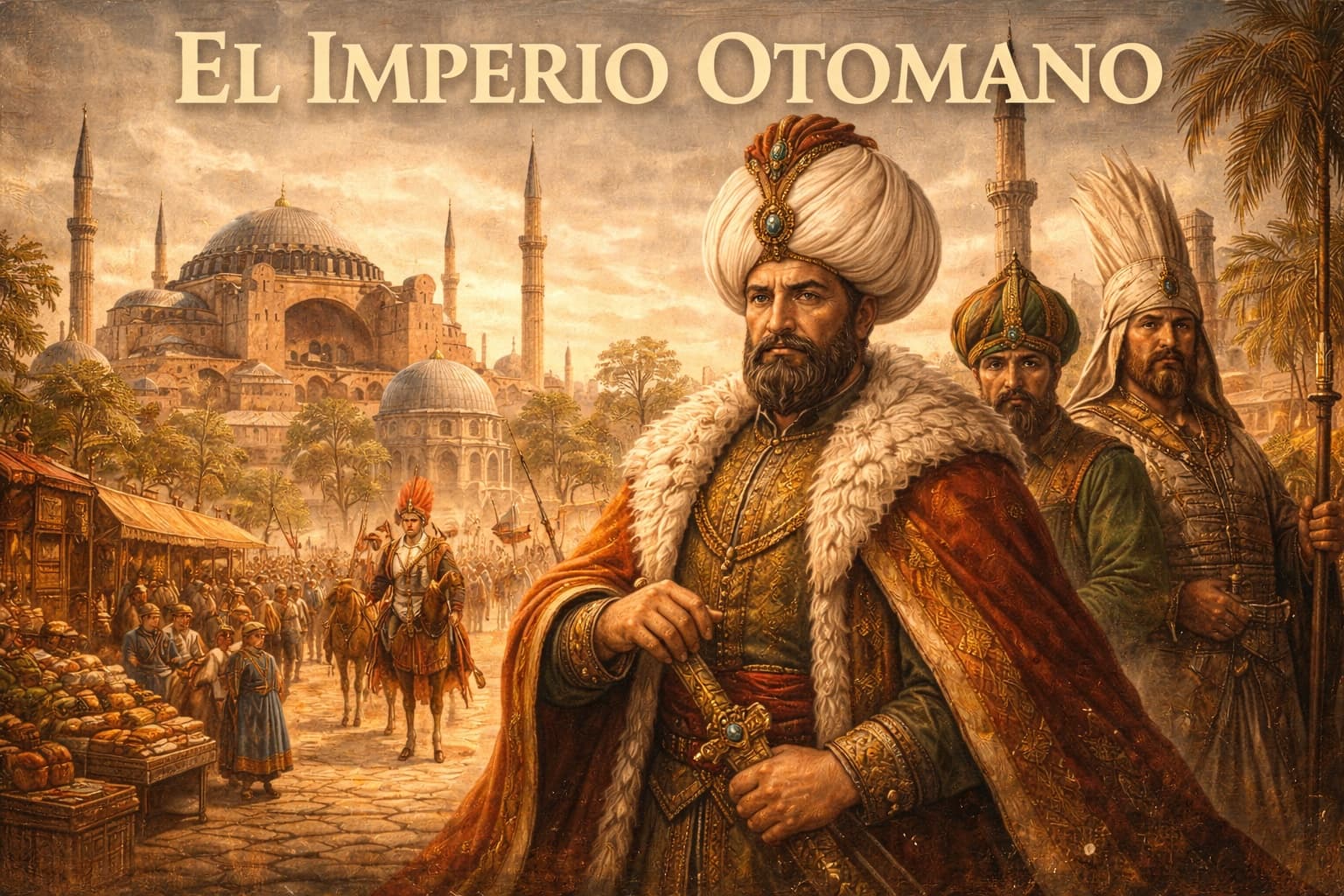
The Ottoman Empire
 Andres Aguilar
For six centuries, the Ottoman Empire sat at the crossroads of Europe, Asia, and Africa — and ruled them all. It absorbed the fall of Constantinople at 21, governed dozens of ethnicities and religions under a single administration, and at its peak stre...
In 1453, Sultan Mehmed II rode on horseback into the Hagia Sophia, one of the most imposing structures human beings had ever raised. He was 21 years old. Just hours before, his troops had breached the walls of Constantinople, the city that had stood for more than a thousand years as the capital of the Eastern Roman Empire. Mehmed dismounted, took a handful of earth, and poured it over his head. A gesture of humility before God, the chronicles say. A calculated gesture for history, any political analyst today would say. Because that 21-year-old knew exactly what he was doing: he was announcing to the world that there was a new power in the room, and that it was going to last.
The Ottoman Empire existed for six centuries. To make the scale of that number comprehensible: when the Ottomans founded their state, the printing press had not yet been invented in Europe, Christopher Columbus had not yet been born, and the Protestant Reformation was more than a hundred years away. When that same empire dissolved, airplanes and silent films already existed, and World War I had ended just five years before. Six centuries of history, dozens of sultans, three continents, and a legacy that still defines borders, conflicts, and cultures across the Middle East, the Balkans, and North Africa.
Understanding the Ottoman Empire is not an abstract academic exercise. It is understanding why the world we live in has the shape it does. The maps we use, the conflicts that remain unresolved, the religious and ethnic tensions that appear in the news every week: many of those lines have their origin in what this extraordinary state was, and in what it eventually became.
The Origins: A Tribe, a Dream, and a Lot of Luck
It all starts in the thirteenth century, in Anatolia, which is more or less what we know today as Turkey. At that time, the region was a patchwork of small Turkish states — called beylik — that had emerged after the Mongols destroyed the Seljuk Sultanate. It was a fragmented, violent world where every local lord was trying to survive and expand at the expense of his neighbors.
One of those local lords was Osman I, the founder of the dynasty that would give the empire its name. Osman was the leader of a relatively small Turkish tribe that controlled a strip of land in northwestern Anatolia, near the border with what remained of the Byzantine Empire. He didn't have the best resources, the largest army, or the most comfortable geographic position. What he had was a vision and, in all historical honesty, remarkably good timing.
There is a legend — worth telling even as legend — that Osman had a dream in which he saw a huge tree sprouting from his chest, its branches covering the entire world. The dream interpreters of the time told him this meant his lineage would rule the world. Whether that is history or retroactive political marketing is hard to say. But what is clear is that Osman began to act as if he believed in that dream, and that made all the difference.
What truly favored the Ottomans in their early decades was the deep crisis of the Byzantine Empire. Byzantium, which had been the dominant power in the region for centuries, was going through one of its worst periods: internal civil wars, economic problems, loss of territory, and an aristocracy that preferred palace intrigue to governing the state. The Ottomans exploited every crack. They didn't conquer by brute force alone; they also negotiated, absorbed local populations, and offered reasonable terms to those who surrendered without a fight. A people that submitted without resistance kept their property, their customs, and their religion. A people that resisted and lost faced the consequences. It was a combination of pragmatism and violence that proved enormously effective.
By the mid-fourteenth century, the Ottomans had already crossed into the European continent. They established their base at Adrianople, in what is today northern Greece and Bulgaria, and from there began expanding into the Balkans. This move into Europe is key to understanding the Ottoman character: from its earliest centuries, this was a state that connected Asia with Europe, that governed over populations of completely different religions and cultures, and that had to develop mechanisms for administering that diversity. The ability to manage difference — rather than eliminate it — was one of the great sources of Ottoman strength during its first centuries.
Mehmed and the Fall of Constantinople: The Hinge Point
Back to 1453 and that 21-year-old. Mehmed II had come to the throne following a complicated period of palace intrigues. His father, Murad II, had abdicated in his favor when he was a teenager, but the situation spiraled out of control and Murad had to return. When Murad died in 1451, Mehmed took power with one clear obsession: Constantinople.
The city was, at that point, more a symbol than a real power. Its population had fallen from hundreds of thousands to barely tens of thousands. Its effective territory was essentially limited to the city walls and little else. But those walls were legendary. The Theodosian triple walls, built in the fifth century, had withstood dozens of sieges over more than a thousand years. No army had ever taken them by direct assault.
Mehmed arrived with a solution to that problem, and that solution was named Urban. Urban was a Hungarian — or Romanian; the sources disagree — engineer who had offered his services to the Byzantine emperor Constantine XI. Constantine could not pay what Urban asked. Mehmed could. Urban designed for the Ottomans cannons of a size no one had built before. The most famous measured more than eight meters long and could hurl stone balls of more than 500 kilograms. It took two hours to reload, but what it did when it fired was devastating. The walls that had resisted catapults and battering rams for centuries were not designed to withstand that kind of impact.
The siege lasted 53 days. On May 29, 1453, the walls gave way. Constantine XI died in the battle — his body was never identified with certainty, which fed legends about his future return that still circulate in Greece. Mehmed entered the city.
The most interesting thing about what Mehmed did after the conquest was not the destruction but the reconstruction. There were indeed three days of pillage, as was the custom of the time when a city did not surrender voluntarily. But afterward, Mehmed actively worked to repopulate the city, attracting Greek, Armenian, and Jewish merchants, allowing Orthodox Christians to keep their Patriarchate, and transforming Constantinople into the cosmopolitan capital he wanted for his empire. Patriarch Gennadios II was personally installed by the sultan himself. It was a clear message about what kind of state the Ottoman Empire would be: one that governed over diverse religious communities, not one that eliminated them. The conquest of Constantinople was not just a military triumph; it was the declaration of a governing philosophy that would sustain the empire for centuries.
Suleiman the Magnificent: When the Empire Reached Its Peak
If Mehmed was the conqueror, Suleiman I was the administrator, the lawgiver, the poet, and the strategist. In Europe they call him Suleiman the Magnificent. In the Islamic world they call him Suleiman the Lawgiver. The fact that the same ruler carries two such different titles in two different traditions already tells you something about the complexity of what we're dealing with.
Suleiman ruled between 1520 and 1566 — forty-six years during which the Ottoman Empire reached its greatest territorial extent and its highest cultural splendor. His territory stretched from Hungary in the north to Yemen in the south, from Algeria in the west to the Persian Gulf in the east. He governed over Arabs, Greeks, Albanians, Bulgarians, Serbs, Hungarians, Armenians, Jews, and Berbers. It was the most powerful and most diverse state in the known world at that moment.
In Europe, kings watched him with a mixture of terror and fascination. Charles V, Emperor of the Holy Roman Empire, was his most direct rival. Francis I of France, who was constantly fighting Charles V, went so far as to forge an alliance with Suleiman. An alliance between the most powerful Christian king in Western Europe and the Ottoman sultan scandalized the Christian world of the time — but Francis was pragmatic: the enemy of my enemy is my friend. And so sixteenth-century geopolitics was already demonstrating that national interests could override any religious frontier.
Suleiman laid siege to Vienna in 1529. Had Vienna fallen, the road to the heart of Central Europe would have been open. It didn't fall, largely because of logistical problems with the Ottoman army and because winter arrived earlier than expected. Suleiman withdrew, but tried again in 1532. He still couldn't take the city. Those two failed sieges of Vienna are, for many historians, the moment that defined the western limit of Ottoman expansion.
Internally, Suleiman codified and systematized the empire's legal system. The Kanun was his monumental achievement. At a time when many European states operated on a chaotic mixture of tradition, custom, and arbitrary decree, the Ottoman Empire developed a relatively clear legal system applicable across the entire territory. That's why they call him the Lawgiver. His chief architect, Mimar Sinan, built during his reign some of the most important works of Islamic architecture, including the Süleymaniye Mosque in Istanbul, which remains one of the most beautiful buildings in the world. Suleiman himself wrote poetry under the pen name Muhibbi — "the lover" — and his verses are still studied in Turkish literature.
But even Suleiman, for all his greatness, had his personal tragedies. The most famous: he ordered the execution of his eldest son and heir, Şehzade Mustafa, convinced that he was conspiring to overthrow him. The woman behind that accusation, the chronicles say, was Hürrem Sultan — the harem favorite who had become his legal wife, something utterly unprecedented in Ottoman history — who wanted the throne for one of her own sons. Mustafa was strangled on his father's orders. That act marked the beginning of a series of succession conflicts that would weaken the empire in the decades that followed.
That the same ruler is called 'the Magnificent' in Europe and 'the Lawgiver' in the Islamic world tells you everything about the complexity of the Ottoman Empire: it was simultaneously a military power that terrified Europe and a state built on law that codified the coexistence of millions.
The Economy of the World: Trade, Routes, and Wealth
One of the least discussed factors of Ottoman power was its control over the trade routes between Europe and Asia. Constantinople, now the Ottoman capital, had already been one of the main nodes of East-West trade before the conquest. Under Ottoman rule, that role was amplified. The Empire controlled the passage between the Black Sea and the Mediterranean, had access to the overland spice and silk routes coming from Persia, India, and China, and dominated much of the Red Sea coast — the other great route to the Indian Ocean.
This commercial control was an enormous source of revenue and also, paradoxically, one of the factors that accelerated European exploration of alternative routes. The kings of Spain and Portugal financed the voyages of Columbus and Vasco da Gama in part precisely to find paths to the spices that didn't depend on Ottoman territory. Columbus was trying to reach Asia by sailing west. Da Gama found the route around the southern tip of Africa. The unintended result of Ottoman dominance over the eastern routes was, in part, the discovery of America and the opening of Atlantic trade. History has these ironies: the Ottomans, without intending to, helped create the commercial system that would eventually leave them behind.
The Grand Bazaar of Istanbul, inaugurated in the fifteenth century, was in its heyday the largest shopping center in the known world. More than four thousand shops, dozens of guilds organized by product, merchants from dozens of countries. It was the heart of a network that connected the silk of China with the linen of Egypt, the spices of India with the amber of the Baltic. That network made Istanbul a cosmopolitan city without parallel in its time.
The System That Made the Giant Work
To understand how such a large state could function for so long, you have to understand some of its particular institutions. One of the most fascinating is the devşirme system.
The devşirme — which can be roughly translated as "collection" — was a system by which the Ottoman state regularly recruited young males from Christian communities in the Balkans, converted them to Islam, and educated them in special palace schools. The best of these young men could become janissaries — the elite military corps of the Ottoman army — or even high officials of the state. Several of the Ottoman Empire's great viziers came through the devşirme.
This sounds paradoxical: the state was using people from conquered populations to build its administrative and military elite. But the logic was clear: these men had no prior family or tribal loyalties within the Ottoman world. Their only loyalty was to the sultan and the state. It was, in a sense, a merit-based bureaucracy built from people who could not betray the system because the system was their entire identity. Compared with European hereditary aristocracies, where office depended on your surname, it was a surprisingly meritocratic arrangement — at least in its original design.
Another central element was the millet system — the word means roughly "nation" or "community" — which allowed non-Muslim communities to govern themselves in their internal, religious, and civil affairs. Greek Orthodox, Armenians, and Jews each had their own recognized structures of authority. They paid special taxes and faced certain restrictions, but they could in general practice their religion, speak their language, and maintain their customs. By the standards of fifteenth- to seventeenth-century Europe, where religious wars were a permanent feature and the Inquisition expelled Jews from Spain, the Ottoman model was remarkably tolerant. When the Jews were expelled from Spain in 1492, it was largely Ottoman territories that took them in.
The Slow Decline: When the Giant Loses Its Footing
Empires don't fall overnight. They fall slowly, sometimes so slowly that those living inside don't notice until it's too late. The Ottoman Empire began its relative decline — not absolute, but relative to a Europe that was growing ever faster — in the late seventeenth century.
The Battle of Vienna in 1683 is the most frequently cited turning point. The Ottomans besieged Vienna again with an enormous army under Grand Vizier Kara Mustafa. This time it seemed as though the city would fall. The defenders were at their limit. But the Polish king John III Sobieski arrived with a relief force and, in the battle that followed, the Ottoman army was routed. It was the last time the Ottomans threatened the heart of Europe. What followed was a long and painful loss of territory.
Internally, the problems were equally serious. The devşirme system had degraded. The janissaries, who were originally a disciplined military elite, had become a political force that made and unmade sultans. In the seventeenth century, several sultans were deposed or killed by the very janissaries who were supposed to protect them. The harem had become a permanent source of instability. Corruption took hold at every level of the administration. And meanwhile, Europe — driven by the Scientific Revolution and then by the Industrial — was accumulating technological and organizational advantages that the Ottoman Empire could not keep pace with.
Mahmud II, in the nineteenth century, finally managed to dissolve the janissaries in 1826 — the episode is known as the Auspicious Incident, which is a rather euphemistic way to describe a massacre — and undertook deeper reforms. But it was late, and the world had moved too fast.
The Last Century: Reforms, Nationalisms, and Collapse
The nineteenth century saw the Ottoman Empire desperately trying to catch up. The Tanzimat — the great reforms of the period 1839-1876 — attempted to modernize the administration, establish legal equality between Muslims and non-Muslims, and create a more modern judicial system. These were real, genuine reforms, driven by an enlightened bureaucracy that understood the state needed to change in order to survive.
The problem was that those reforms arrived at exactly the moment when European nationalism was at its peak. The Greeks had won independence in the 1820s. The Serbs, Bulgarians, and Romanians gained autonomy and then independence throughout the century. Each war, each diplomatic defeat, each lost territory weakened the state further and radicalized those who wanted to resist.
The twentieth century brought the darkest chapter. In World War I, the Ottoman Empire allied with the Central Powers. The war was disastrous on every front. In that context of total war, the Ottoman government — controlled by the Young Turks movement — ordered the deportation and massacre of the Armenian population. What happened between 1915 and 1917 is recognized today by most historians and dozens of countries as a genocide: more than a million Armenians died in death marches, direct massacres, and deliberately lethal conditions. It is a wound that remains open today, that Turkey still refuses to formally acknowledge, and that defines part of the region's diplomatic relationships.
The war ended with the empire defeated and dismembered. The European powers arrived to divide up the territory. A map drawn by European officials with very little knowledge of the region and a great deal of self-interest in their own strategic objectives. That map, with its artificial borders, is largely the map of the Middle East today, and it explains much of the unresolved conflict that persists to this day.
The coup de grâce came with Mustafa Kemal — known from 1934 as Atatürk, "father of the Turks" — the military officer who had been one of the few Ottoman heroes of the war. He led the Turkish War of Independence between 1919 and 1923 and in 1923 proclaimed the Republic of Turkey. The caliphate was abolished in 1924. Six hundred years of history closed with that act.
The Legacy That Cannot Be Ignored
The borders of the Middle East, as already noted, are in large part a direct consequence of how the European powers divided up the Ottoman territories after World War I. The Israeli-Palestinian conflict, the war in Syria, instability in Iraq, tensions in Lebanon: all have deep roots in that moment of colonial carve-up. The straight lines crossing those maps — something you don't find in any border that evolved organically — are the signature of the European diplomats who decided the fate of populations they never consulted.
In the Balkans, the Ottoman imprint is equally deep. The Muslim presence in Bosnia, Kosovo, and Albania is a direct consequence of centuries of Ottoman rule. The architecture of cities like Sarajevo, Skopje, and Plovdiv carries unmistakable marks. The ethnic and religious tensions that exploded in the Yugoslav wars of the 1990s also have roots in that history.
In Turkey itself, the Ottoman legacy is a permanent subject of debate. Atatürk rejected it almost entirely: he changed the alphabet, secularized the state, and westernized society as far as he could. But in recent decades, there has been a process of rehabilitating that Ottoman heritage that fills some with enthusiasm and others with alarm. The Hagia Sophia — which Mehmed converted into a mosque, which Atatürk turned into a museum, and which Erdoğan reconverted into a mosque in 2020 — is the most powerful symbol of that dispute. A building that carries more than 1,500 years of history within its walls and is still a symbolic battlefield.
The Ottoman Empire was neither the multicultural paradise that some nostalgics describe nor the brutal despotism that its detractors oversimplify. It was an extraordinarily complex state that governed an enormous human diversity with a mixture of pragmatism, administrative brilliance, and, in its final decades, profound crisis.
The Ottoman Empire was, in many respects, the first great experiment in history in administering religious and ethnic diversity on a continental scale. It didn't do it perfectly, and its final decades stained that legacy with violence and genocide. But for centuries, the millet system and the relative tolerance of its institutions created a model of coexistence that few civilizations of its era could equal. Understanding that legacy, with all its complexity and contradictions, is not nostalgia: it is the only way to understand why the world we inherited has the shape it does.
And then there is the architecture. The Blue Mosque, the Süleymaniye Mosque, the Grand Bazaar of Istanbul, the medieval cities of the Balkans: they are part of the most impressive architectural heritage in the world. You cannot walk through Istanbul without feeling at every corner the weight of those six centuries. In the Sultanahmet neighborhood, the Roman Hippodrome, the Hagia Sophia, and the Blue Mosque coexist less than a hundred meters apart. It is the history of the world in one square kilometer. Not every empire can say that.
The language, the music, the cuisine: Ottoman cultural influence spreads across the entire region it governed for centuries. The words of Turkish origin in Greek, Serbian, Arabic, and Romanian are a linguistic map of that power. Turkish classical music, with its unique modes and instruments, developed for centuries in Ottoman courts and remains a living tradition. And the cuisine — baklava, köfte, pilaf — crossed every border of the old empire and became so integrated into local food cultures that it's barely recognizable as "foreign." Culture, unlike politics, has no borders that any European diplomat can draw.
There is no way to understand the contemporary world of Turkey, the Balkans, or the Middle East without understanding that all those countries are, to a greater or lesser extent, heirs of a state that existed for six centuries and left its mark on every aspect of the life of the regions it governed. The unresolved conflicts, the identities forged in resistance or collaboration, the urban architectures, the culinary traditions: everything bears the mark of the Ottoman Empire. The end came in 1924. But the legacy, like that of all great empires, did not end with a decree.
Related episodes
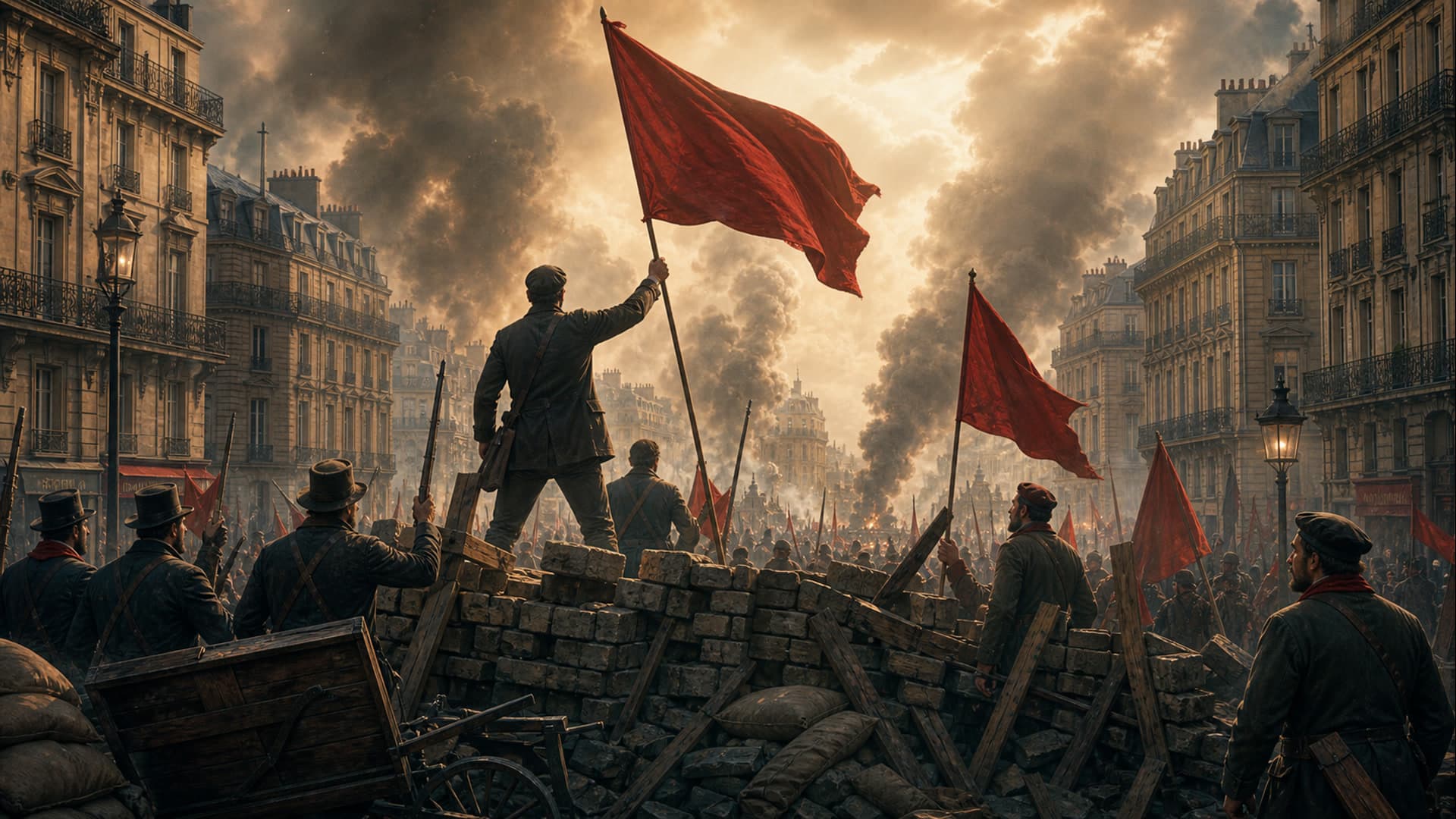
In 1871, Paris experienced 72 days of radical rule; Versailles crushed him in Bloody Week. Ideas and violence that marked the modern left.
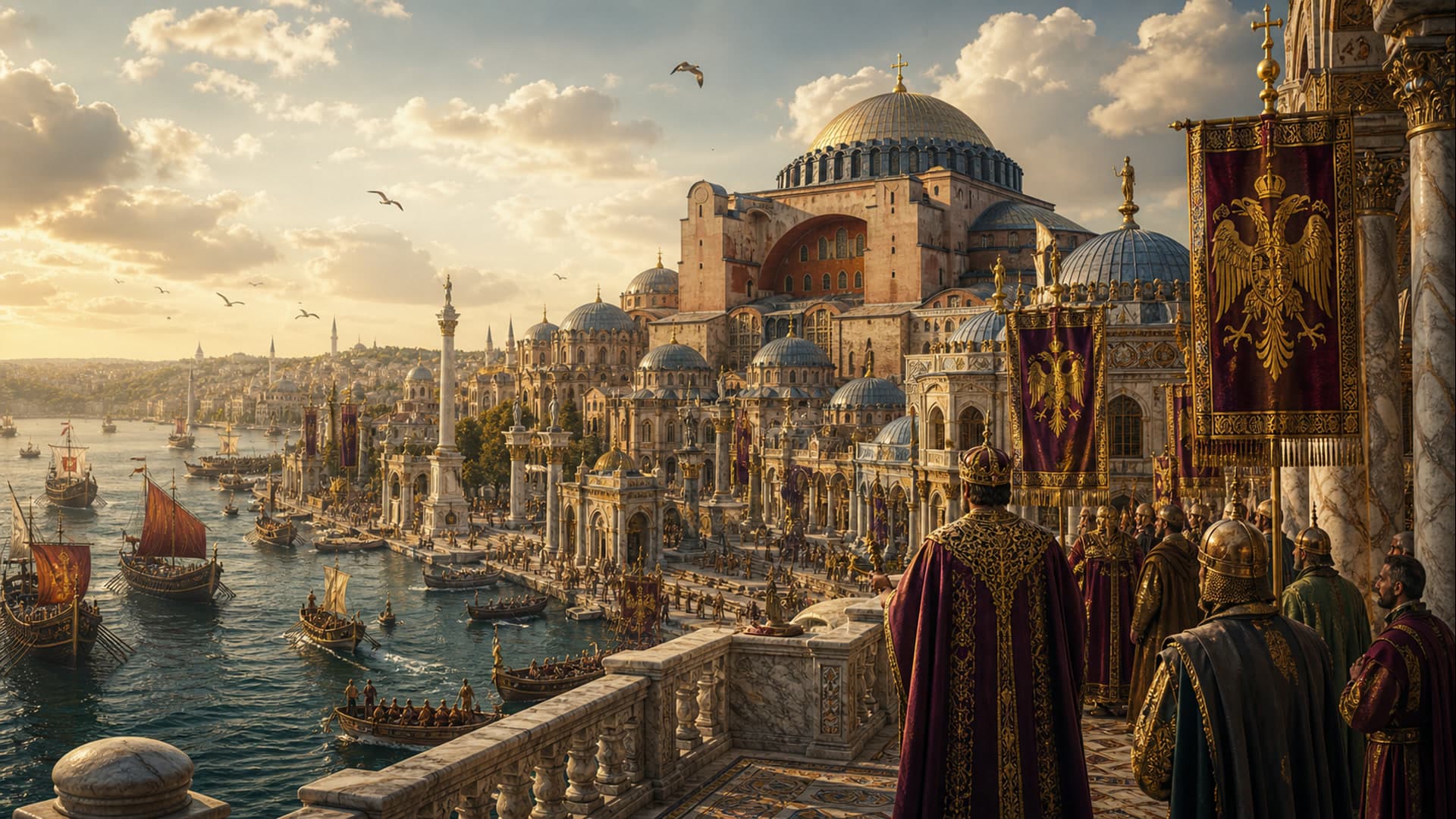
When Rome fell in 476, the Roman Empire kept on existing — for another thousand years, with its capital at Constantinople. That empire almost no one remembers was the bridge between the ancient and modern worlds, the guardian of the Greek texts that fu...
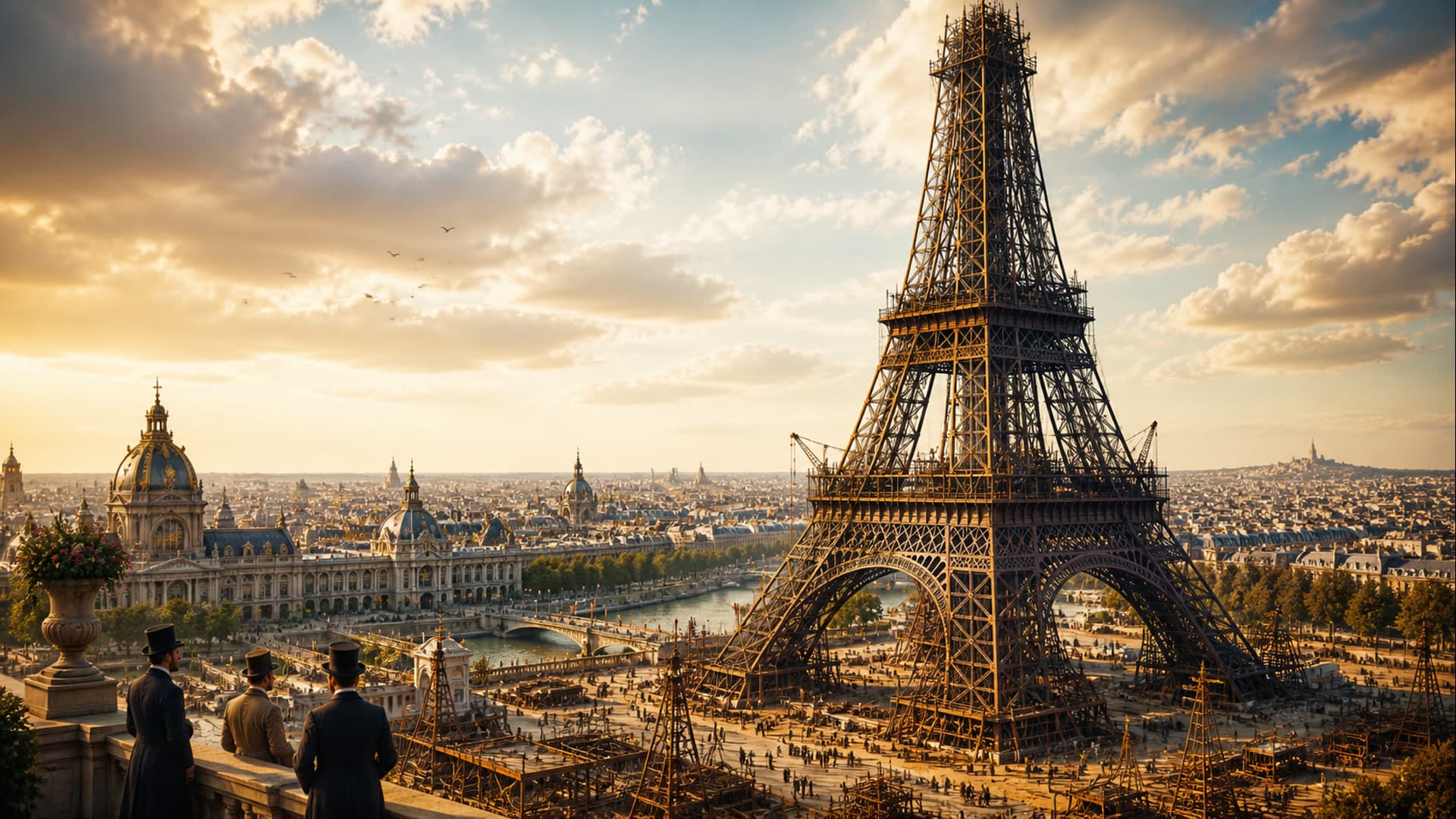
The Eiffel Tower wasn't Eiffel's idea, it was painted red, it was despised by France's greatest writers, and it came within years of being torn down. The man whose name it bears was facing fraud charges when it opened. This is the story of how the worl...