
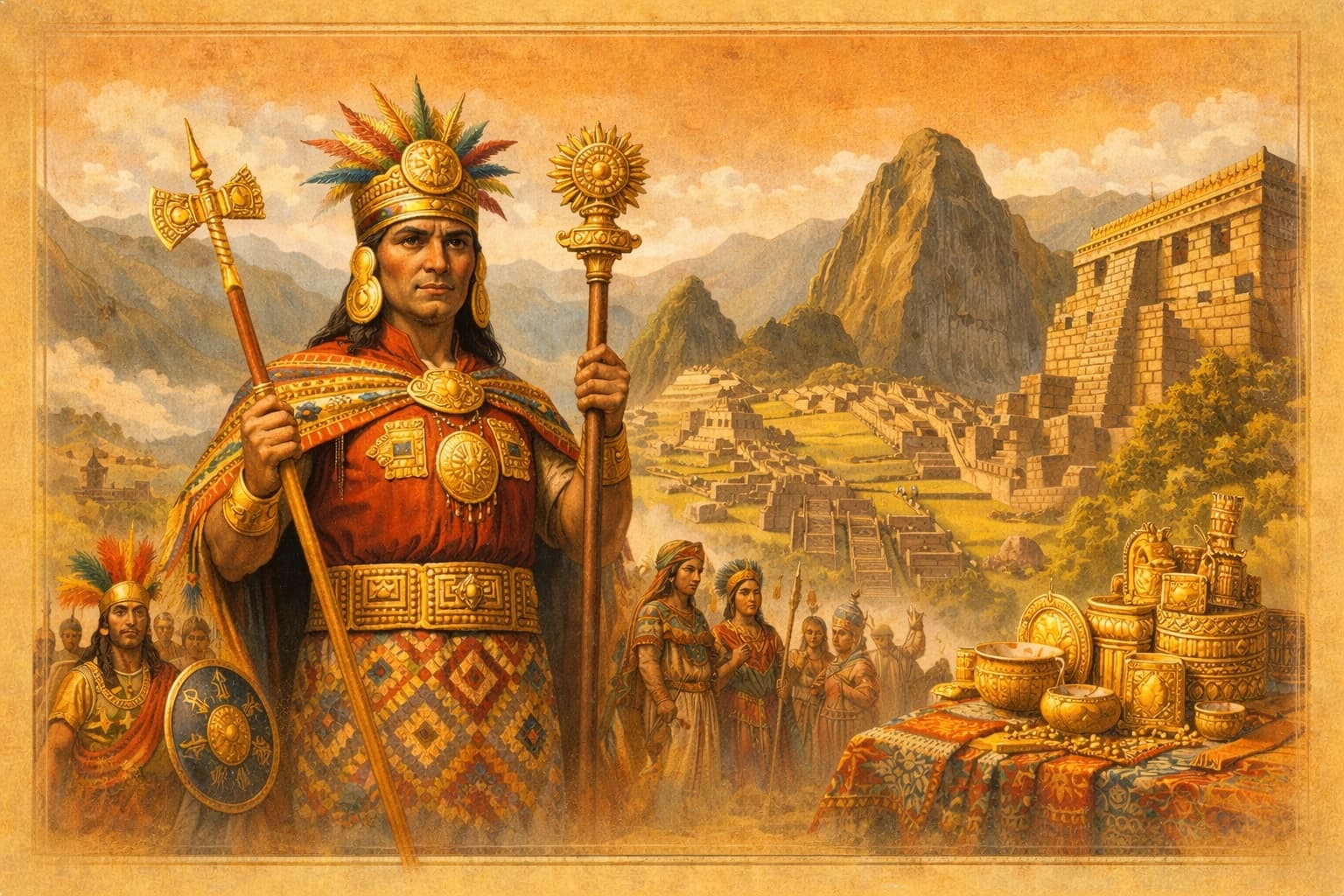
The Inca Empire
 Andres Aguilar
They built cities in the clouds, forty-thousand kilometers of roads, and an economy with no money and no markets. The Tawantinsuyu rose to govern twelve million people in under a hundred years — and was destroyed by a hundred and sixty-eight men in les...
In the fifteenth century CE, there existed in South America an empire without money, without alphabetic writing, without the wheel, without draft animals more powerful than a llama — and yet it was the largest and most sophisticated state on the American continent. It controlled a territory of more than four million square kilometers — roughly twelve times the size of present-day Argentina — stretching across tropical jungle, coastal desert, Andean valleys, and the most inhospitable high plateau in the world. It sustained a population of between ten and twelve million people. It had a paved road network of more than 40,000 kilometers. It built, high in the Andes, cities that still leave us without words. And it did all of this without the tools we take for granted.
That was the Tawantinsuyu, which in Quechua means "the four regions of the world." That was the Inca Empire.
Today we're talking about the greatest of the pre-Columbian empires of the Americas — a civilization that in fewer than a hundred years built something extraordinary, and in fewer than ten years was destroyed by a handful of Spanish conquistadors, in one of the most dramatic and unsettling collapses in human history. There's drama, there's brilliance, there's tragedy, and there are some facts that will surprise even well-read people. And there are also uncomfortable questions that honest history cannot avoid.
The Setting: The Andes as Challenge and Home
To understand the Inca Empire you first have to understand the setting where it was built. The Andes are the backbone of South America: a brutal mountain chain with peaks exceeding six thousand meters above sea level, deep valleys, unpredictable climate, and living conditions that would be considered extreme by any modern standard. The Andean high plateau — the puna — sits at more than 3,500 meters above sea level. Oxygen is scarce. Frosts are frequent. Resources seem limited.
And yet, in those mountains, Andean peoples had spent thousands of years developing agricultural, textile, and construction techniques adapted to that difficult environment. The andenes — agricultural terraces carved into mountain slopes — allowed cultivation at altitudes where any other system would have been impossible. Food preservation techniques, especially freeze-drying — the chuño, potato frozen and then dehydrated — allowed food to be stored for years without refrigeration. Andean camelids — llamas and alpacas — provided wool, meat, and transport in an environment where horses didn't exist and oxen neither. It was a civilization that had learned to make the most of a hostile environment with a creativity still admirable today.
The Incas inherited all that accumulated knowledge and organized it on an imperial scale. What distinguishes the Incas from other Andean peoples is not that they invented terrace agriculture, food preservation, or textile engineering: it's that they managed to integrate those scattered practices into a coherent state system that worked on a continental scale. The difference between an Andean people of the twelfth century and the Tawantinsuyu of the fifteenth is not one of technical knowledge: it's one of political organization. And that organizational capacity is, perhaps, their most extraordinary legacy.
> The difference between an Andean people of the twelfth century and the Tawantinsuyu of the fifteenth is not one of technical knowledge: it's one of political organization. And that organizational capacity is, perhaps, their most extraordinary legacy.
Pachacutec: The Man Who Shook the Earth
The Incas were originally a relatively small people who inhabited the valley of Cuzco, in what is today southern Peru. Cuzco — which in Quechua means "navel" — was their capital. According to their founding mythology, it had been established by Manco Cápac and Mama Ocllo, children of the Sun, who emerged from Lake Titicaca to teach humanity how to live in civilization.
What we know with historical certainty is that the Incas began expanding beyond the Cuzco valley only at the start of the fifteenth century. What made them different was one man: Pachacutec.
Pachacutec came to power around 1438 under dramatic circumstances. A neighboring and powerful people, the Chancas, had launched an invasion of Cuzco. The reigning Inca fled. It was the young prince Cusi Yupanqui who decided to stay and defend Cuzco. According to Inca oral tradition, before the battle he had a vision: the Sun god promised him victory. The Incas defeated the Chancas in a battle described as miraculous — it was said that the stones of the field had turned into warriors to help them — and Cusi Yupanqui took power. He adopted the name Pachacutec, which means "he who shakes the earth" or "he who transforms the world." Both translations fit him perfectly.
In the decades that followed, Pachacutec transformed the Inca from the king of a city-state into the ruler of the largest empire in the Americas. Military expansion, diplomacy, marriage alliances, incorporation of local elites: he used every tool available. He conquered territory to the north and south, had Cuzco built up as an imperial capital worthy of that title, and ordered the construction on a snow-capped ridge at more than 2,400 meters above sea level of a complex that today is the most visited archaeological site in South America: Machu Picchu.
Machu Picchu remains one of the great unanswered questions of American archaeology. We know it was a royal residence — probably of Pachacutec himself — and a religious center. We know it was built without mortar, stones fitted together with a precision that defies comprehension: they fit so perfectly that not even a sheet of paper fits in the joints. We know it was abandoned, probably shortly after the arrival of the Spanish. But why specifically there, on that impossible ridge, among those mountains, remains a mystery that archaeologists debate with passion.
The Gift Economy: Without Money or Markets
The Inca Empire functioned in a way that had no equivalent in the ancient or medieval world. Without money. Without markets. Without monetary exchange of any kind.
The Inca economy was based on what anthropologists call reciprocity: the state provided communities with tools, seeds, and protection, and communities reciprocated with labor — the mit'a, as that labor obligation was called — and with food. The state granaries, called qollqas, were deposits distributed throughout the territory where food was stored to be redistributed in times of famine, to feed armies on campaign, and to sustain workers on major state projects. It was a system of centralized redistribution that historians compare to a planned economy ahead of its time — without the ideological connotations of the modern term.
This system had notable advantages. It eliminated local subsistence crises: when a region suffered a bad harvest, the state qollqas guaranteed that no one would starve. It sustained major infrastructure projects without the need for labor markets or capital: the roads, temples, and cities were built with mit'a labor, organized and provided by the state. And it created a network of loyalties and obligations that integrated conquered peoples into the imperial system more durably than pure force.
The weakness of the system was its rigidity: everything depended on the administrative capacity of the central state. When that center collapsed — as happened with the death of Huayna Cápac and the civil war that followed — the entire web of reciprocities came apart. A system so centralized, so dependent on the figure of the Sapa Inca, had none of the decentralized mechanisms of markets that would allow it to function autonomously when the center failed.
The Quipus: The Writing That Hasn't Been Decoded Yet
Without alphabetic writing, the Inca state recorded all its information — population censuses, storage statistics, administrative records, and perhaps also historical narratives — using quipus. Quipus are systems of knotted cords with different types of knots, colors, and positions. Each knot, each color, each position along the cord carried a specific meaning. It is a form of information coding completely unlike any writing system developed by other civilizations.
Specialists have spent decades trying to fully decipher the quipus and have not yet reached full consensus. Some believe they recorded only numerical data; others think they could also encode narratives. If they are ever fully decoded, we may be reading Inca historical accounts written in rope.
It's worth pausing here, because the question of writing raises an issue that serious historians don't sidestep: if the conventional line dividing prehistory from history is the invention of writing, does that mean the Incas were living in a kind of prehistory when the Spanish arrived? The honest answer is: technically, yes. That definition wasn't invented by Europeans to denigrate anyone; it is a conceptual tool historians use because without writing there are no primary documents, no exact dates, no direct voices of the protagonists. Everything we know about the Incas before the conquest comes from three sources: archaeology, quipus that aren't yet fully decoded, and testimonies gathered by the Spanish after 1532 — already filtered through the conquest itself.
The quipus are the strongest argument for qualifying that conclusion. If it is ever definitively proven that they encoded narratives, the situation changes radically. For now, that proof doesn't exist. And while it doesn't, the problem remains: the Tawantinsuyu is a civilization whose internal history, in its own words, is largely unrecoverable. That is not a moral judgment. It is an acknowledgment of what it means not to have developed writing before being conquered.
> The Tawantinsuyu is a civilization whose internal history, in its own words, is largely unrecoverable.
The greatest lost legacy of the Inca Empire may be precisely the one we cannot recover: the stories that were in the quipus, the internal voice of a civilization that time and conquest turned to silence.
The Roads: The Most Extraordinary Engineering Feat in the Americas
The road network that united this vast territory is one of the great engineering achievements of pre-Columbian history. The Qhapaq Ñan — the "main road" in Quechua — was a network of more than 40,000 kilometers crossing the entire empire from north to south, with branches stretching east and west. It crossed deserts, spanned suspension bridges over torrential rivers — some of those bridges were ritually rebuilt every year, and there are communities in the Andes that maintain that tradition today — and climbed mountains on steps cut into the rock.
Along those roads ran the chasquis, the state messengers, who relayed news from post to post in a manner similar — allowing for the distances involved — to the Persian postal system we discussed in episode eighteen. A message could travel from Cuzco to Quito, in present-day Ecuador, in just ten days. Roughly two thousand kilometers in ten days, without wheels, without horses — only human legs.
> A message could travel from Cuzco to Quito, in present-day Ecuador, in just ten days. Roughly two thousand kilometers in ten days, without wheels, without horses — only human legs.
In 2014, UNESCO declared the Qhapaq Ñan a World Heritage Site. The road network, though partially destroyed and abandoned, remains one of the most impressive infrastructure projects human beings have ever built under such extreme conditions. Modern engineers who have studied the Inca suspension bridges over the Andean rivers were astonished: built without knowledge of the arch and without metal, only with braided plant fibers, they could still support the weight of hundreds of people and llamas at once. That textile engineering is, in many ways, more sophisticated than stone masonry.
Religion: The Sun and the Sacrifice
Inca religion was polytheistic, with the Sun — Inti — as the chief deity. The Sapa Inca was considered the son of the Sun, which gave him a sacred authority over his subjects that could not be questioned without questioning the divine order. The great temples of Cuzco, such as the Coricancha or "temple of gold," were literally covered in gold — the sacred metal representing the light of the Sun. When Pizarro took Cuzco in 1533, the conquistadors stripped the gold plates from the temples — tons of precious metal — and melted them down. They destroyed in days what it had taken generations to build.
Ritual sacrifices were an essential part of the relationship between the human world and the divine. Human sacrifices, though less frequent than in some Mesoamerican cultures, occurred on very specific occasions: the death of the Sapa Inca, major natural catastrophes, moments of political crisis. High in the snowy Andes, archaeologists have found mummies of children sacrificed five hundred years ago in a state of extraordinary preservation, frozen by the cold of the mountain peaks. Analysis of those mummies revealed they had received large doses of alcohol and coca leaves in the days and weeks before the sacrifice. The most widely accepted interpretation is that they were sedated to make the experience as painless as possible. We know that in many cases children were chosen for their beauty and health, considered the finest their communities could offer to the Sun. Within their belief system, it was the highest possible honor. That doesn't make it any less disturbing to us, but it does obligate us to understand it in its own context before judging it.
The religious organization of the state was also a fundamental political tool. The priests of Inti formed an elite that administered the temples, interpreted oracles, and legitimized the decisions of the Sapa Inca. The Virgins of the Sun — the Acllas — were women selected from childhood to serve in the temples, weave the sacred state textiles, and in some cases become wives of the Sapa Inca or be sacrificed in important ceremonies. The state controlled their lives from childhood. They were simultaneously figures of honor and instruments of centralized power.
The Technological Gap: What Explains the Collapse
There is a question that honest history cannot avoid: how was it possible that 168 men destroyed an empire of ten million people? The uncomfortable but necessary answer is that the technological gap between the two worlds was enormous.
In 1532, Europe had universities centuries old: Bologna had been operating since 1088, Oxford since 1096, the Sorbonne since 1150. It had Gutenberg's printing press, invented in 1440, which had unleashed a revolution in the circulation of ideas. It had iron and steel metallurgy stretching back more than two thousand years, gunpowder, compasses, caravels capable of crossing oceans. And above all, it had writing: thousands of years of accumulated knowledge, transmitted, questioned, and expanded from generation to generation.
The Incas, with all their real achievements, had solved in the fifteenth century problems the Egyptians had solved three thousand years earlier: how to build in stone on a large scale, how to organize labor in monumental projects, how to administer a vast territory with messengers and roads. Those are genuine achievements, and accomplishing them without wheels, without iron, and in the most rugged terrain on the planet makes them more impressive, not less. But that doesn't change the fact that at the moment of contact, the technological difference between the two worlds was enormous.
That gap explains much of the collapse. Not everything — smallpox, the civil war, and the betrayal of subjected peoples also weighed heavily — but much. One hundred and sixty-eight men don't destroy an empire of ten million people on luck or cruelty alone. They do it because they have technological advantages so decisive — steel against stone, firearms against slings, horses against infantry — that they neutralize any numerical superiority on the other side. History is not always the victory of the most just. Sometimes it is the victory of those with the deadliest weapons.
The Conquest: The Collapse of a World
The end of the Inca Empire is one of the most dramatic episodes in all of American history. In 1532, Francisco Pizarro arrived on the coasts of present-day Peru with 168 men, 27 horses, and a few pieces of artillery.
By that point, the Inca Empire was in full crisis. Huayna Cápac had died some years earlier, probably a victim of a smallpox epidemic that arrived from the Spanish colonies in the Caribbean even before the Spanish physically reached Peru. The smallpox moved faster than the conquistadors. His death without a clearly designated successor triggered a civil war between two of his sons: Huáscar and Atahualpa. Atahualpa won that civil war, but the process left the empire fractured, with enormous internal tensions and subjected peoples who saw in the strangers a possible path to liberation from the Inca yoke.
Pizarro and Atahualpa met in the city of Cajamarca in November 1532. Atahualpa arrived with his court, his nobles, and several thousand men — unarmed or lightly armed, because it was a diplomatic meeting — convinced that those few bearded strangers could pose no real danger. What happened at Cajamarca is one of the great turning points in American history.
Pizarro laid a trap. His soldiers were hidden in the buildings surrounding the plaza. A Spanish priest named Valverde approached Atahualpa and offered him a Bible, explaining in confused terms that he must convert to Christianity and accept the authority of the King of Spain. Atahualpa took the book, didn't understand what it was, and threw it to the ground. Valverde interpreted that gesture as sacrilege. Pizarro gave the order. The cannons thundered, the Spanish cavalry charged into the unarmed crowd, and in the chaos and carnage that followed, the Spanish captured Atahualpa unharmed amid a massacre of hundreds of Inca nobles.
With the Sapa Inca as prisoner, the Inca political system froze. A state so centralized, so dependent on the sacred figure of the ruler, had no mechanisms to function without him. Atahualpa offered Pizarro to fill an entire room with gold and complete it twice more with silver. And he delivered. Tons of gold and silver arrived from across the empire to pay the ransom of their lord.
Pizarro took the ransom and executed Atahualpa anyway.
That act of brutal betrayal marked the end of the Inca Empire as a sovereign political entity. Without the Sapa Inca, without clear leadership, with the army divided and subjected peoples seizing the chaos to rebel, the Tawantinsuyu disintegrated within a few years.
The reasons for the collapse go beyond cannons and swords. European diseases killed between 50 and 90 percent of the indigenous American population in the century following contact. European steel outmatched Andean weapons technologically. Horses terrified soldiers who had never seen one. And the internal political fragmentation of the empire after the civil war was a factor the conquistadors exploited with consummate skill.
The Legacy That Lives On
The Inca legacy is enormous and very much alive. Quechua, the language of the Inca Empire, is still spoken by between nine and ten million people in Peru, Bolivia, Ecuador, and Argentina. Inca agricultural techniques of mountain terracing are still used today. Machu Picchu is a UNESCO World Heritage Site and one of the world's great tourist destinations. The Qhapaq Ñan road network was also declared a World Heritage Site in 2014.
And there's something more: the debate about what the Inca Empire was — whether it was a socialist utopia ahead of its time or an authoritarian state that subjugated the peoples it conquered — remains a living political debate in the Andean countries. Inca identity is not just history; it is an active part of the present of millions of people who claim to be heirs of that civilization. In Bolivia and Peru, the figure of Pachacutec and the reference to the Tawantinsuyu are part of everyday political vocabulary. These are not museum memories: they are living claims.
The mummies of sacrificed children that archaeologists have found on the snowy Andean peaks, frozen for five hundred years with surprisingly high levels of alcohol and coca in their blood, are a powerful symbol of that complexity. They were not victims of mindless horror: they were, within their belief system, the most valuable offering their communities could make to the Sun. That doesn't make it any less disturbing to us, but it does obligate us to understand it in its own context. That is what honest history asks: understand before judging.
There is also another dimension that the Inca Empire leaves as an open question. The debate about whether the Tawantinsuyu was a utopia or a tyranny — whether its redistribution system was an early form of social welfare or a sophisticated form of absolute state control — says as much about the present of those who have it as about the past they are trying to interpret. Those who see in the Inca Empire a model to be reclaimed find in it proof that it's possible to organize a society without the inequalities of capitalism. Those who see it as an authoritarian state find in it an early example of how centralized power can disguise oppression as solidarity. Both readings probably contain some truth. The peoples the Incas conquered did not always experience it as liberation. The peoples who received food from the qollqas in times of famine did not experience it as oppression. The reality of a state spanning four million square kilometers and twelve million people can never be reduced to a single interpretation.
The Tawantinsuyu lasted fewer than a hundred years in its imperial form. In that time it built more than many states that lasted centuries. That astonishing efficiency is its greatest tribute and its greatest mystery: what would it have been capable of building with another hundred years?
To close, I keep returning to the image of 168 men and 27 horses who forever changed the destiny of ten million people. And to the opposite image: the Andean communities that today, five hundred years later, still renew the fiber suspension bridges over the Andean rivers, using exactly the same techniques the engineers of the Tawantinsuyu developed in the fifteenth century. The conquest destroyed the state. It did not destroy the knowledge. That quiet continuity is, in itself, a form of resistance no conqueror fully managed to suppress. And with the question of the quipus, and everything we will never be able to know because there are no written documents from the inside. And with that tension between genuine admiration for what the Incas built and the honest acknowledgment that the world that destroyed them surpassed them technologically in almost everything that mattered on a battlefield. Both things can be true at the same time. The Tawantinsuyu was a remarkable civilization, and the gap that separated it from sixteenth-century Europe was real and ultimately fatal. Understanding that is not to diminish the Incas: it is to take them seriously as part of human history, with their achievements and their limits.
Related episodes
In 1871, Paris experienced 72 days of radical rule; Versailles crushed him in Bloody Week. Ideas and violence that marked the modern left.
When Rome fell in 476, the Roman Empire kept on existing — for another thousand years, with its capital at Constantinople. That empire almost no one remembers was the bridge between the ancient and modern worlds, the guardian of the Greek texts that fu...
The Eiffel Tower wasn't Eiffel's idea, it was painted red, it was despised by France's greatest writers, and it came within years of being torn down. The man whose name it bears was facing fraud charges when it opened. This is the story of how the worl...