
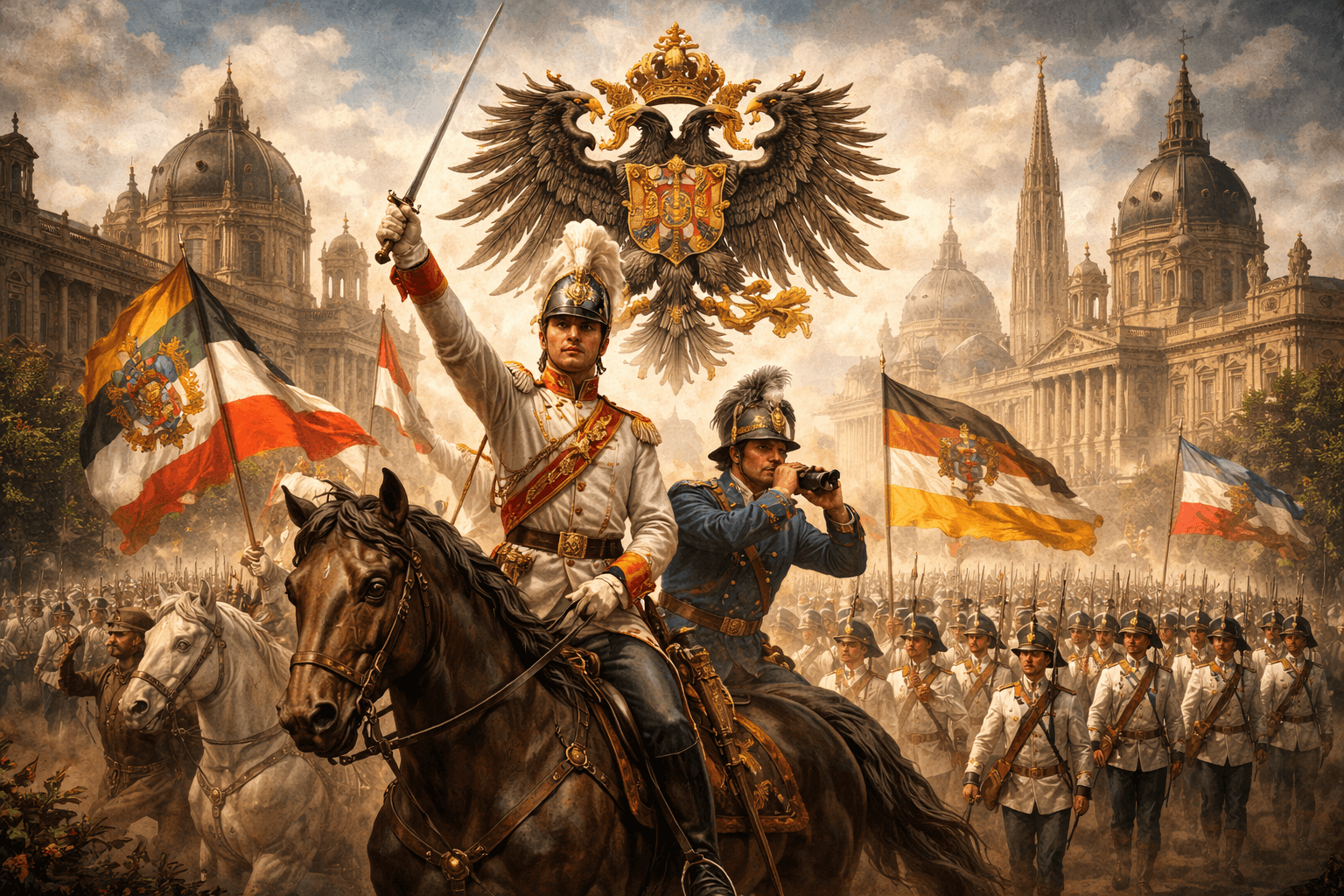
The Austro-Hungarian Empire
 Andres Aguilar
Eleven official languages, two governments, one emperor, and a constitution so tangled that nobody ever said its full name out loud. For over five hundred years, the Habsburgs held together a patchwork of radically different peoples — not with armies, ...
A driver takes a wrong turn, backs up the car, and in that moment, a nervous young man pulls out his pistol. Two gunshots that didn't just kill an archduke — they triggered a world war and brought down a five-hundred-year empire.
The Austro-Hungarian Empire is one of those historical giants that most people recognize by name but few ever fully get their heads around. And honestly, that's understandable — because it was genuinely complex. A multi-ethnic, multilingual, multicultural empire that functioned for centuries before unraveling in an explosion that redrew the map of the world. Its story is fascinating because it illustrates something that still matters today: how it's possible to govern an enormous territory inhabited by radically different peoples — and why that kind of arrangement, sooner or later, can fall apart.
The Habsburgs and the Art of Ruling Without Fighting
To understand the Austro-Hungarian Empire, you have to start long before that name even existed. The Habsburgs had been a major force in European politics since the 13th century. They were one of those dynasties that managed to hold onto power for centuries — not primarily through warfare, but through carefully arranged marriages. Their territories were scattered across the continent: Austria, chunks of German-speaking lands, the Netherlands, Spain at one point, parts of Italy.
There was a saying associated with them, attributed to Emperor Matthias II though its origins are murky: "Bella gerant alii, tu felix Austria nube" — "Let others make war; you, happy Austria, marry." It was a pretty accurate description of their playbook. While other kingdoms burned through their resources on military campaigns, the Habsburgs built their power through meticulously planned dynastic alliances.
The heart of the empire was always Austria, with Vienna as its capital. By the 18th and 19th centuries, Vienna had become one of the great cultural hubs of Europe — the city of Mozart, Beethoven, and Strauss. The city of waltzes, baroque palaces, and opera. But it was also the administrative head of a territory stretching from what is now the Czech Republic to northern Italy, from Poland down to the Balkans. The Schönbrunn Palace, the Habsburgs' summer residence, is perhaps the most eloquent symbol of that power: it has more than 1,400 rooms. Maria Theresa, one of the most important empresses of the 18th century, lived there with her sixteen children, whom she strategically distributed among the royal families of Europe like chess pieces on a continental board.
But Maria Theresa was far more than a prolific mother with dynastic ambitions. She was a ruler of remarkable vision who modernized the machinery of the state in ways that would be felt for generations. She reformed the education system, mandated elementary schooling, reorganized the military, and improved administration across a territory where coordinating anything was a logistical nightmare. Her son, Joseph II, was even more ambitious: he freed the serfs, granted rights to Jews, and suppressed monasteries he deemed unproductive. He was the textbook 18th-century enlightened despot — convinced he could modernize society from the top down through rational decrees. Many of his reforms were reversed after his death, however, because the nobility managed to pump the brakes on much of the process. This pattern — tentative reforms followed by conservative rollbacks — would repeat itself again and again throughout the empire's history, and it helps explain why, by the 20th century, the empire was still carrying political structures that belonged to a different era.
The Habsburgs didn't conquer territory with armies — they did it with marriages. Their foreign policy was, in essence, a family policy.
The revolutions of 1848 shook all of Europe, and Emperor Ferdinand I — ill-suited to govern in such turbulent times — was forced to abdicate. That's when his nephew stepped onto the stage: Franz Joseph I. The man ruled from 1848 to 1916\. Nearly seventy years in power. When he took the throne, people traveled by horse-drawn carriage; when he died, cars and airplanes already existed. He witnessed revolutions, wars, the birth of new nations, and technological changes of civilizational scale. Yet he remained, at his core, a 19th-century man swimming against the current of the 20th. That tension was, in many ways, the central drama of his reign.
The Compromise of 1867 and the Strangest Bureaucratic Machine in Europe
The Austrian Empire that Franz Joseph inherited was a patchwork of nationalities that were nearly impossible to reconcile. Austrian Germans, Czechs, Slovaks, Poles, Ukrainians, Romanians, Croatians, Serbs, Slovenes, Italians — each group with its own language, its own historical memory, its own political ambitions. All under the same emperor, whether they liked it or not.
The Hungarians were the most persistent challenge. They had their own nobility, their own tradition of statehood, and a strong national identity. When Austria suffered a humiliating defeat at the hands of Prussia in 1866 — which left it sidelined from the German unification process that Bismarck was engineering — the Hungarians saw their opening and pushed hard for greater autonomy. The result was the Austro-Hungarian Compromise of 1867, one of the most peculiar constitutional arrangements in European history.
A dual monarchy of unique design was created: a single sovereign, Franz Joseph, who was simultaneously Emperor of Austria and King of Hungary. But beneath that single figure coexisted two separate governments, two parliaments, two prime ministers. Austria had its capital in Vienna; Hungary, in Budapest. The two halves shared the military, foreign policy, and finances — but in everything else, they operated independently.
It was a constitutional arrangement unlike anything before it: one sovereign, two governments, eleven official languages, and a name that practically nobody ever said out loud in full.
The administrative complexity this created was extraordinary. Any reform affecting the empire as a whole required approval from two parliaments that deliberated in different languages and represented frequently opposing interests. The official name of the state was so unwieldy that virtually no one used it — something equivalent to "The Kingdoms and Lands Represented in the Imperial Council and the Lands of the Hungarian Holy Crown." In everyday use, people relied on the abbreviation k.u.k. — kaiserlich und königlich, "imperial and royal" in German — stamped on seals, official documents, and military uniforms. The empire had eleven official languages, and postage stamps had to include the denomination written in every single one of them. It was a bureaucratic nightmare, but also an accurate reflection of the demographic reality of that territory.
Vienna 1900, the Pressure Cooker, and the Tragedies of Franz Joseph
The Austro-Hungarian society of the late 19th and early 20th centuries was, at its most visible layer, extraordinary. In Vienna, there existed an aristocratic and intellectual elite of a sophistication hard to match anywhere else in the world. The famous Viennese coffeehouses were cultural institutions where you'd order a coffee, read newspapers from half a dozen countries, and stay for hours arguing about aesthetics, politics, or philosophy. This wasn't like grabbing a latte to go — people spent entire days there, writing, debating, thinking. Many writers practically lived in those cafés. There was a culture of intellectual gathering that simply didn't exist anywhere else with that kind of intensity.
Sigmund Freud developed psychoanalysis in Vienna. Gustav Klimt painted his gold-laden, symbolism-saturated canvases there. Arthur Schnitzler explored bourgeois psychology in his fiction. Stefan Zweig, who grew up in that imperial city, would later describe it as a world of security and refinement that the 20th century would dismantle without mercy. The musical scene was equally staggering: the Vienna Opera was — and remains — one of the finest in the world. Gustav Mahler served as its director during a crucial decade. The Vienna Philharmonic had cemented itself as one of the greatest orchestras on the planet. The Strauss family's waltzes were played in ballrooms across Europe. The New Year's Concert broadcast annually from Vienna is a direct legacy of that era.
But beneath that brilliant surface, the empire was a pressure cooker. Austrian Germans controlled most of the power and frequently carried themselves with a sense of cultural superiority that other groups found insufferable. The Hungarians, in turn, exerted an assimilationist pressure on the Slavic minorities in their half of the empire that was just as intense as what they themselves had suffered under Vienna. The Czechs demanded autonomy and cultural recognition. The Serbs and Croatians in the south dreamed of uniting with their compatriots to build a great South Slavic state. The Italians in the north wanted to be part of Italy. The Poles kept alive the aspiration of an independent Poland. It was a mosaic of incompatible ambitions held together less by consensus than by centuries of institutional inertia.
Franz Joseph tried to contain these forces by being what he had always been: a traditional monarch, disciplined to an extreme. He lived with surprising austerity — his personal quarters in the Hofburg Palace were notably simple; he rose before dawn and worked through state papers for hours with an inflexible formality. Yet his personal life, for all that power, was a relentless parade of tragedy. He married Elisabeth of Bavaria — known as Sisi — one of the most celebrated women in 19th-century Europe. But Sisi never adapted to life at the Viennese court and spent months away, traveling ceaselessly, fleeing the protocol she found suffocating. In 1889, Crown Prince Rudolf was found dead at his hunting lodge in Mayerling alongside his lover, Baroness Maria Vetsera, in a double suicide that the court attempted to cover up for years. And in 1898, Sisi was assassinated by an Italian anarchist in Geneva — he attacked her with a steel file as she walked toward a lakeside pier. Franz Joseph was left alone, his new heir now his grandnephew, Franz Ferdinand.
Economically, the empire was also a substantial power. Prague was a rapidly developing industrial center, with textile manufacturing and a brewing industry whose products still exist today — the name Pilsner comes from Plzeň (Pilsen in German), a Bohemian city that was part of the empire at the time. Budapest opened its own subway in 1896, the second in the world after London's; that system still runs today and is now a UNESCO World Heritage Site. Trieste was the empire's main port and a major hub of eastern Mediterranean trade. However, economic growth lagged behind Germany and Great Britain, and as working-class conditions fell behind relatively, social tensions multiplied.
The imperial army was a perfect mirror of all those contradictions. Regiments were organized by nationality — one might be made up entirely of Czechs, another of Croatians, another of Hungarians. Officers communicated in German; soldiers, in their own languages. The official solution was to establish a basic military vocabulary of about eighty words that all recruits were required to learn. In practice, many never managed it. The uniforms, designed in an earlier era, were still colorful and eye-catching at a time when modern warfare was won through sustained artillery fire and trenches. When World War I broke out, those uniforms turned soldiers into perfect targets. Only after losing tens of thousands of men did the institution admit it was time to adopt more practical colors. It was an almost too-perfect metaphor for an army that took far too long to understand the world had changed.
Sarajevo and the Machinery of Catastrophe
In foreign policy, Austria-Hungary watched with growing alarm the rise of Serbian nationalism, which aspired to unite all South Slavs under one flag. The problem was that a substantial portion of those Slavs — Croatians, Bosnian Serbs, Slovenes — lived within the empire's borders. In 1908, Austria-Hungary formally annexed Bosnia-Herzegovina, triggering a major diplomatic crisis. Serbia reacted with fury; Russia expressed outrage but wasn't in a position to sustain an armed confrontation. The crisis was resolved without war, but it left deep wounds. The Balkans became what all of Europe called the continent's powder keg. Everyone knew something was going to blow. What nobody anticipated was the scale of the fallout.
Franz Ferdinand arrived in Sarajevo on June 28, 1914, with a schedule that included a military inspection and visits to city institutions. A group of young Serbian nationalists had planned to assassinate him. The first attempt failed: one of the conspirators threw a bomb that the archduke deflected with his arm, and it exploded under the next car in the motorcade, wounding several members of his entourage. Franz Ferdinand arrived at City Hall unharmed and then decided, with remarkable composure, to visit the bombing victims in the hospital.
That's where chance took the wheel of history. The driver didn't know about the modified route, turned the wrong way, and had to stop the car to back up. That pause of a few seconds left the archduke motionless just a few feet from a delicatessen. Gavrilo Princip, one of the conspirators who had already written off the mission as a failure, stepped out of the shop and came face to face with his target. He drew his pistol and fired twice. Franz Ferdinand died from a shot to the jugular. His wife Sophie died from a bullet to the abdomen.
There is something deeply tragic in the details of that marriage. Sophie was a countess, not a princess — by Habsburg rules, not noble enough. Franz Ferdinand married her anyway, but he paid a price: he had to relinquish his children's right to the throne, and at court Sophie was treated as a second-class citizen. At official events in Vienna, she was not permitted to sit beside her husband. It was a constant humiliation, which is why Franz Ferdinand preferred his country estates and avoided the capital. June 28th was their wedding anniversary. And on that day, because the visit was military in nature, protocol allowed Sophie to ride alongside him in the official car. It was one of the rare occasions they were permitted to appear together in public as equals. They both died in that same seat.
It was an almost accidental assassination: the driver got lost, Princip happened to be in exactly the right place. But the consequences were the most catastrophic in modern history.
Austria-Hungary issued an ultimatum to Serbia with demands deliberately designed to be unacceptable, including the right to conduct judicial investigations on Serbian soil — effectively a direct violation of its sovereignty. Serbia accepted nine of the ten points. It rejected the tenth. On July 28, 1914 — exactly one month after the assassination — Austria-Hungary declared war. Russia mobilized its armies in support of Serbia. Germany declared war on Russia. France entered into a defensive agreement with Russia. Germany invaded Belgium to attack France from the flank. Britain, which had guaranteed Belgian neutrality, declared war on Germany. In under five weeks, nearly all of Europe was at war. Franz Joseph was 84 years old when he signed the declaration. He believed it would be a brief, localized conflict. It was one of the most catastrophically wrong assessments in the history of modern warfare.
The Dissolution
World War I laid bare with brutal clarity every fracture the empire had been holding together for decades. The army sent Czechs to fight Russians, Croatians to fight Serbs, Hungarians to fight Italians. Many soldiers had no especially compelling stake in the outcome; they fought out of discipline and institutional inertia, not conviction. Mass surrenders multiplied — Czech regiments were giving themselves up to the Russian army with a speed that suggested relief more than defeat. Desertions were constant. On the home front, the economy progressively collapsed. The Allied naval blockade cut off access to raw materials, rationing spread, inflation skyrocketed, and hunger appeared in the cities. Strikes multiplied. The authority of the state was visibly eroding.
In November 1916, Franz Joseph died. He had been emperor for 68 years and was, for much of the population, the only constant they had ever known. He was buried in the Imperial Crypt in Vienna, alongside Sisi and Rudolf — the family that tragedy had been dismantling piece by piece. He was succeeded by his grandnephew, Karl I, just 29 years old, who attempted to negotiate a separate peace with the Allies by sending secret emissaries to France. The negotiations failed, and when Germany found out, the diplomatic humiliation was severe. The attempt only accelerated the disintegration.
In October 1918, the empire dissolved not so much through military defeat as through internal collapse. The nations that composed it didn't wait for permission — they simply declared independence. The Czechs and Slovaks proclaimed the Republic of Czechoslovakia on October 28th. The South Slavs founded the Kingdom of Serbs, Croats, and Slovenes. The Poles incorporated Galicia into a reconstituted Poland rising in Eastern Europe. The Romanians kept Transylvania. The Italians entered Trentino and Trieste. On November 11th, Karl I declared that he would no longer participate in affairs of state. It was not a formal abdication — it was a weary withdrawal. It was the end.
From an empire of fifty million people, two small, impoverished countries remained. Austria became a republic of six million. Vienna — designed to administer a continent, with a population of two million — became the bloated capital of a country the size of Switzerland. It was economically absurd, and the city fell into deep poverty. Stefan Zweig described that transformation with bitterness in his memoirs: from being a citizen of one of the world's great empires, he suddenly found himself living in a country no one quite knew the purpose of.
The Treaty of Saint-Germain in 1919 formalized the dismemberment of Austria and explicitly prohibited union with Germany, even though many Austrians wanted it. The reparations imposed and the limits placed on the military created a fragile, politically polarized republic that would teeter on the edge of civil war in the 1930s. For Hungary, the Treaty of Trianon in 1920 was even more traumatic: the country lost two-thirds of its territory, and millions of ethnic Hungarians suddenly found themselves living as minorities in foreign states. The wound hasn't fully healed: in Budapest, maps of "Greater Hungary" — the pre-Trianon territory — appear with striking frequency in monuments and public spaces. It's a national trauma more than a century old that continues to shape the country's politics.
The new borders drawn at Versailles did not respect the ethnic realities on the ground. That negligence would be paid for in blood for the rest of the 20th century.
Czechoslovakia incorporated a German-speaking minority of more than three million people in the Sudetenland — the same population Hitler would use as a pretext to dismember the country in 1938\. Yugoslavia united Serbs, Croatians, Slovenes, Bosnians, and Macedonians in a single state, with radically different national and religious identities. We all know how that ended in the 1990s. The problems created by the collapse of the Austro-Hungarian Empire echoed throughout the entire 20th century.
The Ambiguous Legacy of an Imperfect Empire
There is something paradoxical about the fate of the Austro-Hungarian Empire that deserves careful thought. It was not a perfect state — it had serious shortcomings in political representation, equality among its national groups, and the capacity to adapt to the changes the era demanded. The oppression of minorities was real. The rigidity of the political system was maddening. And its inability to reform itself quickly enough was, in the end, part of what destroyed it.
But it was also a space where profoundly different peoples coexisted, mixed, and created culture together. In Vienna in 1900, a young Czech could pursue a university degree, a Jewish merchant from Kraków could build a business, a Croatian officer could forge a military career. There were inequalities and discrimination, yes. But there was also a certain multicultural permeability — a practical tolerance for difference — that would prove very hard to find in the Europe that came after.
When the empire collapsed, the dynamic that replaced it was that of the homogeneous, exclusionary nation-state. And those states set about with considerable energy the task of making their borders match their ethnicities: persecuting minorities, expelling populations, redrawing maps. The extreme nationalism that the empire had contained — imperfectly but really — was fully unleashed. The following decades were the most violent in European history: World War II, the Holocaust, and systematic ethnic cleansing in virtually all of the new successor states. The multicultural Europe that the old empire represented, with all its flaws, was not replaced by something better. It was replaced by something incomparably worse.
When we look at the European Union today — with its free movement of people, its shared institutions, and its attempt to transcend narrow nationalism through voluntary integration — it's not hard to see a certain underlying continuity with what the Austro-Hungarian Empire tried to do, in its authoritarian, anachronistic, and deeply contradictory way, across five centuries of existence. They are obviously very different projects: one was a dynastic empire, the other a democratic and voluntary union. But the underlying idea is similar: that people with different languages, cultures, and histories can share institutions and live together within a common framework.
That's the final paradox: the empire was a dinosaur of the past, and yet it was more cosmopolitan than the nation-states that came to replace it. It was multicultural before that word existed. It was transnational when nationalism was the dominant ideology. Which is why nostalgia persists, especially in Central Europe, for the k.u.k. Zeit — the imperial era. It is not nostalgia for authoritarianism or rigid hierarchy. It's nostalgia for something harder to name: the sense that it was possible, once, to build a space where difference didn't inevitably end in catastrophe.
The next time you read about World War I, about the Balkan conflicts, about the difficult history of Central Europe in the 20th century, remember that driver who took a wrong turn in Sarajevo. Two gunshots that didn't just kill two people — they buried an entire world.
Related episodes
In 1871, Paris experienced 72 days of radical rule; Versailles crushed him in Bloody Week. Ideas and violence that marked the modern left.
When Rome fell in 476, the Roman Empire kept on existing — for another thousand years, with its capital at Constantinople. That empire almost no one remembers was the bridge between the ancient and modern worlds, the guardian of the Greek texts that fu...
The Eiffel Tower wasn't Eiffel's idea, it was painted red, it was despised by France's greatest writers, and it came within years of being torn down. The man whose name it bears was facing fraud charges when it opened. This is the story of how the worl...