
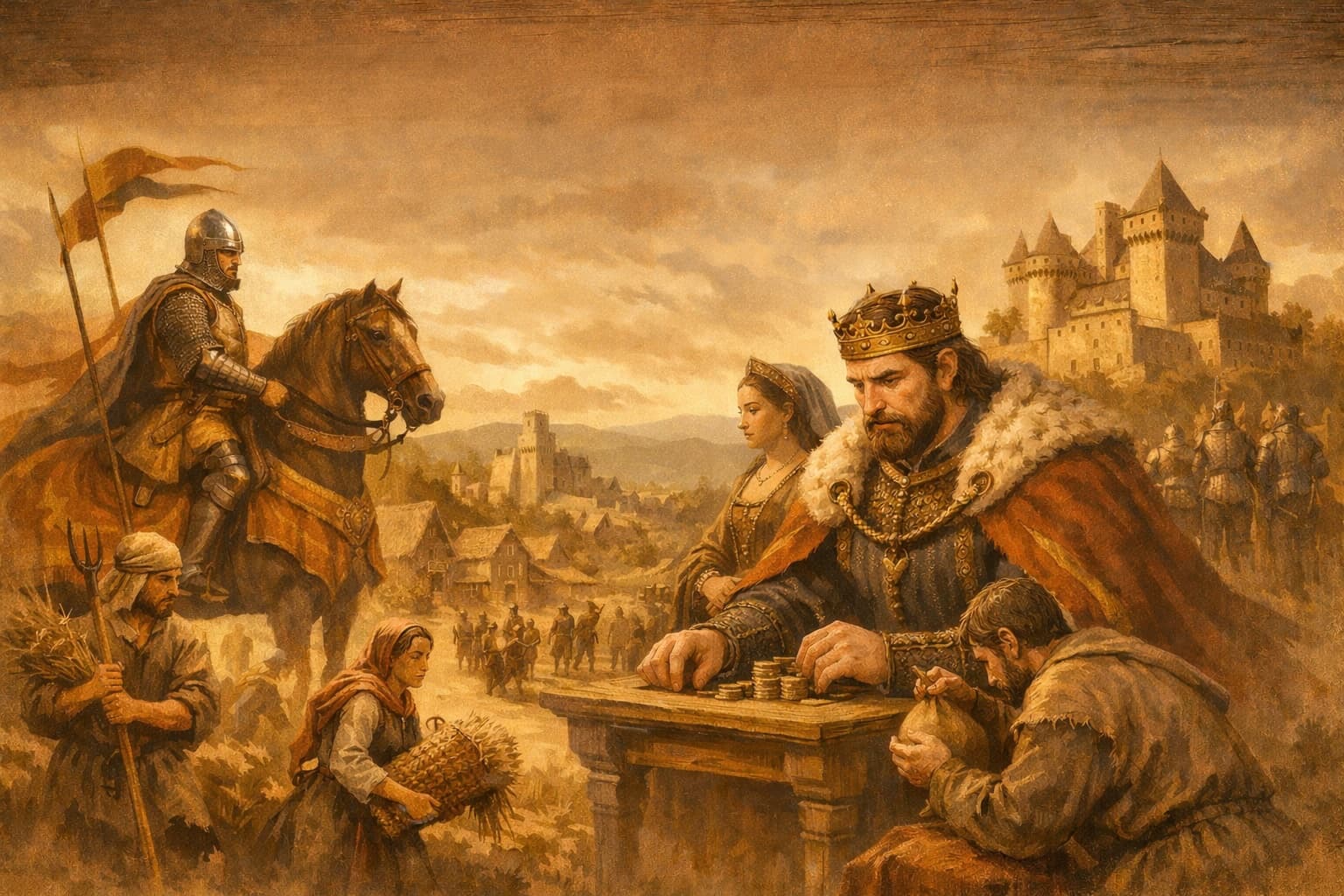
Feudalism
 Andres Aguilar
When the Western Roman Empire collapsed in 476 CE, it didn't just take down a government — it destroyed the roads, the markets, the armies, and every institution that held society together. What emerged from the wreckage was a system that organized Eur...
In the year 800, Charlemagne had a problem: he had unified an enormous territory that no centralized army could control. When he died, his grandsons divided it among themselves. What remained was chaos, invasions on every flank, and millions of people with no one to protect them.
From that desperate need was born one of the most enduring systems in human history. A system that for nearly a thousand years organized the lives of tens of millions of people — defining what they ate, where they lived, whom they married, and how they died. A system that left marks so deep in our culture, our language, and our way of organizing power that still today, in the twenty-first century, we can see it reflected in everyday things we rarely connect to medieval Europe.
To understand feudalism you first have to understand what Europe was like before it. And the answer is fairly dramatic: a disaster.
The Western Roman Empire fell in 476 CE. With it went far more than a government. The road network that connected cities vanished. The legions that kept order vanished. The tax collection systems, the organized markets, the aqueducts, the legal institutions: all of it collapsed in a relatively short period, and what was left in its place was a mosaic of barbarian kingdoms — Visigoths, Ostrogoths, Franks, Burgundians, Saxons — that controlled territory at swordpoint but had neither the infrastructure nor the bureaucratic tradition to govern with any stability.
And on top of that basic disorder came the invasions. The Vikings sailed up the interior rivers of Europe, pillaging everything in their path from Ireland to the south of France. The Magyars, horse riders from the Asian steppes, attacked from the east with a speed that left local armies with no effective response. The Saracens pressed from the southern Mediterranean. In that context, the question every peasant, every small landowner, every inhabitant of a remote village was asking was very concrete: who is going to protect me? The king was far away, weak, and his armies never arrived in time. The Church could save your soul, but not your head. The only practical answer was to turn to the strongest man nearby — the one with the castle and the soldiers — and accept his terms.
The Pyramid of Loyalties
Feudalism was not a system designed by any philosopher or legislator. It was an organic, spontaneous response to a security crisis. But over time it acquired a fairly clear, almost geometric structure.
At the peak of the pyramid sat the king. But the feudal king was not the absolutist monarch of later centuries, the one who said "I am the state" and exercised direct control over the territory. The medieval king was, in many respects, simply the most powerful feudal lord. His authority depended on the agreements he had made with his nobles, not on a centralized bureaucracy that would carry out his orders.
Just below were the great lords of the high nobility: dukes, counts, marquises. They received from the king vast stretches of land — the fiefs — in exchange for an oath of loyalty and the commitment to provide soldiers when needed. The formal act of this agreement was called vassalage and was sealed in a ceremony of homage in which the vassal knelt, placed his hands between those of his lord, and pronounced a solemn oath. It was a contract, with obligations running in both directions: the vassal promised military service and loyalty; the lord promised protection and justice.
Those great lords, in turn, could grant portions of their fiefs to lesser lords — barons, knights — who became their own vassals. And so chains of vertical loyalty were formed where each link owed fidelity to the one above and received obedience from the one below. In theory, the chain ran from the last peasant all the way up to the king. In practice, things were considerably more complicated and contentious.
There is something fundamental that is frequently overlooked: land in the feudal system was not property in the modern sense of the word. It was a conditional grant. You received the land for as long as you fulfilled your obligations. If you betrayed your lord, if you failed to send the promised soldiers, if you launched a rebellion, the lord could reclaim the fief. Land was not just wealth: it was the mechanism of control on which the entire system rested.
Feudalism was designed by no one. It was the spontaneous response of a society in crisis to a very simple question: who protects me? The answer had consequences that would last a thousand years.
The Serf: The One Who Bore the Load
All that architecture of loyalties, oaths, and ceremonies rested on something far more concrete: the labor of millions of people who never pronounced an oath, never received a fief, and rarely appear by name in the historical record. The serfs.
Between eighty and ninety percent of the European population lived and died in the countryside during the Middle Ages. They were the material foundation of the entire system, without whom no feudal lord could pay soldiers, no cathedral could be built, and no royal court could sustain itself. And yet their legal situation was remarkably precarious.
The serf was not exactly a slave in the Roman sense — they could not be sold separately from the land they worked — but they were not free either. They were bound to the land: they could not leave it without the lord's permission. If the lord sold the fief, the serf came along with the deal, as part of the inventory. They could not marry without the lord's authorization, which frequently included paying a fee. They could not grind their grain at any mill other than the lord's, which naturally charged for the service. They could not use the communal oven without paying. They could not fish in the river without paying. The lord owned the mill, the oven, and the river.
And on top of all those obligations in money or in kind, the serf had to work a set number of days each week on the lord's own lands — the seigneurial reserve — without receiving any payment. It was forced labor legally integrated into the structure of rights and duties that feudalism called, with a certain euphemistic elegance, "services."
The daily life of a medieval serf was hard in a way that is difficult to fully grasp today. They lived in a structure of mud and wood, without windows or with very small ones, sharing the space with domestic animals in winter to take advantage of their body heat. They ate mainly black rye bread, boiled legumes, and at best some vegetables from the kitchen garden. Meat was a luxury reserved for feast days. Life expectancy was forty years in the most optimistic scenario, and infant mortality was devastating: of every four babies born, one did not survive the first year.
There is a detail that tends to surprise people when they first encounter it: serfs did not work all the time. The medieval calendar included approximately a hundred and fifty days of mandatory rest between Sundays and saints' feast days, on which work was forbidden by the Church. The rhythm of the year was very different from that of the modern worker: periods of intense labor during sowing and harvest, followed by periods of relative calm. It was not exactly what we'd call well-being today, but it was a system that recognized the need for rest in ways that the subsequent industrial revolution erased for generations.
The Church: The Power Nobody Can Ignore
It is impossible to talk about feudalism without talking about the Catholic Church, because it was an absolutely central institution throughout the medieval period. And when we say "the Church" in that context, we're talking about something with no exact equivalent in the contemporary world.
The Church owned between a quarter and a third of all cultivable land in Western Europe. It was the institution that controlled education, hospitals, and the registration of births, marriages, and deaths. It administered practically everything we would today consider state services. It was also the only institution that functioned continuously across all the kingdoms, with a common language — Latin — and a communication network that far exceeded the capacity of any secular structure.
But beyond that material power, the Church had something even more valuable: the monopoly over what happened after death. In a society where mortality was omnipresent, where practically every adult had watched their children or parents die from diseases without treatment, the promise of paradise or the threat of hell carried a weight that the secular modern imagination finds difficult to recreate. Medieval faith was not a choice between several available options. It was the framework within which all of existence made sense.
Excommunication — the expulsion of a believer from the community of the Church — was therefore a political weapon of exceptional force. An excommunicated king was, in theory, stripped of the divine legitimacy that justified his power, and his subjects were released from the oath of obedience they had sworn to him. There were cases where this had concrete and dramatic consequences. The most famous is that of Emperor Henry IV, who in 1077 had to walk barefoot through the snow to the castle of Canossa, in northern Italy, to beg forgiveness from Pope Gregory VII and obtain the lifting of his excommunication. A man who ruled over millions, humiliated, kneeling in the snow, waiting for the pontiff to receive him. That image alone communicates more about the power of the medieval Church than any abstract description.
The Church was also a channel for social mobility in a system that offered few. An intelligent peasant could enter a religious order, learn to read and write, gain access to texts circulating in Latin, and, if talent followed, reach positions of considerable influence. The clergy was one of the few spaces where birth did not necessarily determine destiny. Thomas Becket, the famous Archbishop of Canterbury murdered in 1170, was the son of a Norman merchant. Many medieval cardinals and abbots came from families with no noble title whatsoever. In that sense, the Church was simultaneously one of the firmest pillars of the established order and one of its few mechanisms of permeability.
The Knight: Between the Myth and the Reality
The chivalric ideal that centuries of romantic literature and the modern film industry have passed down to us — the noble, brave, courtly warrior who protects the weak and serves his lady with devotion — is, to a large extent, a carefully constructed cultural narrative. A code of conduct that began to take shape from the twelfth century onward, primarily as an attempt to put some limits on what was in practice the unchecked violence of a warrior class that operated with minimal oversight.
The real knights of the early feudal period were often men raised from childhood for war, accustomed to violence, and with little spontaneous inclination toward the romantic ideals that posterity attributed to them. Training began at seven years old, when the boy left his family home to serve at another lord's court as a page. He learned to handle weapons, ride horses, and care for equipment. At fourteen he became a squire, assistant to an adult knight. And if he reached twenty-one with the means to afford the equipment — which was extraordinarily expensive, roughly equivalent to the value of a high-end car today — he received the dubbing ceremony and was formally admitted into the knightly order.
The code of chivalry was not born of the natural nobility of medieval warriors. It was born of the Church and the nobility's attempt to put some limits on the violence of an armed class that operated without sufficient restraint.
Outside that framework of formal discipline, actual behavior could be very different from the ideal. Medieval chronicles regularly record knights pillaging villages, imposing illegal levies on peasants on their lands, and behaving in ways that had little to do with the literary model. The Church tried to limit that violence with the institutions of the Truce of God and the Peace of God, which prohibited combat on certain days and in certain contexts, and which in the best cases had only partial results.
What the Church managed more effectively was to channel that warrior energy toward the Crusades. It offered European knights an objective that combined religious legitimacy with the promise of adventure, plunder, and land. The Crusades were, among other things, a mechanism for exporting the internal violence of feudal society outward. With consequences that the history of the Middle East still registers.
The Variety That Books Leave Out
Feudalism was not an identical system everywhere it took root. It varied enormously depending on the region, the period, and local circumstances, and that variation matters if we're to avoid treating it as a uniform model imposed from above.
In England, the Norman Conquest of 1066 produced an unusually centralized and organized version of feudalism. William the Conqueror distributed English territory among his barons while maintaining a considerably firmer royal authority than his continental contemporaries. The result was a powerful but relatively controlled nobility that, a century and a half later, would manage to impose on King John a document of extraordinary historical consequence: Magna Carta in 1215. For the first time in English history, a written document placed limits on the monarch's power and guaranteed certain rights to the nobility — not to the peasants, who would wait much longer for their turn — but it established a principle that Anglo-Saxon law would never forget.
In southern France and in the kingdoms of the Iberian Peninsula, feudalism coexisted with far more persistent Roman legal traditions and with the cultural and technical influence of the Islamic world, producing variants quite different from the Frankish model that nineteenth-century historians took as the archetype. The Spanish Reconquista generated its own seigneurial dynamics, where the frontier with Islam and the constant need to repopulate conquered territories gave peasants and soldiers bargaining power that their northern European contemporaries did not have.
And in the east of the continent — Poland, the Russian territories, the Balkans — feudalism arrived later and in locally adapted forms that sometimes bore little resemblance to the classic model. In some cases, as in Russia, the system of serfdom that emerged from those adaptations proved more rigid and more enduring than anywhere in Western Europe, surviving until 1861.
The Fourteenth Century: When Everything Broke
If feudalism was born of a crisis, it also ended in one. And the crisis of the fourteenth century was of a magnitude that has few equivalents in medieval European history.
The century began with the Great Famine of 1315-1322. Several consecutive years of excessive rainfall destroyed harvests across northern Europe. Granaries emptied, livestock died, food prices soared, and millions of people starved in a continent that until then had experienced two centuries of relatively sustained population growth. Cities filled with beggars, crime increased, and social cohesion began to crack.
Then came the Black Death.
Between 1347 and 1353, the bubonic plague pandemic — with its pneumonic and septicemic variants — killed between a third and a half of the entire population of Europe in just six years. It is the greatest documented demographic disaster in human history in absolute terms. Entire cities were emptied. Monasteries where dozens of monks had lived awoke with a single survivor. Trade routes were interrupted, fields were abandoned, systems of local government collapsed across many regions.
The impact on feudalism was, paradoxically, devastating for the lords and relatively liberating for the serfs who survived. When forty percent of the labor force dies, the remaining workforce becomes scarce and therefore valuable. Lords who had previously been able to dictate terms to serfs from a position of total dominance found themselves competing with each other to get peasants to work their lands. Serfs began to negotiate better conditions, to move toward more generous lords, to demand wages where before they had received only the right to keep living on the same land. The labor market, essentially, entered the feudal domains through the door that the demographic catastrophe had opened.
And on top of that, the Plague generated a crisis of faith of such depth that the ecclesiastical system was not equipped to handle. If God had permitted such horror, if priests died like everyone else without their prayers protecting them, if rich and poor, sinners and the righteous died equally, something didn't add up in the theology of reward and punishment that the Church had been preaching for centuries. That crack in religious authority was one of the first bricks to fall from what, two hundred years later, would become the Protestant Reformation.
The decades following the Plague were ones of unusual social agitation. Peasant revolts broke out in England — the Peasants' Revolt of 1381 — in France — the Jacquerie of 1358 — and at multiple points across Europe. The peasants were not demanding the end of the feudal system as such: they were demanding fairer conditions within it, reduced taxes, an end to the most oppressive forms of serfdom. The revolts were suppressed with ferocity. But something had changed: lords could no longer take the passive obedience of their serfs for granted as a fixed feature of the natural order.
The Cities and the End of Feudalism
Alongside the demographic and religious crises, historians point to another factor equally decisive in the decline of feudalism: the resurgence of cities and commerce that began to be visible from the eleventh century and accelerated notably in the twelfth and thirteenth.
European cities began to grow. Long-distance trade gradually recovered, international fairs appeared — like those of Champagne in France — and novel banking techniques developed in the Italian cities. And with all of that came a new social class that fit none of the compartments in the feudal scheme: the bourgeois. The prosperous merchant, the craftsman with his own workshop, the banker, the notary.
The bourgeois was not noble, not a serf, not bound by feudal loyalty to any specific lord. They had money, and with that money they could buy many things that previously could only be obtained by inheritance or by force. And kings began to notice something politically very useful: they could rely on this new class to weaken their own nobles. The bourgeois paid taxes in money — far more flexible and useful than receiving troops from vassals every time something needed financing — and in exchange asked for legal protection and commercial freedoms.
This alliance between monarchies and the urban bourgeoisie was what built the modern absolute monarchies, which no longer needed the feudal structure of intermediate powers to function. The modern state began to emerge precisely in the space that feudalism was vacating.
Feudalism did not fall by revolution. It yielded slowly over two or three centuries, at different speeds in different places, as the conditions that had made it necessary disappeared.
The disappearance was gradual and uneven. The last legal vestige of feudalism in France vanished on the night of August 4, 1789, when the Revolutionary National Assembly abolished in a single session all remaining feudal rights. In Russia, serfdom was not abolished until 1861. In some corners of Europe, minor feudal rights survived into the twentieth century. There was no single date, no universal moment of rupture. Feudalism dissolved as it had formed: gradually, responding to pressures no one had designed.
A System That Was Not All Darkness
There is a persistent misunderstanding about feudalism that's worth correcting before we close. The popular image of the Middle Ages as a period of absolute intellectual and cultural stagnation — where nothing interesting happened between the fall of Rome and the Renaissance — is a simplification that does not hold up to historical analysis.
It was precisely in the twelfth century, at the height of feudalism, that what historians call the Twelfth Century Renaissance took place: a period of remarkable intellectual ferment. The first European universities were founded — Bologna, Paris, Oxford — which would become the foundation of the university system we know today. Vast quantities of Arabic texts that had preserved and developed Greek philosophy during the centuries when Europe had lost it were translated into Latin. The great Gothic cathedrals were built — Notre Dame, Chartres, Reims — which remain today some of the most impressive structures human beings have ever raised, and which express an aesthetic and technical ambition that refutes any image of a paralyzed civilization.
All of that happened within the feudal framework, with feudalism as the economic and social context. Not despite feudalism, but in many cases thanks to the relative stability that that system — with all its injustices and rigidities — had managed to generate after the centuries of constant invasions that had preceded it. The resources concentrated by the Church financed the cathedrals and the universities. The hierarchy of power that feudalism established also created the surpluses that made culture possible.
What feudalism could never do was adapt fast enough to the changes the fourteenth century set in motion. The monetary economy eroded it from within. The urban bourgeoisie encircled it from outside. The plagues shook it from below. And the monarchies that were building the modern state hollowed it out from above. It was a slow dissolution, without a single moment of rupture, that took centuries to complete.
The Invisible Legacy
The promise at the beginning was that by the end you'd understand why feudalism has more to do with the present than it might seem. Here is where that promise is kept.
The marks are deeper than is usually acknowledged. Some are linguistic: the English word villain, meaning a wrongdoer, comes from villano, the medieval serf. The word fealty comes directly from the medieval Latin fidelitas. Our idea of the knight, of noble conduct, of the Anglo-Saxon gentleman, is a direct heir of the medieval chivalric code.
But beyond vocabulary, feudalism installed in Europe a set of ideas about power and property that took centuries to transform — and in some respects have not finished transforming. The idea that power descends from the top down and requires legitimation from above. The idea that land is the foundation of all real wealth and status. The idea that there are natural hierarchies among people that justify different privileges. Those feudal ideas reappeared, dressed in new vocabularies, in colonialism, in the Latin American hacienda, in the large landed estates that structured the agrarian economy of the Río de la Plata region during the nineteenth century. They were not identical to medieval lordship, but the family resemblance was recognizable.
For those who follow Argentine history in particular, there is a debate among historians about how far the structure of the Pampas agrarian economy in the nineteenth century — with its vast land concentrations in few hands and its mass of landless workers — reproduced logics that came from far back. Not as a direct copy, but as a local variation of a pattern that feudalism had deeply embedded in the Iberian political and economic culture that Spain brought to the Americas.
And if you look at the global concentration of land today — where one percent of rural landowners hold around seventy percent of the world's agricultural land — something of that geography of power that feudalism codified remains recognizable, even if the legal and economic mechanisms sustaining it are completely different.
Feudalism was, simultaneously, a response to a real crisis, a system of organization that provided a certain stability during a period of severe disorder, and one of the most far-reaching systems of exploitation that European history records. All three of those things are true at the same time. History rarely allows itself to be sorted into heroes and villains, and feudalism is a particularly clear example of that complexity. What was born of the desperate need for protection ended up being, for most of those who lived under it, the very structure that guaranteed their lack of freedom.
That is the kind of paradox history produces regularly, and that no simplified account can fully contain.
Related episodes
In 1871, Paris experienced 72 days of radical rule; Versailles crushed him in Bloody Week. Ideas and violence that marked the modern left.
When Rome fell in 476, the Roman Empire kept on existing — for another thousand years, with its capital at Constantinople. That empire almost no one remembers was the bridge between the ancient and modern worlds, the guardian of the Greek texts that fu...
The Eiffel Tower wasn't Eiffel's idea, it was painted red, it was despised by France's greatest writers, and it came within years of being torn down. The man whose name it bears was facing fraud charges when it opened. This is the story of how the worl...