
The Panama Canal
 Andres Aguilar
Connecting two oceans required cutting through 80 kilometers of jungle, defeating the deadliest epidemic of the century, and outlasting one of the most spectacular engineering failures in history. The French tried first — and lost 20,000 lives to yello...
In the middle of the densest jungle on earth, at over one hundred degrees, thousands of men are dying every day. Not in combat — from mosquito bites. What they're building is going to change global trade forever.
The Panama Canal is an artificial gash eighty kilometers — about fifty miles — long that cuts across one of the narrowest points of the Americas, connecting the Atlantic to the Pacific. Before it existed, sailing from New York to San Francisco meant going all the way down the South American continent, battling the brutal storms of the Strait of Magellan, and coming back up the Pacific Coast: a journey of nearly thirteen thousand miles that took months. With the canal, that same trip shrank to under six thousand miles. Half the time, half the fuel, half the risk.
But before we talk about what the canal meant for global trade, we need to talk about what it cost to build it. More than twenty-five thousand people died in the attempt. Not in construction accidents — though those happened too — but killed by mosquito-borne disease. Yellow fever and malaria could take a man down in a matter of days, in a haze of spiking fevers and black vomit. There were stretches when the hospital at Ancón was recording thirty to forty deaths a day. Every mile of that canal cost hundreds of lives. You cannot admire the technical achievement without also reckoning with the price paid by the people who made it possible.
An Idea Five Hundred Years in the Making
The idea of connecting the two oceans was nothing new when 19th-century engineers started making blueprints. The Spanish had already considered it in the 1500s, just a few years after Vasco Núñez de Balboa crossed the isthmus and became the first European to see the Pacific from the American side. King Charles V ordered a feasibility study in 1534\. The conclusion was definitive: impossible. The technology didn't exist, the costs would be astronomical, and besides, if God had placed that barrier of land between the oceans, who were they to challenge that design? The project was shelved for more than three centuries.
The world that dusted it off again was radically different. The 19th century brought industrialization, the expansion of international trade, and a new urgency to shorten maritime distances. The most immediate catalyst was the California Gold Rush of 1848: suddenly, tens of thousands of people needed to get to the West Coast fast, and the route around Cape Horn was too long and too dangerous. In 1855, a railroad was built across the Isthmus of Panama. It was a brutal undertaking that killed thousands of workers during construction, but it proved two things: crossing the isthmus was possible, and there was serious money in it.
The man who tried to turn that possibility into a canal was Ferdinand de Lesseps — and his failure is one of the most instructive stories of the 19th century.
The French Disaster
By 1879, De Lesseps was one of the most famous men in Europe. He had built the Suez Canal, inaugurated in 1869 to international fanfare, and had become a French national hero. When he announced he was going to build a canal in Panama, nobody doubted him. Investors lined up. Shares were sold across all of France.
The problem was that De Lesseps didn't understand — or didn't want to understand — the difference between Suez and Panama. Suez was essentially digging a trench through flat desert. Panama was something else entirely: dense tropical jungle, mountains of extremely hard rock, rivers that flooded without warning, and above all, diseases that simply didn't exist in the Egyptian desert. When his own engineers explained that the topography of the isthmus made a sea-level canal impossible — that locks would be needed to navigate the elevation changes — De Lesseps ignored them. His ego didn't allow for that kind of correction.
The Universal Canal Company broke ground in 1882\. From Paris, things initially appeared to be moving along reasonably well. On the ground, the situation was something else entirely. Yellow fever and malaria cut through the workforce with appalling regularity. Landslides in the Culebra Cut — the point where they had to punch through the Continental Divide — were constant: every time they excavated, the walls of mud and rock would give way, and they'd have to start over. It was like trying to dig a hole in wet sand.
De Lesseps ignored his engineers, ignored the geography, and ignored the biology. Suez and Panama were not the same problem. That confusion cost thousands of investors a fortune and more than twenty thousand workers their lives.
Costs spiraled. By 1888, more than one billion francs had been spent, and the canal wasn't even close to finished. Investors started asking questions they hadn't thought to ask before. The press began investigating. In 1889, the company went bankrupt in what was the largest financial scandal in French history up to that point: thousands of small investors — many of them retirees and middle-class families who had put their life savings into the project — lost everything. De Lesseps and his son were prosecuted for fraud. Ferdinand died in 1894, ruined and with a deteriorating mind.
But the French left something valuable behind in their failure: an enormous amount of work already done, machinery abandoned in the jungle, and — most importantly — the accumulated knowledge of what not to do. All of that was waiting when the Americans arrived.
Roosevelt and the Creation of a Country
In the early 20th century, the United States was emerging as a world power at a pace that surprised even its own citizens. The victory in the Spanish-American War of 1898 had given them territories in the Caribbean and Pacific, and suddenly, they needed a fast way to move their naval fleet between the two oceans. The Panama Canal wasn't just a commercial project — it was a first-order military and strategic necessity.
President Theodore Roosevelt decided the United States was going to build that canal. The immediate obstacle was that Panama wasn't an independent country — it was a department of Colombia. The Americans negotiated with the Colombian government, offering ten million dollars and an annual payment of two hundred fifty thousand dollars in exchange for construction rights over a strip of land across the isthmus.
In August 1903, the Colombian Senate rejected the treaty. They considered the compensation inadequate, amounting to a national humiliation, and felt it ceded too much control to a foreign power. It was a sovereign decision and an entirely legitimate one. Colombia was within its rights.
Roosevelt had no patience for diplomatic nuance.
What happened in the months that followed is one of the most nakedly imperialist episodes in American history. A group of Panamanians — local businessmen, politicians, people connected to the isthmian railroad — declared independence from Colombia in November 1903\. It was no coincidence that the USS Nashville happened to be conveniently anchored off the coast of Colón at that precise moment. When Colombian troops attempted to arrive by sea to suppress the rebellion, the U.S. Navy blocked them from landing. The United States had used its naval power to guarantee that the Panamanian revolution would succeed.
The revolution was, under the circumstances, surprisingly bloodless. Two people died. Three days after the declaration of independence, the United States officially recognized Panama as a sovereign nation. Three days — a record-setting pace for the diplomatic recognition of a newly created state.
Roosevelt would later say, without any attempt at subtlety: 'I took the Isthmus.' He wasn't exaggerating. It had been such a direct political operation that they didn't even try to disguise it.
What followed was even more revealing about the true nature of that freshly minted "sovereignty." Two weeks after independence, on November 15, 1903, the Hay-Bunau-Varilla Treaty was signed. Philippe Bunau-Varilla was a French engineer who had worked on the De Lesseps project and still held financial interests in the bankrupt French company. He appointed himself Panama's representative in the treaty negotiations, despite not being Panamanian and having no real authority to negotiate on behalf of a country that was barely two weeks old. The United States recognized him as a valid negotiating partner because it was convenient.
The resulting treaty was extraordinarily favorable to the United States. They obtained perpetual control over a ten-mile-wide strip of territory across the isthmus — the Canal Zone — with full jurisdiction, their own laws, and their own administrative apparatus. Perpetual meant exactly that: forever. In exchange, they would pay the same ten million dollars that Colombia had rejected, plus an annual rent of two hundred fifty thousand.
When the official Panamanian delegation arrived in Washington to negotiate, they found the treaty had already been signed. There had been no actual Panamanian representative at the table. But what could they do? Panama was a three-day-old state that owed its existence to American military backing. Rejecting the treaty meant risking that support being withdrawn and Colombia reclaiming the territory. It was a trap with no visible exit. Panamanian sovereignty was born conditional from its very first day.
Some legislators in Washington openly criticized the maneuver, pointing out that the United States had acted as a colonial power rather than as a republic that respected the principles it claimed to uphold. Roosevelt didn't engage with those criticisms. He had his canal.
The American Construction: Engineering, Medicine, and Racism
American-directed construction began in 1904\. The first two years were nearly as chaotic as the French era. Infrastructure was inadequate, organization was poor, and disease continued claiming lives with the same efficiency as before.
The real turning point came with two men. The first was engineer John Stevens, who grasped something his predecessors had refused to accept: before you could dig a canal, you had to build everything that would make the canal possible. Railroads to haul away the excavated earth. Hospitals to care for the workers. Decent housing. Clean water systems. Infrastructure was the condition of construction, not its byproduct.
The second was Dr. William Gorgas. Gorgas had applied in Cuba the theories of Cuban physician Carlos Finlay about the link between mosquitoes and yellow fever — theories the medical establishment had spent decades ignoring or dismissing. In Panama, Gorgas declared systematic war on the mosquito: fumigation crews visiting every building, draining swamps, eliminating standing water, and installing window screens. The results were spectacular. Within a year, disease mortality dropped dramatically. By 1906, yellow fever had been eradicated from the Canal Zone. It was the first time in history that a disease had been eliminated from an entire region through planned public health measures.
Stevens also made the most important technical decision of the entire project: definitively abandoning the French idea of a sea-level canal in favor of a lock system. But there's a common misconception worth clearing up here. The locks of the Panama Canal don't exist to compensate for a difference in elevation between the Atlantic and the Pacific — the two oceans are essentially at the same level. The locks exist because Stevens decided to create an artificial lake at the center of the isthmus, elevated about eighty-five feet above sea level, and ships need to climb up to that lake on one side and back down to the ocean on the other.
The logic was elegant. Rather than digging all the way across the isthmus at sea level — which would have required astronomical amounts of excavation and would have required redirecting or containing the Chagres River, which was powerful and unpredictable — a dam was built that turned the river itself into part of the canal. The Gatún Dam blocked the Chagres and allowed the water to accumulate into Gatún Lake, which at the time of its filling was the largest man-made lake in the world: nearly 164 square miles of surface area where there had once been a valley with towns, forests, and rivers. The towns were flooded. Their residents were relocated. It was a project of sufficient scale to literally alter the geography of a country.
In 1907, Stevens resigned, and Roosevelt appointed Colonel George Washington Goethals to finish the job. Goethals was military: he couldn't resign to a president. That, precisely, was what Roosevelt wanted. Under his direction, construction was organized with military discipline. At peak intensity, more than forty-five thousand people were working on the canal simultaneously.
Who those people were and how they lived is a story that the epic narrative of the canal's construction tends to gloss over. The engineers and foremen were mostly white Americans, living in what was called the "gold roll" zone: comfortable houses, social clubs, stores stocked with imported goods, and schools for their children. The Caribbean workers — primarily from Barbados and Jamaica, who made up the majority of the labor force — lived on the "silver roll," with far inferior conditions, wages that could run ten times lower than their American counterparts, and no access to gold roll facilities. It was an apartheid system before that word existed, one that replicated and reinforced the racial hierarchies of the era. There were also Spanish, Italian, Greek, and workers of other nationalities, all organized in a labor pyramid where background and skin color determined living conditions as much as technical skill.
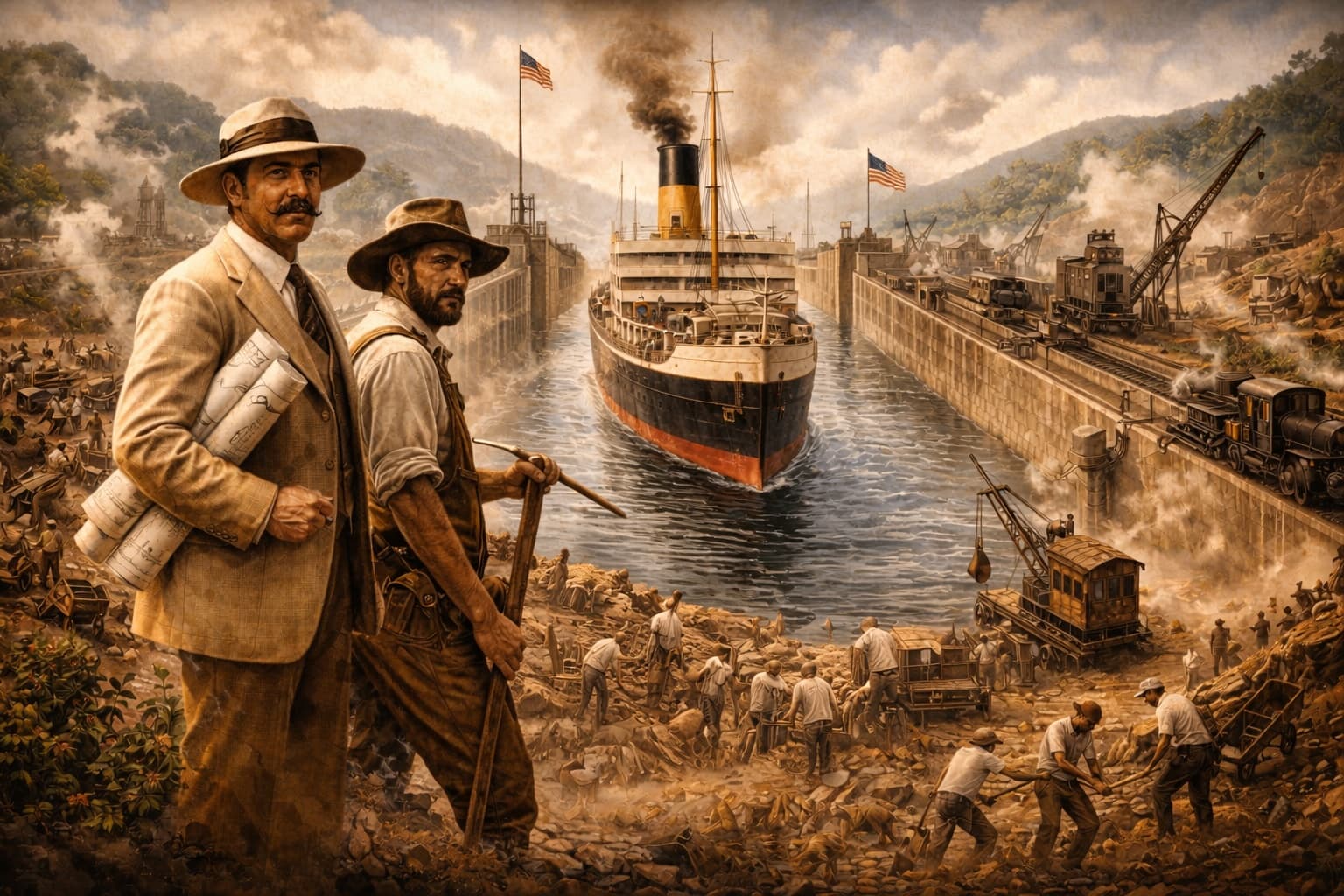
The most demanding technical challenge of the entire project was the Culebra Cut, where the Continental Divide had to be breached. The rock was hard, landslides were constant, and the volume of material to be removed was staggering. By 1913, they had extracted more than 300 million cubic yards of earth and rock. At the most intensive work sites, hundreds of steam shovels operated simultaneously in shifts that ran through the night and through weekends.
How It Works
On August 15, 1914 — coinciding almost exactly with the outbreak of World War I in Europe — the canal officially opened to commercial traffic. The first ship to complete a full transit was the SS Ancon, an American-flagged cargo vessel.
The lock system that makes that transit possible is a remarkable example of applied engineering. A ship entering from the Atlantic arrives first at the Gatún Locks: three consecutive chambers, each sealed by massive steel gates. The ship enters the first chamber, the gates close behind it, and water from the lake begins flowing in through tunnels built into the floor and walls. No pumps, no complicated machinery — just gravity. In ten minutes, the water level rises about thirty feet, and the ship floats higher. The next gate opens, the ship advances, and the process repeats. Three steps lift it eighty-five feet up to the level of Gatún Lake.
From there, the ship navigates about twenty-five miles across the artificial lake, crosses the Culebra Cut, and arrives at the Pacific side, where the Pedro Miguel and Miraflores locks lower it back down to sea level. The entire transit takes between eight and ten hours. Every time a ship crosses, more than fifty million gallons of fresh water from the lake are released into the ocean. It is one of the most complex hydraulic engineering systems in the world — and it operates on the same basic principles as it did in 1914\.
The Canal Zone: A Colony Inside a Country
From the very first day, the Canal Zone was a permanent source of tension between Panama and the United States. The 1903 treaty had handed control of a strip of Panamanian territory to a foreign power in perpetuity. In practice, that meant a ten-mile-wide band cutting all the way across Panama where American law applied, American courts operated, products on store shelves came from the States, and wages were paid in dollars. Panamanians needed authorization to enter a portion of their own national territory. It was a colony inside a supposedly sovereign country, and Panamanians experienced it as the constant humiliation it was.
Decades of accumulated tension boiled over in January 1964, when Panamanian students attempted to raise their flag alongside the American flag at a school inside the Canal Zone. The incidents that followed left more than twenty people dead and hundreds wounded. Panama broke off diplomatic relations with the United States. The movement demanding the canal's return radicalized and became impossible to ignore.
The negotiations that followed were long and politically costly. In 1977, President Jimmy Carter signed the Torrijos-Carter Treaties with Panamanian leader Omar Torrijos. Carter argued that maintaining colonial control of the canal was unsustainable both morally and in terms of foreign policy: America's standing throughout Latin America was being eroded by what was perceived — correctly — as a holdover from 19th-century imperialism. The treaties established the gradual transfer of the canal to Panama, with a final handover date of December 31, 1999\.
The political backlash in the United States was fierce. Conservative voices accused Carter of giving away a vital strategic asset. Ronald Reagan, in the middle of his presidential campaign, captured the opposition's position in a line that resonated: "We built it, we paid for it, it's ours." The treaties passed the Senate by an extremely narrow margin.
On December 31, 1999 — the last day of the millennium — the Panamanian flag was raised over the canal. The United States transferred control after ninety-six years. Many analysts predicted that Panama would be unable to manage the infrastructure of that complexity. The opposite happened: the Panama Canal Authority turned out to be a technically competent and financially solid organization. The canal generates billions of dollars annually for the Panamanian state. In 2016, an expansion was completed that added a third lane of locks for larger vessels — called Neopanamax ships — that couldn't navigate the original locks.
What the Canal Teaches Us
Today, more than fourteen thousand ships cross the canal every year, representing roughly five percent of global maritime trade. That figure carries enormous weight when translated into concrete terms: cars, oil, electronics, food, raw materials. The canal remains a fundamental artery of the global economy, more than a hundred years after it opened.
But the story of the Panama Canal teaches several lessons that go well beyond engineering.
The first is about the nature of modern imperialism. The United States literally manufactured a country to get its canal. Panamanian independence in 1903 was a product of American geopolitical convenience, not a mature national movement. The treaty that defined the new state's sovereignty was negotiated without any real Panamanian representative present and signed by a French citizen acting on behalf of a nation that was not his own. Roosevelt said it plainly and without embarrassment: "I took the Isthmus." The difference between that candor and the usual diplomatic language of imperial expansion is, at best, a matter of style.
Panamanian independence was a product of American geopolitical convenience, not of a mature national movement. The treaty was negotiated without a single actual Panamanian at the table.
The second lesson is about technical arrogance. De Lesseps didn't accidentally stumble into the failure of the French project — he guaranteed it by refusing to listen to the engineers who explained exactly why his plan couldn't work. Previous experience, prestige, and past success are not substitutes for rigorous analysis of the problem actually in front of you. Suez and Panama looked like the same type of project from the outside and were completely different problems in reality. Confusing the two cost a fortune, destroyed reputations, and claimed more than twenty thousand lives.
The third lesson is about the role of medicine. Without Gorgas's campaign against mosquitoes, the American construction would have followed the French project into disaster. The solution to the deadliest problem of the whole enterprise wasn't more dynamite or more steam shovels — it was understanding the biology of the Aedes aegypti mosquito and acting accordingly. It was, in that sense, one of the first great victories of public health as an applied discipline. Finlay had been right for decades, and no one had paid attention. When someone finally did, the results were immediate.
And the fourth lesson is about the human cost of what we call "great achievements of humanity." Twenty-five thousand dead fit in a single line, but it represents twenty-five thousand individual stories cut short: Caribbean workers who crossed the ocean looking for a paycheck and found yellow fever; French engineers who arrived convinced they were about to repeat the triumph of Suez; laborers who dug under the sun without knowing that the rock walls above their heads gave way on a regular basis. The towns of the Chagres Valley, now lying beneath the waters of Gatún Lake. The families waiting in Barbados or Jamaica for a letter that never came.
The Panama Canal is, simultaneously, one of the most extraordinary engineering feats in human history and a reminder that those feats are never abstract. They carry a price — and that price was paid by specific people, with names and families, whose stories rarely get the space they deserve in the telling.
Every year, when those fourteen thousand ships cross those fifty miles of artificial water, they carry with them — without knowing it — the full weight of that history: the French ambition that collapsed along with the walls of the Culebra Cut; the political maneuver that turned a Colombian department into a brand-new country; the mosquitoes that killed by the thousands; the Caribbean workers who built something that wasn't theirs for nearly a century afterward. That's a lot to carry through an eight-hour transit. But it's there.
Related episodes
In 1871, Paris experienced 72 days of radical rule; Versailles crushed him in Bloody Week. Ideas and violence that marked the modern left.
When Rome fell in 476, the Roman Empire kept on existing — for another thousand years, with its capital at Constantinople. That empire almost no one remembers was the bridge between the ancient and modern worlds, the guardian of the Greek texts that fu...
The Eiffel Tower wasn't Eiffel's idea, it was painted red, it was despised by France's greatest writers, and it came within years of being torn down. The man whose name it bears was facing fraud charges when it opened. This is the story of how the worl...