
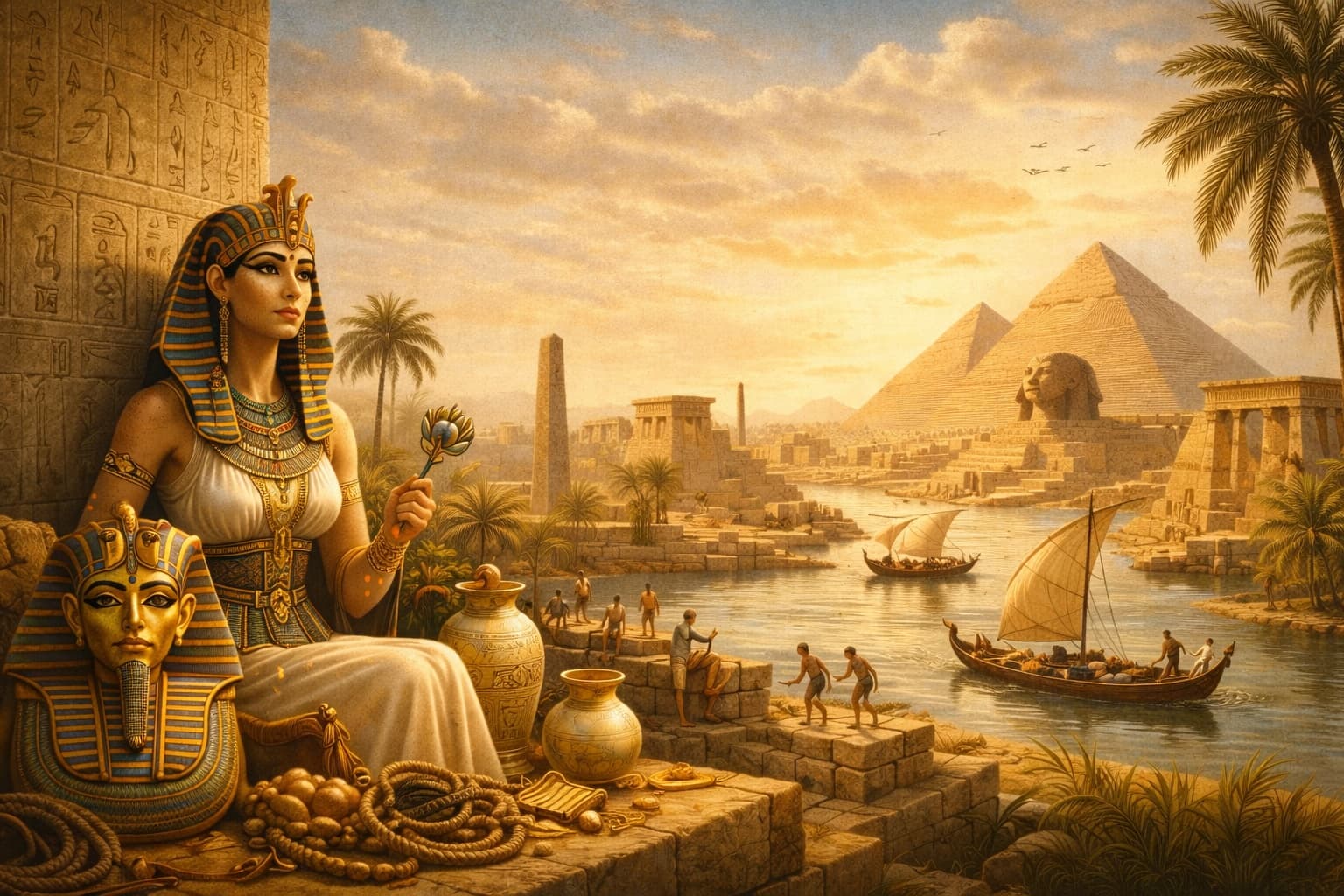
Ancient Egypt
 Andres Aguilar
Three thousand years of one continuous civilization — longer than the entire span of recorded history since Rome fell. Ancient Egypt built pyramids that still puzzle engineers, developed a writing system that lasted millennia, and produced rulers so le...
Here's a fact that sounds like a joke but is completely real: Cleopatra, the last queen of Ancient Egypt, lived closer in time to the launch of the first iPhone than to the construction of the Great Pyramid of Giza. The pyramid was completed around 2560 BCE. Cleopatra died in 30 BCE. The iPhone came out in 2007. That means the gap between the pyramid and Cleopatra is about 2,500 years, while the gap between Cleopatra and us is just over 2,000.
What looks like a monolithic block called "Ancient Egypt" is actually a civilization that lasted more than three thousand years — longer than any other organized state in human history. Three thousand years. To put the scale in perspective: the Roman Empire, which feels ancient to us, lasted only about nine hundred years in its most generous reading. Three thousand years is the span separating the Bronze Age from the twenty-first century. And the Egyptians sustained it for all that time.
The real Egypt was far more complex, more dramatic, and more fascinating than the postcard images in our heads. Pyramids, mummies, pharaohs, hieroglyphics: all of those images are real, but they are barely the surface. Underneath lies failed religious revolutions, documented labor strikes, pharaohs erased from the official record, contact with other civilizations that changed how we think about religion. Ancient Egypt deserves more than the textbook illustrations. It deserves to be read as what it was: one of the longest and most extraordinary adventures in human history.
The Nile Explains Everything
To start from the right place, you have to understand why Egypt existed where it did. The Nile explains everything. In a continent where most of the territory surrounding Egypt is inhospitable desert — the Sahara to the west, the Sinai to the east — the Nile was literally the lifeline. A river that rose every year, flooded its banks, and left a deposit of fertile black sediment that made agriculture possible in the middle of the desert. The Egyptians called their land Kemet, which means "the black land," in reference to that fertile soil. Everything else was Deshret, "the red land" — the hostile desert that paradoxically also protected them from invaders.
The Nile, then, was Egypt's reason for being: its food source, its communication highway, and its natural defense. But the river flooded with unpredictable intensity: a Nile too low meant drought and famine; one too high, catastrophic flooding. Managing that unpredictability was one of the great challenges of Egyptian civilization and probably one of the reasons they developed such an early, powerful centralized state: someone had to organize the canals, the granaries, and the distribution of water. That someone was the pharaoh.
The Egyptians developed a precise 365-day calendar based on the Nile's cycle and on astronomical observation — the appearance of the star Sirius on the horizon at dawn coincided with the start of the annual flood. That calendar was the basis on which Julius Caesar built the Julian calendar, and from there the Gregorian calendar we use today. Our way of counting time has roots in the priests who watched the sky from the banks of the Nile four thousand years ago. That too is the legacy of Ancient Egypt.
The Three Kingdoms: The Arc of Three Millennia
The history of Ancient Egypt is conventionally divided into three great periods that historians call kingdoms, interspersed with periods of fragmentation and chaos called intermediate periods.
The Old Kingdom spans roughly 2700 to 2200 BCE. It is the golden age of monumental construction: the pyramids of Giza, the Sphinx, the funerary complexes that still leave us speechless. The pharaoh was considered a god in life — son of Ra, the Sun god — and the pyramid was the most visible affirmation of that supernatural power. Building something so colossal required resources, organization, and labor that only a very powerful state could mobilize. The pyramid was an argument in stone.
For a long time, people believed the pyramids were built by slaves. We now know that's false. Archaeological excavations near Giza found the remains of the workers: well-fed people with access to medical care — their bones show fractures that healed correctly, implying immobilization and treatment — and buried with dignity. They were not slaves: they were workers organized by the state, probably farmers who worked on the construction projects during the months when the Nile flooded the fields and farming was impossible. It was Herodotus who helped plant the idea of slave-built pyramids, and it lasted centuries longer than it deserved.
The Great Pyramid of Giza, built for Pharaoh Khufu around 2560 BCE, was for nearly four thousand years the tallest structure ever built by human beings. It was surpassed by Lincoln Cathedral in England in the fourteenth century CE. Four thousand years as the tallest building in the world. That is what the word "monumental" means in its most literal sense.
The logistics of pyramid construction remain a subject of debate among archaeologists and engineers. The Great Pyramid uses around 2.3 million stone blocks, with an average weight of about 2.5 metric tons each and some reaching 15 tons. Modern engineers have calculated that finishing it in the approximately 20 years the project took would have required between 20,000 and 30,000 workers. No wheels, no cranes, no steel. Only ramps, levers, ropes, and a labor organization that we still struggle to fully understand. The precision is astonishing: the base of the Pyramid of Khufu has a margin of error of just 2 centimeters over 230 meters per side. Two centimeters. With bronze and wooden tools.
The first architect named in human history was an Egyptian named Imhotep, who designed the stepped pyramid of Pharaoh Djoser around 2650 BCE. It was the first time quarried stone had been used on a monumental scale in construction. It wasn't a pyramid with smooth sides: it was a series of steps rising toward the sky like a giant staircase to the gods. Imhotep was so extraordinary for his time that centuries later the Egyptians deified him — they made him the god of medicine and wisdom. The first architect in history ended up as a god. Not a bad career trajectory.
Hatshepsut: The Pharaoh Erased from History
Hatshepsut was one of the most extraordinary pharaohs in all of Egyptian history, and also one of the most fascinating cases of deliberate historical erasure. She ruled Egypt for about twenty years from around 1478 BCE, during the New Kingdom, as co-regent and then as pharaoh in her own right. She built monuments, expanded trade, and sent expeditions to the distant land of Punt — probably in present-day Eritrea or Somalia — to bring back myrrh, ebony, and exotic animals. It was one of the most prosperous reigns in Egyptian history.
The trouble came after her death. Her successor Thutmose III made a radical decision decades after she died: he ordered the systematic erasure of Hatshepsut's name from every monument in the kingdom. He had her statues destroyed, her images covered with masonry, her name replaced with those of other pharaohs in all inscriptions. The objective was clear: to make her disappear from official history as if she had never existed.
He almost succeeded. For centuries, Hatshepsut was a mystery: archaeologists of the nineteenth century found confusing references to a pharaoh whose name had been erased and could not identify them. It was not until the twentieth century, with more sophisticated archaeological techniques and the ability to read and interpret damaged hieroglyphics, that her story was reconstructed. Today she is considered one of the most capable rulers in all of Egyptian history. The attempt to erase her from history was a failure: the stone, though damaged, spoke anyway.
Hatshepsut's story is the story of stone as permanent memory. Thutmose III erased her from the records. Twentieth-century archaeologists recovered her from the fragments. Stone remembers what people want to forget.
Akhenaten: The Pharaoh Who Tried to Change Egypt's Religion
Akhenaten, the strangest and most disruptive pharaoh in all of Egyptian history, came to power around 1353 BCE and almost immediately made a decision that shook Egyptian society to its foundations: he declared there was only one true god, the solar disc Aten, and banned the worship of all other gods in Egypt's crowded pantheon. He closed the temples of Amun — the most powerful god of the era, whose priesthood held enormous wealth and influence — and founded a new capital, Akhetaten, in a desolate stretch of central Egypt, built from nothing.
It is the first documented case of state-imposed monotheism in history. Some historians see a possible connection between Akhenaten and Moses, given that both lived in Egypt in roughly similar periods. The hypothesis has no definitive proof, but it is intellectually fascinating: did Akhenaten's monotheism influence the religious ideas that eventually gave rise to Judaism? Scholars continue to debate it.
What we do know is that Akhenaten's experiment was a spectacular political failure. The Amun priesthood was too powerful, the Egyptian population was too rooted in its religious traditions, and the new capital in the desert was an impractical long-term project. Akhenaten died around 1336 and almost immediately his successor reversed all his reforms. The most famous of those successors was his son Tutankhamun, who came to the throne at nine years old. Tutankhamun was a politically inconsequential pharaoh who died young. But his tomb, discovered by Howard Carter in 1922 nearly intact after more than three thousand years, became the greatest archaeological find of the twentieth century and the most famous image of Ancient Egypt. A minor pharaoh who became the most famous of all, because no one found his tomb in time to loot it. History has these ironies.
The Egyptian Pantheon: Gods Who Think Big
Speaking of religion: the Egyptian pantheon is one of the richest and most complex in all of antiquity, and it deserves a moment of attention because many of its ideas are more sophisticated than they first appear. The Egyptians had dozens of gods, but it wasn't a chaotic system: each deity represented a force or principle of the universe, and their stories and relationships formed a coherent cosmology that explained the origin of the world, the cycle of life and death, and the place of human beings in all of it.
Ra, the Sun god, was the supreme deity and traveled each day across the sky in his solar barque, illuminating the world. At night, he descended into the underworld and fought against Apep, the serpent of chaos, in order to be reborn at dawn. That image of the sun rising each morning was, for the Egyptians, literally the daily victory of order over chaos, of life over death. Every sunrise was a renewed miracle. The fact that it happened predictably didn't make it less miraculous: it made it more extraordinary, because it meant that order was stronger than chaos.
Osiris, the god of the dead and of rebirth, had a story that anyone today would recognize: he was murdered by his own brother Set, his body was dismembered and scattered across the world, and his wife Isis searched for it, gathered the pieces, and resurrected him. From that posthumous union was born Horus, the falcon god, who avenged his father's death. The pharaoh was considered the living embodiment of Horus and at death became Osiris. Death, resurrection, justice, and rebirth: themes any modern religion would recognize as its own.
The judgment of the soul after death was another central concept. When someone died, their heart was weighed on a scale before the god Anubis against a feather of the goddess Maat, representing truth and justice. If the heart was lighter than the feather — if the person had lived righteously — the soul passed to Aaru, the Field of Reeds, the Egyptian paradise. If it was heavier, it was devoured by Ammit, a creature that was part crocodile, part leopard, part hippopotamus. The connection to Zoroastrianism and the later Abrahamic religions is clear: those ideas of judgment, paradise, and hell have very ancient roots in the Near East and along the Nile, long before any of the great monotheistic religions existed.
Ramesses II: The Pharaoh and His Communications Campaign
The New Kingdom, spanning roughly 1550 to 1070 BCE, is the era of the great warrior pharaohs. Ramesses II is the most famous, and for good reason. He ruled for 66 years, between 1279 and 1213 BCE, and left his mark across all of Egypt: Abu Simbel, Luxor, Karnak, the Ramesseum. He married hundreds of wives, fathered dozens of children — some sources say more than a hundred — and signed the first documented peace treaty in history with the Hittites after the Battle of Kadesh, a conflict both sides claimed as a victory and that was, in reality, more or less a costly draw.
Ramesses was also the greatest propagandist of his own story. He had carved on all the temples of the kingdom accounts of his victories, always with him at the center crushing enemies with his war chariot. The gap between the historical Ramesses and the Ramesses of the temples is the gap between a politician and their communications campaign. What Ramesses built was not just an empire: it was an image of himself so powerful that still today, 3,200 years later, he is the automatic reference point when someone thinks of a warrior pharaoh. In terms of personal brand management, that is an achievement without precedent.
Everyday Life: Medicine, Strikes, and Love
Egypt in this period was also an extraordinarily sophisticated society in its everyday life. The Egyptians had specialized physicians — medical papyri found by archaeologists describe surgical procedures, diagnoses, and treatments for dozens of diseases. Their understanding of human anatomy was advanced for its era, partly because the mummification process involved removing and preserving the internal organs. That intimate contact with the human body generated empirical knowledge that Greek and Roman physicians would later build upon.
They had a complex writing system — the famous hieroglyphics — and also a more practical cursive script called hieratic for everyday documents. They produced literature, love poetry, fantasy tales. Ancient Egyptian love letters have a sensitivity that surprises with its modernity: the longing for the beloved, the description of the other's body, the mixture of desire and tenderness. They also had a sophisticated legal system where women could own property, divorce their husbands, and testify in court. In that respect, the legal status of women in Ancient Egypt was notably more advanced than in the classical Greece that would follow it.
Here's a detail very few people know: the ancient Egyptians practiced a form of labor strike. In the twelfth century BCE, during the reign of Ramesses III, the workers who built the royal tombs in the Valley of the Kings went on strike because the state had not paid their food rations. They stopped working, went to sit at the gates of the temples, and declared: "We are hungry and thirsty; there are no clothes, no fat, no fish, no vegetables." The text of that protest is recorded on a papyrus that today sits in the museum in Turin, Italy. It is the first recorded labor strike in human history. Organized workers stopping production to demand what they were owed: 3,200 years ago. The concept is not as modern as it seems.
What that strike also reveals is that these workers had a consciousness of their rights, that there existed an implicit contractual system between the state and its workers, and that system could break down. They were not anonymous slaves: they were specialists who knew what they were worth and who had enough negotiating power to do something about it. The history of Egypt has many layers, and those who built the pyramids and temples deserve to be recognized not just as craftsmen but as social actors with genuine agency.
The Decline, the Ptolemies, and Cleopatra
The decline of Ancient Egypt was a long process that began around 1070 BCE and extended for centuries. The Libyans, the Nubians from the south, the Assyrians, and finally the Persians — whom we discussed in the previous episode — conquered Egypt at different points. The Persian pharaoh Cambyses II took Egypt in 525 BCE and the country became a Persian province.
Then came the Greeks. Alexander the Great arrived in Egypt in 332 BCE. The Egyptians received him as a liberator from the Persians. Alexander founded Alexandria, which became the largest and most cosmopolitan city in the Mediterranean world. Upon his death, Egypt passed to one of his generals, Ptolemy, who founded the last Egyptian dynasty: the Ptolemaic. And it was in that dynasty that Cleopatra was born.
Alexandria at its height was a city without equal. It had the Lighthouse of Alexandria — one of the Seven Wonders of the Ancient World, more than 100 meters tall — guiding ships from across the Mediterranean. It had the Library of Alexandria, the most ambitious intellectual project of antiquity: an institution that tried to gather all the written knowledge of humanity. Ships arriving at the port were required to declare if they carried books on board; if so, Ptolemaic officials copied them and kept the originals for the library. King Ptolemy III borrowed the original texts of Sophocles, Euripides, and Aeschylus from Athens, deposited an enormous sum as guarantee, kept the originals, and returned the copies. He preferred to lose the deposit rather than return the texts. It was a library worth more than a fortune.
Cleopatra VII, the last of the Ptolemies, is the most famous figure in Ancient Egypt and also one of the most misunderstood. She was not ethnically Egyptian: she was Macedonian Greek, a descendant of Ptolemy. But she was the first of her dynasty to learn the Egyptian language — her predecessors had governed Egypt for three centuries without learning the local tongue. She also learned other languages: ancient sources say she spoke nine.
Her story with Julius Caesar and Mark Antony is one of the great stories of love and power in antiquity. With Caesar she had a son, Caesarion. With Mark Antony she had three more children and built a political project to create a Mediterranean Eastern power bloc that could negotiate on equal terms with Rome. But more than a romantic story, it was a political strategy: Cleopatra understood that the only way to maintain Egypt's independence in the face of Rome's expansion was to forge alliances with the most powerful men in that world. When Octavian — the future Augustus Caesar — defeated Mark Antony at the Battle of Actium in 31 BCE, Cleopatra understood she had lost. She committed suicide the following year, in 30 BCE, and Egypt became a Roman province.
The Legacy That Never Ends
The legacy of Ancient Egypt is impossible to fully measure in a single article. The pyramids are still there, defying time. The hieroglyphics, deciphered only in 1822 thanks to the Rosetta Stone, opened a three-thousand-year window of history that would otherwise have been forever silent. Egyptian medicine, astronomy, architecture, and art influenced the Greeks and Romans, and through them all of Western culture.
Egyptian religious ideas about the judgment of the soul, paradise and hell, connect with Zoroastrianism and through both with the Abrahamic religions. The concept of Osiris — the god who dies and is resurrected, whose sacrifice regenerates the world — has parallels that the early fathers of the Christian Church noticed and on which they produced enormous quantities of theological commentary. Ancient Egypt is buried in the foundations of Western religiosity in ways that are rarely acknowledged.
The scientific expedition Napoleon brought to Egypt in 1798 — which included 150 savants, scientists, and artists alongside the soldiers — was the one that inaugurated modern Egyptology. The result was the Description de l'Egypte, a monumental work in 23 volumes that described in unprecedented detail the monuments, flora, fauna, and customs of Egypt. It was also on that expedition that the Rosetta Stone was found, which would allow Champollion to decipher hieroglyphics in 1822. Without Napoleon and his peculiar intellectual curiosity, Egypt would have remained silent to Western science for decades more. The military conquest was a failure; the intellectual project was one of the most productive in history.
Today, in the twenty-first century, the pyramids remain the most visited tourist destination in Africa. The "Egyptomania" that erupted with Napoleon's expedition in 1798 never fully subsided: in architecture, in art, in jewelry, in tattoos, in films. The Sphinx, the Eye of Horus, decorative hieroglyphics: they appear everywhere, often used with no understanding of their original meaning, but present nonetheless. That visual omnipresence is the most superficial but most widespread form of the Egyptian legacy.
Three thousand years of civilization. Pharaohs who believed themselves gods. Workers who went on strike. Queens erased from history who came back. A pharaoh who invented monotheism and failed. Another who built the tallest building in the world for forty centuries. And a last queen who spoke nine languages and bet everything on an alliance with Rome. That is Ancient Egypt: too much for any postcard.
That the Egyptians sustained that civilization for three millennia — through invasions, famines, civil wars, and climate shifts — is in itself one of the most extraordinary achievements in human history. They didn't do it through inertia: they constantly renewed their religion, their techniques, and their alliances. They did it because they built institutions robust enough to outlast any individual pharaoh. That too is a legacy. And perhaps the hardest one to replicate.
Related episodes
In 1871, Paris experienced 72 days of radical rule; Versailles crushed him in Bloody Week. Ideas and violence that marked the modern left.
When Rome fell in 476, the Roman Empire kept on existing — for another thousand years, with its capital at Constantinople. That empire almost no one remembers was the bridge between the ancient and modern worlds, the guardian of the Greek texts that fu...

The Eiffel Tower wasn't Eiffel's idea, it was painted red, it was despised by France's greatest writers, and it came within years of being torn down. The man whose name it bears was facing fraud charges when it opened. This is the story of how the worl...