
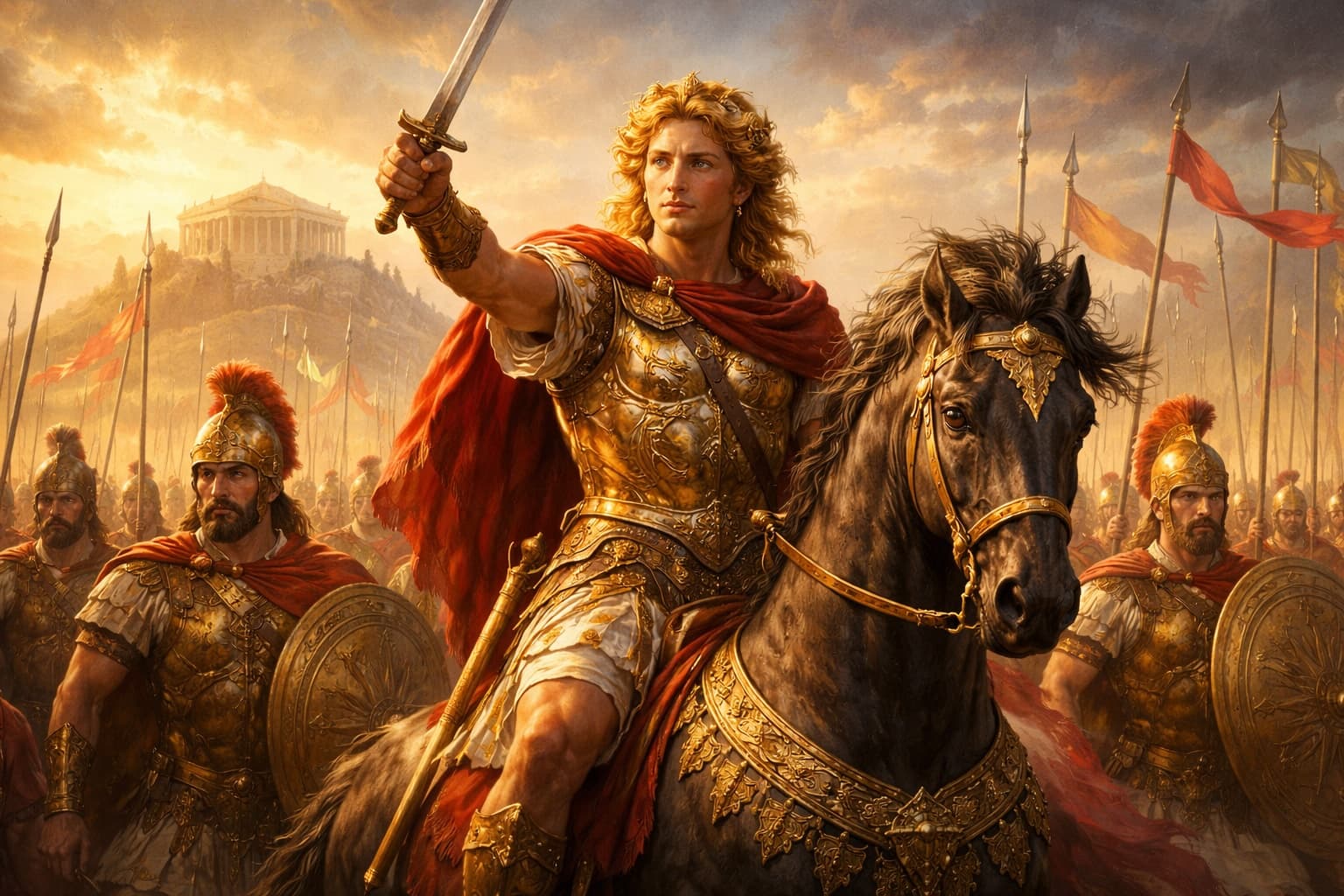
Alexander the Great
 Andres Aguilar
He built the largest empire the ancient world had ever seen — and he did it before his thirty-third birthday. Tutored by Aristotle, obsessed with Achilles, convinced he was the son of a god: Alexander of Macedon didn't just conquer territory, he reshap...
By thirty-two, he had conquered the largest empire in the ancient world, founded more than twenty cities, and never lost a battle. Then, on a June night in Babylon, he simply died.
Thirty-two years old. The age at which many people are still figuring out what they want to do with their lives. Alexander of Macedon, at that same age, ruled a territory stretching from Greece to India, had crossed deserts that killed men of thirst, had defeated armies ten times the size of his own, and believed himself to be the direct descendant of a god. No one before or after him governed as much territory in as little time. And then, in ten days, he went from planning the conquest of Arabia to being dead — with no designated heir, no clear instructions, and only the remark that he left his empire "to the strongest." That abrupt ending is almost as revealing as the life that preceded it.
Macedonia, Olympias, and the Weight of Homer
To understand Alexander, you have to understand where he came from — and where he came from was not the center of the civilized world but its outskirts. Macedonia was, in the eyes of Athenians and Spartans, something like an embarrassing relative: they spoke Greek, but they weren't quite Greek. A northern mountain kingdom, warrior culture and all, that the inhabitants of the great city-states regarded with a mixture of condescension and suspicion.
But Macedonia had Philip II, and Philip was a genius. He had transformed a second-rate kingdom into a regional military power through a tactical innovation that would change ancient warfare: the Macedonian phalanx, an infantry formation equipped with extraordinarily long spears called sarissas — reaching up to twenty feet — creating a wall of iron tips that was practically impenetrable to any conventional cavalry or infantry. With that instrument, Philip had begun extending his influence southward, putting increasing pressure on the Greek city-states.
In that context, Alexander was born in 356 BC. His mother was Olympias, a princess of Epirus — a woman of such intense personality that ancient sources describe her in nearly unanimous terms. She practiced mystery cults, participated in rituals involving snakes, and, according to those same sources, convinced her son from a very young age that he was not the son of Philip but of Zeus himself. That he had been conceived through divine intervention, that he was something more than human. Alexander, apparently, believed it. Or at least decided to live as though he did — which in practice amounts to the same thing.
The relationship between Alexander and his father was a permanent tension between admiration and rivalry. Philip recognized his son's gifts — his intelligence, his physical courage, his military instincts — but the king's successive marriages to new wives represented constant threats to the heir's position. The final break came at the wedding of Cleopatra Eurydice, when the bride's uncle made a toast expressing hope that now a legitimate heir would be born — implying that Alexander's lineage was compromised by his foreign mother. Alexander hurled a cup at him. Philip rose to intervene and tumbled to the floor, thrown off balance by the wine. And Alexander, from across the room, said something that the chronicles record in different versions but with the same meaning: Look at the man who wants to cross from Europe to Asia and can't even make it across the room. He left Macedonia with his mother and went into exile.
But before that rupture, Philip had done something for Alexander that would shape the future conqueror as profoundly as any military campaign: when the boy was thirteen, he hired Aristotle as his tutor. Not an ordinary teacher — the most influential thinker of the age. Aristotle taught him philosophy, medicine, natural science, rhetoric, and literature. And he made him read the Iliad.
That decision had consequences no Persian general could have anticipated. Alexander became obsessed with Achilles, the Homeric hero: the perfect warrior, beautiful and mortal, who chooses a short and glorious life over a long and forgotten one. He carried a copy of the Iliad on every campaign, sleeping with it under his pillow alongside a dagger. Aristotle had taught him how to think. Homer had taught him what to reach for.
Aristotle taught him how to think. Homer taught him what to reach for. And Alexander spent his entire life trying to live up to a fictional hero.
At sixteen, while Philip was away on campaign, Alexander was left in charge of the kingdom. A Thracian tribe rebelled. Alexander raised an army, defeated them, and founded a city he named Alexandropolis. At sixteen. Two years later, he served as a cavalry commander at the Battle of Chaeronea, where Macedonia defeated a coalition of Greek city-states. Philip acknowledged his son's performance — but also began to understand that what he had raised was something difficult to contain.
There is another name that appears in this period and is inseparable from Alexander's story: Hephaestion. They met as young students in Aristotle's classes and never parted. Hephaestion was his closest friend, his confidant, and frequently his second-in-command. If Alexander was Achilles — and he himself cultivated that parallel — Hephaestion was Patroclus, the companion whose death in the Iliad unleashes the hero's most terrible fury. When the two visited Troy at the start of the Persian campaign, Hephaestion laid a wreath on Patroclus's tomb. The message needed no translation. What came later proved it was more than a poetic gesture.
The Road to Power and the First Conquest
In 336 BC, during celebrations for the wedding of one of his daughters, Philip was assassinated. One of his own bodyguards, Pausanias, stabbed him in the theater. Theories about who ordered the killing are plentiful, and none has ever been proven: some point to Olympias, who had every reason to want the man who had discarded her eliminated; others to Alexander himself, who was being pushed aside in the line of succession; others to the Persians, who had obvious geopolitical motives. What is certain is that Alexander, at twenty, was the new King of Macedonia.
His first move was to consolidate power with a speed and coldness that left no doubt about his character. He eliminated potential rivals to the throne — half-brothers, cousins, anyone who might cause problems — and turned south, where several Greek cities had read Philip's death as an opportunity to break free from Macedonian dominance. A miscalculation. Alexander arrived at Thebes and destroyed it. Not sacked it — destroyed it. He killed or enslaved the entire population, sparing only the priests and the descendants of the poet Pindar. The message was unmistakable. The other Greek cities sent delegations of apology before anyone asked for them. Athens included.
With Greece pacified, Alexander could execute the plan he had inherited from his father and made his own: to invade the Persian Empire. The Persians were the dominant power of the known world, controlling territory stretching from Egypt to what is now Pakistan, and they had invaded Greece a century and a half earlier. That invasion had been repelled, but the grievance lived on in Greek collective memory. Alexander used it as a moral justification for what was also, quite plainly, a campaign of conquest and plunder — Macedonia was impoverished after decades of war, and the Persian treasury was legendary.
In 334 BC, with approximately thirty-five thousand men, he crossed the Hellespont into Asia. The first thing he did upon setting foot on Asian soil was visit Troy. He made sacrifices at Achilles's tomb — his hero. He took an ancient shield from Athena's temple that was said to have belonged to a warrior from Homer's war. It was a gesture calculated for posterity, but also entirely sincere: Alexander wasn't playing Achilles for an audience. The identification had lived inside him since childhood.
The first significant battle came at the Granicus River, where the Persians waited on the far bank with cavalry and infantry in a defensive position. Alexander did what he would do his entire life: he attacked without waiting. He placed himself at the head of his elite cavalry — the Companions — and charged directly across the river into the enemy. A Persian nobleman split his helmet with an ax. Another raised his weapon to finish him. Cleitus the Black, one of his guards, cut off the attacker's arm and saved his life. They won the battle. Alexander barely lived to see it.
Darius, Tyre, and the Conquest of Egypt
After the Granicus, the Greek cities along the coast of Asia Minor began opening their gates. Some with genuine enthusiasm — the Greeks of Asia had lived under Persian rule for generations — others with no real alternative. At Gordium, the ancient capital of Phrygia, Alexander encountered what would become the most retold episode of his entire life outside of battle. There stood a cart tied with an extraordinarily complex knot — the Gordian Knot — which according to local legend, whoever untied it would conquer Asia. Alexander tried. He couldn't undo it by conventional means. He drew his sword and cut it. Some versions say he found the pin holding the knot together and pulled it out. The technical detail matters less than the meaning: when the established rules don't get you to the result you're after, you change the rules.
In 333, the first face-to-face encounter with Darius III, the Persian king, came at the Battle of Issus. The contrast in forces was stark: Darius probably had a hundred thousand men or more; Alexander had roughly forty thousand. But Darius made the mistake of choosing a narrow battlefield — caught between the sea and the mountains — where his numerical advantage couldn't fully deploy. Alexander, as always, personally led the cavalry charge toward the enemy center, driving toward the king. When Darius saw that rider cutting directly toward him, he panicked and fled. When a king runs, his army collapses. It was a total victory — and it handed Alexander something of enormous symbolic value: Darius's family, captured in the Persian camp. His wife, his mother, his daughters. Alexander treated them with respect and guaranteed their status. It was an unusual gesture in ancient warfare, and he knew it: the distinction between a barbarian invader and a legitimate king was built in decisions like that one.
Rather than pursuing Darius into the interior, Alexander wheeled south. He wanted to control the entire Mediterranean coastline to cut off the Persian fleet. Most cities surrendered. Tyre did not. It was a city built on an island, separated from the coast by about half a mile of open water, with walls that had always withstood conventional siege. Alexander built a causeway from the coast to the island — essentially creating an artificial land bridge of stone, earth, and timber, advancing yard by yard over seven months under constant attack. He took Tyre and destroyed it. Thirty thousand people were enslaved. The message, as always: don't waste his time.
In Egypt, the reception was entirely different. The Egyptians despised the Persians, who had conquered and governed them harshly. The Persian governor handed over the territory without resistance. Egyptian priests received Alexander as a pharaoh. And he made a pilgrimage to the oracle of Amun at the Siwa oasis, deep in the desert, where he was recognized as the son of the god. Nobody knows exactly what happened in that meeting — what the priest said, what interpretation Alexander gave to what he heard. What is certain is that he emerged from Siwa with a reinforced conviction of his own divine nature that never left him. He founded Alexandria on the Nile Delta — personally choosing the site, laying out the main street grid himself — and turned back east to finish what he had started with Darius.
Gaugamela and the End of the Persian Empire
The decisive battle came in 331 BC at Gaugamela, near what is today Mosul, Iraq. Darius had assembled his largest army: war elephants, scythed chariots designed to cut down enemy cavalry, contingents from across the empire. Alexander had around forty-seven thousand men against a force that doubled or tripled that number. The numerical disadvantage was so obvious that the night before battle, his most experienced general, Parmenion, proposed a surprise night attack to compensate. Alexander refused. He wasn't going to "steal the victory," he said. He wanted to win in open battle, face to face, so there would be no doubt about the outcome.
And he won. The tactic was the same as at Issus: identify a weak point in the enemy line and drive the elite cavalry in a direct wedge toward the king. When Darius again saw Alexander cutting his way toward him, he fled again. His army, stripped of leadership at the critical moment, disintegrated. It was the end of the Persian Empire as a political entity.
Babylon opened its gates. Susa too. At Persepolis, the great ceremonial capital of Persia, the story was different: Alexander allowed his troops to sack the city for days, then burned the great palace of Xerxes. The explanations the sources offer are contradictory — symbolic revenge for the burning of Athens during the Persian Wars a century and a half earlier; a deliberate decision to erase the physical symbol of Persian power; or simply the result of a banquet that got out of hand. Probably all three had some truth to them.
When King Porus was asked how he wished to be treated after his defeat, he answered: 'As a king.' Alexander looked at him, considered the answer for a moment, and gave him his kingdom back. It was that unpredictable combination of brutality and unexpected generosity that made it impossible to know what he would do next.
By 330, Darius was dead — betrayed by his own generals. Alexander hunted down the killers, executed them, and declared himself King of Kings, the supreme Persian title. And there something began that his men couldn't understand and that generated growing tension: Alexander started adopting Persian customs. He dressed like a Persian king. He implemented proskynesis — the prostration that Persian subjects performed before their ruler — which Greeks and Macedonians considered a humiliation fit only for slaves. He married Persian princesses. He incorporated Persian soldiers into the Macedonian phalanxes. Alexander's vision was something no previous conqueror had attempted: a genuine fusion of cultures, an empire where Greeks and Persians held equal status. His soldiers saw it as betrayal.
The tension had moments of violent rupture. At a party in Samarkand, Cleitus the Black — the same man who had saved Alexander's life at the Granicus — got drunk and began criticizing Alexander in front of everyone. He told him he had become more Persian than Macedonian, that he had forgotten who had carried him to where he stood. Alexander, also drunk, grabbed a spear and ran him through. The man who had saved his life was dead. Alexander locked himself away for three days, refused to eat, wept with what appeared to be genuine remorse. But Cleitus was still dead, and everyone else had gotten the message.
The Edge of the Known World and the Long Way Home
After consolidating control over Persia and the territories of Central Asia — fighting in the mountains of what is now Afghanistan, founding cities in Uzbekistan, campaigning through lands no Greek army had ever entered — Alexander pushed east. He wanted to reach the edge of the inhabited world, the ocean that Aristotle said surrounded the entire earth. In 326 he crossed the Indus River and entered the Indian subcontinent.
The last great battle came at the Hydaspes River, against King Porus. For the first time, the Macedonian army faced war elephants in a serious engagement — they had seen a few before, but never as the centerpiece of a military formation. The animals terrified the horses and could tear through a phalanx with sheer mass. Alexander won anyway, combining tactical flexibility with the kind of personal recklessness his men had learned to read as a guarantee of victory. When Porus was captured — he had kept fighting mounted on his elephant until the very end, refusing to flee as Darius had done — and Alexander asked how he wished to be treated, the Indian king answered without hesitation: as a king. Alexander looked at him, considered the reply, and gave him his kingdom back, making him an ally. It was that unpredictable combination of brutality and unexpected generosity that made him impossible to read in advance.
But at the Hyphasis River, further east, the army said enough. They had been marching and fighting for eight years. They were thousands of miles from home, in territory they didn't recognize, facing armies with war elephants. They wanted to go home. Alexander tried to persuade them. He spoke of glory, of the territories still waiting to be conquered, of the ocean so close. Nobody moved. He retreated to his tent for three days, waiting for the silence of his men to break. It didn't. For the first and only time in his life, Alexander had to turn back.
They built altars at the river marking the furthest point of the empire and began the return. The journey home was, in stretches, as deadly as the campaigns themselves. They crossed the Gedrosian Desert — across what is now southern Iran and Pakistan — in heat that killed men from thirst and exhaustion. Thousands of soldiers were lost, not in battle but on the march. It was, according to the sources, one of the hardest ordeals of the entire expedition. They finally reached Babylon in 323\.
The Death of Hephaestion and the End
What awaited Alexander in Babylon was the thing no spear or arrow had ever managed: the loss of Hephaestion. At a banquet in Ecbatana, Alexander's closest friend fell ill with a fever. The physicians prescribed rest and a strict diet. Hephaestion got up, ate an entire chicken, drank wine, and died. Alexander lost control in a way he had never lost it in any battle. He wept for days without stopping. He had the physician executed. He ordered the sacred fires of the empire extinguished — a Persian ritual reserved for the death of a king. He wrote to the oracle at Siwa asking whether he could worship Hephaestion as a god. He began planning a tomb of pharaonic proportions. The grief was on a scale his men had never seen in him before.
He never fully recovered. He kept functioning, kept planning — the conquest of Arabia, then Italy, then North Africa, the circumnavigation of Africa — but something had shifted. The man who had slept with the Iliad under his pillow had spent his whole life living in parallel with a Homeric epic, and he had just lost his Patroclus.
In June of 323, after a banquet, Alexander began running a fever. The symptoms worsened over several days. In ten days he went from planning military campaigns to being unable to speak. His generals filed past him when it became obvious he was dying. They asked to whom he left command. "To the strongest," he reportedly said — though different sources put different words in his mouth. He left no designated heir. His wife Roxana was pregnant, and the son born after his death — Alexander IV — was an infant incapable of exercising any real power.
The cause of death has been debated for over two thousand years. Malaria, typhoid fever, the accumulated damage of repeated war wounds, the sustained alcohol abuse that the sources document in his final years. And poison: there were motives and there was opportunity. His most ambitious generals knew that with Alexander alive they would never be anything but subordinates; with Alexander dead, the world was available to whoever had the strength to take it. One theory points to the regent Antipater, who may have sent poison through his son Cassander — poison so corrosive it supposedly had to be transported in a mule's hoof so it wouldn't dissolve any other container. It may be legend. It may be history. In Alexander's case, the distance between those two categories was never particularly clear.
What Remained
The generals — the diadochi, "the successors" — spent the next four decades killing each other for pieces of the empire. None managed to reunify it. The territory Alexander had built in eleven years fragmented permanently. In that sense, his political project failed.
But the legacy operated on a different scale entirely. The more than twenty cities he founded — most of them named Alexandria, including the Egyptian city that would bear that name for centuries — became centers of cultural exchange that lasted for generations. Alexandria in Egypt, with its lighthouse and its great Library, was for centuries the most important city in the Mediterranean world: the place where Greek science, philosophy, and literature mixed with Egyptian, Persian, and Eastern traditions. Without Alexander, that encounter would not have happened, at least not with that intensity, not at that moment.
The Hellenistic period that followed his death lasted three centuries and was one of the most intellectually fertile in ancient history. Medicine, astronomy, mathematics, geography — all of these disciplines advanced in ways that classical Greek culture, enclosed within its city-states, probably could not have produced on its own. The mixing was the engine. And Alexander was the one who forced the mixing.
He also did something that remains surprising for a conqueror: he actively tried to build a world where conquered peoples were not simply subjugated but integrated. In a mass ceremony at Susa, he married thousands of his soldiers to Persian women, himself taking two additional wives from the Persian nobility. He brought young Persian men from the elite into the army, educated in the Macedonian tradition. He was genuinely offended when his Macedonian men treated Persians with the contempt of conquerors. He didn't achieve what he was after — the cultural and political resistance was too strong, and his premature death left him no time — but the seed was planted.
He was not just a brutal conqueror. He was the man who wept when a friend died, who treated his defeated enemies with respect, who slept with Homer under his pillow. He was all of that simultaneously — which is why he still resists reduction to any single thing.
What makes Alexander so difficult to pin down — what makes his story resist any simplification — is that coexistence of qualities that don't normally inhabit the same person. He destroyed entire cities and treated defeated kingdoms with unexpected generosity. He believed himself a god and wept for days over the death of a friend. He executed thousands without apparent inner conflict and was consumed by remorse for killing Cleitus in a moment of rage. He carried Aristotle's philosophy in his head and Homer's epic in his heart, and the two projects didn't always point in the same direction.
Two thousand three hundred years later, his name is still synonymous with something: the conquest of what seems impossible. He didn't make it to forty. He never saw his son grow up. He didn't consolidate the empire he built. But he changed the world in ways that can still be traced in the map, in languages, in the cultural traditions of half a dozen civilizations. That is what the ancient sources meant when they called him the Great. It wasn't simply a superlative of size. It was the recognition that some lives leave a mark that isn't measured in years — but in centuries.
Related episodes
In 1871, Paris experienced 72 days of radical rule; Versailles crushed him in Bloody Week. Ideas and violence that marked the modern left.
When Rome fell in 476, the Roman Empire kept on existing — for another thousand years, with its capital at Constantinople. That empire almost no one remembers was the bridge between the ancient and modern worlds, the guardian of the Greek texts that fu...

The Eiffel Tower wasn't Eiffel's idea, it was painted red, it was despised by France's greatest writers, and it came within years of being torn down. The man whose name it bears was facing fraud charges when it opened. This is the story of how the worl...