
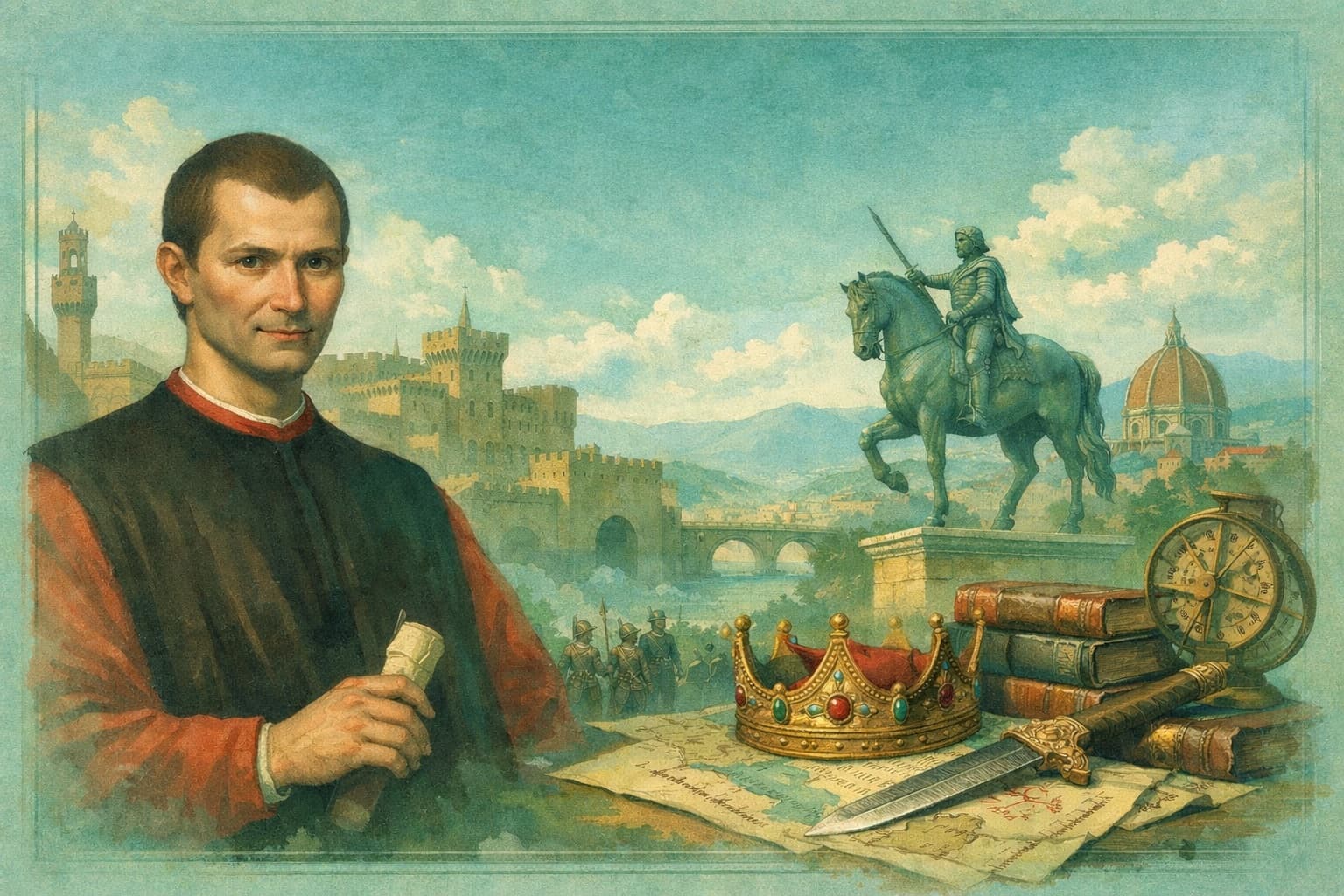
The Prince - Machiavelli
 Andres Aguilar
A tortured and exiled Florentine bureaucrat wrote, five hundred years ago, the most unsettling power manual in history. Not because he invented political cruelty, but because he dared to describe it with brutal honesty. What does The Prince actually sa...
There are books that shock people when they're published and are then forgotten. And there are books that shock people when they're published, keep shocking people five hundred years later, and on top of that become the most quoted, most misunderstood, and most used — and abused — works in the entire history of political thought. Niccolò Machiavelli's The Prince is unquestionably the second kind.
When Pope Clement VIII added it to the Index of Forbidden Books in 1559, he described it as a manual of the devil. When Catherine de' Medici's advisors found it in her personal library after her death, they took it as evidence of her ruthless character. When Napoleon carried it on his military campaigns covered in margin notes, he was using it as a practical guide. And today, when someone says a political decision was "Machiavellian," they almost always say it as an insult. Five hundred years in, and the book is still making people uncomfortable. It must be doing something right.
To understand The Prince you have to understand the moment it was written, because it's impossible to separate it from its context. The year is 1513. Italy is not a country — it won't be for another three hundred and fifty years — but a patchwork of city-states, duchies, republics, and lordships that wage war on each other with a disturbing regularity. France invades from the north. Spain pushes from the south. The Pope has his own army and his own territorial ambitions. And in the middle of that chaos, political fortunes rise and fall with dizzying speed. A ruler could be at the peak of his power in spring and dead or in exile by autumn. That wasn't the exception. It was the normal rhythm of Renaissance Italian politics.
Machiavelli knew all of this firsthand. For fourteen years he served as Secretary of the Florentine Republic — a position we might call something like chief of staff or chancellor today. He traveled as a diplomatic envoy to France, to Rome, to the major powers of the era. He knew Cesare Borgia personally — one of the most feared and fascinating figures of the Renaissance — and watched him operate with a mixture of horror and admiration. He knew Louis XII of France, Pope Julius II, Emperor Maximilian. He wasn't an armchair philosopher. He was a front-row observer of real power. When he wrote about how politics works, he knew exactly what he was talking about.
And then 1512 came. The Medicis reclaimed control of Florence with Spanish help, the republic fell, and Machiavelli didn't just lose his job. He was arrested, accused of conspiracy, and subjected to torture. The method was called the strappado: they tied a person's arms behind their back and let them drop suddenly. He survived. He was declared innocent for lack of evidence and ultimately banished to a small property in the countryside, about nine miles from Florence. He was forty-three years old. Everything he had built, destroyed in one blow.
It was in that forced exile — in that mixture of humiliation and free time — that Machiavelli sat down to write. In a famous letter to his friend Francesco Vettori, he described his routine: during the day he worked in the fields, talked with peasants, played cards at the local tavern. And at dusk, he changed his clothes, put on his finest garments, and for four hours "entered" the worlds of the great men of the past, reading and meditating on history. The Prince was born out of those evenings.
The book is short
The book is short. That in itself was unusual for its era, when political treatises tended to be monumental. It has twenty-six chapters and can be read in a focused afternoon. But every page is dense. And the central argument running through it was enough to shake five centuries of political thought.
That argument is this: politics has its own rules. And those rules are not the same as the rules of Christian morality. A prince who governs strictly according to the precepts of the Gospel — humility, forgiveness, mercy, boundless generosity — will end up destroyed by those who don't have those scruples. And a destroyed prince is useful to nobody.
Machiavelli doesn't say morality doesn't matter. He says that in politics, effectiveness matters more. And that sometimes those two things contradict each other.
In 1513, this was pure dynamite. The entire tradition of medieval political thought had started from the premise that the good ruler was the virtuous ruler in the Christian sense: pious, just, generous, restrained. The so-called "mirrors for princes" — the governance manuals that circulated through European courts — were essentially books of ethics applied to power. Machiavelli knew them well and dismissed them bluntly. He says, with a brutal honesty: many have imagined republics and principalities that have never been seen or known to exist in reality. The one who neglects what is done in favor of what ought to be done learns his destruction sooner than his preservation. People are as they are, not as they ought to be. And they have to be governed as they are.
That's a sentence worth sitting with, because it's the core of the entire book. Machiavelli isn't doing moral philosophy. He's doing political science avant la lettre. He's observing how power actually works in reality, not how theologians think it should work. And in doing so he inaugurates something radically new: the separation of politics and ethics as autonomous disciplines.
One of the most important concepts in the book — and one of the least cited by people who talk about it without having read it — is the distinction between virtù and fortuna. You have to be careful here, because in Machiavelli's Italian these words don't mean exactly what they seem to.
Fortuna is more or less what we'd expect: chance, circumstance, the things beyond our control. The world is unpredictable. Enemies move. Alliances shift. The tide rises and falls. Machiavelli has an image for this that's fairly memorable: fortune is like a river that in flood season sweeps everything away. When the river is calm, nobody thinks about building levees. When it rises, it's too late. Princes who in prosperous times don't think about future adversity — he says — when adversity arrives think only of fleeing instead of defending themselves. They hope that their people, fed up with the conquerors, will call them back. That may be fine when there's no other option, but it's very bad when it could have been foreseen.
Virtù, on the other hand, is not Christian virtue. It's something closer to what we'd call capability, skill, boldness — the ability to act decisively and effectively at precisely the right moment. The virtuous prince in Machiavelli's sense is the one who builds his levees when the river is calm. The one who doesn't wait for luck to smile on him but creates the conditions for his skill to operate. Machiavelli says fortune governs roughly half of our actions. The other half is up to us. He's not a determinist. He genuinely believes that skill and boldness can bend fate.
The example he uses to illustrate virtù at its highest expression is Cesare Borgia
The example he uses to illustrate virtù at its highest expression is Cesare Borgia. He devotes an entire chapter to him with barely concealed admiration. Borgia was the son of Pope Alexander VI and captain-general of the papal armies. He built a principality in central Italy through a combination of bold strokes and calculated cruelty that left his contemporaries speechless. Machiavelli observed him operate up close during a diplomatic mission in 1502 and was fascinated. Not by his cruelty itself, but by the cold logic with which he applied it.
One episode in particular left a deep mark on him. Borgia had pacified the Romagna region — a territory with a long history of violence and lawlessness — using as his governor a man named Ramiro de Lorqua, to whom he had given nearly unlimited powers to impose order. Ramiro used them with notable brutality. Once the territory was pacified, Borgia realized that Ramiro had become a problem: he was hated by the population, and his very presence reminded everyone who had ordered that brutality. One morning, the inhabitants of Cesena found Ramiro de Lorqua in the main square — cut in two, with a bloody knife and a block of wood beside him. Borgia had had him executed without notice or process. The population, Machiavelli says, was at once satisfied and terrified. Satisfied because the man who had oppressed them was dead. Terrified because the man who killed him was even more powerful and unpredictable.
For Machiavelli, this is virtù in its purest form. The ability to use cruelty instrumentally, at the right moment, to produce the desired political effect. Not as excess. Not as sadism. As political surgery.
This brings us to one of the book's most famous and debated chapters: the one that asks whether it is better to be loved or feared. Almost everyone knows the answer — "it is better to be feared than loved, if you cannot be both" — but almost nobody remembers the full argument. And it's far more nuanced than the quote suggests.
Machiavelli doesn't say the prince should be a brutal tyrant. He says something more precise: love is fragile because men love by self-interest. And when self-interest changes, love changes with it. Men are ungrateful and fickle. While the prince benefits them they are entirely his — they offer him their blood, their property, their lives, their children. But when necessity is close at hand, they revolt. The prince who relied entirely on their words, without making other preparations, is lost.
Fear, on the other hand, depends on something the prince can control directly: his power to punish. That's why fear is a more reliable foundation for political power. Not because it's nobler. Because it's more stable.
> Fear, on the other hand, depends on something the prince can control directly: his power to punish. That's why fear is a more reliable foundation for political power. Not because it's nobler. Because it's more stable.
But there's a crucial nuance that gets lost in casual quotes
But there's a crucial nuance that gets lost in casual quotes. Machiavelli also says the prince must avoid being hated. Being feared and being hated are completely different things. Hatred arises when the prince seizes the property or women of his subjects. When cruelty seems arbitrary or unjust. A prince who generates hatred is in constant danger of conspiracy, even from his own circle. Well-managed fear generates respect and obedience. Hatred generates knives in the back. And history — Machiavelli says with considerable coolness — shows that most princes who fell did so because they were hated, not because they were feared.
Another fundamental chapter deals with whether the prince should keep his word. And Machiavelli's answer is: not necessarily. That a prince who always keeps his promises will be destroyed by those who don't. That those who best knew how to be foxes have triumphed. And that the prince must be both lion and fox at the same time. The lion to frighten off wolves, the fox to detect traps. Only the brute force of the lion isn't enough, because there are traps force can't solve. Only the cunning of the fox isn't enough either, because there are direct threats that require confrontation.
Machiavelli adds something important: the prince doesn't need to actually have all the positive qualities, but he needs to appear to have them. The appearance of virtue is politically necessary even when real virtue is impractical. A prince who told the truth in every act, always kept his word, never used force, would be destroyed. But a prince who appears merciful, faithful, upright, and religious — while inwardly maintaining the capacity to be the opposite when necessity demands — that prince can endure.
Another topic the book treats with a depth that often goes unnoticed is the question of mercenaries. In sixteenth-century Italy, the standard practice was for states to hire mercenary armies — called condottieri — to fight their wars. Florence, Milan, Venice: they all depended on these soldiers of fortune who fought for whoever paid best.
Machiavelli is relentlessly critical of this practice. And his argument is simple but powerful: a mercenary army has no real reason to risk its life. They fight for money, and if the battle gets difficult, the rational calculation is to pull back and survive to collect the next paycheck. The mercenary captain is — Machiavelli says with sarcasm — either very capable or not. If he is capable, you can't trust him because he'll seek to advance himself at your expense. If he isn't capable, he ruins you either way.
> For Machiavelli, this is virtù in its purest form: the ability to use cruelty instrumentally, at the right moment, to produce the desired political effect.
> Not as excess. Not as sadism. As political surgery.
A citizen army, on the other hand, fights for its land, its family, its community. It has reasons that go beyond a paycheck. That's why Machiavelli is a passionate advocate of citizen militias — a fairly radical idea for his time — and in fact during his tenure as secretary of Florence he tried to implement one, with mixed results.
This idea connects to something deeper in his thinking: genuine power has to be rooted in society. Not rented from outside. A prince who depends on mercenaries, on foreign allies, on the goodwill of others to stay in power, is always at the mercy of those dependencies. Real autonomy requires your own resources. Your own loyalties. Your own capacity.
> Real autonomy requires your own resources. Your own loyalties. Your own capacity.
There's a dimension of the book that many modern readers overlook
There's a dimension of the book that many modern readers overlook, and it changes the interpretation of the whole work considerably. The Prince was not written for posterity. It was written for a specific person: Lorenzo de' Medici, the young heir who had just reclaimed control of Florence. And it was written, among other things, as a cover letter. Machiavelli wanted to return to active political life. He wanted a job. The book was a demonstration of his capabilities and an offer of services.
Lorenzo never hired him.
And in the final chapters, the tone shifts noticeably. Machiavelli stops being the cold analyst and becomes something closer to a passionate patriot. The book ends with an explicit call for the unification of Italy, for the expulsion of the "barbarians" — the French and Spanish who are pillaging it — and for the emergence of a prince capable of doing what nobody has yet managed: unifying the peninsula under a single power. He quotes Petrarch. He speaks of the need for a redeemer. It's an almost lyrical ending, charged with emotion, that contrasts sharply with the calculated tone of the earlier chapters.
This matters because it suggests that The Prince is not simply a manual of political cynicism. It's also a document of its time. Written by someone who had watched Italy humiliated for decades and who believed the solution was strong and effective leadership — not necessarily good in the moral sense, but capable of bringing order to the chaos and giving Italy the unity that other great kingdoms already had.
The book's legacy is immense and complicated. On one hand, it inaugurated modern political thought: the idea that politics is an autonomous discipline with its own laws, that it can't be reduced to theology or moral philosophy. In that sense, Machiavelli is the founding father of political science as we understand it today. Hobbes read him. Spinoza read him. Montesquieu read him. The founders of the American republic debated his ideas. Frederick the Great of Prussia wrote an entire book refuting him — while applying many of his ideas — in what Voltaire called with amusement "the most Machiavellian book of its time."
On the other hand, the term "Machiavellian" got stuck to the idea of manipulation and ruthless scheming. Which is fairly unfair to someone who was offering an analysis of reality, not a celebration of it. The distinction matters: a doctor who describes the symptoms of a disease is not advocating for it.
There's an eternal academic debate about whether Machiavelli was a republican who wrote The Prince as a satire — or as a warning to citizens about how absolute power operates — or whether he was genuinely a prince's advisor who believed what he wrote. This is Rousseau's reading, among others. The truth is probably somewhere in the middle. He was a republican who loved institutions and political freedom — there's evidence of that in his Discourses on Livy, the other major book he wrote in exile — but he also understood that there are historical moments that require one man at the center of power. And that man, to be effective, has to operate by different rules than the ordinary citizen.
What nobody disputes is the book's relevance
What nobody disputes is the book's relevance. The chapters on how to hold power, on the difference between fear and hatred, on the fragility of alliances based on mutual self-interest, on the importance of controlling the public narrative — all of that remains perfectly applicable for analyzing twenty-first-century politics. The names change. The technology changes. But the mechanics of power are remarkably persistent.
There's a concept from the book that has come back into force in recent political communication analysis, and it comes directly from Machiavelli: the importance of appearances over reality. Machiavelli says the prince doesn't need to actually possess the virtues, but it's essential that he appear to. And he adds something that today reads almost like a modern PR manual: men in general judge more by their eyes than by their hands, because everyone can see but few can feel directly. In a world where politics plays out increasingly on screens, where the constructed image outweighs concrete facts, that observation from 1513 reads like it was written yesterday.
Also worth noting is Machiavelli's observation about advisors. A prince who doesn't know how to choose the people around him well, and who can't distinguish flattery from honest counsel, is in serious trouble. Flattery is dangerous precisely because flatterers tell the prince what he wants to hear. And men — he says — are rarely good at defending themselves from that vice. The antidote is to create a culture where the truth can be spoken without consequences. That requires the prince to demonstrate that he doesn't get upset with people who tell him uncomfortable truths. The one who only hears what he wants to hear ends up making decisions on false information. And decisions based on false information, in politics, are expensive.
And perhaps that's the most unsettling thing of all. That five hundred years later, with democracies, institutions, constitutions, and human rights treaties, the manual written by an exiled and tortured Florentine bureaucrat still describes with precision how the political game works. Machiavelli didn't invent any of it. He just had the nerve to write it down.
If this summary piqued your interest, we recommend reading the full book. It's short, reads quickly, and there are things we can't do justice to in twenty minutes. Worth reading in his own words.
Related episodes

In this article we are going to see what it is about. Who was Chris Voss and why his story matters.

Hesse wrote this book with a razor blade on the table and the date of his own suicide marked on the calendar. What came out wasn't a farewell note but one of the strangest and most widely read novels of the twentieth century. Why does Steppenwolf keep ...

One night in crisis, a Cambridge student asked himself such a strange question that it changed his life: who is the one observing the one who suffers? What he found in answering that question became one of the bestselling spirituality books of the cent...